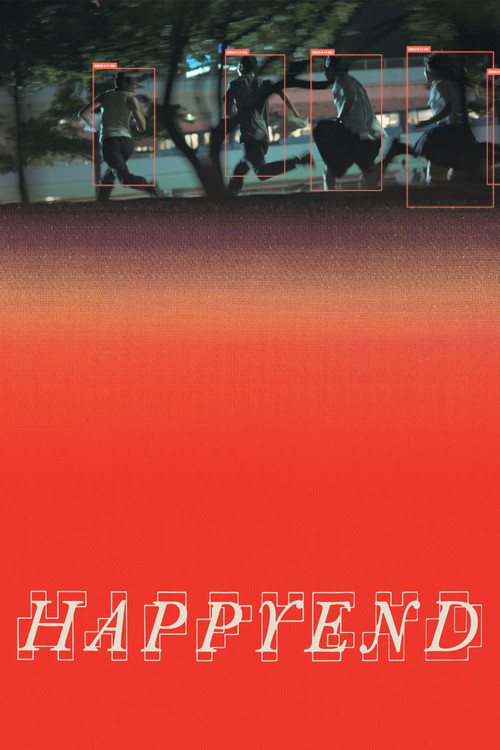
Happyend
2024 · Neo Sora
For when you want a thoughtful, current coming-of-age film with a political edge — something to argue about afterward. Rewarding rather than cozy; it asks you to lean in.
What it's about
In a near-future Tokyo bracing for a long-predicted earthquake, a high school installs an AI surveillance system that scores students' every infraction. Two best friends — techno obsessives since childhood — find a single prank opening a fault line between them: one drifts toward protest and politics, the other clings to music and the way things were. A coming-of-age story where the ground, literal and otherwise, keeps threatening to move.
The experience
Cool, precise, and slow-burning, with a quiet anger humming under its calm surface. It's less about plot twists than about watching a friendship — and a society — strain in real time.
The craft
Director Neo Sora frames rooms in long, level compositions that make the school feel like a state in miniature, and he's quietly pointed about who gets watched hardest — the Korean-Japanese student, the immigrant families, the kids already marked. The club-music undercurrent gives it a pulse the stillness never loses.
Why it matters
Premiering at Venice in 2024, it announced Sora — previously known for filming his father Ryuichi Sakamoto's final concert — as a fiction director to watch, part of a new politically alert wave in Japanese cinema.
Neo Sora — son of Ryuichi Sakamoto, whose final concert he filmed with monastic restraint in Opus — makes his fiction debut with a near-future Tokyo story that wears its science fiction lightly. An earthquake is perpetually imminent; a high school installs an AI surveillance system that scores its students' every infraction; and two best friends, techno obsessives since childhood, find a single prank opening a fault line between them — one drifting toward protest and politics, the other clinging to music and the way things were. Sora's framing is precise and unhurried, rooms held in long, level compositions that make the school feel like a state in miniature, and the film is quietly pointed about who gets watched hardest: the Korean-Japanese student, the immigrant families, the kids already marked. Premiering at Venice in 2024, it joined a wave of young Japanese filmmakers — Sora among them a co-founder of the Zakkubalan collective — turning the genre's tools toward civic questions. The title's missing space is the film's whole mood: an ending that refuses to be happy or unhappy, only open.
Reception
Acclaimed straight out of the gate in Venice 2024's Orizzonti, it then spent a year in distribution limbo — Metrograph Pictures bought it, Film Movement ultimately released it in September 2025 — by which point festival word-of-mouth had made it one of the year's arthouse must-sees.
How Happyend was received, from release to now →
Influences: the films it descends from and the films it influenced
- Zero for Conduct (1933) — The ur-text of the schoolroom-insurrection tableau — children conspiring against a repressive institution shot in near-static frontal compositions — that Happyend's prank-then-uprising structure ultimately descends from.
- If.... (1968) — Establishes the school as a sealed microcosm of an authoritarian state, escalating from petty surveillance and discipline to armed student revolt — Happyend's headmaster-versus-pupils arc is a direct formal reprise.
- Cruel Story of Youth (1960) — Japanese New Wave template of disaffected teenagers whose personal drift becomes political indictment of the postwar order, the movement Happyend consciously revives.
- Death by Hanging (1968) — Foregrounds the Zainichi Korean as target of Japanese state violence and ethnic nationalism; Kou's racial profiling under the surveillance regime extends Oshima's interrogation of who counts as Japanese.
- Merry Christmas, Mr. Lawrence (1983) — The collaborator method Sora inherits directly — Ryuichi Sakamoto's synth score fused to a drama of institutional authority pressing on defiant youth, a pairing Happyend reconstitutes through Sakamoto's influence.
- La Chinoise (1967) — Models political awakening as something rehearsed among a small cell of friends debating theory in a single room, the intimate-radicalization staging Happyend borrows for its student collective.
- Battle Royale (2000) — Near-future authoritarian Japan imposing a technological control apparatus on a classroom of teenagers — the dystopian-school premise Happyend rebuilds as ambient AI surveillance rather than overt bloodsport.
- Late Spring (1949) — Source of the locked-off, low, geometrically composed static frame that Happyend uses to hold its interiors and let performance and duration, not camera movement, carry meaning.
- Elephant (2003) — Renders a single school day as a microcosm through rigorous, patient long-take observation and rotating student POVs under a hum of impending catastrophe — the same detached architecture Happyend applies to its campus.
- Children of Men (2006) — Naturalizes near-future surveillance and immigrant round-ups as mundane background texture rather than spectacle, the ambient-dystopia technique Happyend uses to make racial profiling feel routine.
- The Class (2008) — Treats the classroom as a documentary-real microcosm of a multiethnic society's fault lines, staging racial and institutional tension through everyday pupil-authority friction as Happyend does.
- Pulse (2001) — Static, depopulated compositions turning technological connection into creeping dread and alienation — the formal grammar of unease Happyend transposes onto its AI-surveillance city.
- Evil Does Not Exist (2023) — Contemporary new-Japanese-cinema fusion of static landscape framing with slow-building impending-disaster dread, the exact register Happyend runs alongside its earthquake anxiety.
- Climax (2018) — Uses a techno-scored youth collective as a single-space pressure vessel where communal ecstasy tips into fracture, the dancefloor-as-political-body device Happyend deploys in its rave scenes.
- Ryuichi Sakamoto | Opus (2023) — Sora and the Zakkubalan collective's prior feature, which codifies the austere single-space, music-driven static-frame method and the Sakamoto collaboration that Happyend carries into narrative fiction.
Similar films
- Battle Royale (2000) — influence & lineage
- 18x2 Beyond Youthful Days (2024) — same viewing thread
- Love in the Big City (2024) — same viewing thread
- Dìdi (弟弟) (2024) — same viewing thread
- Girls Like Girls (2026) — same viewing thread
- My Sunshine (2024) — shared sensibility
- Look Back (2024) — shared sensibility
- Weathering with You (2019) — shared sensibility
All the films related to Happyend →
Watch it with: curated runs of related films
- The Long Ache of Growing Up — A run of tender films about first love, self-discovery, and the pull of home — watch them close together and the years, cultures, and heartbreaks start to rhyme.