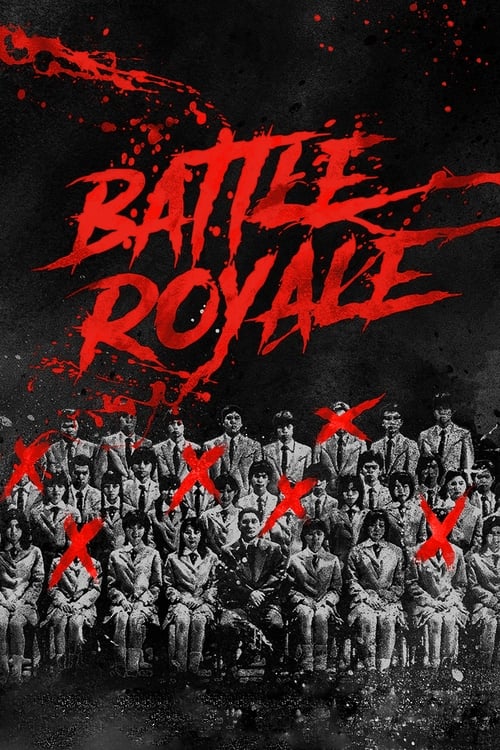
Battle Royale
2000 · Kinji Fukasaku
When you want a film to chew on for days — provocative, confrontational, and emotionally bruising. This is challenge viewing, but it earns every hard moment.
What it's about
In a near-future Japan unraveling from economic collapse and youth rebellion, the government selects one ninth-grade class, gasses them on a school trip, and wakes them on an isolated island with explosive collars, random weapons, and one rule: fight until a single student is left alive in three days. The film follows the classmates — crushes, rivalries, and friendships intact — as each decides what they're willing to do to survive. Their former teacher presides over the game.
The experience
Shocking and strangely operatic — the violence is blunt and fast, but what lingers is the melancholy, the way schoolyard feelings turn lethal when the stakes become absolute. It's a gut-punch that also plays as pitch-black satire.
Performances
Takeshi Kitano is unforgettable as the class's former teacher — deadpan, wounded, and terrifying by turns, he gives the film's cruelty a weirdly human face.
The craft
Kinji Fukasaku, a veteran director in his seventies, stages the mayhem with old-master control and pairs it with swelling classical music, giving a lurid premise the weight of tragedy. The structure — a countdown of the class, name by name — is ruthless and unimprovable, and the script never loses sight of who these kids were before the island.
Why it matters
Debated in Japan's national parliament on release and restricted at home, it became a global cult sensation whose kill-or-be-killed premise seeded an entire genre — its name is now the generic term for last-one-standing stories in film and video games.
Snapshot
Battle Royale (Batoru Rowaiaru) is a survival thriller in which the Japanese state, panicked by juvenile delinquency and social collapse, conscripts a randomly selected ninth-grade class, deposits them on a deserted island, and compels them to fight to a single survivor over three days, enforced by explosive collars and a random-issue arsenal. Adapted from Koushun Takami's 1999 novel, it was directed by Kinji Fukasaku—then in his seventies, a veteran of Toei's yakuza cinema—from a screenplay by his son Kenta Fukasaku. The film pairs unflinching, sometimes lurid violence with an almost operatic melancholy about generational betrayal, and it became one of the most contested Japanese releases of its era, debated in the national Diet and released domestically under an R-15 restriction. Its afterlife has been outsized: it lent its name to an entire video-game genre and became the touchstone reference point for a wave of "death game" narratives across two decades. It stands as a summation of Fukasaku's lifelong preoccupation with young people betrayed by the institutions that claim to protect them.
Industry & production
The film was produced and distributed by Toei Company, the studio to which Fukasaku had been attached for much of his career and whose house style of hard-edged genre filmmaking it extends. The source novel, Takami's Battle Royale, had been a genuine publishing phenomenon—controversial enough to have been passed over for a literary prize on grounds of content, then a bestseller and manga adaptation—so the property arrived pre-loaded with notoriety. That notoriety shaped the production's reception more than its budget: at a moment of national anxiety over youth violence (the late 1990s saw several highly publicized crimes involving minors), the prospect of a mainstream studio film about children slaughtering one another provoked political objection before and after release. The picture was discussed in the Diet, and Toei ultimately released it with an age restriction rather than cutting it into acceptability. Precise budget and box-office figures I will not assert here, as I cannot verify them reliably; what is well established is that the film performed strongly enough in Japan to warrant a 2003 sequel, Battle Royale II: Requiem. Internationally, distribution was cautious and slow—English-language territories, and the United States in particular, delayed an official release for years, partly out of skittishness about a school-massacre premise in the post-Columbine climate—so the film circulated for a long time as an import and cult object before receiving a sanctioned Western home-video release in the early 2010s.
Technology
Battle Royale is, technologically, a conventional turn-of-the-millennium 35mm production rather than a showcase for new tools, and its power derives from staging and performance more than from any technical apparatus. Its most distinctive "technology" is diegetic and design-driven: the explosive collar that renders every student trackable and killable at the state's discretion, and the onscreen apparatus of the game itself—the tallying of the dead, the periodic loudspeaker announcements of casualties and newly forbidden zones. These interface elements—text overlays that name each fallen student and count down the survivors—turn bookkeeping into suspense and give the film a cold, administrative texture that contrasts with its bloodshed. Practical effects and squibs carry the violence. I would not overstate any claim about digital innovation here; the film's modernity is thematic and tonal, not a matter of camera or post-production technology.
Technique
Cinematography
The cinematography is credited to Katsumi Yanagijima, a frequent collaborator of Takeshi Kitano, and the images share something of that lineage's controlled coolness even amid chaos. The island is rendered in overcast, desaturated greens and grays—a washed, wintry palette that denies the material any exotic or adventurous glamour and keeps the tone funereal. Camerawork moves between handheld immediacy in the combat set-pieces and composed, almost still framings in the interludes of talk and reflection, so that violence feels kinetic and its aftermath feels arrested. The film repeatedly isolates individual faces in tight framings, insisting on the particularity of each child even as the premise reduces them to a body count.
Editing
Editing (credited to Hirohide Abe) governs the film's peculiar rhythm, which alternates rapid, brutal action with abrupt tonal shifts into comedy, romance, and pathos. The structure is episodic by design: the film cycles through the deaths of named students, each often given its own compressed vignette, so the cutting must repeatedly establish, escalate, and dispatch a character within minutes. The recurring casualty announcements function as editorial punctuation, chaptering the running time and resetting tension. The effect can feel deliberately jagged—the film refuses a smooth emotional throughline, cutting from farce to horror to tenderness in a way that mirrors the disorientation of its characters.
Mise-en-scène / staging
Staging is the film's signal strength. Fukasaku disperses his large ensemble across a varied island geography—forest, cliffs, a lighthouse, an abandoned clinic, a schoolhouse—so that each locale hosts a distinct social microcosm and a distinct mode of death. The lighthouse sequence, in which a group of girls attempting to cooperate is destroyed by a single act of poisoned mistrust, is the clearest example of staging as thesis: the film uses spatial confinement to dramatize how quickly solidarity curdles into panic. Weapons are pointedly, satirically unequal—one child receives a submachine gun, another a pot lid or a pair of binoculars—and this random distribution is staged as both cruel joke and social allegory. The schoolroom framing device, with the teacher presiding over the "orientation," stages state violence as a grotesque extension of ordinary pedagogy.
Sound
The score, composed by Masamichi Amano and performed with orchestral forces, is central to the film's operatic register. It leans heavily on Western classical music—grand, funereal, and Romantic—so that mass adolescent slaughter unfolds beneath swelling strings and requiem-like passages. This ironic yoking of high-cultural grandeur to schoolyard carnage is one of the film's defining gestures: the music dignifies and mourns the children even as the images degrade them, and the incongruity sharpens the satire. Loudspeaker announcements dominate the diegetic soundscape, the disembodied voice of authority intruding periodically over the natural sound of the island.
Performance
The ensemble is anchored by Tatsuya Fujiwara as Shuya Nanahara and Aki Maeda as Noriko Nakagawa, the film's tremulous moral center, with Tarō Yamamoto as the watchful transfer student Shogo Kawada. Around them, a large young cast is asked to compress whole arcs—loyalty, betrayal, despair, first love—into brief screen time, and the film's emotional credibility rests on their ability to make schematic figures feel specific. Two supporting turns became especially celebrated: Chiaki Kuriyama as Takako Chigusa and Kō Shibasaki as the ruthless Mitsuko Souma, the latter embodying the film's darkest suggestion that some will embrace the game. Presiding over all of it is Takeshi Kitano—billed as "Beat" Takeshi—as the teacher Kitano, a performance of weary, wounded menace whose flat affect and sudden cruelty give the film its most unsettling adult presence and its strain of bruised paternal sorrow.
Narrative & dramatic mode
The film operates in a hybrid dramatic mode that is difficult to stabilize, and that instability is deliberate. Its skeleton is high-concept survival thriller, but it is threaded with adolescent melodrama (unspoken crushes, remembered kindnesses, diary confessions), broad satire (the peppy orientation video, the teacher's petty grievances), and outright horror. The narrative is distributed across an ensemble rather than centered cleanly on its ostensible protagonists, so that the film reads less as one hero's journey than as a mosaic of small tragedies. Flashbacks and voiceover supply interiority to characters who will die within minutes, insisting that each is a full person and not merely an obstacle. The dominant affect is elegiac: for all its violence, the film's governing mood is grief—for lost trust, lost futures, and the failure of adults to protect the young.
Genre & cycle
Battle Royale sits at the intersection of the survival-thriller, the dystopian satire, and the exploitation film, and it belongs to a long "hunted human" lineage that runs back through The Most Dangerous Game and the social-collapse allegory of Lord of the Flies, both of which it explicitly evokes. Its premise of state-sponsored, broadcast-adjacent lethal competition also rhymes with the dystopian media satires of the 1980s such as The Running Man. Yet the film arrived essentially at the head of its own cycle rather than in the middle of one: it is now understood as the progenitor of the modern "death game" or "battle royale" genre, and much of the cycle it belongs to was formed in its wake rather than before it. Within Japanese genre history, it also extends Fukasaku's own jitsuroku (docudrama-realist) violence into an allegorical, near-future key.
Authorship & method
The film is doubly authored, by a father and a son. Kinji Fukasaku (1930–2003) directed; his son Kenta Fukasaku wrote the screenplay, adapting Takami's novel. Kinji Fukasaku had built his reputation in the 1960s and 70s on hard, cynical crime cinema, above all the landmark Battles Without Honor and Humanity yakuza series, films distinguished by handheld energy, moral disillusion, and contempt for institutional authority. Battle Royale transposes those preoccupations onto the schoolyard. Fukasaku repeatedly connected the material to his own adolescence during the Second World War—he has described working in a munitions factory as a teenager, enduring air raids, and emerging with a deep distrust of the adult authorities who had sent his generation to die; that autobiographical charge, widely reported and consistent across his own statements, is the interpretive key most critics reach for. Among his key collaborators, cinematographer Katsumi Yanagijima supplies the cool, composed image; composer Masamichi Amano supplies the ironic orchestral grandeur; editor Hirohide Abe manages the tonal whiplash; and Takeshi Kitano, more than an actor here, lends his own auteur persona of impassive violence to the film's central adult role. Fukasaku's method throughout favors visceral immediacy and emotional directness over subtlety—an old genre craftsman's confidence in staging, pace, and the human face.
Movement / national cinema
The film belongs to Japanese commercial genre cinema rather than to any tidy art-cinema movement, and specifically to the Toei studio tradition of muscular, socially skeptical filmmaking that Fukasaku helped define. It is best read against the backdrop of turn-of-the-millennium Japanese anxieties: economic malaise after the collapse of the 1980s bubble, alarm over youth crime and the fraying of the postwar social contract, and a broader cultural pessimism about the intergenerational compact. The film's science-fictional framing—an authoritarian state legislating the sacrifice of its children—reads transparently as allegory for these pressures. It also participates, obliquely, in a J-horror-adjacent moment of internationally exported Japanese genre film around 2000, though its concerns are sociopolitical rather than supernatural.
Era / period
Released in 2000, the film is very much a document of the millennial turn. Its dystopia is near-future and recognizably contemporary, extrapolating present fears rather than imagining a distant world; the "Battle Royale Act" is framed as a state's brutal response to unemployment, truancy, and the perceived insubordination of the young. The film's sensibility—its distrust of institutions, its sympathy for a generation told it has no future—captures a specifically post-bubble Japanese mood, but its themes proved portable enough that the film aged into a global reference. Its delayed and cautious release abroad also makes it a period marker of a particular anxiety: the reluctance of post-Columbine Western distributors to handle a film about children killing children in a classroom-derived scenario.
Themes
At its core the film dramatizes the betrayal of the young by the old: the state, the school, and the parental generation collude to turn children against one another, and the adult world's failure is the true horror beneath the bloodshed. Trust and its collapse form the central dramatic engine—the film returns again and again to the moment when cooperation becomes impossible and fear overrides bond, most devastatingly in the lighthouse sequence. It is also a satire of competition itself, of a society that pits its members against each other for survival and calls it fairness; the randomly distributed weapons literalize structural inequality. Threaded through the carnage is a stubborn romanticism—first love, loyalty, small mercies—that the film treats not as naïveté but as the only meaningful resistance to the game. Beneath all of it runs Fukasaku's wartime memory: the conviction that being sent to kill and die by one's elders is the defining trauma the young inherit.
Reception, canon & influence
Critical reception was polarized and, over time, decisively revaluing. In Japan the film was as much a political controversy as a critical event, condemned in some quarters as irresponsible and defended in others as a serious, even moral, work; its notoriety was inseparable from its early reputation. Internationally, its restricted circulation made it a cult film first and a canonical one later, as critics increasingly recognized it as a major late work by a significant director and as a formally bold synthesis of exploitation energy and genuine feeling. Its most visible champion was Quentin Tarantino, who has repeatedly named it among the films he most admires from the period of his own career and who cast Chiaki Kuriyama as Gogo Yubari in Kill Bill—a concrete line of influence running out of the film.
Looking backward, the film draws on Lord of the Flies, The Most Dangerous Game, and the tradition of dystopian media-spectacle satire, filtered through Fukasaku's own yakuza-film disillusion and his generation's war experience. Looking forward, its footprint is enormous and, in one respect, literal: the term "battle royale" now names a dominant video-game genre—last-player-standing survival matches on a shrinking map—popularized by titles that adopted the phrase and the premise wholesale. Its structural DNA is widely felt in later "death game" narratives; it is the film most often invoked, fairly or not, as a precursor to The Hunger Games (whose author, Suzanne Collins, has stated she had not encountered it before writing) and to the global success of Squid Game, whose survival-competition-as-class-allegory shares much of Battle Royale's satirical charge. Whether as direct source or as the shared ancestor everyone points back to, Fukasaku's film became the reference coordinate for an entire storytelling mode—an unusually clear case of a single work naming and shaping a genre that outgrew it.
A Deleuzian reading
A boy is handed a bag.
The full Deleuzian reading of Battle Royale →
Reception
So controversial on release that it was debated in Japan's parliament, and it went unreleased in US theaters for over a decade — now it's a canonized cult classic and a rite-of-passage watch for anyone getting into Japanese cinema.
How Battle Royale was received, from release to now →
How to watch Battle Royale: what to notice on a first viewing
- Look at what each student pulls out of the issued bag. The lottery hands one child a submachine gun and the next a pot lid or a pair of binoculars. Nobody onscreen remarks on the mismatch. No fight in this film is a fair one, and the props tell you that before any blood does.
- Listen for the loudspeaker announcements and what they list. An official voice breaks over the island at intervals, reading the names of the dead and declaring new forbidden zones. The usable map shrinks on a schedule. Standing still becomes its own way of dying, and the film gets chaptered by a ledger read aloud.
- Watch the washed-out greens and grays of the island. Yanagijima keeps the palette overcast and desaturated. The weather stays wintry, the light stays flat, and nothing in the landscape looks like an adventure. The look denies the premise any glamour and sets the film at a funeral from the first reel.
- Watch how fast the film cuts from a joke to a killing. Abe jumps between farce, horror, romance, and grief without smoothing the joins. Each student gets a compressed vignette that has to establish, escalate, and finish within minutes. You never get steady emotional footing, which is the footing the kids on the island are denied too.
- Watch Kitano work the orientation with a pointer and a chart. He presides over the briefing exactly as a teacher presides over a lesson. The room stays a classroom. His affect is flat, tired, faintly wounded, then abruptly cruel. State killing and ordinary schooling are shown sharing one body language, and the body is his.
The whole guide to watching Battle Royale, with the keys for a rewatch →
Influences: the films it descends from and the films it influenced
- Battles Without Honor and Humanity (1973) — Fukasaku's own freeze-frame-plus-onscreen-text obituary device — naming each combatant as he dies — is reused wholesale for Battle Royale's dwindling-student captions, along with the handheld, institution-loathing staging.
- Lord of the Flies (1963) — Establishes the enforced-microcosm in which unsupervised schoolchildren self-organize into hunting factions and rehearse adult savagery — the spatial-microcosm thesis Battle Royale inherits and literalizes with weapons.
- The Most Dangerous Game (1932) — The foundational human-as-quarry-in-a-bounded-arena structure, with a defined kill-zone and a countdown, that Battle Royale scales up from a single hunt to an entire class.
- The Tenth Victim (1965) — Codifies legalized, media-broadcast murder-as-game satire, marrying death-game premise to spectacle irony — the register Battle Royale plays deadpan through its instructional loudspeaker and orientation video.
- If.... (1968) — Armed schoolboys turning ordnance on their own institution, staged with abrupt tonal-whiplash between placid naturalism and surreal massacre — the exact tonal gear-shift Battle Royale runs on.
- A Clockwork Orange (1971) — The ironic scoring of youth brutality to grand classical music that Battle Royale echoes with its Verdi Requiem and Strauss cues — orchestral grandeur as sardonic counterpoint to slaughter.
- Sonatine (1993) — Forges the impassive, deadpan-then-detonating Kitano violence persona that Battle Royale imports intact into Kitano's teacher figure, using his auteur stillness as the film's still center of menace.
- Kill Bill Vol. 1 (2003) — Tarantino literally cast Battle Royale's Chiaki Kuriyama as Gogo Yubari, transplanting the schoolgirl-in-uniform-as-lethal-combatant image and the meteor-hammer flail straight out of Fukasaku's film.
- Battle Royale II: Requiem (2003) — The direct sequel extends the loudspeaker-diegesis rulebook and large-young-ensemble mosaic, formalizing Battle Royale's collar-detonation and shrinking-safe-zone mechanics into franchise grammar.
- The Hunger Games (2012) — Adopts the arena of drafted teen tributes fighting to a single survivor on a controlled, shrinking map with sponsor/announcer intrusions — the death-game structure Battle Royale is perennially named as the coordinate for.
- As the Gods Will (2014) — Relocates the killing to the classroom itself and runs it as escalating episodic-vignette games, extending Battle Royale's school-as-abattoir premise and tonal whiplash into gamified set-pieces.
- The Belko Experiment (2016) — Transposes the microcosm to a sealed office tower where an unseen voice orders coworkers to kill via loudspoken instructions and headset-detonators — a corporate restatement of Battle Royale's collar-and-announcement apparatus.
- Alice in Borderland (2020) — Builds Japanese survival-game spatial-microcosms with diegetically-announced rules and a large young ensemble picked off across episodic arenas, carrying forward Battle Royale's map-bound elimination staging.
- Squid Game (2021) — Weaponizes childhood games under a masked authority's loudspeaker announcements as a class-allegory satire — inheriting Battle Royale's survival-competition-as-social-critique charge and announcement diegesis.
- The Purge (2013) — Extends the legalized-violence-window satire, with a broadcast siren and countdown sanctioning killing for a fixed period — the state-authorized-slaughter framing Battle Royale pioneered as social critique.
- The Hunger Games: Catching Fire (2013) — Provides the youth-forced-to-kill ensemble structure: named teen combatants in a monitored, time-pressured arena, alliances forming and breaking under a survival countdown.
- Confessions (2010) — Supplies the junior-high-classroom-as-killing-ground frame and the vengeful adult presiding over pupils, plus the slow-motion schoolyard bloodletting Nakashima restages around Matsu Takako's teacher.
- Happyend (2024) — Near-future authoritarian Japan imposing a technological control apparatus on a classroom of teenagers — the dystopian-school premise Happyend rebuilds as ambient AI surveillance rather than overt bloodsport.
- The Maze Runner (2014) — The enclosed lethal experiment run on adolescents by an unseen adult authority — the observed-subjects, security-versus-truth premise that governs WCKD's control of the Glade.
- Series 7: The Contenders (2001) — A near-simultaneous death-game satire built as faux reality-TV, sharing Battle Royale's broadcast-framing irony and randomly-drafted-civilian-combatants conceit without direct contact.
- The Hunger Games: The Ballad of Songbirds & Snakes (2023) — Foundational grammar of the state-sanctioned, youth-killing-youth arena as televisual spectacle, the survival-thriller mechanism the prequel depicts in its primitive early-Games form.
Similar films
- The Hunger Games (2012) — influence & lineage
- Sonatine (1993) — influence & lineage
- Lord of the Flies (1963) — influence & lineage
- Godzilla Minus One (2023) — same viewing thread
- Neon Genesis Evangelion: The End of Evangelion (1997) — same viewing thread
- Bullet Ballet (1998) — often watched together
- Outrage (2010) — shared sensibility
- Grave of the Fireflies (1988) — shared sensibility
All the films related to Battle Royale →
Watch it with: curated runs of related films
- Bodies at the End of the World — A run of visionary, punishing films where flesh is scarred, melted, mechanized or sacrificed while the world tips into its last days — watch these back to back when you want cinema at its most extreme and transcendent.