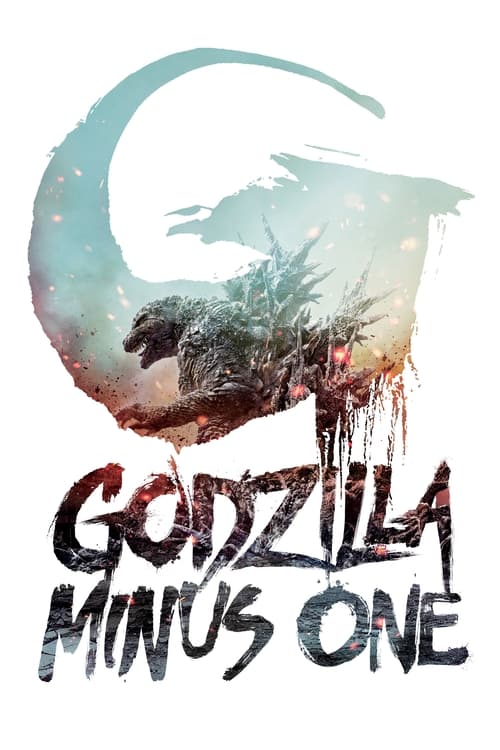
Godzilla Minus One
2023 · Takashi Yamazaki
The $15M kaiju drama that out-emoted Hollywood, won the VFX Oscar, and became the permanent exhibit in every "why do blockbusters cost $250M" argument.
When you want a blockbuster that actually makes you feel something — big-screen spectacle for a night you're ready to be thrilled and cry a little too. More cathartic than comforting.
What it's about
In Japan just after World War II, a former kamikaze pilot who couldn't complete his mission comes home to a flattened Tokyo, crushed by survivor's guilt, and starts piecing together a makeshift family among the ruins. Then Godzilla rises from the sea — and with the government and military in no position to help, ordinary, exhausted civilians must organize their own last stand against a horror the country cannot absorb.
The experience
Genuinely frightening and genuinely moving in the same breath: the monster scenes play as pure terror, but between them beats a sincere human melodrama about shame, grief, and earning the right to live. It builds to sequences that will have you holding your breath, then wipe you out emotionally.
Performances
Ryunosuke Kamiki carries the film as the haunted pilot Shikishima, playing survivor's guilt as a physical weight — his breakdowns land as hard as any monster attack.
The craft
Takashi Yamazaki directed, wrote, and supervised the visual effects, and the result won the Academy Award for Best Visual Effects on a budget around fifteen million dollars — a fraction of Hollywood's. Godzilla has rarely felt this heavy, this loud, or this malevolent; see it on the biggest screen with the best sound you can find.
Why it matters
It became the highest-profile proof in years that a modest budget and total craft can out-spectacle a blockbuster, earning Japan its first Oscar for visual effects and returning the franchise to the raw postwar horror of the 1954 original.
Snapshot
A post-WWII kaiju drama in which a former kamikaze pilot haunted by survivor's guilt confronts Godzilla as both literal destroyer and embodiment of a nation's accumulated grief. Released on November 3, 2023 — the seventieth anniversary year of the franchise's founding — Godzilla Minus One is Toho's most emotionally direct entry in decades, stripping the series back to the register of Ishiro Honda's 1954 original: horror as trauma, the monster as catastrophe that a broken society cannot expect its institutions to absorb. Produced for a reported budget of approximately fifteen million dollars, it became the first Japanese film to win the Academy Award for Best Visual Effects (96th ceremony, March 2024), and it demonstrated, in terms the international industry was forced to reckon with, that spectacle and craftsmanship do not require Hollywood-scale expenditure.
Industry & production
Godzilla Minus One was produced by Toho Studios, the institutional home of the franchise since 1954, with visual effects handled entirely by SHIROGUMI Inc., the company Yamazaki himself co-founded. The film thus sits in a peculiar industrial position: it is simultaneously a studio franchise property and, in its production apparatus, something closer to an auteur VFX project. Yamazaki functions as writer, director, and VFX supervisor — a concentration of roles unusual in studio filmmaking and almost without precedent at this scale in Japan.
The film was not a Marvel-adjacent co-production or a Japanese–American hybrid in the manner of Gareth Edwards's 2014 Godzilla (Legendary/Warner). It was financed and produced entirely within the Japanese studio system, distributed internationally by Toho International. Its North American theatrical run, beginning December 1, 2023, outperformed virtually all expectations for a subtitled Japanese genre film, earning substantial grosses that renewed international discussion of Toho's franchising strategy. Exact worldwide figures circulated widely in trade reporting; the film's commercial performance relative to its production cost became a recurring reference point in industry debates about bloated Hollywood VFX budgets.
The screenplay was written by Yamazaki alone, departing from the franchise's long tradition of collaborative genre writing. Its structural decision — to set the film in 1945–1947, in the immediate rubble of defeat, rather than in contemporary Japan — anchors the allegory in the historical ground Honda had originally occupied.
Technology
SHIROGUMI's VFX team for Godzilla Minus One was reported at roughly thirty-five core artists, a figure that circulated with something like disbelief in the trade press following the film's Oscar win. For context, American blockbusters routinely employ hundreds or thousands of VFX workers across multiple vendors. Yamazaki's method — developed across decades of effects-heavy Japanese productions including the Always: Sunset on Third Street trilogy and Space Battleship Yamato (2010) — is to integrate VFX pre-visualization tightly with production design and cinematography, so that digital shots are planned with a precision that reduces iteration and waste.
The film was shot digitally. A black-and-white version, Godzilla Minus One/Minus Color, was released theatrically in Japan and in limited international engagements, stripping color to foreground the film's kinship with classical postwar Japanese cinema and with Honda's original monochrome Gojira. Both versions used the same cut; the black-and-white treatment was not a stylistic revision but a tonal reframing that proved the underlying image design to be fundamentally luminance-driven.
Godzilla himself was rendered entirely in digital VFX. The production design team devised a variant creature design — taller, more scarred, with a grotesque dorsal-fin enlargement that evokes atomic deformity — that departs from recent franchise iterations while remaining legible within the franchise's visual grammar.
Technique
Cinematography
The cinematographer was Kōzō Shibasaki, a long-term Yamazaki collaborator. Shibasaki's approach to the period material is notably restrained: the film avoids the high-contrast amber-grade nostalgia of much postwar-Japan prestige filmmaking, working instead in a cooler, harder palette that keeps the ruined cityscape from prettifying. Wide lenses and held frames characterize the human-drama passages, maintaining spatial legibility and allowing the actors room to inhabit period-accurate environments. The contrast with the action sequences — where coverage becomes more fragmented and scale exaggerated — is a deliberate tonal rhythm rather than an inconsistency.
The most-discussed single passage is the Ginza attack sequence, in which Godzilla walks through central Tokyo. Shibasaki and Yamazaki choreograph the shot at human eye level, tracking characters at street level as Godzilla advances above and behind them. The choice to anchor scale in the human body rather than in establishing overhead compositions is consistent with the film's overall priority: the monster's meaning derives from its proximity to grief-saturated individuals, not from its abstract enormity.
Editing
Editing by Ryūji Miyajima sustains a bifurcated rhythm that separates the film's domestic-drama passages from its action set pieces, allowing the former to breathe at a tempo closer to classical Japanese melodrama than to contemporary blockbuster cutting. The effect is that the kaiju sequences register as genuine ruptures rather than anticipated attractions. Miyajima's management of the final act — a civilian-organized naval operation — is particularly controlled, cutting for tactical clarity without sacrificing emotional stakes.
Mise-en-scène / staging
Yamazaki stages the human scenes in tight domestic interiors — the bombed-out Tokyo shack that Shikishima and Noriko gradually convert into a home — and uses the enclosure to amplify the vulnerability that Godzilla's appearances shatter. The film's production design reconstructs late-1940s Tokyo with unusual fidelity, rendering the co-presence of war ruin and tentative civilian renewal that characterizes photographs of the period. Godzilla's scale is consistently staged relative to recognizable architectural elements — a train, a bridge, a row of shop fronts — rather than abstracted into skyline spectacle.
The Odo Island prologue, in which Shikishima first encounters Godzilla and fails to fire, is staged as a horror sequence in the classical sense: confined space, partial revelation, the creature glimpsed in parts before its full form is given. The decision to withhold full visibility in the opening mirrors the Spielbergian grammar of Jaws (1975), a structural influence Yamazaki has acknowledged in general terms when discussing his approach to monster restraint.
Sound
Composer Naoki Sato, a frequent Yamazaki collaborator, wrote an original score while incorporating Akira Ifukube's 1954 Godzilla march at specific strategic moments — most pointedly at the creature's first full-scale emergence. The decision to hold back Ifukube's theme until it arrives as an almost unbearably recognizable dread-chord functions as an act of franchise memory: audiences familiar with the original will experience the borrowed material as both tribute and escalation. Sato's original cues favor low brass and strings in a register that borrows from postwar Japanese film scoring traditions without pastiche.
Godzilla's roar employs a variant of the classic sound design, modified with lower-frequency extension to enhance visceral impact in theatrical exhibition. The film's sound design otherwise foregrounds environmental texture — the creak of minesweeper hulls, the specific acoustic character of bomb-damaged streets — in service of period immersion.
Performance
Ryunosuke Kamiki's performance as Kōichi Shikishima is the film's emotional center and its most serious artistic gamble. Kamiki, known in Japan across a wide range of roles from youth drama to genre work, plays a character whose defining posture is implosion: guilt, withheld grief, the muted affect of a man who believes he should be dead. The performance resists easy catharsis, making the eventual turn toward action feel earned rather than generic. Minami Hamabe as Noriko operates in a contrasting register — more expressive, more conventionally sympathetic — and the dynamic between the two sustains the film's domestic spine.
Narrative & dramatic mode
The film's narrative architecture is classical in the precise sense: it builds toward a decisive confrontation through escalating personal loss, with the monster functioning simultaneously as external catastrophe and as objective correlative for the protagonist's interior state. Shikishima's guilt over surviving his kamikaze mission — over having failed to attack Godzilla at Odo Island when he had the chance — maps onto the creature's subsequent devastation of Tokyo in a way the film never makes schematic but always keeps emotionally present.
The civilian-organized plan to defeat Godzilla, coordinated outside any official military or government apparatus, constitutes the film's most pointed political argument: the state that sent young men to die has abdicated, and survival belongs to those who choose one another. This is not the bureaucratic satire of Shin Godzilla (2016) but something more sentimental and more direct — a melodrama about the will to live at the precise historical moment when institutionalized death-worship had been the dominant ideology.
Genre & cycle
Godzilla Minus One belongs to the long tradition of the kaiju eiga — the Japanese giant-monster film — but positions itself at the subgenre's most sober extreme. The franchise spans tonal registers from horror (Gojira, 1954) through camp adventure (the Showa-era cycle) through political satire (Shin Godzilla) to MonsterVerse spectacle. Yamazaki explicitly re-occupies Honda's founding coordinates: Godzilla as embodiment of nuclear catastrophe and militarist trauma, encountered by a civilian society without institutional recourse.
The film also participates in a broader early-2020s cycle of blockbuster filmmaking — alongside entries in franchise cinema worldwide — that sought to recover emotional legibility after a decade of exhausted spectacle inflation. Its success, critical and commercial, fed into discourse about "real stakes" versus CGI overload, though Yamazaki's approach is less a formal revolt against visual effects than a disciplined argument about their purpose.
Authorship & method
Takashi Yamazaki is, first, a VFX artist who became a director — a trajectory that has shaped every formal decision in his career. His films are, without exception, effects-heavy, and his method is to develop VFX pipelines in house rather than farming them to vendors, giving him a degree of pre-visualization control rare outside animation. His directorial sensibility is melodramatic in the classical Japanese mode: he favors emotional directness, period reconstruction, and a refusal of ironic detachment that can read as naïveté but is better understood as a commitment to accessible grief.
Kōzō Shibasaki, his longtime DP, brings a compositional discipline that prevents Yamazaki's melodramatic instincts from becoming oversweet. Naoki Sato has scored several Yamazaki projects and understands the director's need for music that amplifies emotional stakes without obscuring the drama beneath orchestration. The collaboration between these three constitutes a working unit with a coherent aesthetic — populist, technically exacting, emotionally unguarded — that distinguishes Yamazaki from both the art-cinema branch of contemporary Japanese film and from the genre cool of directors like Sion Sono.
Movement / national cinema
Godzilla Minus One is straightforwardly a product of the Japanese studio system, and its engagement with postwar Japanese history places it in continuous dialogue with a particular strand of national cinema — the mode of films that processed defeat, occupation, and reconstruction through genre and melodrama. Honda's Gojira, Kurosawa's Stray Dog (1949) and Drunken Angel (1948), and the broader postwar melodrama tradition all inhabit the same historical and emotional terrain. Yamazaki's film does not cite these texts directly; it operates in a tradition they established.
The film's international reception raises questions about what constitutes national cinema in a franchise context. Godzilla Minus One is simultaneously a Japanese film in its production, personnel, language, and historical concern, and a globally legible franchise property. Its Oscar win — the first for a Japanese VFX film — was received in Japan as a moment of national artistic recognition, while in international critical discourse it was framed primarily as a quality argument about blockbuster filmmaking.
Era / period
The film is set between August 1945 (the final days of the war) and approximately 1947. This period is the enabling condition of its central argument: Japan at ground zero, or as the title frames it, already at zero before Godzilla takes it to minus one. The production design, costume, and social texture of occupied, rubble-filled Tokyo situate the film firmly in postwar reconstruction cinema as both a historical subject and a generic tradition.
As a production artifact, the film sits in the early 2020s — post-pandemic, post-MonsterVerse expansion, at a moment when the kaiju franchise had become sufficiently globalized that a Japanese studio entry could receive wide North American theatrical exhibition and mainstream awards consideration without needing to be an English-language co-production.
Themes
Survivor's guilt is the film's governing theme, inseparable from its postwar setting. Shikishima is a man who was supposed to die and did not — first as a kamikaze pilot who aborted his mission, then as the sole survivor of Godzilla's attack on the naval outpost at Odo Island. The film asks whether survival is itself a form of obligation or whether it can be transformed into a reason to live rather than an ongoing debt to the dead. The final act — Shikishima's volunteering for the civilian anti-Godzilla operation — is his answer.
Closely related is the film's critique of sacrificial ideology. The kamikaze program is treated not with nationalist nostalgia but as an institutional demand for death that the film's protagonist resists and that the narrative retrospectively validates as resistance. The civilian coalition that defeats Godzilla is composed of people who have each refused, in one form or another, to be consumed by the violence the state prescribed for them.
The domestic stakes — Shikishima's attachment to Noriko and to the infant Akiko — give the film its melodramatic warmth and its stakes. The monster's specific destruction of what Shikishima has rebuilt is the film's cruelest narrative turn and its most direct argument: grief cannot be deferred forever by reconstruction; it has to be confronted.
Reception, canon & influence
Critical reception was strongly positive both in Japan and internationally, with particular attention to the film's emotional directness and the improbability of its VFX achievement at reported budget levels. The Academy Award for Best Visual Effects at the 96th ceremony (2024) was the first awarded to a Japanese production in the category, and it triggered sustained industry commentary about the differential between Hollywood and Japanese VFX production costs and methodologies.
Looking backward, the film's most important antecedents are Honda's Gojira (1954) — the founding text it explicitly returns to — and the tradition of postwar Japanese melodrama. Within the franchise, it stands apart from both the American MonsterVerse entries and from Hideaki Anno and Shinji Higuchi's Shin Godzilla (2016), which it resembles in seriousness but differs from in mode: where Shin Godzilla is a satire of institutional paralysis shot in a mockumentary register, Godzilla Minus One is a humanist melodrama.
Spielberg's Jaws is a plausible structural influence on the film's economy of creature revelation, and the civilian-organized monster-hunt plot has precedents in classical Hollywood adventure. Honda is the deeper formal ancestor, however — particularly the Honda who made Gojira as a film about what it feels like to be on the receiving end of total destruction.
As of this writing, the film's forward influence remains to be fully assessed. Its commercial performance and awards recognition have reopened Toho's international distribution ambitions, and it has been cited repeatedly — in trade press, in filmmaker interviews, in online critical discourse — as evidence that franchise filmmaking's quality problems are structural and financial rather than inherent to scale or spectacle. Whether that argument translates into changed studio practice is a question the next several years of blockbuster cinema will answer.
A Deleuzian reading
A man sits in the gun turret of a fighter that has set down on a dark island airstrip.
The full Deleuzian reading of Godzilla Minus One →
Reception
It arrived quietly as a Toho anniversary project and detonated: rave reviews, a record-breaking US run for a Japanese live-action film, and an Oscar — going from 'the other 2023 Godzilla content' to instant modern classic in about three months.
How Godzilla Minus One was received, from release to now →
Influences: the films it descends from and the films it influenced
- King Kong (1933) — Cooper and Schoedsack establish the partial-creature-revelation grammar — fragment before whole, bystander reactions as scale proxies, architectural destruction read from street level — that Honda encoded into kaiju-eiga and that Yamazaki reactivates in the overhead-train approach of the Ginza attack sequence.
- The Beast from 20,000 Fathoms (1953) — Lourié's nuclear-awakened marine creature introduces the low-frequency roar as primary dread signal before visual confirmation and frames the monster through a civilian-scientist perspective against institutions unwilling to act — two formal elements Honda absorbed directly into Gojira and that Yamazaki inherits through Honda.
- Gojira (1954) — Honda deploys Ifukube's main theme as a dread-onset chord rather than triumph fanfare, and sustains civilian sightlines at street level during destruction sequences rather than cutting to military command — the two specific formal axioms Yamazaki explicitly reinstates after decades of franchise drift away from both.
- Them! (1954) — Douglas formalizes the nuclear-anxiety creature as objective correlative for the Bomb's civilian aftermath and structures civilian-expert cooperation — entomologist, FBI, military — as the only viable institutional response, establishing both the creature-as-trauma grammar and the organized-resistance narrative Yamazaki transposes into his postwar Pacific setting.
- Twenty-Four Eyes (1954) — Kinoshita's postwar melodrama formalizes the implosive grief performance register — grief expressed through physical containment, averted gaze, and delayed eruption rather than outward display — that Yamazaki applies to Kōichi's survivor-guilt sequences, where PTSD manifests as bodily rigidity and silence rather than audible mourning.
- Jaws (1975) — Spielberg's grammar of sustained creature withholding — the shark established through sound design and surface disturbance before full visibility — and his third-act structure of a civilian-improvised hunting operation running without institutional sanction directly shape Yamazaki's economy of Godzilla revelation and the internal logic of the Shinkai Maru mission.
- Barefoot Gen (1983) — Mori's hibakusha-survival narrative renders institutional abandonment as the failure to deliver food and medicine rather than as military defeat, and structures atomic aftermath through a child civilian's unbroken POV — the survivor-guilt-as-forward-drive grammar Yamazaki transposes into Kōichi's failed-kamikaze backstory as the engine of the whole film.
- Grave of the Fireflies (1988) — Takahata encodes postwar civilian loss through domestic-object detail — the meaning of food tins and care routines under erasure — which Yamazaki borrows for the Ōfuna household sequences, where grief accrues through interrupted domesticity rather than direct spectacle, grounding the monster film in the classical Japanese home-as-wound construction.
- Godzilla vs. Destoroyah (1995) — Builds its climax on a 1954-style scientific super-weapon and a mortality/sacrifice frame, repeating the circular-closure-to-the-original move.
- Godzilla (1954) — Recovers the two elements the spectacle-descendants dropped — the extended civilian vignette given real duration, and a plan whose cost falls on the man who devises it — while rebuilding the atomic-breath blast as a mushroom cloud over a named district and quoting the contrabass roar's low-register attack.
- Cloverfield (2008) — Reeves extends the civilian-POV kaiju grammar into found-footage form, subordinating spectacle to experiential dread and withholding the full creature to the film's final minutes — a formal commitment to the horror register over the wonder register that Yamazaki achieves through entirely different cinematographic means but identical tonal intention.
- A Quiet Place (2018) — Krasinski extends the sound-as-primary-dread grammar into a feature-length formal principle — creature defined entirely by its acoustic signature, ambient silence as survival mechanism, sound design doing the horror work before any visual — and structures the film around domestic-enclosure staging and implosive grief performance within a family unit abandoned by any functioning institution.
- Nope (2022) — Peele sustains partial-creature-revelation as a formal discipline across a full feature — the UFO withheld through cloud cover, oblique angles, and motion-triggered disappearance — and uses the creature's visual-attraction lethality as a metacommentary on monster-cinema spectatorship itself, extending the partial-revelation grammar into a reflexive register that questions the gaze the form requires.
- Gamera: Guardian of the Universe (1995) — Kaneko recovers the kaiju-eiga horror register within a commercial franchise context — slow, heavy creature movement, real-location destruction staged at eye level, a score withholding orchestral uplift — demonstrating that the Honda serious-mode could survive decades of franchise kitsch and establishing the methodological template Yamazaki follows in recovering Godzilla from its own diminishment.
- The Host (2006) — Bong structures the monster film around a civilian family's self-organized resistance against institutional incompetence — the Korean government and US military as antagonists more operationally present than the creature — using the monster as a class-vulnerability correlative; his bifurcated tonal rhythm (grief, dark comedy, creature horror in the same sequence) is a parallel solution to the same bifurcated-rhythm problem Yamazaki solves through melodrama.
- District 9 (2009) — Blomkamp achieved Hollywood-scale VFX on a $30M budget by keeping effects development tightly integrated within a small in-house team rather than farming to vendors — the production methodology that directly parallels Yamazaki's micro-VFX approach — while embedding the spectacle within a civilian-protagonist-against-institutional-abandonment narrative structure.
- Shin Godzilla (2016) — Anno and Higuchi's recovery of the kaiju-eiga horror register — grotesque evolving creature physiology, sound design prioritizing visceral dread over orchestral uplift, the Japanese bureaucracy as the film's real dramatic subject — establishes the commercial and critical conditions under which a serious Godzilla was viable, creating the audience Minus One inherits while pivoting from institutional satire to humanist melodrama.
- Godzilla: King of the Monsters (2019) — Sibling in the global kaiju resurgence that, like this film, foregrounds the heritage Ifukube motif and low-angle votive monumentality of Godzilla while reuniting it with human disaster-melodrama.
- Hope (2026) — Delivered sustained blockbuster-grade creature work through a small in-house domestic VFX team at a fraction of an American budget, establishing the cost-and-vendor template Hope tests at $46m with a Korean vendor sharing the risk.
Similar films
- Barefoot Gen (1983) — influence & lineage · same viewing thread
- Shin Godzilla (2016) — influence & lineage
- Grave of the Fireflies (1988) — influence & lineage
- Cloverfield (2008) — influence & lineage
- Evangelion: 3.0+1.0 Thrice Upon a Time (2021) — same viewing thread
- Neon Genesis Evangelion: The End of Evangelion (1997) — same viewing thread
- Battle Royale (2000) — same viewing thread
- Godzilla (1954) — shared sensibility
All the films related to Godzilla Minus One →
Watch it with: curated runs of related films
- Bodies at the End of the World — A run of visionary, punishing films where flesh is scarred, melted, mechanized or sacrificed while the world tips into its last days — watch these back to back when you want cinema at its most extreme and transcendent.