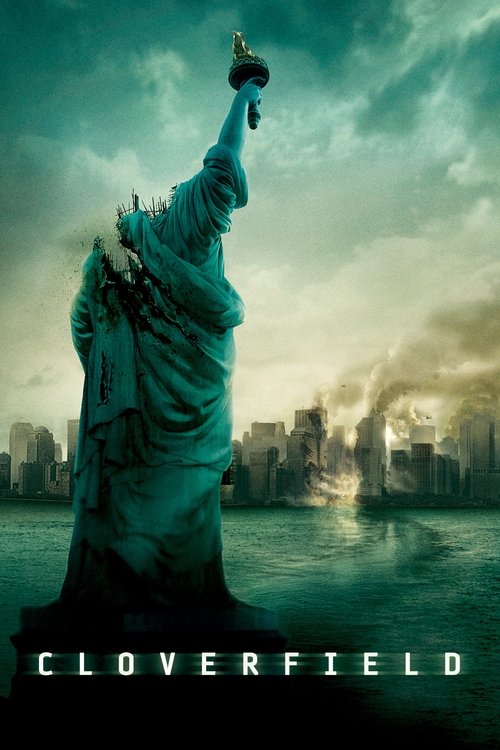
Cloverfield
2008 · Matt Reeves
For when you're craving pure adrenaline — a lights-off, phone-down thrill ride you can finish on a work night. Fair warning: if shaky handheld camera makes you queasy, this is the final boss.
What it's about
A going-away party in a Manhattan loft, caught on a friend's camcorder — toasts, gossip, a fresh break-up — until something enormous hits the city and the lights go out. What follows is one night of five young New Yorkers trying to survive as a skyscraper-sized creature tears through the streets, all of it seen through the single camera one of them refuses to put down. The framing device: the footage is a recovered tape, government evidence from 'the area formerly known as Central Park.'
The experience
Relentless once it kicks off — a sprint of panic, rubble, and glimpses of something you never quite get a full look at, which makes it worse. Short, loud, and genuinely stressful; the shaky camera puts you in the crowd instead of above it.
The craft
The entire film honors its found-footage conceit: no score, no cutaways, no God's-eye view — just what one consumer camcorder catches, which turns a giant-monster spectacle into a ground-level disaster document. The sound design does monstrous work, with the creature mostly heard before it's seen, and the effects are seamlessly stitched into amateur-looking video. Big screen and loud speakers strongly recommended.
Why it matters
Launched on one of the most famous viral marketing campaigns ever run, it proved found footage could carry a blockbuster, spawned a whole franchise, and became the definitive monster movie of the smartphone-camera era. It also marked Matt Reeves as a director to watch.
Snapshot
Cloverfield is a found-footage monster film that fuses the spectacle of the kaiju tradition with the intimate, disorienting grammar of consumer-camcorder video. Produced by J.J. Abrams's Bad Robot, written by Drew Goddard, and directed by Matt Reeves in his first major studio feature, the film stages the destruction of Manhattan by a colossal creature entirely through the lens of a single handheld camera carried by ordinary young New Yorkers fleeing for their lives. Its premise is announced by its framing device: a recovered tape, cataloged by the U.S. government as material retrieved from "the area formerly known as Central Park." That conceit—the whole film as a piece of evidence—governs everything about its form. Released by Paramount in January 2008 on the back of one of the era's most discussed viral marketing campaigns, Cloverfield became a touchstone for how the found-footage mode could be scaled to blockbuster ambition, and the seed of a loosely connected anthology that would extend across the following decade.
Industry & production
Cloverfield originated within Bad Robot, the production company Abrams built across television (Alias, Lost) and feature work. Abrams produced rather than directed; the directing assignment went to Matt Reeves, his longtime collaborator (the two had created the TV series Felicity together), and the screenplay to Drew Goddard, a writer who had come up through the Whedon and Abrams television orbit (Buffy the Vampire Slayer, Alias, Lost). The film was made for Paramount Pictures.
The defining industrial fact about Cloverfield is its marketing. A teaser was attached to prints of Transformers in the summer of 2007 carrying no title—only chaotic party footage interrupted by an off-screen catastrophe, a glimpse of the Statue of Liberty's severed head skidding into a Manhattan street, and the date "1-18-08." The absence of a name turned the trailer itself into a puzzle and drove months of online speculation, supported by an alternate-reality game built around fictional brands (the Japanese conglomerate Tagruato and its soft drink Slusho!) embedded in tie-in websites. The campaign is widely cited as a landmark in viral and mystery-driven film promotion, exploiting the same forum-and-clue culture Abrams had cultivated with Lost. The production was conducted under heavy secrecy, with the creature's design and even the project's identity withheld; precise budget and grosses are part of the public record but vary by source, so I note only that the film was made comparatively cheaply for a studio monster picture and was a substantial commercial success on release.
Technology
The film is built on a technological pretense: that we are watching footage shot on a single consumer-grade camcorder. In practice it was photographed on professional digital cameras and, in places, configured to mimic the look, motion, and artifacts of prosumer video. The conceit extends to a recurring device—fragments of older footage (a day at Coney Island) bleeding through underneath the newly recorded material because the tape was being reused, a detail that doubles as an emotional counterpoint and as a marker of the camcorder's material reality.
The creature and the city's destruction were realized through digital visual effects, with creature animation and effects work distributed among houses including Double Negative and Tippett Studio, and creature design led by Neville Page. The monster—nicknamed "Clover" in production—was conceived as an enormous, panicked juvenile, accompanied by smaller parasitic creatures that detach from its body, a design choice that kept the threat both gigantic and, at street level, intimate. Crucially, the effects were staged to be glimpsed rather than displayed: the technology of the spectacle is subordinated to the technology of the camera, so that the most expensive images arrive partial, blurred, or whip-panned away from. Exact vendor credits and the division of labor among effects houses are documented in the film's credits; where my knowledge of the specific shot-by-shot allocation is thin, I flag that rather than guess.
Technique
Cinematography
Cinematography is credited to Michael Bonvillain. The film's visual signature is the simulated single-camera handheld long take: lurching frames, motion blur, lens flares from explosions and emergency lighting, automatic exposure hunting as the camera swings from dark interiors to fire-lit streets, and frequent loss of the subject entirely. The "operator" within the fiction is a character, Hud, an amateur, so the framing is motivated by his panic, his curiosity, and his unreliability—he points the camera at the wrong things, lowers it at crucial moments, and keeps filming when a trained operator would not. This diegetic camera logic is the film's central formal idea: every compositional "flaw" is justified by who is supposedly holding the device. The approach trades the legibility and coverage of conventional action cinema for immediacy and dread, withholding the establishing wide shots that would let an audience orient itself.
Editing
The editing, credited to Kevin Stitt, sustains the illusion of a continuous, in-camera recording. Cuts are largely disguised as camcorder artifacts—stops and starts in the "recording," digital glitches, or moments where the camera is set down or jostled—so that the film reads less as an assembled sequence of shots than as one tape played back. The underlying Coney Island footage provides the only true cross-cutting in the film, surfacing in fragments to remind us of an earlier, happier day and to mark the recording as a physical object with a history. The pacing is propulsive and the overall runtime compact, in keeping with the premise that this is a single evening's worth of recovered material.
Mise-en-scène / staging
Staging is organized around partial visibility and the street-level vantage. The creature is never given a clean reveal; it is staged behind buildings, through dust, in the dark, or in the split-second a terrified cameraman happens to catch it. Set-pieces—a collapsing skyscraper, a flight across a tilting, half-fallen apartment building, a sequence in a subway tunnel, a military triage and evacuation zone—are blocked so that the human characters are always small within enormous, chaotic spaces. The Manhattan geography is rendered as a maze of debris and choke points rather than a map. The iconic single image of the campaign, the Statue of Liberty's head in the street, exemplifies the staging strategy: a monument of the city reduced to inexplicable wreckage at human scale.
Sound
Sound is among the film's most important and least obvious achievements. Within the fiction there is no musical score; the soundtrack is diegetic—screams, sirens, structural groans, military ordnance, and above all the creature's distinctive bellow, a designed roar meant to register as both animal and architectural. The handheld camera's microphone motivates an intimate, often distorted, close-perspective sound field. The single deliberate exception is the end-credits cue: composer Michael Giacchino wrote an orchestral overture, often referred to as "Roar! (Cloverfield Overture)," that plays only after the found footage ends. It is an affectionate pastiche of the symphonic monster-movie scores of the Toho/Godzilla tradition, and its placement—outside the diegesis, over the credits—preserves the film's rule that the world inside the tape has no score.
Performance
The performances, by a then largely unknown ensemble—Michael Stahl-David, T.J. Miller (as the often-unseen cameraman Hud), Lizzy Caplan, Jessica Lucas, Mike Vogel, and Odette Yustman (later Odette Annable)—are pitched toward naturalism and improvisatory reality. Because most of the cast is frequently off-camera or caught in unflattering, badly lit fragments, the acting must read as overheard rather than presented; dialogue overlaps, jokes curdle into fear, and emotional beats arrive sideways. Miller's work is notable precisely because it is mostly vocal, his character defined by a running commentary from behind the lens. The casting of unfamiliar faces reinforces the documentary pretense: there are no stars to reassure us that anyone will survive.
Narrative & dramatic mode
The dramatic mode is restricted first-person testimony. We know only what the camera records and only what its handlers happen to witness, which means the catastrophe is experienced as rumor, partial glimpse, and sudden proximity rather than as an explained event. The story's engine is deceptively small: an attempt to cross a monster-occupied Manhattan to rescue a friend, Beth, trapped in a damaged apartment. This personal quest grafts a melodramatic spine onto the disaster spectacle, giving the chaos a direction and the characters a reason to walk toward danger. The framing device—government-stamped recovered footage—installs dramatic irony from the first frame: the apparatus of retrieval implies catastrophe and casts the lovers' ordinary party banter at the start in an elegiac light. The film withholds explanation almost entirely; the creature's origin, fate, and nature are left largely unresolved, a deliberate refusal that keeps the audience inside the characters' ignorance.
Genre & cycle
Cloverfield sits at the intersection of two genres. It is a kaiju/giant-monster film in lineage—an American answer to the city-destroying creature features epitomized by Godzilla—and it is a found-footage film in form, descended from the faux-documentary horror tradition. Its innovation is to apply the subjective, low-fi found-footage grammar, previously associated with intimate horror, to the maximal spectacle of the disaster movie. It thus belongs to the post-Blair Witch found-footage cycle that intensified through the late 2000s (overlapping in time with the Paranormal Activity phenomenon and the [REC] franchise), while also participating in the 2000s revival and reinvention of large-scale monster and disaster cinema.
Authorship & method
Cloverfield is best understood as the product of the Bad Robot method—mystery-box construction, secrecy, and audience participation—filtered through specific craftsmen. J.J. Abrams functioned as producer and conceptual architect, and the film bears his fingerprints in its puzzle-driven marketing and its strategy of withholding. Matt Reeves directed, translating the concept into a sustained exercise in restricted point of view; the film launched a major directing career that would continue with Dawn of the Planet of the Apes and War for the Planet of the Apes and later The Batman, work that shares Cloverfield's interest in immersive, character-anchored spectacle. Drew Goddard wrote the screenplay, bringing the genre-literate sensibility he would later display as writer-director of The Cabin in the Woods and screenwriter of The Martian. The key technical collaborators—cinematographer Michael Bonvillain, editor Kevin Stitt, composer Michael Giacchino, and creature designer Neville Page—each served the film's governing rule that form must obey the fiction of the tape. The method, in sum, is constraint as authorship: a rigorously maintained single-camera premise that every department was required to honor.
Movement / national cinema
The film is an American studio production, but its lineage is transnational. Its monster-movie DNA is explicitly Japanese, descending from the Toho kaiju tradition, an homage made audible in Giacchino's end-credits overture. Its found-footage form draws on a more diffuse international horror lineage. Cloverfield does not belong to a formal film movement; it is better placed within an industrial tendency of the 2000s—the Hollywood embrace of digital, low-fidelity aesthetics and participatory, internet-native marketing—than within any auteurist or national school.
Era / period
Cloverfield is profoundly a film of its moment: post-9/11 New York and the broadband internet of the mid-to-late 2000s. Its imagery—a dust cloud surging down a Manhattan avenue, debris-blinded crowds, a severed monument, ad hoc cell-phone and camcorder documentation of disaster—directly evokes the visual memory of September 11, 2001, and the film was widely discussed (and sometimes criticized) on those grounds. It is also a YouTube-era artifact, predicated on a culture in which catastrophe is recorded and circulated by amateurs, and on an online fan culture capable of decoding a marketing puzzle. The film could not have existed, in form or in promotion, a decade earlier.
Themes
The film's central theme is the catastrophe witnessed from below: history as something that happens to you while you are pointing a camera at it, understood only in fragments. From this flow several concerns. There is the theme of mediation—of experience routed through, and arguably distanced by, the recording device, and the question of why one keeps filming at all. There is the elegiac theme embedded in the reused tape, the happier past literally underlying the present disaster. There is the post-9/11 theme of an American city's sudden vulnerability and of survival amid incomprehensible scale. And there is a generational portrait: privileged, ironic young New Yorkers whose ordinary romantic and social dramas are obliterated by an event they can neither understand nor escape, their small story rendered both trivial and unbearably precious by the disaster that engulfs it.
Reception, canon & influence
On release in January 2008, Cloverfield arrived as an event film whose months-long mystery campaign had primed an unusually engaged audience, and it opened to strong commercial results. Critical reception was substantial and divided in a characteristic way: praise for the audacity and immersive intensity of the formal conceit, and for the marketing's ingenuity, set against complaints about thin characterization, the literal nausea induced by the shaky camera, and unease about its appropriation of 9/11 imagery. (I describe the shape of the response rather than cite specific figures or quotations, which I would not want to misattribute.)
Looking backward, the film's influences are clear and acknowledged: the kaiju tradition of Godzilla and Toho; the found-footage horror lineage running from Cannibal Holocaust (1980) through the genre-defining The Blair Witch Project (1999); and the disaster-movie convention of the city under siege. Its formal wager was to weld the first to the second.
Looking forward, Cloverfield helped legitimize found footage as a vehicle for large-scale, effects-driven spectacle rather than only intimate horror, and it stands as a high-water mark of internet-era mystery-box marketing, influencing how studios used secrecy and viral puzzles to build anticipation. Its most concrete legacy is institutional: it became the anchor of a loosely connected anthology produced by Bad Robot, continued in 10 Cloverfield Lane (2016)—a film developed from unrelated material and rebranded into the franchise—and The Cloverfield Paradox (2018), notable for its surprise release. As an experiment in constraint, a document of its anxious historical moment, and a proof of concept for spectacle-scale found footage, Cloverfield retains a secure place in accounts of 2000s American genre cinema.
A Deleuzian reading
Hud keeps filming.
The full Deleuzian reading of Cloverfield →
Reception
In January 2008 it was the payoff to one of the most feverish viral-marketing campaigns ever, then got shrugged at as a shaky-cam gimmick; now it's fondly reclaimed as the high-water mark of the found-footage era and the seed of a whole mystery-box franchise.
How Cloverfield was received, from release to now →
Influences: the films it descends from and the films it influenced
- Cannibal Holocaust (1980) — Originates the 'recovered footage' frame in which the camera's own discovery and survival are the narrative device — exactly the conceit Cloverfield reuses by presenting the film as a found tape (SDF/'Central Park, formerly Central Park') with timestamps and digital artifacts.
- The Blair Witch Project (1999) — Establishes the performer-operated handheld camera plus improvised naturalistic ensemble, and builds terror through partial visibility (the threat kept off-frame) — the dread grammar and the pre-release viral mystery campaign Cloverfield directly inherits.
- Festen (The Celebration) (1998) — Dogme 95's discipline of consumer-grade handheld and strictly diegetic, source-only sound is the formal rule Cloverfield adopts — 'form must obey the fiction of the tape,' no non-diegetic score until Giacchino's end-credits overture breaks the seal.
- Godzilla (Gojira) (1954) — Defines the kaiju template of a metropolis methodically leveled as collective trauma; Cloverfield welds this monster-stomps-the-city spectacle onto found-footage grammar, even staging the creature's scale via toppled skyscrapers and shed parasites.
- King Kong (1933) — The original giant monster loose in Manhattan, scaled against named landmarks; Cloverfield's decapitated Statue of Liberty and skyline-framed creature are the same architecture-as-yardstick staging.
- The Battle of Algiers (1966) — Pioneers newsreel-grade handheld staging of urban catastrophe with a non-star naturalistic ensemble so restaged chaos reads as documentary — the verisimilitude strategy Cloverfield applies to crowds fleeing a collapsing downtown.
- Saving Private Ryan (1998) — Kamiński's shutter-stripped, shoulder-mounted combat photography and tightly restricted soldier's-eye POV; Cloverfield transposes that disorienting, debris-in-the-lens handheld immersion and ground-level sightline onto a monster attack.
- 28 Days Later (2002) — Proves consumer DV's low-res, smeared aesthetic can carry apocalyptic scale and depopulated-city spectacle, legitimizing the lo-fi video texture Cloverfield uses for large-scale destruction.
- Jurassic Park (1993) — Reeves inherited Jurassic Park's sub-bass somatic design — creature announced by ground vibration and infrasound before visual confirmation — and made the technique formally transparent by stripping away classical coverage, exposing in handheld vérité the creature-as-sensory-event logic that Spielberg embedded within a classical Hollywood grammar.
- The Host (2006) — Extends The Host's handheld-panic creature attack into full first-person subjectivity, keeping spatial orientation 'just legible enough' amid urban chaos as its core formal proposition.
- Godzilla Minus One (2023) — Reeves extends the civilian-POV kaiju grammar into found-footage form, subordinating spectacle to experiential dread and withholding the full creature to the film's final minutes — a formal commitment to the horror register over the wonder register that Yamazaki achieves through entirely different cinematographic means but identical tonal intention.
- The Lost World: Jurassic Park (1997) — Extends the sub-bass-driven, street-level kaiju rampage, keeping the creature concealed and read through human-scale reaction in the Jaws/Godzilla lineage this film channels.
- District 9 (2009) — Extends Cloverfield's proof of concept that handheld/mockumentary newsreel texture can host effects-heavy sci-fi spectacle, wrapping CG creatures in interview and security-cam vérité.
- Monsters (2010) — Inherits the naturalistic, character-first creature film in which the kaiju is glimpsed only at human scale and the camera stays with ordinary people — Cloverfield's restraint scaled to a road movie.
- Trollhunter (2010) — Carries the found-footage conceit explicitly to giant-monster terrain, using a tagging-along documentary crew to justify the handheld camera capturing kaiju-scale creatures.
- Chronicle (2012) — Pushes spectacle-scale found footage toward superpowers while solving Cloverfield's core problem — keeping the camera diegetically 'earned' — via an in-world telekinetically floating camera that frees the operator from holding it.
- 10 Cloverfield Lane (2016) — The institutional heir: an unrelated script rebranded into the Bad Robot anthology, continuing the mystery-box authorship and secrecy-as-marketing method Abrams established with Cloverfield.
- The Darkest Hour (2011) — Establishes the young-survivors-traverse-a-stricken-metropolis structure, told at ground level with civilians improvising movement through a city whose authorities have already collapsed.
- Project X (2012) — Filters a large-scale disaster through a single partygoer's handheld camcorder, pivoting from a house party into escalating chaos — the exact party-then-catastrophe swing Project X inherits.
- Dawn of the Planet of the Apes (2014) — Reeves's own experiment in mobile, ground-level handheld immersion and creature-adjacent POV feeds Dawn's roving camera and the 360-degree tank-turret pan.
- As Above, So Below (2014) — Demonstrated the single consumer-camera POV threading terrified people through collapsing, dark, cramped underground spaces — a subway-tunnel grammar echoed in the catacomb crawls.
- The Host (Gwoemul) (2006) — A near-contemporary that re-anchors the kaiju film to an ordinary civilian family rather than the military or scientists — the restricted, character-first POV onto monster catastrophe that Cloverfield runs in parallel.
- REC (2007) — Same-year single-camera, near-real-time found footage built around a reporter-and-operator pair, sustaining the diegetic camera-logic and partial-visibility scares Cloverfield deploys on a city scale.
- Paranormal Activity (2007) — Contemporary found-footage horror enforcing strict in-world reasons for the camera to keep rolling, plus a slow-platformed, secrecy-driven release — the same diegetic-camera rigor and viral marketing kinship.
- War for the Planet of the Apes (2017) — Reeves extending his own signature — immersive, restricted-POV spectacle anchored to a single protagonist's experience — from the camcorder constraint of Cloverfield to performance-capture-driven epic scale.
- I Am Legend (2007) — Shares I Am Legend's New York disaster subgenre framework and its location-composite approach to rendering central Manhattan uninhabitable, developed in adjacent production timelines drawing on identical post-9/11 anxiety about catastrophic rupture in the specific geography of the island, with creature-stalked streets as the shared visual proposition.
- Godzilla (2014) — Parallel commitment to street-level, human-scale kaiju experience and withheld full-monster reveals, privileging on-the-ground terror over god's-eye spectacle.
- War of the Worlds (2005) — Descendant that radicalizes the film's ground-level, restricted-POV catastrophe and 9/11 iconography — dust clouds, fleeing crowds, falling debris — into full found-footage.
- Godzilla (1998) — A descendant kaiju-in-Manhattan film that keeps the dim, partial, fast-moving creature and birthing parasites, but inverts Emmerich's slick coverage into handheld found footage.
- Pacific Rim (2013) — Sibling in the post-Godzilla American kaiju revival; its city-scale monster-in-the-rain destruction and fluid-simulation water/debris work feed the same VFX vocabulary del Toro deploys at full wide scale.
- Shin Godzilla (2016) — Builds monster dread from restricted, on-the-ground POV and deliberate minimal reveal, withholding full creature exposure as a suspense strategy.
- The Mist (2007) — Applies the same handheld, deglamorized-verité camera language to a creature feature and reads the monster attack as a post-9/11 allegory of ordinary people amid an incomprehensible catastrophe.
Similar films
- [REC] (2007) — influence & lineage
- The Blair Witch Project (1999) — influence & lineage
- King Kong (1933) — influence & lineage
- War for the Planet of the Apes (2017) — influence & lineage
- Godzilla (2014) — shared sensibility
- Godzilla: King of the Monsters (2019) — shared sensibility
- Godzilla (1998) — shared sensibility
- Godzilla Minus One (2023) — shared sensibility