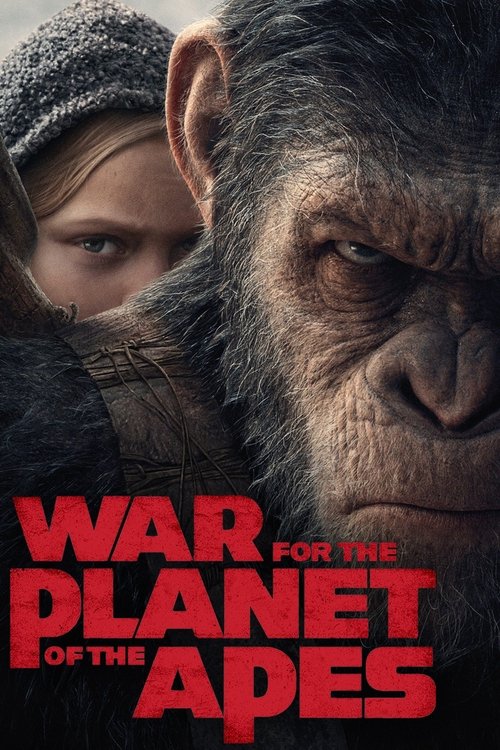
War for the Planet of the Apes
2017 · Matt Reeves
When you want a big-canvas spectacle that takes itself seriously — an epic to sink into on a cold night when popcorn action won't cut it and you're up for something mournful and grand.
What it's about
Caesar, the intelligent chimpanzee who has led his apes through years of uneasy survival, is dragged into a final conflict with a remnant human army commanded by a ruthless Colonel. After his people suffer terrible losses, Caesar sets out on a wintry journey of vengeance that tests everything he believes about leadership, mercy, and what separates him from his enemies. It's the conclusion of a trilogy, but it plays as a self-contained epic of grief and deliverance.
The experience
Somber, mythic, and surprisingly hushed for a blockbuster — long stretches play almost without dialogue, carried by faces and snow-covered landscapes. It's a war movie that feels more like a western crossed with a prison drama, heavy with moral weight but never grim for its own sake.
Performances
Andy Serkis's motion-capture work as Caesar is one of the great screen performances of its era — every flicker of doubt and fury reads on a digital face — and Woody Harrelson brings chilling, wounded conviction to the Colonel.
The craft
The visual effects set a benchmark: apes rendered so completely that you stop thinking of them as effects at all, photographed against real snow, rain, and firelight. Matt Reeves directs with patience and classical sweep, and Michael Giacchino's score leans into myth rather than bombast. This one genuinely rewards the biggest screen and best sound you can give it.
Why it matters
It closed out one of the most critically respected blockbuster trilogies of the 2010s and made the definitive case that a motion-capture performance could anchor a film's entire emotional life, fueling a long-running conversation about awards recognition for the technique.
Snapshot
War for the Planet of the Apes is the third and concluding film of the rebooted Planet of the Apes trilogy that began with Rupert Wyatt's Rise of the Planet of the Apes (2011) and continued with Matt Reeves's Dawn of the Planet of the Apes (2014). Reeves returned to direct and co-wrote the screenplay with Mark Bomback. The film completes the arc of Caesar (Andy Serkis), the genetically enhanced chimpanzee whose leadership of an emergent ape society drives all three films, following him into a war against a paramilitary human remnant commanded by a fanatical figure known only as the Colonel (Woody Harrelson). Despite its martial title, the film is less a combat spectacle than a somber revenge-and-deliverance narrative — a chamber drama of grief, moral corrosion, and eventual passage toward a promised land. It is widely regarded as one of the most technically accomplished and emotionally serious blockbusters of its decade, and as the capstone that retroactively confirmed the reboot trilogy as a rare example of sustained, escalating quality in modern studio franchise filmmaking. It also functions as an origin bridge: its plot mechanics — a mutation of the engineered virus that robs surviving humans of speech and higher reason — quietly seed the world of Franklin Schaffner's original Planet of the Apes (1968).
Industry & production
The film was produced and distributed by 20th Century Fox, the studio that had held the Apes property since the original 1968 adaptation of Pierre Boulle's novel La Planète des singes. It arrived at the tail end of Fox's independence, before the Disney acquisition of 2019, and represents the studio's continued investment in a franchise it had successfully revived as a prestige-tier tentpole rather than pure spectacle. Reeves, whose profile had risen through Cloverfield (2008), Let Me In (2010), and especially the critically lauded Dawn, was given substantial authorial latitude; his handling of the trilogy's middle chapter positioned him for the DC assignment The Batman (2022). Principal photography took place largely in British Columbia, Canada, with production designer James Chinlund realizing the Colonel's fortified quarry base and the snowbound wilderness through which Caesar travels. The visual-effects work — the film's true production centerpiece — was executed by Weta Digital in Wellington, New Zealand, under senior visual-effects supervisor Joe Letteri and visual-effects supervisor Dan Lemmon, the same core team responsible for Dawn and, further back, the Avatar and Lord of the Rings performance-capture milestones. Exact budget and grosses should be treated with the usual caution regarding studio accounting, but it is well established that the film earned meaningfully less at the worldwide box office than Dawn had, while retaining strong critical standing — a pattern consistent with a trilogy capper that skewed darker and more contemplative than its predecessors.
Technology
War stands near the summit of pre-2020 performance-capture and digital-character technology. Its central technical achievement was Weta Digital's ability to bring photoreal, emotionally legible ape characters into real, unforgiving exterior environments — snow, rain, mud, water, and natural firelight — rather than the controlled soundstages that had historically favored digital creatures. Weta and the production advanced on-location performance capture significantly: actors performed in costume and marker rig on the actual shooting locations, with capture data recorded outdoors in adverse weather, allowing the digital apes to be lit and integrated with the plate photography they inhabited. The film pushed rendering of fur, wet fur, breath vapor, and skin in cold conditions, and refined the ocular and facial-muscle systems that made close-up ape performance readable at the level of micro-expression. This continuity of tooling and personnel across Dawn and War is essential to understanding the trilogy: the technology matured in lockstep with the storytelling ambitions, so that by 2017 the filmmakers could stage long, dialogue-light passages of silent or signed communication among fully digital protagonists and trust an audience to follow them.
Technique
Cinematography
Michael Seresin, the veteran New Zealand–born cinematographer (a longtime Alan Parker collaborator whose credits include Midnight Express and Angela's Ashes), returned from Dawn to shoot War. His photography favors a muted, wintry palette — steel grays, whites, and blacks — with strong, sculptural use of shadow that lends the film the gravity of a war picture and, at moments, the iconography of the Western and the prisoner-of-war film. Seresin stages the apes' faces in intimate close-up while reserving grandeur for wide compositions of figures against snowfields and forests, and his handling of firelight and low-key interior scenes in the Colonel's compound gives the film its Conradian, end-of-the-world texture. The imagery consistently privileges legibility of performance over kinetic action.
Editing
The film was edited by William Hoy and Stan Salfas, both returning from Dawn. The cut is notably patient for a summer blockbuster: it withholds large-scale combat for long stretches, builds through sustained scenes of travel, captivity, and moral deliberation, and trusts silence. The editing must also carry a heavy load of nonverbal storytelling — sign language, glances, and reaction — sequencing shots so that an audience reads intention and emotion from digital faces without dialogue. Action, when it comes, is assembled for clarity of geography rather than fragmentation.
Mise-en-scène / staging
James Chinlund's production design anchors the film's iconography: the Colonel's quarry fortress, with its ape prisoners laboring on a wall, and the pointed graffiti "APE-POCALYPSE NOW" scrawled in the compound, make the film's borrowings explicit. Staging draws heavily on the visual grammar of the war and escape genres — the prison camp, the tunnel, the wall, the massed columns of soldiers and captives. Reeves and Seresin repeatedly frame Caesar as a solitary, burdened leader-figure, isolating him within compositions to externalize his interior struggle.
Sound
The sound design carries an unusual weight because so much of the film's communication is nonverbal; ambient sound, breath, and the acoustic character of snow and wilderness do expressive work that dialogue would ordinarily do. Michael Giacchino's score (see below) is integrated with this design to shape emotional register in scenes that are otherwise wordless.
Performance
Andy Serkis's Caesar is the trilogy's through-line and, by common critical assent, the culmination of his career-long project to establish performance capture as legitimate screen acting. Here Caesar is older, wearier, and morally compromised — tempted toward vengeance in a way that echoes the fallen bonobo Koba of Dawn — and Serkis renders that internal war largely through the eyes and posture of a digital character. He is supported by a returning ensemble of capture performers, including Karin Konoval as the orangutan Maurice and Terry Notary as Rocket, whose continuity across the trilogy gives the ape society a lived-in coherence. Steve Zahn provides the film's tonal relief as "Bad Ape," a traumatized, isolated chimp, while Woody Harrelson plays the Colonel as a self-mythologizing zealot in the Kurtz mold. Amiah Miller plays Nova, the mute human child the apes adopt — a role whose name deliberately invokes the original 1968 film.
Narrative & dramatic mode
The film's dramatic mode is that of the mythic journey and the revenge tragedy inflected toward deliverance. After a devastating personal loss inflicted by the Colonel, Caesar splits from his people to pursue vengeance, accompanied by a small band; the narrative becomes a quest that carries him — and eventually his captured tribe — toward escape and a promised sanctuary. Structurally the film is deliberately Biblical, casting Caesar as a Moses figure leading his people out of bondage toward a land he himself will not fully enter. It is a mode of moral seriousness unusual for its budget class: the drama turns on Caesar's temptation to become the thing he hates, and its resolution is elegiac rather than triumphant.
Genre & cycle
War is a hybrid of science fiction, war film, and Western, layered onto the long-running Planet of the Apes franchise cycle. Within science fiction it belongs to the post-apocalyptic strain, but its genre identity is most strongly borrowed from the war and prisoner-of-war film — The Bridge on the River Kwai, The Great Escape — and from Apocalypse Now, itself a war film built on Conrad. The Western is present in its wilderness journey, its lone-avenger structure, and echoes of John Ford. As the third entry in a franchise cycle, it is engaged in the specific work of trilogy completion: honoring the arc established since 2011 while functioning as a prequel-by-implication to the 1968 original.
Authorship & method
Matt Reeves is the trilogy's decisive authorial presence across its final two films, and his method is legible here: an emphasis on character interiority, restraint with spectacle, atmospheric dread, and the treatment of genre premises as vehicles for moral drama — tendencies traceable back through Let Me In and Dawn. He co-wrote the screenplay with Mark Bomback, who had scripted Dawn; the writing foregrounds theme and allegory, and leans confidently on wordless sequences. His key collaborators form a remarkably stable authorial unit sustained from Dawn: cinematographer Michael Seresin, composer Michael Giacchino, editors William Hoy and Stan Salfas, and the Weta Digital team under Joe Letteri and Dan Lemmon. Giacchino's score is a significant authorial element in its own right — thematically developed, at times using percussive and primal textures alongside sweeping orchestral writing, and continuous with the musical identity he established for Dawn. This continuity of craft personnel is central to the trilogy's coherence: the same hands shaped the world across films, allowing technique and theme to deepen rather than reset.
Movement / national cinema
The film does not belong to a national-cinema movement in the conventional sense; it is a product of the American studio system. But it is worth noting the strong transnational infrastructure behind it: a New Zealand–born cinematographer, Canadian shooting locations, and — crucially — Weta Digital in Wellington as the effects engine. In that sense War is part of the globally distributed, VFX-driven mode of contemporary Hollywood blockbuster production, in which New Zealand's post-Lord of the Rings effects industry plays an outsized creative role. It also sits within a lineage of "elevated" or auteur-driven tentpoles of the 2010s that sought critical as well as commercial legitimacy.
Era / period
Released in July 2017, the film is a late-period 20th Century Fox production, arriving in a franchise-saturated blockbuster landscape and distinguishing itself precisely by its restraint and gravity. It reflects the mid-2010s moment when performance-capture technology had matured enough to carry fully non-human protagonists through a mainstream drama, and when studios were briefly willing to fund darker, more auteur-inflected franchise entries. Read against its cultural moment, critics frequently noted the resonance of its imagery of walls, captivity, and authoritarian zealotry, though such contemporaneous readings should be understood as interpretive rather than as stated authorial intent.
Themes
The film's central themes are vengeance and its moral cost; leadership and the burden of sparing others one's own darkness; mercy versus annihilation; and deliverance from bondage. The Moses/Exodus allegory is explicit and structural. A second major theme is the loss and meaning of language and reason: the mutation that renders surviving humans mute and diminished is both a plot mechanism bridging to the 1968 film and a thematic inversion — as apes ascend toward speech and society, humans descend from it. The Colonel embodies a further theme of fanaticism and the willingness to sacrifice one's own kind in the name of purity and survival. Grief, sanctuary, and the passing of a torch from one generation to the next thread through the whole.
Reception, canon & influence
Critically, War was received as a strong culmination of a well-regarded trilogy, praised in particular for Weta Digital's effects, Serkis's performance, Giacchino's score, and Reeves's willingness to make a somber, character-driven blockbuster. (Specific aggregate scores and box-office figures are widely reported but are omitted here to avoid citing numbers imprecisely; the film's warm critical reception and its status as a lower-grossing but respected trilogy capstone are the secure claims.) A recurring strand of its reception was renewed argument about whether performance-capture acting deserves formal awards recognition — a debate Serkis's Caesar had long anchored.
The influences on the film are unusually legible and openly acknowledged within the text: Joseph Conrad's Heart of Darkness and Coppola's Apocalypse Now (the Colonel as a Kurtz figure, the "Ape-pocalypse Now" graffiti); the war and escape films of David Lean and John Sturges; the American Western and, in its journey structure, films in the tradition of John Ford; and the Biblical Exodus narrative. Above all it is in dialogue with its own franchise — the 1968 original and Pierre Boulle's source novel — which it retroactively sets up.
Its legacy forward is twofold. Within the franchise, it consolidated the reboot trilogy's reputation as a benchmark for how to build an escalating, thematically serious blockbuster series, and it laid narrative groundwork continued in the later Kingdom of the Planet of the Apes (2024), set generations after Caesar's death. More broadly, together with Dawn it advanced the industrial and artistic case for digital protagonists carrying dramatic weight in real environments, influencing the ambitions of subsequent performance-capture and creature-driven productions. Its clearest personal legacy was for Reeves himself, whose work across the trilogy directly enabled his subsequent authorship of The Batman.
A Deleuzian reading
Watch the breath.
The full Deleuzian reading of War for the Planet of the Apes →
Reception
Landed in 2017 already crowned — critics called it the rare threequel that sticks the landing — and its stock has only risen since, with the Caesar trilogy now routinely named the best blockbuster trilogy of the 2010s.
How War for the Planet of the Apes was received, from release to now →
How to watch War for the Planet of the Apes: what to notice on a first viewing
- Watch Caesar's face during silences, before anyone speaks or acts. Weta rebuilt the ocular and facial-muscle systems so small movements read clearly; Serkis uses that resolution to show Caesar deciding who to become. Deleuze calls this a potisign, a face of power approaching a decision it has not yet made.
- Notice the gray, white, and black palette, and where firelight falls. Seresin shoots snowfields and forests in cold, sculptural light, then switches to low, warm firelight inside the Colonel's compound. The shift in light marks the difference between wilderness grief and the compound's fanatic warmth.
- Listen for breath, wind, and snow instead of dialogue. Long stretches carry no speech at all; ambient sound and Giacchino's score do the emotional work that lines would elsewhere. This nonverbal design forces you to read intention from sound and face, not words.
- Notice how long the film waits before large-scale combat begins. Hoy and Salfas cut travel, captivity, and quiet deliberation for long stretches, withholding the spectacle the title promises. The patience means grief and moral cost outweigh action as the film's real subject.
- Follow the signing, glances, and gestures apes use instead of speech. Whole scenes play out in sign language and posture alone, asking you to decipher meaning without dialogue to guide you. Deleuze calls an image that must be worked out rather than simply heard a lectosign; this film runs on them.
The whole guide to watching War for the Planet of the Apes, with the keys for a rewatch →
Influences: the films it descends from and the films it influenced
- Planet of the Apes (1968) — Supplies the franchise's core device of inverting the human/ape hierarchy as dramatic engine, and the mute-human motif that War literalizes in Nova and the soldiers who lose speech.
- Rise of the Planet of the Apes (2011) — Established Serkis's Caesar as a lead dramatic performance-capture protagonist and Weta's emotive facial pipeline that War inherits and refines.
- Dawn of the Planet of the Apes (2014) — Direct source of the stable craft unit — Seresin's lensing, Giacchino's percussive thematic score, Hoy/Salfas editing, Weta under Letteri/Lemmon — and Reeves's grammar of sustained mocap close-ups.
- Apocalypse Now (1979) — Lends its Heart of Darkness upriver-to-a-rogue-commander structure and the Colonel-as-Kurtz figure, acknowledged in the film's own 'Ape-pocalypse Now' graffiti.
- The Bridge on the River Kwai (1957) — Models the POW forced-labor camp as a moral arena governed by a commander's fixed obsession, the staging War borrows for the Colonel's wall-building prison.
- The Great Escape (1963) — Provides the mechanics of the tunnel breakout — camp geography, sentries, the dug escape route — that War restages for the apes' liberation.
- The Searchers (1956) — Supplies the Western template of a solitary avenger's landscape-spanning revenge journey, framed against wilderness, that structures Caesar's ride toward the Colonel.
- The Lord of the Rings: The Two Towers (2002) — Gollum is the origin point of actor-driven, fully dramatic performance capture — the Serkis/Weta method whose direct descendant is Caesar.
- King Kong (2005) — Extended Serkis-plus-Weta capture to a wholly emotive non-human lead with on-set reference performance, the technical and acting groundwork War builds on.
- Barry Lyndon (1975) — Its firelight and available-light low-key interiors prefigure Seresin's candle- and fire-lit compositions that give War its wintry, source-motivated shadow.
- The Ten Commandments (1956) — Furnishes the Moses/Exodus liberation-of-an-enslaved-people template — leader delivering his kind toward a promised land he won't enter — that War's ending explicitly enacts.
- The Adventures of Tintin (2011) — Represents the maturation of Weta's actor-driven facial capture into fully expressive, emotionally legible digital faces — the realized solution to the semi-realism Tintin could only approximate.
- The Jungle Book (2016) — Extends the case War advanced for photoreal creature ensembles acting opposite live elements, banking on the emotive-capture credibility the Apes films proved.
- Alita: Battle Angel (2019) — A fully CG performance-capture lead headlining a live-action drama — a direct beneficiary of the digital-protagonist legitimacy Serkis's Caesar established.
- The Batman (2022) — Reeves ports the trilogy's low-key muted palette, patient dread, and character interiority into a franchise tentpole — the authorship the Apes films directly enabled.
- Kingdom of the Planet of the Apes (2024) — Continues the story generations after Caesar's death, inheriting Weta's creature pipeline and the trilogy's world-grammar of ape society and human muteness.
- Better Man (2024) — Proved a performance-captured primate could headline a somber, adult dramatic feature and sustain a feature-length emotional arc in close-up, the precedent Better Man extends from war epic into intimate biopic.
- Let Me In (2010) — Sibling in method rather than plot: Reeves's restraint, atmospheric dread, and treatment of a genre premise as intimate moral drama, carried forward into the Apes films.
- Avatar (2009) — Parallel push to make performance-capture protagonists carry dramatic weight in believable environments via facial-capture rigs, developed in the same Weta-adjacent R&D milieu.
- The Revenant (2015) — Weds on-location, wintry natural-light cinematography to a primal, near-wordless revenge-survival journey — the same fusion of endurance landscape and vengeance War pursues.
- Cloverfield (2008) — Reeves extending his own signature — immersive, restricted-POV spectacle anchored to a single protagonist's experience — from the camcorder constraint of Cloverfield to performance-capture-driven epic scale.
Similar films
- Dawn of the Planet of the Apes (2014) — influence & lineage · same viewing thread
- Kingdom of the Planet of the Apes (2024) — influence & lineage · same viewing thread
- Planet of the Apes (1968) — influence & lineage · same viewing thread
- Rise of the Planet of the Apes (2011) — influence & lineage
- King Kong (2005) — influence & lineage
- The Revenant (2015) — influence & lineage
- Star Wars: The Force Awakens (2015) — same viewing thread
- The Empire Strikes Back (1980) — same viewing thread
All the films related to War for the Planet of the Apes →
Watch it with: curated runs of related films
- The Blockbuster Sci-Fi Canon — A run of the effects-driven epics that taught modern audiences what a movie could feel like — from the desert planets of Star Wars to the rain of Blade Runner and the sands of Arrakis.