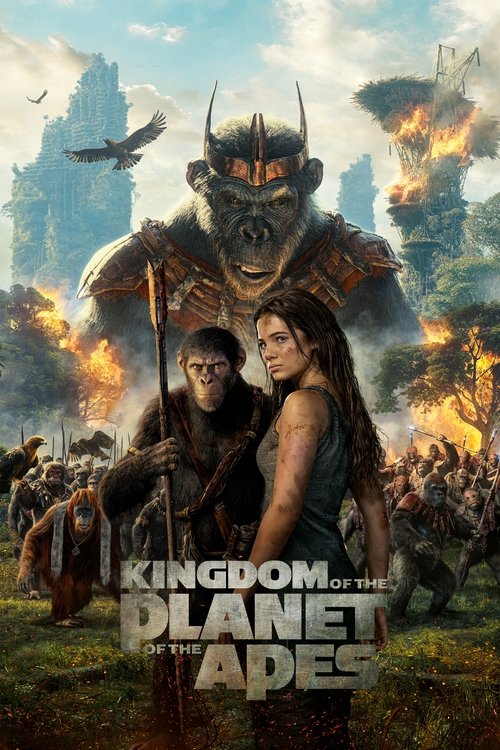
Kingdom of the Planet of the Apes
2024 · Wes Ball
For a night when you want a proper widescreen spectacle with a brain — an epic to sink into with the lights off, comforting in shape but with ideas that linger past the credits.
What it's about
Generations after the ape leader Caesar's death, apes rule a green, overgrown Earth while humans scavenge mutely at the edges. Noa, a young chimpanzee from a clan that raises eagles, sees his village burned and his family taken by the armies of Proximus Caesar, a warlord who has twisted the real Caesar's teachings into the founding myth of a coastal empire. His pursuit across the ruins becomes a journey of discovery — with a wise old orangutan and a human woman who is not what she seems — that forces him to question everything he's been told about the past.
The experience
A big, earnest adventure that takes its time: long stretches of quiet world-wandering punctuated by genuinely tense set pieces, with an undercurrent of melancholy about civilizations forgetting themselves. It's immersive rather than frantic — you settle into its world and stay there.
Performances
Owen Teague makes Noa's curiosity and hurt read through a fully digital face, Kevin Durand gives Proximus Caesar a booming, seductive menace, and Peter Macon's gentle orangutan Raka quietly steals every scene he's in.
The craft
The motion-capture apes are astonishing — every flicker of doubt legible on nonhuman faces — set against landscapes where skyscrapers have become cliffs of vines and rust. This is a film built for the biggest screen you can find, with a rich soundscape of wind, birdcalls, and distant thunder that makes the empty world feel alive.
Why it matters
It proved the rebooted Apes saga could outlive its central character and keep drawing audiences, extending one of the rare modern blockbuster franchises praised as much for its ideas as its effects.
Snapshot
Kingdom of the Planet of the Apes opens "many generations" after the death of Caesar, the ape leader whose moral authority anchored the three preceding films of the rebooted series. In the intervening centuries, apes have become the planet's dominant order while humans have regressed to a feral, largely mute scattering. The film follows Noa, a young chimpanzee of an eagle-keeping clan, whose village is razed and family enslaved by the forces of Proximus Caesar — a self-aggrandizing bonobo who has weaponized a garbled memory of the real Caesar into the founding myth of a coastal empire. Noa's pursuit becomes an education: in the company of the orangutan Raka, last keeper of Caesar's actual teachings, and a human woman, Mae, who is far more intelligent and purposeful than she first appears, he learns that history is not a fixed inheritance but a contested resource. The fourth installment in the reboot and the tenth Planet of the Apes film overall, Kingdom functions as a generational reset: it preserves the franchise's signature performance-capture realism and its interest in the ethics of power while handing the saga to new characters, and it leaves human–ape relations poised, deliberately, on an unresolved knife-edge.
Industry & production
Kingdom of the Planet of the Apes was produced and distributed by 20th Century Studios, the former 20th Century Fox unit absorbed into the Walt Disney Company in 2019. This corporate change is consequential to the film's existence: the Apes property had been one of Fox's most reliably prestigious franchises, and Kingdom represents Disney's decision to continue rather than retire a valuable piece of acquired intellectual property. Rather than recall Matt Reeves, who had directed Dawn (2014) and War (2017) and helped define the trilogy's elegiac tone, the studio handed the film to Wes Ball, known chiefly for the Maze Runner young-adult trilogy (2014–2018). Ball brought several of his established collaborators with him, signaling an intention to refresh the series with a new creative team rather than imitate Reeves.
The film was shot largely in Australia, with the production using outdoor locations and purpose-built sets to escape the soundstage confinement that performance-capture work has historically required. It was released theatrically on 10 May 2024 across conventional, IMAX, Dolby Cinema, 4DX, and ScreenX formats, and grossed over $397 million worldwide — a solid commercial result that justified the studio's plan to extend the new arc, though the figure trailed the trilogy's most successful entries and the critical consensus regarded it as somewhat slighter than its predecessors. The decision to set the story generations after Caesar's death was the central structural gamble: it freed the filmmakers from the burden of resolving the prior arc while risking the loss of the audience's accumulated emotional investment in Caesar himself.
Technology
The film's defining technical achievement, as with the entire reboot, lies in performance capture, executed by Wētā FX — the New Zealand house that has carried the franchise's digital apes since Rise of the Planet of the Apes (2011). Visual-effects supervisor Erik Winquist, who has worked on every film in the reboot, oversaw a program of more than 1,500 visual-effects shots, with roughly thirty-three minutes of the film reported to be entirely digital. The headline advance of the reboot era — capturing actors' performances on location, in natural light and weather, rather than on a controlled volume stage — reaches a mature form here. The apes are rendered as fully photoreal CG characters driven by the on-set performances of actors in motion-capture suits, with facial capture translated through Wētā's animation pipeline into anatomically distinct ape musculature. Paul Story served as animation supervisor, with Stephen Unterfranz and Phillip Leonhardt among the sequence-level VFX supervisors.
The persistent technical problem the team addresses is the gap between a human performer's face and an ape's: the apes must read as the actors' performances while remaining convincingly non-human in skull shape, eye placement, and the absence of a human-like brow and lip range. The film extends the franchise's water and environment work as well, building the overgrown, vine-choked ruins of a drowned human civilization that the apes inhabit without comprehending. Where the record is thinner — on the precise machine-learning tools used in the facial pipeline — the studio's published accounts emphasize craft and iteration over any single proprietary breakthrough.
Technique
Cinematography
Gyula Pados served as director of photography, shooting on the ARRI Alexa LF — a large-format digital camera — paired with vintage Panavision anamorphic lenses dating to the late 1960s and early 1970s. The choice is pointed: anamorphic glass of that vintage gives the image a soft, flaring, slightly imperfect character that cuts against the clinical precision of the digital apes, lending the photoreal creatures a photographed, film-era texture. The large-format sensor combined with old anamorphic optics produces a shallow, painterly depth of field and a wide, immersive frame suited to the film's emphasis on landscape — the eagle aeries, the forest canopy, the coastal ruins of Proximus's kingdom. Pados favors natural and naturalistic light, consistent with the location shooting, which both serves the realism of the apes and roots the film in a recognizable, sun-and-weather-bound world rather than a stylized future.
Editing
Dan Zimmerman, a regular Ball collaborator from the Maze Runner films, edited Kingdom. The cutting follows the conventions of contemporary studio adventure filmmaking — clear geography in action, sustained coverage in dialogue — but the film's pacing is notably patient by blockbuster standards, particularly in its long first act, which lingers in Noa's village and on the rituals of the eagle clan before the inciting violence arrives. This measured exposition is a structural choice in service of world-building: the audience must understand the ordinary life that Proximus's raid destroys. The editing tightens considerably in the film's later movement at the coastal stronghold, where multiple agendas — Noa's rescue, Mae's secret objective, Proximus's ambitions — converge.
Mise-en-scène / staging
The production design organizes the film around a contrast between two ape societies: Noa's clan, integrated into a forest ecology and defined by its bond with eagles, and Proximus's empire, a regimented coastal settlement built atop and out of human ruins. Proximus surrounds himself with the salvaged iconography of human power — most pointedly, he has a captive human, Trevathan, read to him from history and quotes the Roman emperors, styling his rule as an imperial inheritance. The staging consistently visualizes the film's thesis about appropriated history: the apes live inside the literal wreckage of the human world, using its objects without grasping their meaning, and Proximus's authority is built on a misreading of both human and ape pasts.
Sound
The sound design supports the film's central conceit — apes who speak — by carefully calibrating ape vocalization against human regression, so that the apes' fluent speech reads as the new norm and human muteness as the loss. The aural world of the forest and the coast is dense and naturalistic, consistent with the location-shot image. John Paesano's score (discussed below) is woven into this design as a carrier of franchise memory.
Performance
Owen Teague anchors the film as Noa, a coming-of-age protagonist whose performance must register naïveté hardening into judgment, conveyed entirely through a capture performance translated into chimpanzee physiognomy. Kevin Durand's Proximus Caesar is the film's most theatrical creation — voluble, self-dramatizing, and genuinely menacing — a villain who talks his way through his own mythology. Peter Macon's Raka, the orangutan keeper of Caesar's true creed, supplies the film's conscience and much of its warmth, and his arc carries real pathos. Freya Allan plays Mae (later revealed to carry the name Nova, a franchise echo), the human whose intelligence and concealed purpose complicate the film's apparent sympathies; her performance is conventionally live-action against the captured apes. William H. Macy appears as Trevathan, the collaborator human who has thrown in with Proximus.
Narrative & dramatic mode
Kingdom adopts the structure of a mythic coming-of-age quest: a young protagonist is torn from a stable home by catastrophe, undertakes a journey with mentors and ambiguous companions, confronts a tyrant, and returns altered. Onto this familiar armature the film grafts a more sophisticated argument about historiography. Its dramatic engine is not simply Noa's growth but the competition over Caesar's legacy — Raka preserves the authentic teaching ("apes together strong," compassion across species), Proximus has corrupted it into a charter for conquest, and Noa must adjudicate between them while learning that the human Mae has her own designs that may not align with ape interests at all. The film's most distinctive narrative move is its refusal of a clean resolution to the human–ape question: it ends with trust unestablished and the future genuinely open, positioning itself as the first chapter of a new cycle rather than a self-contained statement.
Genre & cycle
The film sits at the intersection of science fiction, adventure, and the contemporary legacy-sequel cycle. As science fiction it belongs to the post-apocalyptic subgenre, depicting a transformed Earth long after a civilizational collapse. As a franchise entry it participates in the 2010s–2020s Hollywood economy of revived, decades-spanning intellectual property, where studios extend established brands across generational time-jumps. Within the Apes lineage specifically, Kingdom is a "soft reboot": a standalone sequel to War for the Planet of the Apes (2017) that preserves continuity while clearing the board of its previous protagonists. It also explicitly gestures back toward the 1968 original — the appearance of the name Nova, the imagery of a buried human civilization rediscovered, the irony of human regression — folding the reboot's forward momentum back toward the saga's foundational text.
Authorship & method
Wes Ball directs from a screenplay by Josh Friedman, a writer known for science-fiction work including Terminator: The Sarah Connor Chronicles. Ball's method is collaborative and team-based, importing trusted department heads from his earlier films: composer John Paesano and editor Dan Zimmerman both worked with him on the Maze Runner trilogy. Paesano's score is notable for its deliberate engagement with franchise musical history — he incorporated Jerry Goldsmith's themes from the 1968 Planet of the Apes, treating that music as what he described as the saga's legacy, so that the score performs the same act of inheritance the narrative dramatizes. Cinematographer Gyula Pados's vintage-anamorphic approach and Wētā FX's Erik Winquist supplied the film's visual identity. The authorial signature here is less a single directorial vision in the auteur sense than a successful act of franchise stewardship — Ball's task was to honor the realism and gravity established by Rupert Wyatt and especially Matt Reeves while opening a new narrative space, and the film's craftsmanship reflects that custodial brief.
Movement / national cinema
Kingdom is a product of mainstream American studio filmmaking — specifically the Disney-era 20th Century Studios — and as such it does not belong to any art-cinema movement. Its more meaningful affiliation is industrial and transnational: it is a film made by an American studio, shot in Australia, with its defining creative labor performed by a New Zealand visual-effects house. This pattern is characteristic of contemporary tentpole production, in which the "national cinema" of a blockbuster is effectively a globalized supply chain of tax-incentivized location shooting and specialist post-production. Wētā FX's continuity across the reboot makes the franchise, in a sense, a New Zealand achievement in craft as much as an American one in financing and authorship.
Era / period
The film arrived in May 2024, deep into the post-pandemic recovery of theatrical exhibition and at the height of Hollywood's reliance on established franchises to draw audiences back to cinemas. It reflects the period's defining tension: studios betting heavily on known intellectual property while attempting to refresh it for new audiences. It also belongs to a moment of intensifying debate about performance capture and digital character creation — the question of where photographed performance ends and digital animation begins — though Kingdom's apes predate and sidestep the generative-AI anxieties that were beginning to dominate industry discourse around the same time. Its release in a broad spread of premium formats (IMAX, Dolby, 4DX, ScreenX) is typical of the era's strategy of differentiating the theatrical experience from streaming.
Themes
The film's governing theme is the politics of history and memory — how a founder's words are preserved, lost, and deliberately distorted to legitimize power. Proximus Caesar is a study in the instrumentalization of myth: he has converted Caesar's ethic of solidarity into an ideology of empire, and his courtly appropriation of human Roman history underscores the film's interest in how rulers borrow the prestige of the past. Against this, Raka embodies faithful transmission, and Noa's arc is the acquisition of historical literacy — the capacity to distinguish the authentic inheritance from its corruption. A second major theme is interspecies trust and its limits: Mae's concealed agenda forces the film, and Noa, to confront whether human and ape interests can be reconciled at all, and the film pointedly declines to answer. Underlying both is an ecological and civilizational meditation: the apes inhabit the ruins of human hubris, and the film asks whether the new dominant species will repeat the old one's errors. These concerns extend the reboot's long-standing preoccupation with power, empathy, and the moral cost of survival.
Reception, canon & influence
Kingdom of the Planet of the Apes received generally positive reviews, with particular praise reserved for Wētā FX's visual effects, which several critics judged among the year's best and worthy of awards consideration, and for Kevin Durand's villain. The broad critical consensus, however, placed it a step below the Reeves-directed Dawn and War, regarding it as accomplished but less emotionally resonant and less thematically concentrated than the trilogy it follows — a competent extension rather than a culmination. Its commercial performance, grossing over $397 million worldwide, was sufficient to confirm the franchise's continued viability.
The influences on the film run backward through its own lineage. Most immediately it inherits Matt Reeves's tonal seriousness and Wētā's capture realism from Dawn and War, and Rupert Wyatt's Rise before them. Beyond the reboot, it draws on Franklin J. Schaffner's 1968 original — explicitly, through the recovered name Nova and the buried-civilization imagery — and on the broader post-apocalyptic and mythic-quest traditions. Jerry Goldsmith's 1968 score is a direct musical influence, quoted within Paesano's work.
The film's forward influence is, as of this writing, still emerging. As the launch of a new generational arc, its primary legacy is intended to be the continuation it sets up: it establishes Noa, the surviving question of Mae/Nova's humanity, and an unresolved human–ape standoff as the seeds of subsequent films. Whether Kingdom comes to be seen as a successful pivot or a transitional placeholder will depend on what the franchise builds from it — a judgment the historical record cannot yet settle.
A Deleuzian reading
Watch the apes move through the world they've inherited.
The full Deleuzian reading of Kingdom of the Planet of the Apes →
Reception
Landed in May 2024 as one of the few dependable performers in a shaky blockbuster summer, with solid reviews and roughly $400M worldwide. Two years on the consensus has settled: a genuinely good new chapter, but ranked below the Matt Reeves entries — 'promising start,' not 'new peak.'
How Kingdom of the Planet of the Apes was received, from release to now →
Influences: the films it descends from and the films it influenced
- Planet of the Apes (1968) — Supplies the buried-civilization archaeology reveal and the recovered name Nova, while Goldsmith's atonal 1968 cues are literally quoted inside Paesano's score so the music performs the same inheritance the plot dramatizes.
- Rise of the Planet of the Apes (2011) — Established the single emotive performance-capture ape (Serkis's Caesar) as a film's identification-point protagonist, the protocol Noa is built on.
- Dawn of the Planet of the Apes (2014) — Pioneered shooting Weta facial-capture outdoors in daylight forest locations rather than a clean stage, the location-capture pipeline Kingdom extends.
- War for the Planet of the Apes (2017) — Set the tonal gravity and patient pacing Ball was tasked to honor, and proved capture performance could carry a slow wilderness drama shot in real snow.
- The Lord of the Rings: The Two Towers (2002) — Gollum was Weta's first fully emotive facial-capture CG character; that animation methodology is what makes an ape face like Noa's legibly expressive.
- King Kong (2005) — Weta refined Serkis-driven facial action coding specifically on a giant ape, the direct technical ancestor of photoreal ape musculature and eye performance.
- Avatar (2009) — Introduced the head-mounted facial-capture rig and on-set virtual camera that let actors perform photoreal creatures within naturalistic environments.
- Apocalypto (2006) — Models the subtitled, non-English coming-of-age survival chase through jungle and ruins, with calibrated pre-modern vocalization standing in for dialogue.
- Stalker (1979) — Defines the patient drift through nature-reclaimed industrial ruins — the overgrown, vine-swallowed appropriated-ruins staging Kingdom adopts for its lost cities.
- 2001: A Space Odyssey (1968) — The 'Dawn of Man' ape prologue and the monolith-as-tool myth template the franchise's evolutionary imagery and its theme of myth instrumentalized into power.
- The Maze Runner (2014) — Ball's own post-apocalyptic coming-of-age quest, and the source of his imported team — editor Dan Zimmerman and composer John Paesano — and his propulsive tempo.
- Maze Runner: The Death Cure (2018) — Ball's direct next step: he carries the trilogy's practical-plus-CG method and engineered-vs-ruined landscape staging onto a larger canvas of overgrown human structures.
- The Revenant (2015) — Shares the available-light, large-format wilderness shooting that the capture units mimic to keep digital apes embedded in photographically real landscapes.
- The Jungle Book (2016) — Parallel craft of photoreal CG animals that speak and emote convincingly inside a fully digital naturalistic ecosystem carrying a young protagonist.
- Alita: Battle Angel (2019) — A Weta photoreal capture protagonist engineered as the emotional lead, the same studio's hero-character pipeline applied contemporaneously to Noa.
- Dune (2021) — Large-format epic built on patient pacing and the politics of weaponized prophecy — the instrumentalized-myth and memory themes Kingdom dramatizes through Proximus's distorted Caesar.
- Avatar: The Way of Water (2022) — The contemporary benchmark for Weta capture realism, pushing the same performance-capture toolset Kingdom relies on for sustained emotive non-human faces.
Similar films
- Dawn of the Planet of the Apes (2014) — influence & lineage · same viewing thread
- War for the Planet of the Apes (2017) — influence & lineage · same viewing thread
- Planet of the Apes (1968) — influence & lineage · same viewing thread
- Avatar: The Way of Water (2022) — influence & lineage · same viewing thread
- Rise of the Planet of the Apes (2011) — influence & lineage
- King Kong (2005) — influence & lineage
- Avatar (2009) — influence & lineage
- Jurassic World Rebirth (2025) — same viewing thread
All the films related to Kingdom of the Planet of the Apes →
Watch it with: curated runs of related films
- The Blockbuster Sci-Fi Canon — A run of the effects-driven epics that taught modern audiences what a movie could feel like — from the desert planets of Star Wars to the rain of Blade Runner and the sands of Arrakis.
- Worlds Worth Getting Lost In — A run of maximalist, effects-driven pictures that each conjure a whole world from scratch — watch them when you want to be swept somewhere on the biggest screen you can find.