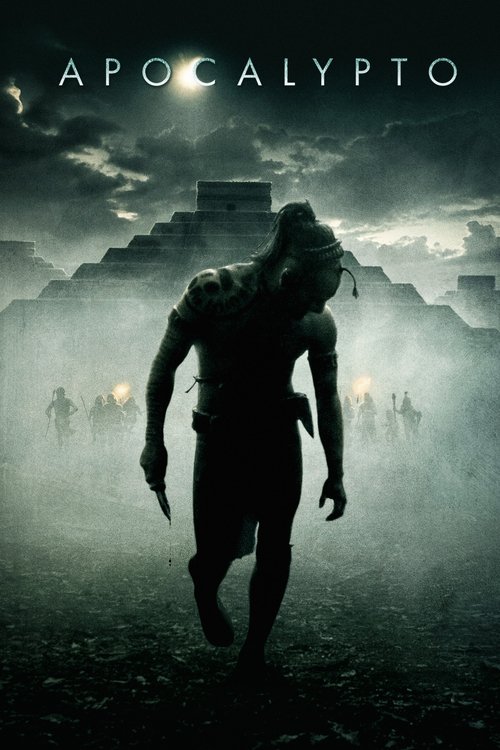
Apocalypto
2006 · Mel Gibson
When you want white-knuckle intensity and total immersion — a subtitled foot-chase through the jungle that plays like an action movie with teeth. Absolutely not for a squeamish night; save it for when you want to be put through it.
What it's about
In the pre-Columbian Maya world, a young forest hunter named Jaguar Paw sees his village destroyed by raiders and is marched in chains toward a decaying city — and the sacrificial pyramid at its heart. Driven by the family he left hidden behind, he seizes one desperate chance to run. Performed entirely in Yucatec Maya by a largely indigenous cast, it's a survival chase staged inside a vanished civilization.
The experience
Relentless — after a deceptively warm opening it becomes one long, escalating pursuit, brutal and often hard to watch, but so kinetically staged you can barely breathe. The violence is real and graphic; the momentum never lets up.
Performances
Rudy Youngblood, a first-time lead heading a cast of non-professional and indigenous actors, carries the film almost wordlessly through sheer physical performance — fear, grief, and animal determination written on his face.
The craft
Mel Gibson stages the chase with ferocious clarity, shooting real jungle with a mobile camera, and the recreated Maya city — teeming, painted, terrifying — is one of the most vivid ancient worlds ever put on film. The commitment to a living indigenous language deepens the immersion rather than distancing you.
Why it matters
Proof that a subtitled film in an ancient language could be a visceral mainstream thriller, it remains the most striking big-screen depiction of the Maya world and Gibson's boldest formal gamble as a director.
Snapshot
Apocalypto is Mel Gibson's third feature as director and the most formally radical: a chase thriller staged entirely within the pre-Columbian Maya world, performed in Yucatec Maya by a cast of largely non-professional and indigenous actors, and presented to audiences with subtitles. Released in December 2006 through Touchstone Pictures, it followed the enormous and divisive success of The Passion of the Christ (2004) and extended that film's wager — that a mass audience would accept a dead or marginal language and an "ethnographic" surface in exchange for visceral immediacy. The narrative is deceptively simple. Jaguar Paw, a young hunter from a forest village, sees his community razed by a raiding party from a decaying city-state; he is marched to that city to be sacrificed atop a pyramid, escapes during a solar eclipse, and is pursued back through the jungle by his captors in a sustained, near-wordless run for survival. Around this primal spine Gibson builds an argument about civilizational rot, signaled by the epigraph he places before the first image — Will Durant's line that "a great civilization is not conquered from without until it has destroyed itself from within." The film is at once a kinetic genre exercise and a polemic, and it remains one of the more contested major studio releases of its decade, admired for its craft and indicted for its history.
Industry & production
Apocalypto was produced through Gibson's Icon Productions and distributed by Touchstone, the Disney label, a more conventional studio arrangement than the self-financed, self-distributed gamble of The Passion. Gibson co-wrote the screenplay with Farhad Safinia, a relative newcomer, and the two developed a project explicitly designed to avoid stars, English dialogue, and the familiar iconography of the historical epic. Production was based in Mexico, principally in the states of Veracruz and around Catemaco, using jungle locations and large purpose-built sets for the Maya city, including pyramid and plaza structures realized at scale. Casting drew heavily on indigenous and Latino performers, many without prior screen experience; the lead, Rudy Youngblood (of Comanche, Cree, and Yaqui descent), was cast as Jaguar Paw after an extended search, with Dalia Hernández, Raoul Trujillo, Gerardo Taracena, and Jonathan Brewer among the principals. The shoot was physically demanding — extensive running, mud, body paint, prosthetics, and practical jungle work — and the production leaned on local crew and Maya-language coaching to drill performers in dialogue most did not speak natively.
The release was overtaken by events outside the frame. In mid-2006, during post-production, Gibson was arrested for drunk driving and made antisemitic remarks to the arresting officers, triggering a public scandal that shadowed the film's marketing and much of its critical reception. The commercial record, by contrast, was solid: the film opened at the top of the domestic box office and performed respectably worldwide against a mid-range budget, confirming again that Gibson could move a subtitled, ultraviolent picture into the multiplex. Exact budget and gross figures are widely reported but vary by source; the safe summary is that it was a clear commercial success relative to its cost.
Technology
Apocalypto is historically notable as one of the first major studio features shot digitally on the Panavision Genesis camera, then a newly introduced high-definition system. The choice was pragmatic as much as aesthetic: digital capture allowed long takes and high shooting ratios in punishing jungle conditions, immediate review of footage, and lighter, more mobile rigs for handheld and running coverage where film magazines would have been cumbersome. It placed the film at the leading edge of the mid-2000s transition from photochemical to digital acquisition on big-budget productions, alongside a small cohort of early Genesis adopters. The digital workflow also fed a substantial digital-intermediate and effects pipeline — set extensions, crowd augmentation for the city sequences, and the eclipse — though Gibson kept the visible effects subordinate to practical sets, makeup, and stunt work. The film's much-noted gore was achieved largely through practical prosthetics and effects, consistent with Gibson's preference for tactile, in-camera brutality over digital abstraction.
Technique
Cinematography
Dean Semler, the Australian cinematographer best known for Dances with Wolves (for which he won an Academy Award) and Mad Max 2, shot the film, and his work negotiates the new digital tool with a classical action sensibility. The palette runs hot and earthen — green canopy, ochre skin, blood, the bleached stone and lurid blues of the city. Semler and Gibson favor handheld and shoulder-mounted camera for the village raid and the long jungle pursuit, generating a propulsive instability, while reserving more composed, frontal staging for the city set-pieces and the sacrificial platform, where the architecture of power is laid out in depth. The Genesis sensor's behavior in low light and dense foliage shaped the look; the film often sits in a humid, slightly desaturated register punctuated by saturated ritual color.
Editing
Cut by John Wright, Apocalypto is structured as a sustained accelerando. The first act establishes village life with relative patience and comic texture; the raid introduces a brutal escalation; the march and the city sequence function as a horrific set-piece; and the final act is essentially one long chase, edited for momentum and spatial clarity over the pursuit's many stages — river, waterfall, quicksand, forest. Wright's cutting keeps the geography of the chase legible, a discipline that distinguishes the film from less coherent action editing of the period, and times the eclipse and the climactic beach reveal as structural turns rather than mere shocks.
Mise-en-scène / staging
The production design is the film's central spectacle: the Maya city, with its painted pyramids, lime-pits, mass graves, and choreographed throngs, is staged as a vision of decadent excess — disease, slavery, ritual slaughter, and crowds rendered as a frenzied mob. Gibson stages the sacrifice sequence as the film's set-piece of horror, with the executioner, the priest, and the crowd organized around the pyramid's vertical axis. Against this, the forest is staged as a more intimate, vertical, trap-laden space. Costume, body modification, scarification, and elaborate makeup do enormous expository work, signaling status, faction, and corruption without dialogue.
Sound
The Yucatec Maya dialogue is itself a sound-design decision as much as a linguistic one: stripped of comprehension for nearly all viewers, speech becomes texture and rhythm, throwing weight onto breath, drums, and ambient jungle sound. James Horner's score blends orchestral writing with ethnic percussion, vocal textures, and indigenous-evoking instrumentation; it is propulsive in the chase and ominous in the city, and like the film it courts a generalized "primitive" sonority rather than ethnomusicological precision. The sound mix foregrounds physical effort — running, breathing, impact — in keeping with the film's bodily emphasis.
Performance
The performances are pitched toward physical presence and expressive immediacy rather than verbal nuance, appropriate to a film whose audience reads faces and bodies before words. Rudy Youngblood carries the picture as Jaguar Paw largely through endurance and reaction; Raoul Trujillo's Zero Wolf supplies a flinty, implacable antagonist; the ensemble of indigenous performers lends the village and city an unfamiliar, non-Hollywood texture that is central to the film's claim of authenticity. Much of the acting is reactive and athletic, shaped by the demands of the chase.
Narrative & dramatic mode
Beneath its ethnographic surface, Apocalypto is built on a thoroughly classical, even archetypal, narrative engine: the captivity-and-escape tale and the chase. Its dramatic mode is mythic rather than psychological — characters are defined by role and action (hunter, father, raider, priest) more than interiority, and the moral scheme is stark. The forest village is coded as harmonious, fertile, and humane; the city as cruel, sick, and doomed. The plot turns on elemental motivations — protecting a pregnant wife hidden in a pit, returning home, revenge — and on portents (a prophetic sick girl, the eclipse) that lend events a fated quality. Gibson, as in Braveheart and The Passion, organizes the drama around suffering, endurance, and deliverance, with the protagonist's body as the site of meaning.
Genre & cycle
The film sits at the crossroads of the historical epic and the survival-chase thriller, with a strong horror inflection in its city sequences. It belongs recognizably to the lineage of the wilderness pursuit film and the "man hunted through the landscape" tradition, while its language-and-subtitle strategy ties it directly to Gibson's own The Passion of the Christ and, more broadly, to a small cycle of prestige films using dead or minority languages for immersive effect. It also participates in a long, fraught Hollywood tradition of jungle and "primitive world" adventure, which is precisely the terrain on which its critics engaged it.
Authorship & method
Apocalypto is a strong auteur statement, continuous with Gibson's directorial signature: extreme corporeal violence framed as ordeal and redemption; a fascination with bygone or alien cultures rendered with surface fidelity and language authenticity; a Manichaean moral architecture; and a virtuoso command of large-scale action staging. His key collaborators reinforce that signature — co-writer Farhad Safinia, who shared the project's conception; cinematographer Dean Semler, bringing epic-action pedigree and early digital expertise; editor John Wright, sustaining the chase structure; and composer James Horner, supplying a driving, percussive score. The method — non-stars, location shooting, indigenous casting, minority-language dialogue, practical brutality, leading-edge digital capture — is consistent and deliberate, a continuation of the Passion experiment transplanted from sacred history to pre-Columbian Mesoamerica.
Movement / national cinema
The film resists easy national placement. It is an American studio production, shot in Mexico, performed in an indigenous Mesoamerican language, with a multinational cast and crew. It does not belong to Mexican national cinema in any meaningful institutional sense, despite its location and personnel, nor to an indigenous film movement, since its authorship and financing are firmly Hollywood. It is best understood as part of a Gibson-driven tendency within 2000s American cinema toward high-budget, language-authentic historical immersion — a tendency without a school, essentially personal to its director.
Era / period
Apocalypto depicts the late Classic-to-Postclassic Maya world on the eve of European contact, closing with the arrival of Spanish ships off the coast. Its historical setting is, however, deliberately unspecific and much disputed. Scholars of Mesoamerica noted that the film's signature horrors — large-scale human sacrifice by heart extraction, mass beheadings, the imagery of a city in collapse — conflate and exaggerate practices, drawing more on popular images associated with the Aztecs than on the documented Maya, and compress centuries and cultures into a single lurid tableau. The terminal image of approaching Spanish vessels frames the entire Maya world as already self-destroying at the moment of conquest, a reading many historians regarded as both inaccurate and ideologically loaded.
Themes
The film's master theme, announced by the Durant epigraph, is internal decay: the conviction that civilizations rot from within before they fall. Fear is its explicit subject — the city runs on terror, and Jaguar Paw's arc is the conquest of fear, marked by his repeated vow not to be afraid and his reclaiming of agency in the forest he knows. Around this cluster nature versus civilization (the wholesome forest against the diseased city), fatherhood, lineage, and home (the wife and unborn child in the pit as the literal stakes of survival), and a cyclical sense of beginnings and endings, captured in the final turn toward the sea and a "new beginning." The film also flirts with apocalypse in the etymological sense its title invokes — an unveiling or revelation — though critics divided sharply over whether its vision of the indigenous past was revelatory or merely a projection of contemporary anxieties about civilizational collapse.
Reception, canon & influence
Critical reception was sharply split and inseparable from its moment. Many reviewers praised the film's sheer craft — its momentum, its immersive design, Semler's photography, the audacity of the language strategy — and it earned awards-season attention in technical categories. Others recoiled from its relentless violence, and a significant body of criticism, led by Mesoamericanist scholars such as Traci Ardren and others, attacked it as historically distorting and, more seriously, as reproducing a colonial narrative in which a savage, self-destroying indigenous civilization is implicitly rescued or relieved by the arriving Europeans. These debates were amplified by the Gibson DUI scandal that broke shortly before release, which colored the film's reception and complicated its commercial and cultural standing.
Looking backward, the film's influences are clear: Gibson's own Braveheart and The Passion of the Christ (for the suffering-body epic and the dead-language strategy), the long tradition of the wilderness chase and captivity narrative, and the visual heritage of Hollywood jungle adventure. Looking forward, its most concrete legacy is technological and tactical — it stands as an early proof of concept for digital acquisition on a major action production via the Panavision Genesis, and as further evidence that subtitled, non-English, language-authentic spectacle could find a mass audience, a lesson visible in subsequent prestige productions that embraced minority or reconstructed languages for immersion. Its scholarly afterlife has been substantial but largely critical: the film became a recurring case study in debates over the ethics of representing indigenous peoples on screen, the politics of historical accuracy in popular cinema, and the limits of "authenticity" as an aesthetic value. That dual legacy — technically pioneering, formally accomplished, and ethically contested — is the most honest summary of where Apocalypto sits in film history.
A Deleuzian reading
Listen to *Apocalypto* before you watch it.
The full Deleuzian reading of Apocalypto →
Reception
Released in late 2006 under the shadow of Gibson's DUI scandal, it was received as a technically stunning but controversial curiosity — Mayan scholars objected to its portrayal of the civilization. Since then it's steadily climbed into 'actually one of the great chase movies' territory, regularly reappraised as visceral, pure-cinema filmmaking.
How Apocalypto was received, from release to now →
Influences: the films it descends from and the films it influenced
- The Passion of the Christ (2004) — Established Gibson's dead-language strategy — casting a full subtitled film in a reconstructed tongue (Aramaic/Latin) — and the suffering-body ordeal framed shot-by-shot as redemptive martyrdom, transplanted here from sacred history to the Maya.
- Braveheart (1995) — Source of Gibson's large-scale practical battle staging and his signature of corporeal violence rendered as moral ordeal, with the camera held on the body in extremis rather than cutting away.
- The Naked Prey (1965) — Provides the literal template for Apocalypto's second half — a captive stripped and released to be hunted across hostile wilderness by a relentless party, his survival measured as one continuous accelerating chase.
- Dances with Wolves (1990) — Shot by Apocalypto DP Dean Semler, it proved subtitled indigenous-language dialogue (Lakota) spoken by a native cast could anchor a mass-audience epic, the exact immersion strategy Gibson extends to Yucatec Maya.
- Aguirre, the Wrath of God (1972) — Model for grueling jungle location shooting and indigenous immersion in which the environment itself becomes antagonist, staging a civilization's hubris as physical descent rather than dialogue.
- Quest for Fire (1981) — Pioneered the wordless prehistoric immersion built on an invented/reconstructed language and performance carried entirely through physical presence and gesture, the same authenticity-as-aesthetic Gibson pursues.
- Deliverance (1972) — Codifies the wilderness survival-chase geography — men pursued through unmapped terrain, the river as both threat and escape route — that structures Jaguar Paw's flight.
- The Last of the Mohicans (1992) — Fuses the captivity-and-chase through dense forest with a driving percussive score, the propulsive rhythm-and-pursuit pairing Horner reprises for Apocalypto's final act.
- Come and See (1985) — Defines the subjective, handheld immersion in atrocity — keeping the camera locked to a single overwhelmed witness so the audience endures violence rather than observes it, the experiential mode Gibson adopts.
- The Mission (1986) — Gibson extends the indigenous-language, jungle-set survival epic shot on location with native casts, inheriting The Mission's commitment to immersive Mesoamerican/South-American physical authenticity.
- Avatar (2009) — Extends the proof that a constructed minority language (Na'vi) plus leading-edge digital capture can sustain immersion for a mass audience, following Apocalypto's lesson that subtitled authenticity is no commercial liability.
- 10,000 BC (2008) — Direct commercial follow — prehistoric chase spectacle built on invented tribal languages and a captivity-rescue arc, chasing the same authentic-ancient-world immersion two years later.
- The Revenant (2015) — Inherits the wilderness captivity-survival ordeal carried by extreme physical-presence performance, natural-light earthen palette and handheld immersion that puts the viewer inside the hunted body.
- Embrace of the Serpent (2015) — Takes the indigenous-language authenticity strategy seriously as ethics rather than spectacle, casting Amazonian native speakers and reconstructed tongues — a corrective answer to the colonial-narrative critique Apocalypto drew.
- Bone Tomahawk (2015) — Replays the rescue-party-into-hostile-wilderness captivity chase, building to deliberate, anatomically graphic brutality presented as ordeal in the same unflinching register.
- The Northman (2022) — Extends surface-fidelity reconstruction of a vanished culture — ritual, language, material detail — as the bedrock of a brutal physical-revenge epic, treating authenticity as the engine of immersion.
- Hacksaw Ridge (2016) — Gibson's immediately prior film perfected sustained handheld physical-ordeal cinema — the body pushed to its limit as the vehicle for spiritual transcendence — establishing the authorial method Hacksaw Ridge applies to a WWII biographical subject without formal interruption.
- Kingdom of the Planet of the Apes (2024) — Models the subtitled, non-English coming-of-age survival chase through jungle and ruins, with calibrated pre-modern vocalization standing in for dialogue.
- Athena (2022) — Builds an entire feature as a propulsive chase-and-pursuit through hostile terrain, sustaining adrenaline through relentless forward movement and physical-stakes choreography over plot.
- Beasts of No Nation (2015) — Its all-non-professional indigenous cast and sustained subjective chase through visceral jungle violence model the propulsive first-person survival staging Beasts uses on the march.
- Bāhubali: The Beginning (2015) — Sustains feature-length subtitled dialogue in a language no audience speaks, carrying antagonist menace through phonetics and performance rather than semantics — precisely the device of the Kalakeya's Kiliki scenes, and the source of the same representational problem.
- The New World (2005) — Contemporary pre-contact project pursuing indigenous-language authenticity and immersion in a doomed first-encounter world, the lyrical inverse of Gibson's kinetic treatment of the same historical threshold.
- Master and Commander: The Far Side of the World (2003) — Pursues total period immersion as visceral, naturalistic chase at the edge of a vanishing world, prizing embodied authenticity over expository historical framing.
- RRR (2022) — Its sinewy, forward-driving chase choreography through hostile wilderness is a cousin to Bheem's jungle-hunt introduction and the raw kinetic-body action style.
- I Dream in Another Language (2017) — Performs an entire feature in a reconstructed indigenous tongue (Yucatec Maya) with immersive subtitling and jungle-green figures-in-landscape — full spoken-language immersion as formal principle.
Similar films
- Aguirre, the Wrath of God (1972) — influence & lineage · same viewing thread
- The Passion of the Christ (2004) — influence & lineage · often watched together
- The Revenant (2015) — influence & lineage · often watched together
- Come and See (1985) — influence & lineage · same viewing thread · often watched together
- Braveheart (1995) — influence & lineage
- Avatar (2009) — influence & lineage
- Deliverance (1972) — influence & lineage · same viewing thread
- Mad Max 2 (1981) — same viewing thread
All the films related to Apocalypto →
Watch it with: curated runs of related films
- Into the Heart of Darkness — A run of grueling journeys into hostile country — jungle, ice, desert, occupied forest — where the ordeal strips men down to something primal, hallucinatory, and often unrecoverable.