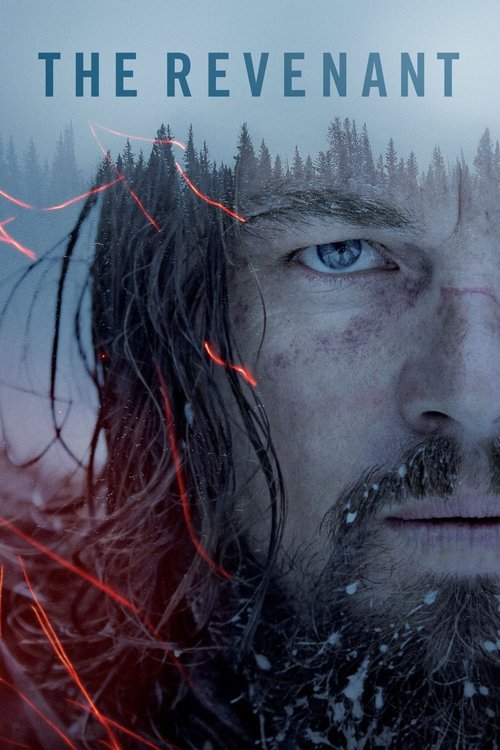
The Revenant
2015 · Alejandro G. Iñárritu
For when you want to be put through something — a full-body cinema experience rather than a cozy watch. Save it for a night when you have the stamina, ideally on the biggest, loudest setup you have.
What it's about
In the 1820s American frontier, fur trapper and scout Hugh Glass is mauled by a grizzly and left for dead in the winter wilderness by a man he trusted his son's safety to. What follows is an odyssey of pure survival: Glass crawling, freezing, and fighting his way across hundreds of hostile miles, driven by grief and the promise of revenge. Loosely based on a documented 1823 ordeal.
The experience
Punishing and immersive — you feel the cold in your teeth. It's less a plot than an endurance ritual, hypnotic in stretches and viscerally intense in others; the bear attack alone is one of the most harrowing sequences in modern cinema.
Performances
Leonardo DiCaprio gives a nearly wordless, physically extreme performance — eating, freezing, and suffering for real on camera — that finally won him his Oscar. Tom Hardy is just as good as Fitzgerald, a mumbling, self-justifying survivor whose menace feels disturbingly practical.
The craft
Emmanuel Lubezki shot the entire film in natural light, and it shows: dawn and dusk skies, breath fogging the lens, long flowing takes that put you inside the chaos. Made under famously brutal real-winter conditions, it's one of the great arguments for seeing a film big and loud.
Why it matters
It won Oscars for Iñárritu and Lubezki, ended the long-running joke about DiCaprio's Academy drought, and pushed the industry conversation about how far immersive, location-based filmmaking can go.
Snapshot
A punishing, visionary survival epic set in the early American frontier, The Revenant follows Hugh Glass (Leonardo DiCaprio), a fur trapper and scout who, after being savaged by a grizzly bear and left for dead by a treacherous companion named John Fitzgerald (Tom Hardy), drags himself across hundreds of miles of hostile wilderness on a mission of vengeance. Loosely adapted from Michael Punke's 2002 novel of the same name—itself dramatizing the documented 1823 ordeal of a real frontiersman—the film is as much an immersive sensory experience as a narrative: a meditation on survival, grief, Indigenous sovereignty, and the American continent as a force that dwarfs and indifferent to human drama. Shot entirely in natural light by Emmanuel Lubezki and produced under conditions of extraordinary physical and logistical difficulty, it became one of the defining productions of the 2010s.
Industry & Production
The Revenant was produced by New Regency Productions and distributed by 20th Century Fox, with a reported production budget of approximately $135 million—a figure that swelled considerably beyond initial projections due to the film's uncompromising location demands. Principal photography began in October 2014 in Alberta, Canada, before relocating to British Columbia; when the Canadian winter proved insufficiently snowy in 2015, the production relocated to Ushuaia, Argentina, at the southern tip of Patagonia. The shoot lasted approximately nine months in total—roughly twice the length originally planned.
By most accounts, the production was one of the most grueling in recent Hollywood memory. Key crew members departed mid-shoot; Iñárritu's refusal to use artificial lighting or controlled studio conditions placed extraordinary demands on cast and crew, who endured sub-zero temperatures, remote access, and shifting natural light windows that left only narrow daily shooting opportunities. That the film exists at all is a testament to the commitment—some would say obsession—of its director and cinematographer.
The film grossed approximately $533 million worldwide, representing a considerable commercial success for a film of its difficulty and running time (156 minutes). DiCaprio's long-anticipated Academy Award win generated significant popular attention, and the film received twelve Oscar nominations, winning three: Best Director (Iñárritu), Best Actor (DiCaprio), and Best Cinematography (Lubezki). It did not win Best Picture; that award went to Spotlight at the 88th Academy Awards.
Technology
The Revenant represents one of the most consequential deployments of large-format digital cinematography in prestige filmmaking. Lubezki shot primarily on the Arri Alexa 65, a large-format sensor camera capable of capturing exceptional detail and tonal range in low-light conditions. This choice was inseparable from the film's governing aesthetic principle: every shot was lit exclusively by available natural light—sunlight, firelight, and ambient sky. No supplemental artificial lighting was used on location.
The Arri 65's enlarged sensor, combined with Lubezki's preference for wide-angle lenses in the 12mm–14mm range (frequently the Leica Summilux-C series), produced the film's characteristic visual grammar: extreme depth of field, immersive field of view that curves toward the periphery, and faces pressed so close to the lens that the viewer occupies the same spatial plane as the subject. The effect is of being inside the landscape rather than observing it from outside.
The bear attack sequence—among the most technically ambitious set pieces in recent cinema—combined performance-capture, digital animation (handled largely by Industrial Light & Magic), and practical stunt work. DiCaprio performed against a partial physical rig and stand-in elements, while the bear itself was constructed in postproduction. The seamlessness of the integration was widely noted as a benchmark in creature visualization.
Costume designer Jacqueline West's period-accurate fur and leather work, combined with practical environment work on the locations, anchored the film's hyperrealist texture, ensuring that the technology never reads as abstraction.
Technique
Cinematography
Lubezki's cinematography in The Revenant extends and radicalizes his prior natural-light work with Terrence Malick (Days of Heaven was his model; The New World and The Tree of Life his more immediate precursors). The wide-angle, long-take aesthetic he had developed on Birdman (2014) is here applied to a wholly different emotional register: where Birdman used the approach for claustrophobic theatrical anxiety, The Revenant deploys it to achieve sublime exposure.
Shots are composed to make the human figure small within the frame—a speck beneath a canopy of bare cottonwoods, a stumbling silhouette against a white horizon—while simultaneously pressing the camera uncomfortably close to that same figure in close-up. This oscillation between cosmic vastness and suffocating proximity is the film's central cinematographic tension. The camera moves fluidly, often circling action in long arcs or pushing forward through undergrowth, rarely cutting when it can instead find the next beat through movement. The golden-hour light that so often bathes the landscape gives the wilderness a deceptive, almost Edenic beauty that comments ironically on the violence being transacted beneath it.
Editing
Editing on The Revenant was handled by Stephen Mirrione, a long-term Iñárritu collaborator (he has edited every Iñárritu feature from Amores Perros onward). The edit respects the integrity of Lubezki's long takes while also structuring Glass's ordeal into a rhythm of ordeal-and-vision: waking consciousness alternates with dreamlike flashback sequences of Glass's deceased Pawnee wife (Grace Dove), and these transitions are handled with impressionistic fluidity rather than conventional clarity. The pacing is deliberately slow and durational—the film refuses the acceleration typical of action-survival narratives—which places unusual demands on the viewer and has divided critical opinion.
Mise-en-Scène / Staging
Iñárritu stages the film's violence with an anti-choreographic rawness: the bear attack, the opening ambush sequence, and the film's various brutal hand-to-hand encounters are characterized by spatial disorientation, interrupted sightlines, and the refusal to cut away at moments of impact. The staging prioritizes physical truth—the ungainliness of bodies in struggle, the difficulty of motion in heavy snow—over aesthetic legibility. This approach is consistent across the film: Glass's survival is staged as physical labor rather than heroic spectacle. He does not look good doing any of it.
The use of the frontier environment as a staging element—the river crossings, the horse carcass shelter, the descent through ice-crusted rapids—integrates landscape directly into dramatic action rather than treating it as backdrop. The physical world is an active antagonist as much as Fitzgerald.
Sound
The sound design is one of the film's most underappreciated achievements. Supervising sound editor Martin Hernandez (a frequent Iñárritu collaborator) constructed a sonic environment of extraordinary density and precision: the granular crunch of snow underfoot, the wet labor of Glass's breathing, the creak of frozen trees, wind as a constant low presence. Ambient sound is elevated to near-musical status, and the film frequently lets these environmental textures carry sequences that another film would score.
Ryuichi Sakamoto composed the score in collaboration with electronic musician Alva Noto, with additional contributions from guitarist Bryce Dessner. The music is sparse, slow, and tonal—long sustained strings and electronic drones that hover at the edge of perception. It functions less as emotional commentary than as extension of the soundscape, deepening the film's atmosphere without directing the viewer's feeling. This restraint is deliberate and notable; a lesser film would have scored Glass's suffering more heavily.
Performance
DiCaprio's performance is overwhelmingly physical—a body pushed to and past its apparent limits. The role requires sustained endurance acting in genuinely harsh conditions, and DiCaprio locates Glass's will-to-survive less in psychology than in animal instinct. The famous sequences of DiCaprio eating raw bison liver, submerging himself in frozen rivers, and crawling through mud are not stunts in the conventional sense; they are performances of physical fact. The performance was widely credited as the culmination of DiCaprio's career-long project of physical transformation in service of character.
Tom Hardy's Fitzgerald is a more complex acting proposition: his performance is deliberately opaque, his motivations buried beneath a regional accent and physical guardedness. Hardy works against the grain of clear villainy, rendering Fitzgerald comprehensible (if not sympathetic) in his ruthless pragmatism.
Narrative & Dramatic Mode
The Revenant operates simultaneously as a genre picture (the revenge Western, the survival film) and as a meditation that repeatedly interrupts genre momentum with visionary sequences. Glass's visions of his wife and the ruined mission church punctuate the forward drive of the revenge plot, pulling the film toward the register of spiritual fable. This doubling of modes—durational realism and lyric vision—is the film's most distinctive narrative characteristic and the source of both its admirers' enthusiasm and its detractors' frustration.
The narrative withholds conventional psychological interiority from Glass; we learn little about him beyond what shapes his immediate situation. The film trusts physical action and environmental context to carry the dramatic weight. This is Malickian in method, though Iñárritu's temperament is more visceral and less transcendent than Malick's.
Genre & Cycle
The Revenant belongs to a wave of revisionist Westerns produced in the first two decades of the twenty-first century that interrogate the myth of westward expansion through attention to its costs: Indigenous displacement, ecological violence, the contingency of survival. Dead Man (Jarmusch, 1995), The Assassination of Jesse James by the Coward Robert Ford (Dominik, 2007), True Grit (Coens, 2010), and Bone Tomahawk (Zahler, 2015) form part of the same reconsideration, though The Revenant is distinguished by its scale and its sustained treatment of Arikara characters as political and narrative agents.
The film's treatment of Indigenous peoples—while considerably more complex than the classical Western tradition's erasure—received critical scrutiny from scholars and Indigenous commentators. The Arikara chief Elk Dog (Duane Howard) and the Pawnee character Hawk (Forrest Goodluck), Glass's son, are given substantial screen time and the film uses their languages (consultants worked on Arikara and Lakota linguistic accuracy), but questions were raised about the extent to which Indigenous sovereignty remains subordinated to a white protagonist's story of personal grief.
Authorship & Method
Alejandro G. Iñárritu's cinema from Amores Perros (2000) through Babel (2006) was defined by multi-strand narrative architecture, hyperkinetic editing, and a sociological scope. Biutiful (2010) marked a turn toward more focused, single-protagonist work. Birdman (2014) introduced his collaboration with Emmanuel Lubezki and a new formal vocabulary: the single-take aesthetic, natural-light immersion, a cinema of bodily and psychological exposure.
The Revenant deepens that collaboration to an almost total identification. Lubezki's third consecutive Oscar for Best Cinematography (Gravity, Birdman, The Revenant) represented an unprecedented achievement and testified to how central his eye has been to the film's meaning. The screenplay, co-written by Iñárritu and Mark L. Smith, departs significantly from Punke's novel—most notably in giving Glass an Indigenous son (invented) and in radicalizing the landscape as quasi-metaphysical presence.
Iñárritu's method on set is documented as intensely collaborative and simultaneously autocratic: he maintains strict control over visual conception while allowing and demanding physical improvisation from actors. His direction of DiCaprio reportedly involved refusing to script dialogue for certain sequences, demanding authentic physical response to environment instead.
Movement / National Cinema
The Revenant is a production in the American prestige tradition, financed and distributed by a major studio, but it is directed by a Mexican filmmaker whose sensibility sits athwart Hollywood convention. Iñárritu is one of the "Three Amigos" of Mexican cinema—alongside Alfonso Cuarón and Guillermo del Toro—who emerged from the Mexican art-cinema world of the 1990s and reshuffled the hierarchies of American filmmaking in the 2000s. His win for back-to-back Best Director Oscars (unprecedented) consolidated this group's dominance in the prestige sphere and raised genuine questions about authorship, national cinema, and what "American film" means in a globalized industry.
The film itself is set in American space but largely shot in Canada and Argentina, crewed internationally, and steeped in a sensibility toward landscape and suffering closer to European art cinema than to Hollywood genre product.
Era / Period
The Revenant is positioned at the apex of the mid-2010s prestige epic cycle, a period defined by studios' willingness to back expensive auteur-driven single-director spectacles—Gravity, Interstellar, Mad Max: Fury Road, The Revenant itself—as both commercial and awards-season propositions. It also arrives at a moment of intensifying cultural scrutiny of frontier mythology and colonial history in American popular culture. The film's formal extremism—its refusal of comfort, its durational demands—situates it within a prestige market that had learned, following The Tree of Life's 2011 Palme d'Or, that difficulty could be commercially packaged.
Themes
The Revenant is organized around several interlocking thematic concerns. Survival—the body's sheer insistence on continuing—is the film's most immediate subject; the screen time devoted to Glass's physiological endurance is unprecedented in mainstream cinema. But survival is also framed spiritually: the Pawnee medicine man Hikuc tells Glass that "revenge is in the creator's hands," and the film's closing image and Glass's final look into the camera suggest that vengeance, once achieved, empties rather than restores.
Father-son grief—Glass's relationship to his murdered son Hawk—drives the emotional engine beneath the survival plot and gives the film its only access to interiority. The visions of Glass's wife, framed in a ruined church overgrown with trees, suggest the interpenetration of the sacred and the natural, the human and the ecological.
At a broader level, The Revenant engages American origins: the fur trade as the violent economic foundation of westward expansion, the relationship between European settlers and Indigenous nations as one of systematic dispossession, and the American land itself as neither welcoming nor indifferent but as something more like a witness—sublime, vast, and permanently marked.
Reception, Canon & Influence
Critical reception was strongly positive but not unanimous. Many critics admired the film's formal ambition, Lubezki's cinematography, and DiCaprio's performance while expressing reservations about the narrative's thinness and what some perceived as Iñárritu's grandiosity. Variety, The Guardian, and The New York Times gave it strong reviews; certain critics found its philosophical aspirations unearned by its screenplay.
Influences on the film (backward): The debts are substantial and legible. Terrence Malick's entire oeuvre—especially Days of Heaven (1978) and The New World (2005), both shot by Lubezki and both organized around landscape as spiritual medium—is the most pervasive influence. Werner Herzog's Aguirre, the Wrath of God (1972) and Fitzcarraldo (1982) shadow the project in their treatment of the jungle/wilderness as arena for the collision of European ambition and natural force. Andrei Tarkovsky's long takes, elemental imagery, and spiritual interiority (especially Stalker and Andrei Rublev) inform the film's visual philosophy. Néstor Almendros's natural-light work on Days of Heaven is the direct cinematographic ancestor; Lubezki has acknowledged this lineage explicitly.
Legacy and forward influence: The Revenant accelerated several trajectories in prestige filmmaking. Lubezki's three consecutive Oscar wins crystallized natural-light, large-format digital cinematography as the dominant aesthetic of prestige spectacle in the mid-2010s. The film's immersive, physically committed approach to historical survival narratives influenced subsequent productions; its use of Indigenous language and consultation, while contested, contributed to an ongoing conversation about representation in frontier-set film that continued into works like Hostiles (Scott Cooper, 2017) and Killers of the Flower Moon (Scorsese, 2023). The bear attack sequence is regularly cited as a benchmark in digital creature integration.
Most durably, The Revenant established—or confirmed—that Iñárritu and Lubezki's collaboration represented one of the defining director-cinematographer partnerships of contemporary cinema, capable of bending the machinery of studio production toward a personal and uncompromising formal vision.
A Deleuzian reading
The breath comes first.
The full Deleuzian reading of The Revenant →
Reception
Arrived as the loudest Oscar campaign of its decade — 12 nominations and the 'Leo finally wins' coronation — but the years since have cooled it into 'stunning to look at, exhausting to sit through,' with the suffering-as-awards-bait critique now the default take.
How The Revenant was received, from release to now →
Influences: the films it descends from and the films it influenced
- Days of Heaven (1978) — Néstor Almendros's magic-hour-only available-light cinematography is the explicit technical ancestor Lubezki has named; its grammar of landscape-as-spiritual-medium in natural light is the foundation The Revenant digitally scales into large-format.
- The New World (2005) — Lubezki's prior Malick collaboration first deployed ultra-wide-angle Steadicam immersion in colonial wilderness with lyric vision sequences interrupting a survival-and-contact narrative—the identical structural and visual vocabulary The Revenant transplants into genre filmmaking.
- The Tree of Life (2011) — Lubezki's ultra-wide natural-light digital photography and the film's impressionistic free-association editing—intercutting subjective vision with narrative present—is the immediate formal laboratory for The Revenant's flashback and vision-sequence architecture.
- The Thin Red Line (1998) — Malick's precedent of interrupting a genre survival narrative with lyric first-person narration and elemental landscape shots that reframe combat as spiritual inquiry pioneers the lyric-vision-interruption mode The Revenant inherits and deepens.
- Aguirre, the Wrath of God (1972) — On-location jungle cinematography in which the environment's physical extremity becomes the film's formal texture, establishing landscape-as-antagonist as a mode where wilderness devours European colonial ambition—the staging logic Iñárritu applies to the American frontier.
- Fitzcarraldo (1982) — The production philosophy of collapsing actor ordeal into character ordeal—Kinski and the crew's real danger becoming the film's formal substance—makes physical suffering the performance medium rather than its simulation, which Iñárritu explicitly extends with DiCaprio.
- Stalker (1979) — Durational long takes in elemental outdoor environments—mud, water, ash—used as the formal mechanism for spiritual interiority, establishing the grammar of slow landscape immersion as a conduit for altered psychological states that The Revenant's pacing architecture inherits.
- Andrei Rublev (1966) — The historical epic as endurance-performance vehicle, with medieval violence staged in anti-choreographic, muddy, unglamorous physicality and landscape functioning as an active moral force—the template for The Revenant's revisionist-epic register and its refusal of heroic choreography.
- Birdman or (The Unexpected Virtue of Ignorance) (2014) — The immediate precursor in which Iñárritu and Lubezki established their core collaborative vocabulary: natural-light long-take cinematography, a cinema of psychological and bodily exposure, and systematic refusal of classical shot-reverse-shot grammar that The Revenant then pushes into wilderness spectacle.
- Gravity (2013) — Lubezki's ARRI Alexa large-format digital work—particularly the extended single-shot survival sequences in an extreme environment—established the technical pipeline and sensor philosophy that The Revenant directly inherits, earning Lubezki back-to-back Oscars bridging the two films.
- McCabe & Mrs. Miller (1971) — Emmanuel Lubezki's natural-light, low-contrast photography — achieved without artificial sources in cold outdoor environments — directly echoes Zsigmond's McCabe work; the figure of a man dying slowly in a hostile winter landscape while the surrounding world conducts its commerce indifferently repeats McCabe's final movement as its structural premise.
- Master and Commander: The Far Side of the World (2003) — Extends M&C's handheld-embedded camera in natural light and its theme of nature's brutal indifference into a punishing, weather-beaten survival realism.
- Hostiles (2017) — Revisionist frontier western incorporating Native American language, on-reservation consultation, and a landscape austerity in direct post-Revenant dialogue, part of the lineage the film opened around Indigenous representation and unglamorous physicality in prestige westerns.
- Killers of the Flower Moon (2023) — Structures an American historical epic around Indigenous interiority and colonial dispossession as its moral center—Osage perspective reframing the frontier narrative—extending the representational conversation The Revenant accelerated about whose story the genre is authorized to tell.
- 1917 (2019) — The immersive continuous-take survival epic in extreme terrain descends directly from the Birdman/Revenant demonstration that long-take spectacle could sustain a studio-scale narrative, transposing the grammar of landscape-as-antagonist from frontier wilderness to WWI trenchscape.
- Wind River (2017) — Lubezki's 35mm anamorphic shooting of extreme winter wilderness — light-source discipline, patient wide frames, landscape treated as collaborator rather than backdrop — established the market vocabulary Ben Richardson's Wind River cinematography explicitly builds on.
- Okja (2017) — Established the Alexa 65 workflow Khondji inherits — large-format capture in available and low natural light — which is what lets Okja's CG body hold skin detail and atmospheric depth in the same frame as an actor without a lighting cheat.
- The Power of the Dog (2021) — Revisionist western using wide-angle landscape photography (Ari Wegner) as psychological and spiritual medium, demythologizing frontier masculinity through the same arid-landscape-as-antagonist grammar that The Revenant applies to winter wilderness and colonial trauma.
- The Lighthouse (2019) — Endurance performance in an elemental environment-as-antagonist, with dense environmental sound texture dominating over score and physical ordeal deployed as the formal strategy for psychological disintegration—parallel craft logic to The Revenant's bear-country isolation.
- Annihilation (2018) — Landscape as a quasi-metaphysical devouring entity that physically rewrites the protagonist's body and identity, with sparse electronic score submerged in dense environmental sound texture—the landscape-as-antagonist-with-lyric-vision structure transposed into a science-fiction register.
- Train Dreams (2025) — Shares Bryce Dessner's spare co-composed score and natural-light landscape photography that dwarfs the human figure amid the violence of frontier 'progress.'
- True Grit (2010) — Lubezki's natural-light-only photography, explicitly eschewing golden-hour warmth for harsh blue-gray winter light, extends the anti-golden-hour methodology Deakins deployed in True Grit; both films also frame the revenge drive as a morally exhausting rather than satisfying process against desolate American wilderness.
- All Quiet on the Western Front (2022) — Emmanuel Lubezki's large-format natural-light anamorphic cinematography — using only available light in extreme conditions, the wide-angle lens pressed into bodies that fill the frame — combined with DiCaprio's physicalized somatic-depletion performance establishes the contemporary model Friend's approach updates; both cinematographers use the large format not for spectacle but to make the body's suffering materially legible.
- The Hateful Eight (2015) — Part of the same 2015 large-format prestige Western moment: Emmanuel Lubezki's 65mm-digital-large-format exhibition strategy and the Western as site for interrogating American violence — both films marked a simultaneous critical rediscovery of format as meaning-making device rather than novelty.
- Dunkirk (2017) — Lubezki's IMAX-equivalent natural-light photography and DiCaprio's largely wordless physical performance built the prestige case that survival cinema could dispense with conventional dramatic scaffolding; co-established, in the same two-year window as Dunkirk, a market category for dialogue-minimal experiential cinema at awards scale.
- Society of the Snow (2023) — Lubezki's natural-light-only cinematography in snow and extreme cold — practical outdoor shooting without artificial illumination — is the direct industrial precedent Pedro Luque responds to in Society of the Snow's natural-light-priority, desaturated high-altitude palette.
- Lone Survivor (2013) — Shares the physical-endurance survival aesthetic — the body brutalized by hostile wilderness, immersive in-the-action camera following falls and collisions — as a contemporary peer in punishing on-location realism.
- Dune: Part Two (2024) — Greig Fraser's contemporary peer in natural-hard-light, available-light wilderness capture; the naturalistic-light blockbuster ethos Fraser carries into Arrakis's unforgiving sun.
- Kingdom of the Planet of the Apes (2024) — Shares the available-light, large-format wilderness shooting that the capture units mimic to keep digital apes embedded in photographically real landscapes.
Similar films
- The New World (2005) — influence & lineage
- Aguirre, the Wrath of God (1972) — influence & lineage
- Braveheart (1995) — same viewing thread
- Andrei Rublev (1966) — influence & lineage · often watched together
- Stalker (1979) — influence & lineage · often watched together
- Annihilation (2018) — influence & lineage · often watched together
- Shutter Island (2010) — often watched together
- 12 Years a Slave (2013) — often watched together
All the films related to The Revenant →
Watch it with: curated runs of related films
- Against Overwhelming Force — A run for when you want scale and physical punishment — men set against armies, tanks, and the frozen wild, holding a line that by rights should have broken them.