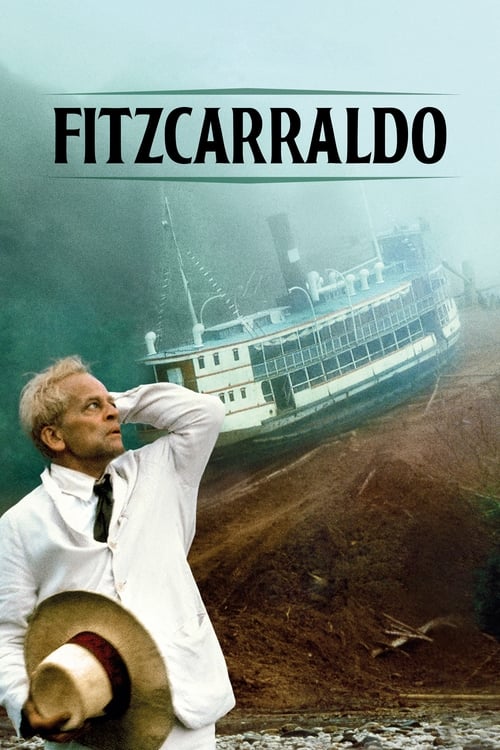
Fitzcarraldo
1982 · Werner Herzog
For when you want to watch obsession taken to its absolute limit — a film to gawk at and argue about afterward. This is an expedition, not a cozy night in; give it your full attention and a free evening.
What it's about
In turn-of-the-century Amazonia, an Irish dreamer nicknamed Fitzcarraldo is possessed by one idea: build an opera house in the jungle city of Iquitos. To pay for it, he hatches a scheme to reach an untouched rubber territory — which requires hauling a full-sized steamship over a mountain between two rivers, with the help of the indigenous people whose land he's crossing.
The experience
Hypnotic and slightly mad — long stretches of river, jungle, and opera swell toward a spectacle you can hardly believe you're seeing. It's funny, exhausting, and genuinely awe-inspiring, because you know none of it is faked.
Performances
Klaus Kinski is unforgettable as Fitzcarraldo — wild-eyed, grinning, teetering between visionary and lunatic — a performance whose off-the-rails intensity is inseparable from the film's legend.
The craft
Werner Herzog actually did it: a 320-ton steamship dragged over a jungle ridge with no models, no miniatures, no effects — the camera simply records the impossible happening. That documentary reality gives every frame a weight no digital spectacle can match, and the jungle photography and swelling opera music turn the whole thing into a fever dream. See it big if you ever get the chance.
Why it matters
The film and its infamous production became one of cinema's great legends — a byword for directorial obsession mirroring its own story — and cemented Herzog's reputation as the filmmaker who refuses to fake anything.
Snapshot
A haunted Irish dreamer in turn-of-the-century Amazonia schemes to build an opera house in the jungle city of Iquitos, and to finance it he plots to harvest rubber from a territory accessible only by hauling a 320-ton steamship over a steep ridge between two rivers — using the labor of the Campa (Ashaninka) people and an improvised system of block-and-tackle. Herzog filmed the mountain-crossing without models, scale replicas, or optical effects: the ship goes over the hill because it goes over the hill. The gap between that fact and the rest of cinema is the film's permanent claim on the imagination.
Industry & production
Fitzcarraldo was produced under Werner Herzog Filmprodukt with co-financing from the West German television network ZDF and the support of producer Lucki Stipetic (Herzog's brother-in-law), who managed a production that became one of the most protracted and dangerous in postwar European filmmaking. The casting history alone constitutes a sub-plot: Jason Robards was originally cast in the title role and completed roughly forty percent of principal photography before severe amoebic dysentery forced his withdrawal. Mick Jagger, who had been cast in a supporting role as Fitzcarraldo's companion Wilbur, departed when his touring commitments made continuation impossible. Herzog then recast the film entirely with Klaus Kinski — their fourth collaboration — and reshot everything from the beginning.
A secondary production crisis struck when the initial jungle location, selected near the Peru-Ecuador border, had to be abandoned after Aguaruna indigenous communities issued threats against the cast and crew (reportedly including a specific threat against Kinski's life), and because intermittent armed conflict in the region made the area too dangerous. The entire operation relocated several hundred kilometers deeper into the Peruvian Amazon, near the Urubamba River. Les Blank, the American documentary filmmaker, was present for much of the production and made Burden of Dreams (1982) concurrently — a film that has since become one of the essential documents of filmmaking under extreme conditions and a canonical text on Herzog's methods. Herzog himself kept journals throughout, eventually published in English translation as Conquest of the Useless (2004, German; 2009 in English), which offers an unfiltered account of hallucination, logistical despair, and obsessive purpose. The production ran roughly from 1979 to 1982.
Technology
The film's central technological fact is its refusal of miniature or photographic trickery. To move the steamship — a vessel weighing in the neighborhood of 320 tons — up and over a forty-degree slope, the production built an elaborate pulley-and-cable apparatus and employed hundreds of local workers over several months. The process was both genuinely dangerous (several workers were injured; at least one fatality is documented in some accounts, though precise figures are contested in the record) and geologically destructive to the hillside. This literalism was not merely a stunt: it was a philosophical position for Herzog, who has repeatedly articulated his conviction that the cinema requires what he calls "ecstatic truth" — an intensity of physical reality that transcends documentary accuracy and achieves something larger. The ship's passage over the ridge is not a symbol of anything so much as it is an act, and the camera's job is to bear witness to the act.
Beyond the ship sequence, the production made use of location sound recording in conditions that consistently threatened equipment — humidity, flooding, and the general hostility of the rainforest to electronics. This presented significant post-production challenges in sound mixing. The film was shot on 35mm. Color grading, by the standards of 1982 analog photochemical processing, was handled conventionally; the Amazon's palette of green, brown, and the white of river mist required no augmentation.
Technique
Cinematography
Thomas Mauch, who had shot Aguirre, the Wrath of God (1972) and Even Dwarfs Started Small (1970) with Herzog, served as director of photography. His approach to the Amazon is characteristically unrhetorical: wide shots that establish the river and the jungle as genuinely vast rather than decoratively exotic, and close work on Kinski's face that neither flattens his intensity nor stylizes it. The pivotal ship sequence is filmed with a matter-of-factness that heightens rather than diminishes its absurdity — the camera does not reach for the sublime; the sublime arrives because the event is real. Handheld work is used sparingly, reserved for moments of crowd movement or instability aboard the vessel. The dominant grammar is observational and slow, with long takes that allow the environment to fill in around the human drama.
Editing
Beate Mainka-Jellinghaus, Herzog's regular editor through much of this period (she had cut Aguirre, The Enigma of Kaspar Hauser, and Stroszek), assembled the film. Her rhythm is unhurried in a way that signals European art cinema rather than genre adventure: sequences breathe, pauses are respected, and the film permits itself the full 158 minutes of its theatrical cut. The cutting seldom works against the actors or the landscape; it tends instead to find the moment when an image has said what it can say and then release it.
Mise-en-scène / staging
Staging under these production conditions was necessarily improvisational. Kinski's notorious volatility — documented with forensic precision in Herzog's later essay-memoir film My Best Fiend (1999) — meant that the mise-en-scène often had to absorb rather than direct his performance energy. What Herzog achieved is a kind of managed unpredictability: Fitzcarraldo moves through the film like a man who has confused the internal and external worlds, and the staging reinforces this by placing him consistently at the edge of frame or at the boundary between civilized space (the ship's cabin, the opera house stage) and the uncontrolled jungle. The gramophone on the ship's prow — through which Caruso arias drift across the river toward the Campa people on the banks — is the film's most purely theatrical staging gesture, and one of its most complicated, given the colonial dynamics it embodies.
Sound
Sound is the film's deepest formal obsession. Herzog counterpoints the acoustic chaos of the Amazon — insects, water, bird calls, the mechanical groaning of cables under stress — against the pristine recorded voice of Enrico Caruso, heard through a gramophone's mechanical horn. The effect is genuinely strange: a nineteenth-century Italian tenor's voice floating into the jungle in the twentieth century, mediated by shellac and a spring motor. Popol Vuh, the German experimental band led by keyboardist Florian Fricke, composed additional score material, continuing the collaboration they had sustained across multiple Herzog films (Aguirre, Heart of Glass, Nosferatu). Fricke's characteristic combination of synthesizer, ethnic instrumentation, and ecclesiastical atmosphere complements but does not compete with the Caruso recordings. The film's sound design understands that silence — relative silence, the cessation of the gramophone, the pause in the engine — can be its most expressive register.
Performance
Kinski's Fitzcarraldo is megalomaniacal and genuinely tender in roughly equal measure, a combination that Kinski was uniquely equipped to produce by virtue of what appears, on the record, to have been a genuinely unstable psychology. He plays the character's grandiosity without irony and his vulnerability without sentimentality. Claudia Cardinale as Molly, the brothel madam who finances Fitzcarraldo's dreams and loves him with patient exasperation, delivers a performance of considerable warmth and credibility that is often undervalued in discussion of the film, which tends to collapse into analyses of Kinski and Herzog.
Narrative & dramatic mode
The film operates in the mode of the heroic-absurdist fable. Fitzcarraldo's scheme is objectively insane, and the film knows this, but it extends to him — and to his dream — a kind of operatic seriousness that refuses ridicule. The narrative structure is episodic rather than conventionally dramatic: obstacles accumulate (hostile territory, the sheer physical impossibility of moving the ship) without resolving into a conventional climax. The ending, in which the indigenous workers cut the ship's mooring cables and send it through the rapids while an onboard phonograph plays, destroying the rubber plan but providing Fitzcarraldo with an unexpected operatic moment on the river, is neither triumphant nor tragic in any orthodox sense. It is, characteristically for Herzog, something for which ordinary dramatic categories are insufficient.
Genre & cycle
The film is in formal dialogue with the Hollywood adventure epic and with the tradition of the colonial jungle film (John Huston's The African Queen, 1951, is an obvious touchstone, and Herzog has acknowledged it), but it systematically refuses those genres' teleological satisfaction. Where Hollywood adventure films build toward the mastery of nature or the accomplishment of the mission, Fitzcarraldo ends in a kind of lateral swerve — the ship goes through the rapids, the dream is compromised, and yet something is achieved that cannot be named in practical terms. It belongs more naturally to the lineage of European art cinema's interrogation of the adventure narrative alongside films like Apocalypse Now (1979) and Aguirre itself.
Authorship & method
Herzog's authorial signature is inseparable from what critics and scholars have termed his "documentary of the extreme": the pursuit of situations so physically demanding or psychologically vertiginous that the camera becomes a witness to something unprecedented. His stated aesthetic doctrine of "ecstatic truth" — the conviction that factual accuracy alone cannot produce cinematic truth, but that the staging of physically real, extreme events can — reaches its fullest expression here. The decision to actually move the ship is the filmmaking equivalent of a philosophical position.
Popol Vuh's Florian Fricke functions as a near-collaborator of authorial significance across the Herzog films of this period; the textural relationship between his scores and Herzog's images is so consistent as to constitute a joint sensibility. Mauch's cinematography similarly extends a visual grammar established in Aguirre — the long river shot, the overhead view of the jungle canopy, the face in extreme close-up against an indifferent natural background. Mainka-Jellinghaus's editing provides the temporal architecture within which these elements cohere.
Movement / national cinema
Fitzcarraldo belongs to New German Cinema (Neues Deutsches Kino), the movement that emerged in the late 1960s and reached its international peak in the 1970s and early 1980s. Herzog, alongside Rainer Werner Fassbinder, Wim Wenders, Volker Schlöndorff, and Margarethe von Trotta, constituted the recognized core of this movement. New German Cinema was defined by its rejection of the postwar German commercial film industry and its alignment with European art cinema's formal ambitions, its interrogation of German historical and cultural identity, and its frequent engagement with international co-production. Fitzcarraldo is the most internationally scaled of Herzog's films — shot in Peru with a mixed European and Peruvian cast and crew — but its preoccupation with obsessive individual vision, its philosophical weight, and its production under ZDF funding locate it firmly within the movement's institutional and aesthetic framework.
Era / period
The film arrives at the moment of New German Cinema's international apogee and also, in retrospect, near its conclusion: Fassbinder died in 1982, the year of Fitzcarraldo's release, and the movement's collective energy was dissipating. Herzog's Amazonian films represent a strand of the era's filmmaking that turned away from European urban modernity entirely — toward the colonial past, the non-Western world, and the extremity of natural environments. This tendency also characterizes the period internationally: Apocalypse Now (1979), The Mission (1986), and various "heart of darkness" narratives define a late-1970s through mid-1980s fascination with the colonial jungle as a space for interrogating Western civilization's pretensions.
Themes
The film's central theme is the collision between European romantic idealism — specifically, the operatic sublime, understood as civilization's highest achievement — and the indifferent materiality of nature. Fitzcarraldo's opera house dream is not mocked, but the film shows exhaustively what it costs to impose a European cultural fantasy on a South American landscape and its people. The treatment of the Campa workers raises questions the film does not fully resolve: they are depicted as participants in the adventure, as observers of European absurdity, and ultimately as agents who repossess the situation by cutting the ship loose — but their interiority is largely inaccessible, a limitation the film shares with most Western films of indigenous encounter and does not fully transcend.
Obsession and megalomania are treated, as throughout Herzog's work, as simultaneously destructive and generative: Fitzcarraldo is clearly a man who cannot function in ordinary social reality, and this same incapacity is what produces the astonishing fact of the ship on the hill. The film is also concerned with the relationship between art and commerce — Fitzcarraldo needs rubber money to fund opera, and the two pursuits are incompatible in ways the narrative enacts.
Reception, canon & influence
Fitzcarraldo won the Prize for Best Director (Prix de la mise en scène) at the Cannes Film Festival in 1982 — the same festival where Missing (Costa-Gavras) won the Palme d'Or. Critical reception was strong if not universal: the film's length and formal deliberateness divided commentators, while its central stunt generated near-universal acknowledgment of something unprecedented. The ethical questions raised by the production — coercive labor conditions, the destruction of indigenous land, the treatment of Kinski's violently erratic behavior as a production asset — were present in criticism at the time and have intensified in subsequent reassessments.
The film's backward influences include the foundational adventure narratives of Joseph Conrad (Nostromo, Heart of Darkness), which supply both the Amazonian colonial setting and the ironic gap between civilizing mission and colonial reality. The figure of Carlos Fermín Fitzcarrald, an actual Peruvian rubber baron of the late nineteenth century who did transport a vessel overland between river systems (though by different means and at smaller scale), grounds the narrative in a real historical episode, though Herzog's Fitzcarraldo is not a biographical portrait. The tradition of Hollywood epic location filmmaking (David Lean, John Huston) and the German silent cinema's fascination with natural landscape (F.W. Murnau's Tabu, 1931) are also legible influences.
Its forward influence has been substantial and mostly oblique — operating less through direct imitation than through the conceptual example it set. The idea of the production itself as a kind of art object, and of the physical ordeal of making a film as inseparable from its meaning, filtered into subsequent discussions of filmmaking ethics and ambition. Burden of Dreams became a canonical document of the "making of" as an independent art form. Herzog's own later work — particularly Grizzly Man (2005) — developed the same preoccupations (the obsessive individual, the indifferent natural world, the catastrophic consequence of romantic delusion) in documentary rather than fiction form. Directors working in extreme location conditions in subsequent decades — Terrence Malick in The New World (2005), Cary Joji Fukunaga in early projects, various Latin American filmmakers engaging with colonial history — have cited Herzog's Amazonian films as foundational. The film's reputation has grown steadily since release and it is now generally regarded as one of the essential films of the 1980s and of Herzog's career, alongside Aguirre, the Wrath of God as the twin summits of his fictional work.
A Deleuzian reading
The ship is on the mountain.
The full Deleuzian reading of Fitzcarraldo →
Reception
It arrived in 1982 trailing years of catastrophic production headlines and won Herzog Best Director at Cannes; over time the film and its legend have fused, and it's now canonized as the ultimate monument to obsessive filmmaking.
How Fitzcarraldo was received, from release to now →
Influences: the films it descends from and the films it influenced
- Aguirre, the Wrath of God (1972) — Thomas Mauch's cinematography — river-fog wide shots and extreme close-ups on Kinski's face — the Popol Vuh score, and Kinski's megalomaniacal-tenderness performance template are all reprised directly in Fitzcarraldo; the film is the formal dress rehearsal for every major device.
- Even Dwarfs Started Small (1970) — Mauch and Herzog's first fully developed experiment in long-take observational staging — landscape that dwarfs and is indifferent to human action, absurdist behavior filmed without explanatory editing — fixes the visual grammar Fitzcarraldo inherits wholesale.
- Greed (1924) — Stroheim's insistence on filming in actual Death Valley heat and working gold mines — rejecting studio substitutes because physical reality was inseparable from dramatic truth — is the direct methodological precedent for Herzog's position that the 320-ton ship must literally cross the mountain.
- Nanook of the North (1922) — Flaherty's staged-documentary grammar — filming real physical ordeal while directing it for the camera, blurring the epistemological line between document and performance — is the formal frame Herzog inherits; both understand the camera's witness to actual hardship as the film's primary claim.
- The African Queen (1951) — Huston shot on the Congo and Ruiki rivers using an actual working vessel, establishing the genre grammar of a European obsessive aboard a river boat against a hostile tropical environment; the ironic counterpoint between the protagonist's romantic vision and an indifferent jungle is the direct template Fitzcarraldo inhabits.
- Andrei Rublev (1966) — Tarkovsky's episodic lateral structure — autonomous tableaux that accumulate rather than cause each other — and his staging of extreme physical conditions (mud, fire, ice) as spiritual metaphor rather than dramatic obstacle directly precede Herzog's narrative grammar and his insistence that the ship crossing be an act, not a symbol.
- Stalker (1979) — Tarkovsky's long-take grammar for an obsessive guide leading unwilling companions through a hostile, logic-degrading zone toward a destination of uncertain meaning is the formal template for Herzog's river-journey structure; both films treat an indifferent hostile environment as the real protagonist against which human will dissolves.
- Apocalypse Now (1979) — Both belong to the Heart of Darkness cycle: Coppola's use of Wagner's 'Ride of the Valkyries' and The Doors as ironic counterpoint to jungle atrocity establishes the formal principle — European culture played against tropical violence — that Herzog reprises with Caruso recordings on the ship's gramophone.
- The Man Who Would Be King (1975) — Herzog stages the same narrative of a deluded Western man imposing his grandiose project on indigenous terrain, with the set-piece of impossible physical endurance — the ship hauled over the mountain — structured as a rope-bridge-like witness sequence in which the camera observes hubris enacting itself in real time rather than cutting away from the spectacle.
- Sorcerer (1977) — Extends Sorcerer's practical, in-camera spectacle to its logical extreme by physically hauling a real steamship over a mountain, refusing the fake in favor of documented, back-breaking effort.
- Cobra Verde (1987) — The final Herzog-Kinski collaboration directly extends the Fitzcarraldo colonial-epic-subverted template: Mauch returns as cinematographer applying the same observational long-take grammar to the West African slave trade, and the motif of a European obsessive commanding indigenous labor toward an impossible, self-defeating task reappears with degraded irony.
- My Best Fiend (1999) — Herzog's essay-film uses Fitzcarraldo footage as primary material to theorize the director-volatile-actor relationship, making explicit the formal strategy — managed unpredictability as generative force — that operates implicitly in the fiction films; the Fitzcarraldo ship sequence is re-examined as both production catastrophe and formal achievement.
- The Thin Red Line (1998) — Malick and cinematographer John Toll extend the long-take observational grammar of jungle-as-protagonist — allowing the environment to fill around human drama rather than be subordinated to it — while Malick's counterpoint of Fauré's 'Agnus Dei' against Pacific combat applies the same European-music-versus-tropical-landscape formal principle as Caruso against Amazonian chaos.
- Grizzly Man (2005) — Herzog applies the ecstatic truth methodology to found documentary footage; Treadwell's video recordings function structurally like Fitzcarraldo's gramophone — civilization's artifact deployed in wilderness — and Herzog assembles from them the identical dialectic of European romanticism versus nature as annihilating, indifferent force.
- Embrace of the Serpent (2015) — Guerra's black-and-white Colombian Amazon epic directly inherits the colonial-jungle-subverted grammar: actual river journeys as narrative spine with deferred or irresolvable resolution, observational long takes that let the jungle overwhelm human purpose, and the staging of European scientific obsession against indigenous botanical knowledge as an encounter neither party can survive intact.
- The Revenant (2015) — The production philosophy of collapsing actor ordeal into character ordeal—Kinski and the crew's real danger becoming the film's formal substance—makes physical suffering the performance medium rather than its simulation, which Iñárritu explicitly extends with DiCaprio.
- Society of the Snow (2023) — Herzog's commitment to filming actual extreme-environment physical labor rather than simulating it establishes the practical-over-VFX precedent Bayona follows in using real Andes locations and actual altitude conditions rather than studio reconstruction.
- Zama (2017) — The grand imperial ambition physically defeated by the river and forest becomes, in Zama, the same colonial will drained of grandeur — the epic dismantled from inside its own genre.
- The Promised Land (2023) — The purest study of the builder imposing his geometric will on an indifferent wilderness, ambition as an affliction that consumes the man pursuing it against impossible terrain.
- Godland (2022) — Centers the film on the obsessive hauling of a heavy European artifact across impassable ground — the template for Godland's priest dragging a disassembled church over Iceland.
- The Enigma of Kaspar Hauser (1974) — Beate Mainka-Jellinghaus's editing rhythm — unhurried, full-duration pauses, episodic lateral rather than causal arc — and the Popol Vuh score appear identically in both films; Kaspar Hauser fixes Herzog's narrative grammar of the outsider-protagonist whose incomprehension of civilization mirrors the audience's incomprehension of him.
- Woyzeck (1979) — Shot back-to-back with Fitzcarraldo using the same Kinski collaboration, Woyzeck is where Herzog perfects the staging method of absorbing rather than directing Kinski's on-set volatility — converting psychological instability into a formal principle that Fitzcarraldo then deploys at maximum industrial scale.
- Burden of Dreams (1982) — Shot concurrently on the same Amazonian location, Blank's documentary develops the production-as-subject aesthetic that Fitzcarraldo itself employs — treating the physical ordeal of making the film as primary artistic material — and the two works are formally interdependent, each serving as the other's making-of.
- The Mission (1986) — Chris Menges's cinematography deploys identical civilization-jungle-threshold staging at Iguazú Falls, and Ennio Morricone's score applies the same counterpoint principle as Caruso: European sacred music — here Jesuit chant and baroque strings — played against Amazonian landscape and indigenous resistance to colonial labor.
- The Lovers on the Bridge (1991) — The auteur's ruinous, monument-building production excess — physically building/hauling the real thing rather than faking it — mirrors Carax's insistence on rebuilding the Pont-Neuf full-scale.
Similar films
- Burden of Dreams (1982) — influence & lineage
- Aguirre, the Wrath of God (1972) — influence & lineage
- My Best Fiend (1999) — influence & lineage
- Embrace of the Serpent (2015) — influence & lineage
- Grizzly Man (2005) — influence & lineage
- Apocalypse Now (1979) — influence & lineage
- The Enigma of Kaspar Hauser (1974) — influence & lineage
- Woyzeck (1979) — influence & lineage
All the films related to Fitzcarraldo →