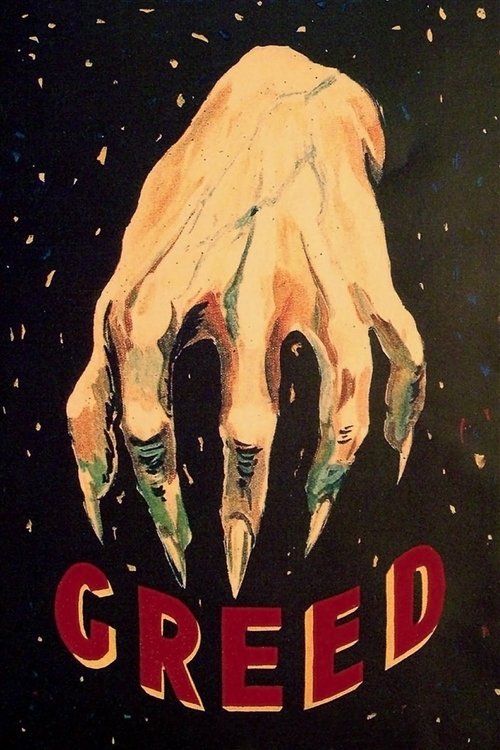
Greed
1924 · Erich von Stroheim
For when you want something dark and elemental — a night for a heavy, hypnotic classic rather than comfort viewing. Rewarding for anyone curious how savage early cinema could be.
What it's about
A hulking, slow-witted dentist in turn-of-the-century San Francisco marries a timid young woman — and then she wins $5,000 in a lottery. The money poisons everything: she hoards it with mounting mania, he sinks into poverty and rage, and a jealous former friend schemes to take what he thinks he's owed. It's a marriage story that curdles into obsession, ruin and crime.
The experience
Grim, riveting and startlingly modern — the psychology of miserliness and resentment is drawn with a cruelty and detail that silent film rarely attempted. It builds a slow dread, ending in one of cinema's most unforgettable final stretches.
Performances
ZaSu Pitts, known mostly for comedy, is astonishing as Trina — her transformation into hollow-eyed, gold-clutching mania is one of the silent era's great performances, with Gibson Gowland and Jean Hersholt matching her in brute force and slipperiness.
The craft
Stroheim shot obsessively on real locations — actual San Francisco streets, an actual mine, and the blinding salt flats of Death Valley in killing heat — decades before location realism was the norm. The images have a documentary weight, with gold objects hand-tinted to glow inside the black-and-white frame.
Why it matters
MGM cut Stroheim's nine-plus-hour version down to a fraction and destroyed the rest, making it cinema's most famous mutilated masterpiece — the defining cautionary tale of the artist versus the studio, and still hugely influential as pure filmmaking.
Snapshot
Greed is the great mutilated masterpiece of American silent cinema: Erich von Stroheim's exhaustive, near-clinical adaptation of Frank Norris's 1899 naturalist novel McTeague, released by the newly formed Metro-Goldwyn-Mayer in a version that represented only a fraction of what its director shot and assembled. The film follows McTeague (Gibson Gowland), a hulking, slow-witted unlicensed dentist in San Francisco, whose marriage to the timid Trina (ZaSu Pitts) curdles into ruin after she wins a $5,000 lottery prize and descends into pathological miserliness, while McTeague's jealous former friend Marcus (Jean Hersholt) sets in motion the betrayal that drives the couple toward a final, fatal confrontation in Death Valley. Stroheim aimed at a total, unflinching transcription of Norris's world; MGM aimed at a releasable program length. The struggle between those two ambitions produced both one of cinema's enduring monuments to artistic obsession and its most famous act of studio vandalism — the destruction of footage that has never been recovered. What survives is a roughly 140-minute release print, supplemented by a 1999 reconstruction that uses surviving production stills to approximate the lost narrative.
Industry & production
The production history of Greed is inseparable from a corporate transformation. Stroheim began the film for the Goldwyn Pictures Corporation, which during the prolonged shoot and post-production was folded, in 1924, into the merger that created Metro-Goldwyn-Mayer. Stroheim thus lost his original sponsors and inherited new overseers — most consequentially Irving Thalberg, the young head of production who had already clashed with the director at Universal, where he had removed Stroheim from Merry-Go-Round. The two men embodied opposed conceptions of the medium: Stroheim the auteur-naturalist for whom completeness was a moral as well as artistic principle, Thalberg the executive for whom a film was a commercial product that had to fit a theater's schedule.
Stroheim shot an enormous quantity of footage and assembled a first cut of extraordinary length. The exact figure has become legend and is genuinely uncertain in the historical record: accounts cite a rough cut in the range of eight to ten hours (often given as roughly 42 reels). Stroheim himself reduced it substantially, then handed the further reduction to his friend, the director Rex Ingram, and editor Grant Whytock, who brought it down toward four hours, intended for release in two parts. MGM rejected even this, and the studio cut the film to roughly ten reels — about 140 minutes. The excised negative footage was, by the most commonly repeated account, destroyed, the silver reclaimed from the nitrate; no complete print is known to survive, and decades of searching have not recovered the missing reels. The precise mechanics and motives of that destruction are imperfectly documented and should be treated with appropriate caution, but the loss itself is not in doubt.
The shoot was notable for its insistence on authenticity over studio convenience. Stroheim filmed extensively on real locations in San Francisco rather than on sets, and staged the climax in the actual Death Valley, subjecting cast and crew to extreme desert heat. Stories of the production's hardships — illness, exhaustion, the punishing conditions of the finale — have accreted into film-historical folklore and, like much surrounding Greed, mix documented fact with retrospective embellishment.
Technology
Greed was made within the technological constraints of mid-1920s silent filmmaking: orthochromatic black-and-white nitrate stock, hand-cranked or motor-driven cameras, no synchronized sound, and exhibition with live musical accompaniment. Within those limits the film is distinguished by one striking deployment of color technology: selective hand-coloring of gold objects. Throughout the picture, gold — McTeague's outsized tooth-shaped shop sign, the gilded canary, coins, dental gold — was tinted by hand frame by frame so that the metal glints against the monochrome image. This is among the film's most discussed technical features, turning a laborious artisanal process into a thematic device that literally illuminates the object of the characters' obsession. The location work also pressed the era's portable equipment to its limits, demanding that cameras and stock function in the heat and glare of the desert, conditions hostile to both machinery and film emulsion.
Technique
Cinematography
The photography was the work of Ben Reynolds and William H. Daniels, the latter of whom would become one of MGM's most celebrated cinematographers (later closely associated with Greta Garbo). Their images for Greed are notable for deep, detailed compositions that keep foreground action and background environment simultaneously legible, supporting Stroheim's documentary impulse to record the texture of real places. The San Francisco exteriors have an almost ethnographic specificity, and the Death Valley sequences exploit the flattening, merciless light of the desert to strand the figures in an indifferent landscape. The camera generally observes rather than editorializes, a restraint that intensifies the material's cruelty.
Editing
Editing is the central drama of Greed's history and, paradoxically, its most compromised dimension. The surviving release version bears the marks of drastic compression: subplots vanish, motivations are foreshortened, and the studio inserted explanatory intertitles to bridge gaps left by the missing footage. Stroheim's own structural conception — built on extensive parallel material, including a substantial subplot involving the minor characters Maria and Zerkow whose miserliness mirrors Trina's — was largely sacrificed. Rick Schmidlin's 1999 reconstruction, produced for Turner Classic Movies, attempts to restore that architecture by interpolating surviving production stills, intertitles, and the continuity of Stroheim's screenplay alongside the extant footage, expanding the film to roughly four hours. It is an act of scholarly approximation, not a recovery of the lost cut, and it should be understood as such.
Mise-en-scène / staging
Stroheim's mise-en-scène is the film's most fully preserved achievement. His commitment to realism extended to the smallest props and the dressing of real interiors, producing an environment dense with the specifics of working-class and petit-bourgeois life. The staging repeatedly counterpoints human ritual against intrusions of mortality and irony — most famously the wedding of McTeague and Trina, staged so that a funeral procession passes visible through the window behind the ceremony, marriage and death framed in a single composition. Such juxtapositions are characteristic: Stroheim builds meaning into the spatial arrangement of the frame, letting the world comment on the characters without recourse to titles.
Sound
As a silent film, Greed had no recorded sound and was exhibited with live musical accompaniment that varied by venue; no single definitive original score in the later sense governed its presentation. Modern restorations and broadcasts have carried newer accompaniments — the 1999 TCM reconstruction, for instance, was presented with a score composed for it — but these are subsequent additions rather than part of the 1924 release as such.
Performance
The performances are pitched toward naturalistic heaviness rather than the stylized gesture common in much silent acting. Gibson Gowland gives McTeague a brute physicality shading into helplessness, the strength of an ox harnessed to a mind that cannot protect him. Jean Hersholt's Marcus is a study in petty resentment escalating to vindictiveness. The revelation is ZaSu Pitts — then known primarily for comedy — whose Trina charts a harrowing arc from shy bride to compulsive hoarder, fondling and bathing in her gold coins, her face curdling into something feral. Critics have long regarded it as among the finest performances of the silent era, and a striking instance of a comic actress redirected into tragedy.
Narrative & dramatic mode
The dramatic mode is literary naturalism translated to film: a deterministic vision in which character is destiny and destiny is degradation. Following Norris (himself influenced by Zola), the narrative treats its people as organisms shaped by heredity, environment, and the corrupting pressure of money, moving with grim inevitability from modest contentment toward mutual destruction. The structure is a long, patient descent rather than a plotted intrigue; tension accrues from the steady erosion of dignity, not from suspense in the conventional sense. The release version's compression damages this gradualism — the slow tightening that Stroheim's full cut presumably achieved is replaced by something more abrupt — but the deterministic shape remains legible, culminating in the famous Death Valley finale where McTeague and Marcus, manacled together over the contested fortune, are left to die in the desert beside a mule and the gold neither can carry away.
Genre & cycle
Greed sits at the intersection of social drama and crime tragedy, but it resists the generic conventions of either. It predates and stands largely apart from the cycles that would organize Hollywood crime film — it is not a gangster picture or a melodrama of the underworld, but a study of ordinary avarice. Its closest kinships are with the literary-naturalist adaptation and with the broader impulse toward realism in 1920s cinema. In retrospect it reads less as a member of a contemporary cycle than as a singular work whose uncompromising realism anticipated later movements more than it joined any existing one.
Authorship & method
Greed is among the purest expressions of the director-as-author in the studio era, and a cautionary monument to the cost of that purity. Stroheim's method was totalizing: shoot the novel entire, on real locations, with authentic detail, and let length follow truth rather than commerce. His key collaborators served that vision — cinematographers Ben Reynolds and William H. Daniels realized the deep, observational images; editors Rex Ingram and Grant Whytock attempted to reconcile Stroheim's cut with releasability before the studio overrode them. The screenplay was Stroheim's own adaptation of Norris. There was no composer in the modern sense for the 1924 release, given silent exhibition practice. The decisive "authorial" intervention, tragically, came from outside the artistic team: Thalberg and MGM, whose final cut means that the film bearing Stroheim's name is, by his own bitter account, not the film he made. Stroheim's career never fully recovered from the pattern Greed exemplified, and he became cinema's archetype of the genius destroyed by the studio system.
Movement / national cinema
The film belongs to American silent cinema but is profoundly shaped by European sensibilities — Stroheim was Austrian-born, and his naturalism draws on continental literary models. It is most usefully placed within the international current of cinematic realism and naturalism in the 1920s, distinct from the German Expressionism of the same years (which worked through stylization and the studio) precisely in its insistence on the unstyled real. Within Hollywood it represents the road not taken: a realist, location-based, novelistically complete cinema that the industrializing studio system was structurally disinclined to permit.
Era / period
Made in 1923–1924 at the exact moment the modern studio oligopoly was consolidating — the MGM merger that swallowed Stroheim's production was itself emblematic — Greed is a period piece in two senses. It depicts turn-of-the-century San Francisco with fidelity, and it documents, in its own fate, the industrial transition from the relatively director-driven 1910s and early 1920s to the producer-supervised studio system that Thalberg helped define. It stands near the end of the silent era's first maturity, a few years before sound would again transform the medium's economics and aesthetics.
Themes
The film's governing theme is money as a corrupting, dehumanizing force — gold not as wealth but as pathology. Avarice operates as a kind of disease that infects love, friendship, and finally the will to live; the hand-tinted gold makes the obsession visible, a glittering contamination spreading across the monochrome world. Surrounding this are naturalism's classic preoccupations: heredity and the persistence of brutish instinct beneath civilized surfaces (McTeague's atavistic violence), environment as fate, and the indifference of the universe, figured by the lethal beauty of Death Valley. The recurring juxtaposition of marriage and death, fortune and ruin, frames human striving as ironic and doomed. The film is, finally, a moral fable without consolation: greed consumes everyone it touches and rewards no one.
Reception, canon & influence
The influences on the film are clear and acknowledged: Frank Norris's McTeague as direct source, and behind it the naturalist tradition of Émile Zola, whose deterministic vision of human beings as products of biology and circumstance Stroheim absorbed and translated into images.
Contemporary critical reception of the 1924 release was mixed and is imperfectly documented; the truncated film bewildered some and impressed others, and its commercial performance was not strong — precise box-office figures should not be asserted with confidence. What is certain is the dramatic rehabilitation of its reputation over the following decades. As the legend of the lost footage grew and the surviving film was reassessed, Greed ascended into the canon as one of the supreme achievements of silent cinema and a touchstone in debates about realism, authorship, and studio interference. It has recurred on critics' and scholars' lists of the greatest films, and its production saga became the paradigmatic story of artistic vision crushed by commerce.
Its forward influence runs along two lines. Aesthetically, its uncompromising location realism and naturalist severity anticipate later realist movements and the broader prestige of location-based, novelistically faithful filmmaking. Institutionally and mythically, Greed became the founding case study in the loss of film heritage and in the auteur-versus-studio conflict — invoked whenever a director's cut is suppressed or footage destroyed. The 1999 reconstruction renewed scholarly attention and made the film's lost architecture partially legible to modern audiences. Greed endures less as a film one can fully see than as a wound in cinema's history: proof of how great the medium's ambitions could be, and how readily the industry could refuse them.
A Deleuzian reading
Start with the gold.
The full Deleuzian reading of Greed →
Reception
Butchered by MGM from von Stroheim's colossal cut to a fraction of its length and dismissed by many 1924 critics as sordid and grim, it's since been canonized as one of the supreme achievements of silent cinema — the mutilated masterpiece par excellence.
How Greed was received, from release to now →
Influences: the films it descends from and the films it influenced
- Intolerance (1916) — Stroheim apprenticed under Griffith, and Greed's contrapuntal wedding-and-funeral montage descends directly from Intolerance's parallel cross-cutting of converging ceremonial fates.
- Foolish Wives (1922) — Stroheim first perfected here the totalizing method of building authentic full-scale environments (a reconstructed Monte Carlo) and letting runtime follow novelistic completeness — and suffered the studio's butchering of his cut as a rehearsal for Greed's fate.
- Blind Husbands (1919) — His directorial debut established the obsessive accretion of naturalistic physical detail and psychological gesture that Greed later scales to the length of an entire novel.
- The Crowd (1928) — Urban location shooting and a deliberately non-star naturalistic lead dramatize environment-as-fate — the ordinary man ground down by economic circumstance, Greed's determinism moved into the modern city.
- Nana (1926) — Renoir, who said Foolish Wives made him want to direct, adapted Zola directly in conscious emulation of Stroheim's dense naturalist mise-en-scène and detailed realist decor.
- Toni (1935) — Location shooting with regional non-professionals and a deterministic working-class tragedy form the direct conduit carrying Stroheim's location realism toward Italian neorealism.
- La Bête Humaine (1938) — A faithful Zola adaptation that translates literary naturalism's biological determinism into deep-focus location cinema shot among real locomotives and rail yards.
- The Treasure of the Sierra Madre (1948) — Gold-lust as moral corrosion played out as a slow descent in punishing real desert locations — a reincarnation of Greed's Death Valley finale and its money-as-corruption arc.
- Bicycle Thieves (1948) — Neorealist street-location shooting with non-actors enacting pure economic determinism — the realist lineage Stroheim's uncompromising location severity helped seed.
- La Terra Trema (1948) — Verga/Zola-style naturalism shot on real Sicilian locations with the actual fishing community, staging environment-as-fate at the novelistic scale Stroheim aspired to.
- The Magnificent Ambersons (1942) — The other canonical studio-mutilation tragedy — RKO recut it and burned the excised reels — inheriting Greed's myth of the lost masterpiece alongside its deep-staged compositional density.
- McCabe & Mrs. Miller (1971) — A built-from-scratch authentic period settlement and naturalistic overlapping detail make commerce the corrupting engine of the frontier, extending Greed's realist environment-as-character.
- Heaven's Gate (1980) — Obsessive location authenticity and runaway length pitched against the studio re-enact, almost beat for beat, the Greed director-versus-commerce disaster as modern myth.
- There Will Be Blood (2007) — A literary-naturalist adaptation (Sinclair) of money-as-corruption tracing one man's slow moral descent through deep compositions staged on harsh real landscapes — Norris's determinism in a new century.
- Citizen Kane (1941) — Von Stroheim's anti-hagiographic portrait of a man obliterated by his own appetites — sustained across epic temporal breadth through location shooting and actual objects — provides the naturalist template for Kane's 'great man destroyed from within' trajectory.
- The Wedding March (1928) — Extends Greed's ironic ceremony-versus-decay staging and reuses the hand-colored insert technique, treating the wedding itself as ornate spectacle masking corruption.
- Queen Kelly (1929) — The same authorial maximalism collided with producer control (Swanson and Kennedy shut it down mid-shoot), re-enacting Greed's studio-interference catastrophe within Stroheim's own filmography.
- The Birth of a Nation (1915) — Stroheim, who acted and assisted under Griffith, carried forward the feature-length naturalist epic and obsessive location-facsimile staging, extending Griffith's ambition for the long-form American narrative film.
- The Best Years of Our Lives (1946) — Stroheim's uncompromising long-form realist domestic drama, refusing melodramatic relief, is the ancestor of Best Years' commitment to extended, unflinching everyday observation.
- The Wind (1928) — Von Stroheim's Death Valley finale uses extreme location heat as a literal killing antagonist, the same 1920s Hollywood commitment to naturalist environmental extremity filmed on punishing real terrain.
Similar films
- The Treasure of the Sierra Madre (1948) — influence & lineage
- The Crowd (1928) — influence & lineage
- Heaven's Gate (1980) — influence & lineage · same viewing thread
- Bicycle Thieves (1948) — influence & lineage · often watched together
- The Cabinet of Dr. Caligari (1920) — often watched together
- Casino (1995) — often watched together
- The Cook, the Thief, His Wife & Her Lover (1989) — often watched together
- 8½ (1963) — often watched together
All the films related to Greed →
Watch it with: curated runs of related films
- Mutilated Masterpieces — Watch these monumental silent-era and epic behemoths together — each one butchered by a studio or a censor and only later reclaimed as a monument — when you want cinema at its most ruinous, obsessive, and grand.