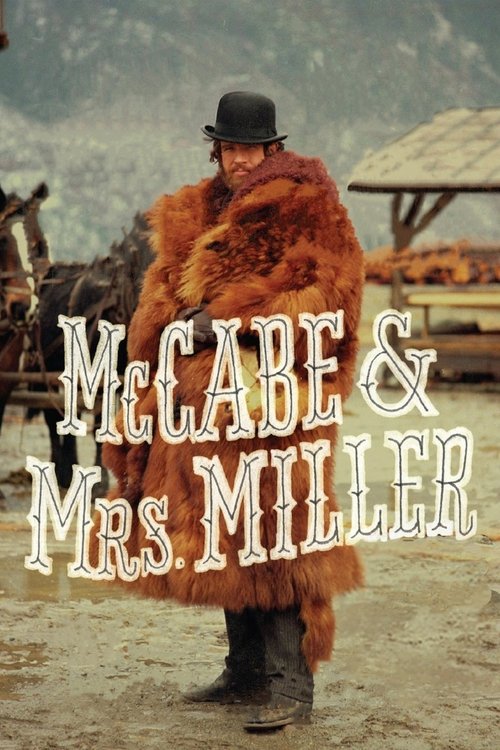
McCabe & Mrs. Miller
1971 · Robert Altman
For a cold, contemplative night when you want atmosphere over action — something melancholy and gorgeous to sink into. Comfort viewing for people whose comfort is a little sad.
What it's about
A small-time gambler rides into a muddy mining settlement in the Pacific Northwest, around 1902, and opens a saloon and brothel on bluster alone. A sharp, opium-smoking English madam arrives and makes him an offer: let her run it properly, and they'll both get rich. Their prickly partnership thrives — until a mining corporation decides it wants what they've built.
The experience
Slow, snowbound, and quietly heartbreaking — less a Western than a sad, beautiful ballad about two people who almost connect. It's hushed and wintry, with humor around the edges, and it sneaks up on you emotionally.
Performances
Warren Beatty makes McCabe a wonderful blowhard — all mumbled bravado hiding a man in over his head — and Julie Christie is flinty, funny, and devastating as Mrs. Miller. Their chemistry is the film's aching center.
The craft
Vilmos Zsigmond's cinematography looks like faded photographs come to life — hazy, golden interiors and blue-white snow, achieved through techniques that made the studio nervous. Altman layers overlapping, half-heard dialogue over it all, and Leonard Cohen's songs run through the film like weather. It deserves the biggest, darkest room you can give it.
Why it matters
A cornerstone of 1970s American filmmaking that redefined what a Western could be — mournful, muddy, anti-heroic — and cemented Altman's reputation as the era's great rule-breaker.
Snapshot
McCabe & Mrs. Miller is a revisionist Western set in the fictive Pacific Northwest mining settlement of Presbyterian Church, circa 1902. A small-time gambler named John McCabe (Warren Beatty) arrives to open a saloon and brothel, soon joined by the shrewdly entrepreneurial English madam Constance Miller (Julie Christie), who reorganizes his operation into a profitable enterprise. Their fragile commercial partnership — and the equally fragile community they help build — is undone when a corporate mining concern sends hired killers to acquire their holdings by any means necessary. The film ends with McCabe bleeding out in the snow while, cross-cut across town, Mrs. Miller retreats to an opium pipe. Robert Altman shot it with Vilmos Zsigmond's aleatory, pre-flashed cinematography, overlapping improvised dialogue, and three Leonard Cohen folk songs in place of a conventional score. It arrived in 1971 as a mainstream release that felt nothing like a mainstream film: formally loose, tonally elegiac, and hostile to every expectation the Western genre had trained its audience to hold.
Industry & production
The film was adapted from Edmund Naughton's 1959 novel McCabe, a lean, hardboiled narrative whose title character is rougher and less sympathetically drawn than Beatty's interpretation. Altman brought on Brian McKay as co-writer, and the screenplay preserved the novel's kernel — small operator crushed by corporate force — while softening McCabe's edges and expanding Mrs. Miller's agency considerably.
Warner Bros. financed and distributed the picture. Producers David Foster and Mitchell Brower guided the project through the studio. Warren Beatty, then one of Hollywood's most commercially valued stars following Bonnie and Clyde (1967), was both a significant draw and, by most accounts, an occasionally fractious creative presence; he had strong opinions about his character's presentation that did not always align with Altman's deliberately deflationary vision. Julie Christie, fresh from Doctor Zhivago (1965) and Darling (1965), was cast against the expectation of glamour — Altman and Christie worked to make Mrs. Miller practical, unglamorous, and unromantically self-interested.
Production built the town of Presbyterian Church from scratch on a ranch in West Vancouver, British Columbia. The construction was deliberately staged over time so that the camera could record the settlement growing — raw lumber gradually weathering, structures accumulating — lending the film the texture of a place actually coming into being. That material authenticity, mud, cold, and architectural improvisation, is inseparable from the film's meaning.
Technology
Vilmos Zsigmond's approach to exposure was the film's most technically decisive choice. Working with Altman's consent, Zsigmond employed a technique known as "flashing" or pre-fogging: the negative was given a controlled low-level exposure to white light before processing, compressing the tonal range and degrading contrast. The result suppressed blacks, lifted shadows, and gave highlights a milky, antique quality that evoked hand-tinted Victorian photography or faded daguerreotypes. No other major Hollywood Western of the period looked remotely like it. The technique required precise calibration to avoid destroying the image entirely, and Zsigmond's control over the process represented a significant advance in its practical application.
Anamorphic widescreen lenses were used throughout, but frequently in conjunction with long telephoto focal lengths that compressed space and allowed the camera to observe action from a distance without intruding on it. This created a voyeuristic remove consistent with Altman's governing aesthetic of eavesdropping rather than directing.
Technique
Cinematography
Zsigmond's visual language on the film amounts to an extended argument that the West was not bright and wide-open but dim, murky, and close. Interiors are lit with apparent sources — candles, oil lamps, a single window — rather than studio approximations of natural light, producing pools of amber and gold against deep shadow. Exterior shots make constant use of ambient overcast, the perpetual cloud cover of British Columbia standing in for the frontier's refusal to be heroic. Snow and fog appear repeatedly in the final third, progressively obscuring the frame until McCabe's death scene is shot in conditions that make him difficult to locate within the image. The camera finds him almost by accident.
Zsigmond and Altman favored slow zooms and camera movements that adjust their position in ways that feel observational rather than expressive — catching performers in the corner of the frame, allowing action to begin before the lens has settled on it. This gives the cinematography the quality of documentary contingency, a record of what happened to be present rather than what was composed for effect.
Editing
Lou Lombardo's editing is elliptical and uncommitted to the conventions of continuity. Scenes begin late and end early; significant events are implied rather than shown. The film's first act establishes McCabe's business dealings and growing community through a series of scenes in which half the relevant information is delivered in muttered, overlapping dialogue that the viewer must reconstruct rather than receive. Time is treated as compressible: Presbyterian Church grows from a muddy clearing to a recognizable settlement in what feels like weeks rather than the months presumably implied. This temporal compression is not hidden; it is part of the film's argument that communities cohere quickly and can dissolve just as fast.
The final extended crosscut between McCabe's gunfight in the snowbound town and the townspeople fighting the blazing church fire is the film's most formally ambitious sequence. The parallel actions share no causal connection — the fire is an accident, McCabe's battle a corporate assassination — and Lombardo cuts between them without explaining their relationship, forcing the viewer to supply the irony: the town is fighting to preserve an institution while its founding entrepreneur freezes to death unseen in the alleys.
Mise-en-scène / staging
Altman's staging reflects his commitment to creating an environment that actors inhabit rather than a set they perform on. The interiors of the Presbyterian Church saloon and brothel are dressed with a density that precludes any single correct place to look. Background business — conversations, transactions, arguments — proceeds at the same level of detail as foreground drama, and Altman frequently allows his characters to drift through a scene without centering them in frame. This dispersal of attention means the viewer must decide where to look, and can miss significant action. The film rewards repeat viewing in ways that many more conventionally staged films do not.
Sound
Altman had been developing a multi-track location sound approach since at least MASH (1970), and McCabe & Mrs. Miller advances it further. Cast members wore radio microphones on set, and multiple conversations were recorded simultaneously, producing a sonic texture in which no single voice fully dominates. The resulting overlapping dialogue sounds less like scripted performance than ambient community noise: people talking past each other, conducting different business, half-hearing what the protagonist hears. This technique, which Altman would refine across the following decade, was largely unprecedented in American studio filmmaking.
Leonard Cohen's three songs — "The Stranger Song," "Sisters of Mercy," and "Winter Lady," all from his 1967 debut album — function not as underscore but as thematic commentary. Altman reportedly came to Cohen's music independently during production and recognized that the songs' themes of longing, prostitution, and spiritual failure mapped precisely onto the film's concerns. John McCabe is, in a sense, the stranger of "The Stranger Song": a man who gambles on others' dreams and watches the table turn. The songs are dropped in at structurally significant moments without fanfare, and their folk guitar plainness makes them sound genuinely of a piece with the film's anti-mythological disposition.
Performance
Beatty's performance remains somewhat under-discussed relative to Christie's. He plays McCabe as a man whose reputation for toughness is mostly hearsay, who bluffs his way through negotiations he doesn't fully understand, and who mumbles much of his dialogue in a fashion that suggests a man talking to himself as much as to others. Beatty made deliberate choices to make McCabe smaller and more hesitant than his star image suggested; accounts of the production suggest friction with Altman over this, though the precise nature of their disagreements is not fully documented in the public record.
Christie won the Academy Award nomination that year for her performance — earthy, pragmatic, and ultimately opaque. Mrs. Miller is never sentimentalized. She runs a business, takes opium, and does not offer McCabe the emotional rescue the genre structure suggests. When she retreats to the opium den at the film's end while he dies, it is not abandonment so much as a woman doing the only sensible thing: survival.
Early roles for Shelley Duvall and Keith Carradine appear in the ensemble, both characteristic of Altman's habit of discovering and deploying faces that belonged to no existing star category.
Narrative & dramatic mode
The film operates in what might be called the elegiac mode: events are presented with the quality of things already lost, recorded after the fact. The narrative follows a recognizable arc — rise and fall, hubris and consequence — but strips it of the moral framework the Western genre conventionally provides. McCabe is not heroic, exactly, but neither is his death deserved. He dies because a corporation sent killers and the town lacked the structural capacity to protect its own members. The film declines to make this a tragedy in the classical sense — there is no fatal flaw, only the logic of capital accumulation meeting a small operator unprepared for its scale.
Altman does not withhold irony, but he also does not lean on it. The community built in Presbyterian Church is genuinely appealing — warm, improvisational, capable of collective effort, as demonstrated by the church fire scene — even as it proves unable to protect the conditions of its own existence.
Genre & cycle
McCabe & Mrs. Miller belongs to the cycle of revisionist Westerns that dominated American cinema between roughly 1969 and 1973. Sam Peckinpah's The Wild Bunch (1969) had already made the genre's violence literal and exhausting rather than stylized and cathartic; Arthur Penn's Little Big Man (1970) had assaulted its mythology from a Native American perspective; Butch Cassidy and the Sundance Kid (1969) had deflated its heroism into comedy. Altman's contribution was to foreground capitalism itself as the Western's suppressed subject — to make explicit that the myth of the frontier was always, underneath, a story about property and extraction.
The film participates in genre less as homage or deconstruction than as replacement. Its conventions — the gunfight, the brothel, the saloon, the corporation, the lone hero — are all present and all inverted. The gunfight is not cathartic but pathetic. The brothel is a business, not a house of sin. The lone hero dies unnoticed.
Authorship & method
Robert Altman had arrived at his mature method by 1971 after years of television work and several features; MASH (1970) had established him commercially and critically, and McCabe represented his first full expression of the aesthetic he would pursue for the following decade: ensemble casting, overlapping sound, multiple camera setups, improvisational latitude for performers, and a refusal to privilege any single emotional register.
Vilmos Zsigmond, born in Hungary and trained in Budapest, had fled his homeland after the 1956 Soviet intervention and worked through the 1960s on low-budget American productions before McCabe brought him to serious critical attention. His collaboration with Altman established him as one of the major American cinematographers of the decade; he would go on to shoot The Deer Hunter (1978) and Close Encounters of the Third Kind (1977), for which he won the Academy Award.
Lou Lombardo's editing was crucial to the film's rhythm; he had cut The Wild Bunch for Peckinpah, and brought comparable skill with fragmented temporal structures to Altman's material.
Leonard Cohen's presence as the film's de facto composer was accidental and transformative. Cohen had no prior film scoring experience and played no role in production; Altman's appropriation of three existing songs rather than commissioning original music was a formal statement as much as a practical choice.
Movement / national cinema
The film is emphatically American in subject but Canadian in material — shot in British Columbia, built in the lower mainland, with the province's specific cold and gray providing the visual conditions the film required. It belongs broadly to the New Hollywood movement: the early 1970s period in which the collapsed studio system allowed directors unusual creative authority and the resulting films bore the marks of individual vision rather than genre convention. Altman is one of the central figures of that movement, and McCabe is among its defining works.
Era / period
The film belongs to the first half of the 1970s, the period in American cinema characterized by political disillusionment (the Vietnam War still ongoing at release, Watergate approaching), formal experimentation, and a systematic dismantling of genre conventions inherited from classical Hollywood. It shares this period with The Godfather (1972), Chinatown (1974), Nashville (1975), and Taxi Driver (1976) — films that treat the machinery of American mythology with suspicion rather than celebration.
Themes
Capitalism and the destruction of small enterprise. The film's most insistent concern is the relationship between individual initiative and corporate scale. McCabe builds something; a larger entity arrives to absorb it or eliminate him. This is presented not as exceptional but as structural — the ordinary mechanism of American expansion.
The myth of the West versus its material reality. Presbyterian Church is cold, muddy, precarious, and in constant danger of burning or freezing. The heroic frontier of classical Westerns is nowhere in evidence.
Obscurity and invisibility. McCabe dies in snow so heavy the camera can barely locate him. Mrs. Miller disappears into opium-induced interiority. The film's visual and dramatic logic consistently moves its characters toward erasure.
The limits of partnership. McCabe and Miller's relationship is professional before it is personal, and the film is careful to observe that their attraction to each other does not translate into the kind of solidarity that might have saved them. She is pragmatic; he is dreaming.
Community and its fragility. The townspeople are vivid and various, and the community they form is genuinely warm. But communities in this film organize to fight fires, not to protect their own members from corporate assassination. The film notes this distinction without editorializing.
Reception, canon & influence
Initial critical reception was divided. The film's diffuse pacing, deliberately muffled dialogue, and wholesale subversion of Western conventions confused some reviewers. Pauline Kael at The New Yorker was among its earliest and most forceful champions, and her advocacy was significant in establishing the film's prestige. The film was not a major commercial success in its initial release.
Julie Christie received an Academy Award nomination for Best Actress; the film received no additional nominations, which now reads as a period artifact rather than a considered judgment.
Influences on the film. Altman drew on Jean Renoir's naturalistic ensemble staging and his refusal to subordinate character to plot. The Italian Neorealist tradition — Rossellini, De Sica — is present in the commitment to location shooting and ambient performance. Ingmar Bergman's capacity for isolating figures against hostile landscapes may be felt in the film's final third. The revisionist Westerns immediately preceding it, particularly Peckinpah's The Wild Bunch, established the genre's susceptibility to formal reinvention. Edmund Naughton's source novel provided the structural skeleton.
Legacy and forward influence. McCabe & Mrs. Miller is now regularly placed among the greatest American films; it appears on canonical lists compiled by critics, scholars, and practitioners with a consistency that reflects its status as a film whose reputation has grown with every decade. HBO's Deadwood (2004–2006), in its attention to the economics of frontier community-building and its refusal to romanticize the West, is visually and thematically indebted to Altman's model, though creator David Milch brought his own literary influences. Alejandro González Iñárritu's The Revenant (2015) echoes Zsigmond's naturalistic, low-contrast photography and the figure of a man dying in cold weather without adequate witness. Paul Thomas Anderson, who has cited Altman as a foundational influence, brings a comparable interest in ensemble texture and ambient sound to films like Boogie Nights (1997) and There Will Be Blood (2007). The film's handling of the Western as an economic rather than moral form shaped how the genre has been approached ever since by filmmakers not content with its inherited satisfactions.
A Deleuzian reading
The camera finds him almost by accident.
The full Deleuzian reading of McCabe & Mrs. Miller →
Reception
A box-office disappointment in 1971 that split critics — though Pauline Kael famously championed it as 'a beautiful pipe dream of a movie' — it's since been fully canonized, landing in the National Film Registry and routinely topping lists of the greatest Westerns ever made.
How McCabe & Mrs. Miller was received, from release to now →
Influences: the films it descends from and the films it influenced
- The Rules of the Game (1939) — Altman directly adopted Renoir's method of staging multiple characters simultaneously in deep-focus long-take frames with no single figure granted dramatic priority — the dispersed ensemble with no moral center is the formal template McCabe inherits and transposes to the frontier saloon.
- Bicycle Thieves (1948) — The Neorealist commitment to location shooting, ambient diegetic noise as texture rather than musical comment, and non-theatrical performance in which characters exist within a social environment rather than performing for the camera passes directly into Altman and Zsigmond's handling of the Presbyterian Church crowd scenes.
- The Seventh Seal (1957) — Bergman's device of isolating a solitary figure moving toward certain death across a wide, indifferent landscape provides the formal template for McCabe's final pursuit through snow — a dying man unremarked by any witness, the world continuing its commerce around him.
- Ride the High Country (1962) — Peckinpah's elegiac framing of Western protagonists as men whose virtues are archaic and whose deaths will pass unmourned established the genre's susceptibility to this mode; Altman extends the device from individual character pathos into a structural critique of the economic forces that produced the frontier itself.
- Easy Rider (1969) — Hopper's decision to build the film's emotional architecture from pre-existing rock songs rather than commissioned scoring — treating recorded cultural artifacts as a formal vocabulary — is the direct precedent for Altman's appropriation of three Leonard Cohen songs, a choice that works identically: the songs arrive pre-loaded with associations that exceed what any original score could carry.
- The Wild Bunch (1969) — Editor Lou Lombardo cut both films; his technique of fracturing a single action across multiple camera angles and temporal durations — creating elliptical rather than continuous montage — moves directly from Peckinpah's ambush sequences to Altman's social scenes, where the same fragmentation is applied to conversation rather than violence.
- MASH (1970) — The overlapping multitrack dialogue system — multiple actors speaking simultaneously across different spatial planes, requiring the audience to select rather than receive — was first deployed here and carried wholesale into McCabe as the primary sound strategy; the technical infrastructure Altman built on MASH made McCabe's sound design possible.
- High Noon (1952) — Altman directly inherits High Noon's ballad-as-Greek-chorus device — using Leonard Cohen's pre-existing songs as diegetically adjacent commentary framing the hero's fate — while inverting the emotional register from universal moral proposition to elegy for a genre that has consumed its own mythology.
- Bonnie and Clyde (1967) — Altman placed Leonard Cohen's pre-existing folk songs anachronistically over a revisionist Western, directly extending Penn's pre-existing-score strategy, while matching the desaturated, underexposed documentary palette Guffey had calibrated to Walker Evans's FSA photographs.
- Butch Cassidy and the Sundance Kid (1969) — Altman and cinematographer Vilmos Zsigmond developed Hall's diffusion-filtration, overexposed warm-palette Western photography into a total aesthetic system — grain, color temperature, and lens flare all expressing historical decay — extending the visual logic of Butch Cassidy's Bolivian sequences across an entire film.
- Shane (1953) — Altman extended Shane's sound/strategic-silence principle by inversion: the climactic gunfight in falling snow muffles violence into near-inaudibility, making death heavy through the presence of stillness rather than amplification — equivalent moral purpose achieved by opposite acoustic means.
- My Darling Clementine (1946) — Vilmos Zsigmond's heavily flashed, desaturated cinematography inverts Clementine's B&W monumentalism — the founding vision rendered murky and intimate rather than granite-clean — while Leonard Cohen's folk songs as nondiegetic score directly extend Clementine's folk-leitmotif structure while stripping it of all consolatory function.
- The Long Goodbye (1973) — Zsigmond and Altman's second collaboration extends the slow observational zoom as a persistent ironic device — the telephoto lens following Marlowe through contemporary Los Angeles as it followed McCabe through frontier mud — transposing the technique into neo-noir and demonstrating the zoom's generic portability.
- Nashville (1975) — Altman scaled the overlapping-dialogue ensemble method to 24 principal characters, making McCabe's dispersed staging the explicit blueprint for a film in which no single scene grants any figure narrative dominance and the multitrack sound design becomes inseparable from the subject of American performance culture.
- Days of Heaven (1978) — Zsigmond applied the same pre-fogged, natural-light cinematography — soft grain, reduced contrast, image density resembling period photography — that defined McCabe's visual texture; the technique moves intact from the Pacific Northwest mining camp to the Texas Panhandle wheat fields, carrying with it the same quality of witnessed-rather-than-dramatized time.
- Heaven's Gate (1980) — Zsigmond's third major revisionist Western as cinematographer after McCabe and The Deer Hunter; Cimino adopted Altman's frontier capitalism as subject and the pre-fogged naturalistic image as visual grammar, extending McCabe's critique of corporate violence against small communities into an epic of class warfare on the same Western terrain.
- There Will Be Blood (2007) — Anderson builds Daniel Plainview as the logical terminus of McCabe's frontier capitalism argument — where McCabe's entrepreneur is destroyed by the larger capital arriving behind him, Plainview becomes the destructive capital itself; the Altmanesque ambient ensemble staging Anderson learned from MASH and Nashville is here stripped away, leaving a single figure whose monstrousness the wide frame refuses to excuse.
- The Revenant (2015) — Emmanuel Lubezki's natural-light, low-contrast photography — achieved without artificial sources in cold outdoor environments — directly echoes Zsigmond's McCabe work; the figure of a man dying slowly in a hostile winter landscape while the surrounding world conducts its commerce indifferently repeats McCabe's final movement as its structural premise.
- Train Dreams (2025) — Builds the frontier from naturalistic period-labor texture, weather, and mournful folk scoring rather than genre heroics, the anti-mythic western template.
- Unforgiven (1992) — Altman replaced the Western's sunlit visual iconography with mud, overcast skies, and rain, and used ambient sound texture in place of dramatic underscore — both formal decisions directly anticipate Unforgiven's Alberta palette and Niehaus's decision to leave large portions of the film unscored.
- Short Cuts (1993) — Vilmos Zsigmond's bounced-light, flashed-stock naturalism — non-directional sources reading as practical ambience, camera held at observational remove — established the visual grammar of unsympathetic witness that Walt Lloyd replicated for Short Cuts' California interiors.
- Close Encounters of the Third Kind (1977) — Vilmos Zsigmond's signature aesthetic—anamorphic diffusion filters, deliberate lens flare from practical sources within frame, soft-focus backlight—debuts here and carries intact into CE3K's night-encounter sequences, where the same photographic instability codes the alien as something a camera struggles to contain.
- The Prestige (2006) — Vilmos Zsigmond's gauze-diffused, flashed-negative period photography — deliberately desaturated and grained to approximate nineteenth-century photographic memory — is the direct technical forerunner of Pfister's Prestige palette; both films consciously refuse the warm romanticism of conventional costume drama.
- The Right Stuff (1983) — Vilmos Zsigmond's natural-light anamorphic work and Altman's overlapping-dialogue ensemble staging in wide-frame group compositions establish the post-classical American grammar that Deschanel and Kaufman inherit for the Mercury Seven sequences, where each figure's position within the frame carries the institutional argument.
- Klute (1971) — Gordon Willis's extreme telephoto compression in deep shadow — figures barely distinct from surrounding darkness, ambient urban noise competing with dialogue clarity — pursues the same New Hollywood program as Zsigmond's work on McCabe: using cinematographic technique to destabilize genre legibility and replace convention with unease.
- Two-Lane Blacktop (1971) — Made the same year, Hellman's anti-genre road film shares McCabe's elliptical continuity editing, anti-star performance deflation (casting musicians James Taylor and Dennis Wilson as leads), and refusal of narrative resolution — two films arriving simultaneously at the same rejection of conventional dramatic satisfaction.
- Pat Garrett and Billy the Kid (1973) — Bob Dylan's pre-existing folk songs function identically to Cohen's songs in McCabe: both films deploy a singer-songwriter's recorded work as ambient elegiac commentary rather than commissioned scoring, making the soundtrack's pre-existing cultural weight inseparable from the film's dirge-like tone.
- The Godfather (1972) — Contemporaneous New Hollywood experiment in motivated, low-intensity natural-light cinematography (Zsigmond's copper-tinted interiors) applied to genre subversion; the two films' formal divergence — Altman's zoom-dependent handheld versus Coppola's controlled prime-lens classicism — constitutes a live debate about genre revisionism's available options.
- The Searchers (1956) — Vilmos Zsigmond's deliberately fogged, lens-diffused, desaturated Technicolor palette is a systematic inversion of Hoch's saturated Searchers color; Altman uses the same Technicolor printing technology as a counter-argument, draining the mythic Fordian frontier of its chromatic authority.
- The Last Picture Show (1971) — Released the same year as the other great New Hollywood revisionist-western experiment in immersive period reconstruction, deglamorizing the frontier through texture and weather rather than myth.
- First Cow (2020) — Establishes the muddy, half-built, commerce-driven frontier settlement and the folk-ballad score over overlapping ambient sound that Reichardt inherits, replacing gunfight mythology with the grind of petty enterprise.
Similar films
- Ride the High Country (1962) — influence & lineage · same viewing thread
- The Long Goodbye (1973) — influence & lineage
- Heaven's Gate (1980) — influence & lineage
- Nashville (1975) — influence & lineage
- The Wild Bunch (1969) — influence & lineage · same viewing thread
- Pat Garrett & Billy the Kid (1973) — same viewing thread
- The Misfits (1961) — same viewing thread
- Wanda (1970) — shared sensibility
All the films related to McCabe & Mrs. Miller →
Watch it with: curated runs of related films
- Print the Legend — A run of frontier myths and their unmaking — town-taming marshals, aging gunfighters, and the stories the newspapers chose to print instead of the truth.
Film essays and courses that include it
- Robert Altman
- Print the Legend: The Western from Myth to Memory
- The Corrupting Vein: Cinema's Century with Greed
- Nobody's Darling: Sex Work, Survival, and the Cassavetes-Baker Line
- The Ten Years the Directors Won
- The Death of the Main Character
- The Genre That Aged With America
- The Move That Fell Out of Favor