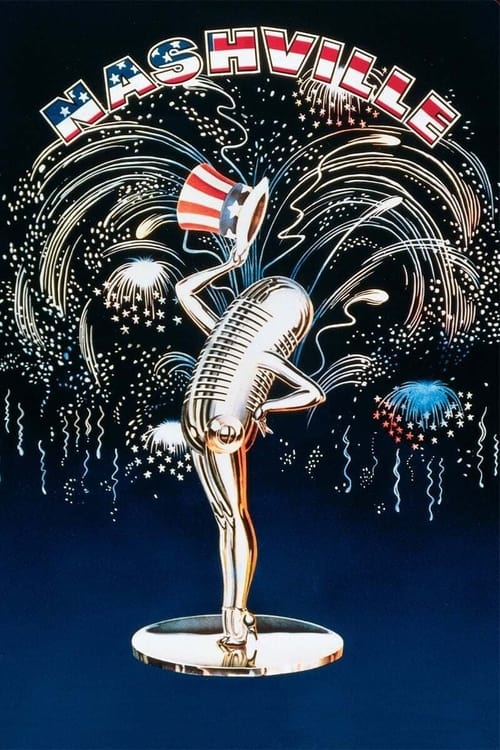
Nashville
1975 · Robert Altman
For when you want to disappear into a big, messy, human panorama — a film to give a whole evening to, ideally with someone to talk it over with after. More fascinating than cozy, but endlessly rewatchable.
What it's about
Over five days in the country-music capital, twenty-four characters — stars, wannabes, groupies, reporters, waitresses, session players — cross paths as a populist presidential campaign rolls into town and starts recruiting singers for a big rally. There's no single hero; the film drifts from stage to traffic jam to hospital room to recording booth, building a whole city of ambition, delusion, and genuine talent, with America's post-Watergate anxieties humming underneath every song.
The experience
Loose, funny, and teeming — conversations overlap, storylines brush past each other, and full musical numbers play out live, so it feels less like watching a plot than eavesdropping on a country. It's a long, immersive hang that sneaks up on you, turning from satire to something genuinely piercing by the end.
Performances
The ensemble is one of the great casts ever assembled, with Lily Tomlin quietly devastating as a gospel-singing housewife and Ronee Blakley extraordinary as a fragile country queen pushed back on stage too soon. Keith Carradine's womanizing folk singer gets the film's most quietly brutal musical moment.
The craft
Altman's signature overlapping sound lets a dozen conversations breathe at once, and the cast wrote and performed much of the music themselves — the songs are real, whole, and central rather than background. It rewards good speakers and full attention; the film's meaning lives in what's happening at the edges of the frame.
Why it matters
A defining achievement of 1970s New Hollywood, it caught America's post-Watergate moment like almost nothing else and became the model for every sprawling multi-character mosaic that followed.
Snapshot
Robert Altman's Nashville is a panoramic autopsy of American mythmaking, tracing twenty-four characters across five days in the country-music capital as a populist presidential campaign converges with the entertainment industry's machinery of desire. At once a backstage musical, a political satire, a social mosaic, and an elegy for a country that had just watched Watergate and Vietnam unravel its civic self-regard, the film stands as one of the defining achievements of the New Hollywood era — a work whose formal radicalism and thematic ambition have only grown in retrospect. Its climax, a public assassination at Nashville's Parthenon replica, fuses the political and the spectacular into an image that feels simultaneously inevitable and catastrophic.
Industry & production
Paramount Pictures produced and distributed Nashville through its partnership with Robert Altman's Lion's Gate Films (the independent shingle Altman had established, distinct from the later studio). Altman conceived the project as a direct immersion: he sent screenwriter Joan Tewkesbury to Nashville with instructions to observe, absorb, and report. Tewkesbury spent time in the city's music world, attending recording sessions and performances, and her script emerged from that documentary encounter. The screenplay, unusually for a film of this scale, arrived relatively lean — more infrastructure than blueprint — because Altman expected his cast to develop their characters through research and improvisation. Actors were encouraged, and in many cases required, to write their own songs and perform them live on camera with working Nashville musicians, blurring the boundary between preparation and shooting. Filming took place largely on location in Nashville in 1974, with a production strategy that sought to embed the crew within the city's real rhythms. The budget was modest relative to the film's ambitions, and the use of actual venues — the Grand Ole Opry, the Parthenon in Centennial Park, the Nashville airport, local clubs and recording studios — gave the production a texture that studio reconstruction could not have provided.
Technology
The film's most consequential technological innovation was Altman's deployment of an eight-track sound recording system that allowed multiple microphones to capture separate character dialogue tracks simultaneously, which could then be mixed and layered in post-production. Where classical Hollywood production required actors to speak in orderly turn so that dialogue could be cleanly recorded, this system liberated Altman's staging: characters could speak across and through one another, conversations could overlap, background chatter could carry narrative information without foregrounding it. The result on screen is an acoustic democracy — no single voice commands the field by default. The technology was bespoke to the production, developed with Altman's sound collaborators, and it made possible the film's distinctive sensory experience of overhearing rather than eavesdropping. Altman also worked with cinematographer Paul Lohmann to exploit the long zoom lens as a primary visual tool — a choice with both practical and expressive consequences, allowing the camera to observe from distance without disturbing performances, while creating the slightly flattened, surveillance-inflected imagery that characterizes the film's look.
Technique
Cinematography
Paul Lohmann's cinematography is defined by its telephoto grammar. The zoom lens, operated at extended focal lengths, compresses spatial depth and renders the crowd-scenes — the airport arrivals, the Opryland sequences, the outdoor concert — as dense, textured tableaux in which no figure dominates. The camera watches rather than directs, panning to catch a gesture, losing a character in a crowd, or dwelling on a face that the narrative has momentarily forgotten. This optical stance aligns with the film's epistemological posture: we are always partly outside, partly uninformed, assembling meaning from partial glimpses. Lohmann and Altman rarely use close-ups in the classical sense — moments of high emotional intensity are often filmed at medium distance, refusing to tell the audience how to feel. The color palette leans toward the naturalistic, with the warm tones of country venues and the flat light of daytime exteriors giving the film the texture of documentary footage.
Editing
Sidney Levin and Dennis M. Hill edited Nashville, and their task was to sustain a coherent architecture across twenty-four characters and multiple intersecting plotlines without recourse to a conventional protagonist's throughline. The editing strategy is largely additive rather than causal: scenes end not because an action has been completed but because another thread has accumulated enough pressure to demand attention. The film's rhythm is therefore episodic and cumulative, building its emotional mass slowly over its nearly two-and-a-half-hour running time. The climactic sequence — the outdoor concert at the Parthenon — sustains extended takes of performance and reaction that allow tension to gather without conventional intercutting.
Mise-en-scène / staging
Altman's staging is governed by his concept of overlapping action: at any given moment, several events of roughly equal narrative weight are occurring within the frame. Scenes at parties, clubs, and public gatherings are choreographed so that background conversations carry subplot information, and the foreground is not always where the most important thing is happening. This anti-hierarchical staging draws on the ensemble traditions of theatrical naturalism but extends them into a cinematic form that refuses the classical focus-pull toward significance. The Parthenon — Nashville's famous full-scale replica of the Athenian temple, built for the 1897 Tennessee Centennial Exposition — functions as the film's supreme mise-en-scène choice: the setting rhymes populist American spectacle with ancient civic catastrophe, and the outdoor stage before it becomes both a democratic space and an arena.
Sound
The multi-track sound design is the film's formal backbone. Altman's mixing philosophy allowed him to place character dialogue at varying levels of audibility — a conversation on one side of the frame at full volume, a different exchange elsewhere at near-threshold. Audiences described the experience of watching Nashville as resembling being at a party where multiple conversations are simultaneously available; the listener exercises selection. This is precisely the effect Altman sought: the film implicates the audience in the act of attention, making them participants in the hierarchy of meaning they construct. The musical performances are recorded live on location, with all the sonic roughness that entails, and this acoustic honesty distinguishes the film's music scenes from the polished productions of the conventional Hollywood musical.
Performance
Altman assembled a large cast that spanned established names (Henry Gibson, Lily Tomlin, Ned Beatty, Geraldine Chaplin) and relative newcomers (Jeff Goldblum, Scott Glenn, Keith Carradine), and his rehearsal-and-improvisation method required each performer to develop an independent life for their character. Crucially, the actors who play country musicians performed their own material: Keith Carradine wrote and performed "I'm Easy," which won the Academy Award for Best Original Song; Ronee Blakley composed and performed her character Barbara Jean's repertoire, drawing on her own background as a singer-songwriter; Henry Gibson delivered his cheerfully reptilian Haven Hamilton with material he co-developed. This integration of musical authorship into performance created a coherence of character and song that scripted lyrics rarely achieve. Tomlin, as the gospel choir member Linnea, brings a layered interiority to a character who occupies relatively little screen time. Geraldine Chaplin's Opal — a BBC reporter who is exposed as a fraud — functions almost as a satirical commentary on the observer's role.
Narrative & dramatic mode
Nashville operates in the mode of what critics and theorists have subsequently called the network narrative or hyperlink film: a structure in which multiple characters, plotlines, and locales intersect through proximity and coincidence rather than through a single causal chain. The film has no protagonist in the conventional sense; it has a field. The Hal Philip Walker presidential campaign — a fictional Replacement Party candidate whose amplified voice issues from a circling campaign van but who never appears on screen — provides an off-center spine, a political energy that permeates the film without organizing it. The dramatic mode is tragicomic: characters pursue ambitions (musical stardom, sexual conquest, political proximity, emotional connection) that are variously pathetic, touching, and doomed, and the film views them with a compassion that does not exempt them from irony. The ending — the assassination of Barbara Jean, the crowd's traumatized rally around the anthem "It Don't Worry Me," sung by the previously unnoticed Albuquerque (Barbara Harris) — refuses resolution while delivering catharsis of a peculiarly American kind: the spectacle absorbs the violence and the public keeps singing.
Genre & cycle
Nashville belongs to the post-classical American cinema's reassessment of genre as a critical instrument. It is simultaneously a backstage musical (with the conventions of that form — ambition, performance, romantic triangles — present but inverted), a political satire in the tradition of American literary muckraking, and a social panorama in the mode of the epic novel. The country-music milieu allows Altman to treat an entire cultural apparatus — the industry's gatekeeping, its manufacture of authenticity, its management of regional and class identity — as his subject matter. The film belongs to the cycle of 1970s American films that deployed genre forms against themselves: alongside Chinatown (1974), The Long Goodbye (1973, also Altman), and McCabe & Mrs. Miller (1971, Altman), it constitutes a sustained engagement with American myth and its failures.
Authorship & method
Robert Altman had developed his distinctive method across a decade of television work and through the breakout success of M\A\S\H* (1970), refining an approach that treated the screenplay as a provisional document and the set as a space of collaborative discovery. His authorship is the authorship of the conditions of production: he curated the ensemble, established the sonic and visual parameters, and created an atmosphere of permission that licensed improvisation within structure. Joan Tewkesbury's screenplay is an indispensable partner to this method — her ear for Southern vernacular and her structural arrangement of the film's threads provided the architecture Altman's improvisational method required. Paul Lohmann, stepping in as cinematographer, adapted to Altman's mobile, responsive approach, producing work that matches the director's anti-hierarchical instincts. The film's songs, collectively authored by cast members, constitute a form of distributed authorship unusual in American cinema, and their quality — ranging from the deliberately schlocky to the genuinely moving — is part of the film's texture of authenticity and critique simultaneously.
Movement / national cinema
Nashville is a central document of New Hollywood, the loose movement of American filmmakers — Altman, Coppola, Scorsese, Ashby, Bogdanovich, Cassavetes, Spielberg — who, between roughly 1967 and 1980, transformed American studio cinema through an injection of European art-cinema influence, documentary realism, and a revisionary stance toward Hollywood genre. Altman occupies a distinctive position within this movement: where Coppola and Scorsese engaged classical genre forms with operatic intensity, Altman consistently worked against concentration and unity, dispersing narrative authority across ensembles and refusing the close-up as the privileged site of meaning. Nashville represents the fullest realization of this diffuse method. It is also, and not incidentally, a film deeply embedded in a specific American regional identity — the South, country music, the Bible Belt's entanglement of religion, entertainment, and politics — that the coastal cinema of New York and Los Angeles rarely addressed with this attention.
Era / period
The film was shot in 1974 and released in June 1975, in the immediate aftermath of Nixon's resignation (August 1974), the fall of Saigon (April 1975), and the complete collapse of the political and military projects that had defined American public life for a decade. The Hal Philip Walker campaign — its speeches full of vague populist grievance, its visual presence limited to a circling loudspeaker van — reads as a diagnosis of what American politics had become: a performance of energy without content, a populism that cultivated resentment rather than vision. The film registers the post-Watergate exhaustion and disillusionment without stating it didactically; the mood is in the pacing, in the characters' unfulfilled hungers, in the way violence erupts from nowhere into a crowd that doesn't know what to do except keep singing.
Themes
The film's thematic core is the relationship between performance and identity, and between spectacle and political life. All twenty-four characters are performers of some kind — musicians, politicians, camp followers, journalists, audience members — and the film refuses to distinguish authentic selfhood from performed selfhood. Haven Hamilton's patriotic kitsch and Barbara Jean's vulnerable balladry are equally constructed, equally products of an industry that packages feeling for consumption. The assassination turns this theme toward something darker: in America, Altman suggests, the political and the spectacular are not merely analogous but structurally identical — and when violence enters the spectacular space, the only available response is to absorb it into the show. The film is also a meditation on community without solidarity: twenty-four people occupy the same city, intersect, occasionally connect, and remain fundamentally isolated.
Reception, canon & influence
Critical reception. Nashville opened to rapturous notices from the major American critics. Pauline Kael's review in The New Yorker, published before the film's wide release, was one of the most celebrated acts of advance critical advocacy in postwar American film journalism, and it established a frame for the film's reception as a work of unusual ambition and social intelligence. The film received five Academy Award nominations, including Best Picture, Best Director, Best Supporting Actress (twice: Lily Tomlin and Ronee Blakley), and Best Original Screenplay; it won for Keith Carradine's "I'm Easy." In subsequent decades it has been ranked consistently among the greatest American films, appearing in the American Film Institute's canonical lists and in international critics' polls.
Influences on the film (backward). Jean Renoir's La Règle du jeu (1939) is the inescapable precursor: the country-house weekend replaced by the Nashville weekend, the hunting party replaced by the outdoor concert, the social mosaic and the violence that disrupts it. Altman acknowledged Renoir as a primary influence throughout his career. The film also draws on the Italian neorealist tradition's integration of location and nonprofessional texture; on the direct cinema documentary movement (D.A. Pennebaker's Don't Look Back, 1967, is a plausible DNA donor for the music-world observation); and on Altman's own earlier multi-strand work in M\A\S\H and McCabe & Mrs. Miller*.
Legacy (forward). Nashville's most direct inheritor is Paul Thomas Anderson, who has cited Altman as his formative influence and whose Short Cuts (1993) — an adaptation of Raymond Carver stories set in Los Angeles — is explicitly Altmanesque in its ensemble structure and diffuse causality. Anderson's Magnolia (1999) extends the network-narrative form toward the operatic. Altman himself returned to the ensemble mode throughout his subsequent career, but Nashville remains the form's exemplary American instance. The film's model of the ensemble drama — many characters, no hero, American social anxiety as subject — has shaped television as much as cinema: the multi-protagonist cable drama of the 2000s and 2010s owes a structural debt that is rarely acknowledged but is pervasive. The film also established country music as a legitimate subject for serious American cinema, influencing a long line of Nashville-set or country-music-adjacent films and the more recent critical attention to the genre's entanglement with Southern identity, commerce, and myth. The question it poses — what happens when the spectacle absorbs the catastrophe, when the show must go on because there is nothing else — has not lost urgency.
A Deleuzian reading
Put yourself at the party in the middle of it — the smoke-and-Naugahyde fundraiser, the airport welcome, any of the film's big rooms — and notice that you cannot hear everything at once.
The full Deleuzian reading of Nashville →
Reception
Critics crowned it instantly — Pauline Kael famously raved about it from a rough cut months before release, calling it the movie she'd been waiting for — but audiences were cooler and it lost Best Picture to One Flew Over the Cuckoo's Nest. Fifty years on it's settled in as Altman's masterpiece and a fixture on greatest-American-films lists.
How Nashville was received, from release to now →
Influences: the films it descends from and the films it influenced
- La Règle du jeu (1939) — Renoir's deep-focus choreography simultaneously activates multiple planes of action with equivalent dramatic weight — servants and aristocrats performing in the same frame — establishing the anti-hierarchical ensemble staging Altman explicitly cited as his model for refusing to privilege any single character within a scene.
- Shadows (1958) — Cassavetes built performances through improvisation workshops and reactive sync-sound capture on location, establishing the actor-as-author method Altman institutionalized by requiring Nashville's cast to write their own songs and develop characters beyond the script's lean infrastructure.
- Blow-Up (1966) — Antonioni's systematic deployment of the telephoto zoom as an epistemological instrument — the image that simultaneously reveals and forecloses certainty — provided Altman and Lohmann the formal grammar for Nashville's surveillance-mode cinematography, where the long lens watches without knowing what it sees.
- Medium Cool (1969) — Wexler embedded scripted actors inside real political crowds and police charges at the 1968 Democratic National Convention, photographed at observational zoom-lens distance without staging the environment — the direct prototype for Altman's practice of filming at real Nashville venues with working musicians as unrehearsed co-performers.
- Gimme Shelter (1970) — The Maysles deploy multiple cameras with zoom lenses holding on individual faces within the Altamont crowd rather than the performers, modeling Nashville's acoustic-democratic observation strategy where the audience carries as much visual weight as the stage and entertainment-event footage transforms without warning into evidence of catastrophe.
- M*A*S*H (1970) — Altman's first systematic deployment of multiple simultaneous microphones recording overlapping character speech without scripted turn-taking establishes the acoustic model — several conversations coexisting without hierarchy — that Nashville's eight-track isolation recording system then extends to its fullest democratic complexity across twenty-four characters.
- McCabe & Mrs. Miller (1971) — Working with Zsigmond, Altman perfects filming ensemble action from extreme telephoto distance with actors unaware of their framing, producing untheatricalized performance texture that Lohmann directly replicates for Nashville's crowd sequences — the camera positioned as witness rather than director of emotional attention.
- Dr. Strangelove or: How I Learned to Stop Worrying and Love the Bomb (1964) — Altman extended Strangelove's parallel-cut architecture across twenty-four characters in five simultaneous narrative threads and adapted Kubrick's technique of deploying pre-existing popular music ironically — country and gospel songs performing the same critical function as 'When Johnny Comes Marching Home,' scoring American institutional self-mythology against itself.
- The Long Goodbye (1973) — The multi-track overlapping dialogue and anti-dramatic texture accumulation that The Long Goodbye uses within a genre frame become Nashville's total formal structure — twenty-four characters talking across each other without hierarchy, the same acoustic democracy scaled from a genre picture to a portrait of an entire culture.
- O Lucky Man! (1973) — Extends the mosaic state-of-the-nation satire built around embedded original songs, using performed music as the connective tissue and editorial frame for a sprawling national portrait.
- A Face in the Crowd (1957) — Fuses entertainment and politics through overlapping live performance, teeming crowds, and dense overlapping open-microphone sound — the populist-singer-as-political-force lineage in ensemble form.
- Do the Right Thing (1989) — Lee stages street conversations with overlapping sound layers from competing radios and ambient voices, and frames group scenes without conventional foreground/background hierarchy, directly inheriting Nashville's acoustic-democratic staging principle where no single voice commands the sonic field.
- Short Cuts (1993) — Altman's explicit Nashville transposition to Los Angeles uses Raymond Carver stories to populate a twenty-two-character mosaic structured by the same overlapping multi-track sound design, the same refusal of narrative hierarchy, and the same editing logic of additive accumulation over causal forward motion.
- Boogie Nights (1997) — Anderson deploys zoom lenses in long lateral tracking shots to observe ensemble group dynamics from within a crowd — inheriting Altman's telescopic-surveillance optical stance — while structuring the porn-industry cast as Nashville structured its country-music milieu: as a surrogate family whose collective life, not any individual arc, is the film's real subject.
- Magnolia (1999) — PTA's acknowledged Nashville homage transposes the simultaneous-multi-character mosaic to the San Fernando Valley, using Aimee Mann songs as Nashville used country performance — music as emotional substrate connecting otherwise unrelated lives — while retaining Altman's climax-as-collective-breakdown structure and refusal of a narrative center.
- Babel (2006) — Iñárritu extends Nashville's anti-hierarchical multi-character mosaic to global scale, using geographic and linguistic fragmentation rather than a single city as connective tissue — retaining the same structural refusal of a single protagonist center while replacing Altman's acoustic democracy with temporal fragmentation as the formal organizing device.
- A Prairie Home Companion (2006) — Altman's final film returns explicitly to Nashville's backstage/onstage simultaneity structure — live radio performance as the public event around which private dramas converge — reinstating the multi-track acoustic democracy and treating the listening audience as a collective presence equal in weight to the performers.
- The Blues Brothers (1980) — Built an ensemble narrative from actual musicians and singers playing characters within an accretion-over-causality structure converging on a climactic performance event, with widescreen staging designed to contain multiple performers simultaneously—the template Blues Brothers applies to soul rather than country.
- Almost Famous (2000) — Ensemble backstage music-industry staging in which cameo-weighted figures deliver moral deflation of the industry's self-mythology; Altman's use of peripheral characters as ethical anchors in a world of compromised performers directly precedes Crowe's deployment of Lester Bangs as the puncturing conscience outside the tour bus.
- Traffic (2000) — Altman invented the chapter-structured network narrative in which twenty-plus characters operate in separate social orbits whose juxtaposition generates meaning no single thread produces; Traffic's strand architecture and principled withholding of cathartic convergence descend directly from this template.
- Being There (1979) — Altman embeds television cameras within the diegetic political space as commentary on how media and aspiration co-constitute each other, and the wide Panavision frame holds crowds so individuals are always embedded in competing systems of gaze — both devices Ashby inherits for his TV-saturated political satire.
- Glass Onion: A Knives Out Mystery (2022) — Altman's multi-strand ensemble construction, where characters' social performances constitute the satirical text rather than subplot texture, is the structural ancestor of Gosford Park's model that Glass Onion inherits: the ensemble as instrument of class critique rather than mystery machinery.
- Don't Look Up (2021) — Altman's overlapping-ensemble method — simultaneous storylines managed through acoustic layering of competing dialogue, converging on a media-spectacle climax in which the political and entertainment industries become indistinguishable — is the direct source of McKay's Altman-ensemble staging and multi-track sonic design.
- Amarcord (1973) — Fellini builds a community portrait from vignettes without a conventional protagonist — the town itself as subject, episodic accumulation replacing causal narrative — sharing Nashville's structural architecture of substituting collective social texture for a single character throughline as the film's organizing logic.
- American Graffiti (1973) — Lucas uses a continuous rock-radio broadcast as the acoustic spine linking simultaneous storylines among a dispersed ensemble in a single night, structurally parallel to Nashville's use of country performance as the political-social organizing thread — in both films the music simultaneously broadcasts and interrogates the culture the characters are embedded in.
- One Flew Over the Cuckoo's Nest (1975) — Altman's editing refuses to privilege any single performer over the ensemble, distributing screen attention across 24 characters through a logic of behavioral surveillance; Cuckoo's Nest applies the identical ensemble-distribution principle within the single closed world of the ward.
- The Magnificent Ambersons (1942) — Altman's overlapping ensemble dialogue — no speaker privileged, social meaning emerging from acoustic texture rather than individual line — scales the Mercury Theatre sound-design principle that Ambersons applied to family breakdown into a city-wide polyphonic system where class, ambition, and grief layer without resolution.
- 3 Women (1977) — The multi-track overlapping sound-recording system Altman and sound designer Jim Webb developed for Nashville — simultaneously capturing ambient noise, overheard dialogue fragments, and score across eight channels — is the direct technical infrastructure inherited by 3 Women's layered ambient-sound-design, though applied here to a concentrated two-person register rather than an ensemble.
- Network (1976) — Builds satire through sprawling ensemble set-pieces where performance-as-public-spectacle exposes a culture, paralleling Network's choral indictment of mass media.
- 21 Grams (2003) — The foundational large-ensemble mosaic converging on one violent event, originating the overlapping-lives architecture Altman codified and Arriaga inherited.
- Best in Show (2000) — Supplies the multi-strand ensemble that converges on a single public event, with restless zoom lenses and overlapping naturalistic talk treated as documentary coverage rather than scripted scenes.
- Midnight in the Garden of Good and Evil (1997) — Episodic, plotless ensemble portrait of a single American city assembled from a gallery of eccentrics and performers playing near-versions of themselves — the structural cousin to Midnight's city-portrait diffuseness.
- Cabaret (1972) — Every song is performed diegetically on an actual stage and intercut with a political panorama, with no non-diegetic scoring — the same wager that keeping music inside the fiction lets the film think about spectacle.
- H-8... (1958) — Marshals a sprawling ensemble network that converges on one sudden public catastrophe, extending the many-strands-bound-by-a-single-event architecture.
- Shampoo (1975) — Multi-track overlapping dialogue and a political campaign broadcast running continuously beneath the action as diegetic sound, both films using an entertainment demimonde as the instrument for reading an election.
Similar films
- Short Cuts (1993) — influence & lineage · same viewing thread
- American Graffiti (1973) — influence & lineage · often watched together
- A Woman Under the Influence (1974) — same viewing thread · often watched together
- M*A*S*H (1970) — influence & lineage
- McCabe & Mrs. Miller (1971) — influence & lineage
- Dog Day Afternoon (1975) — same viewing thread · often watched together
- Magnolia (1999) — influence & lineage · often watched together
- The Rules of the Game (1939) — influence & lineage · often watched together
All the films related to Nashville →
Watch it with: curated runs of related films
- New Hollywood Unravelings — Watch these together for the rawest strain of New Hollywood — loose, lived-in character studies of Americans who can't hold the shape their lives demand.