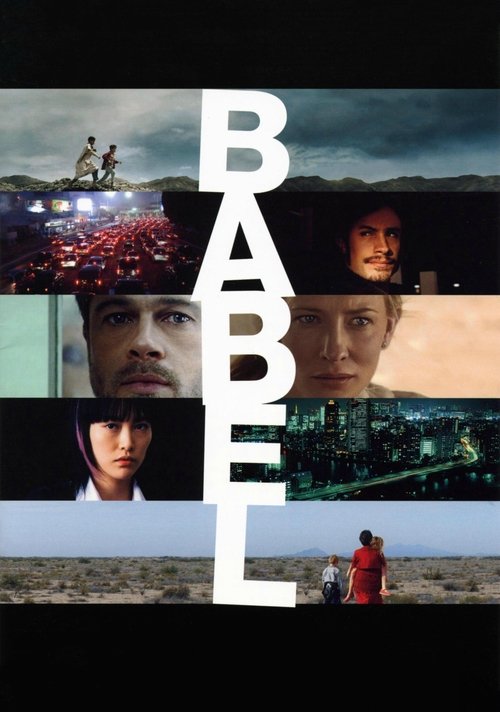
Babel
2006 · Alejandro G. Iñárritu
For when you want a film to chew on for days — a demanding, globe-spanning drama for a serious night, not a light one. Reach for it when you're ready to feel implicated, not soothed.
What it's about
A single rifle shot in the Moroccan desert wounds an American tourist, and the shockwave travels through four families on three continents: the injured couple stranded far from help, the goatherd's sons who fired the gun, the Mexican nanny caring for the couple's children back in San Diego, and a deaf teenage girl adrift in Tokyo. Their stories interlock across borders and languages, each one a study in people failing — or straining — to be understood.
The experience
Heavy, immersive, and deliberately uncomfortable — the film tightens several vises at once, cutting between crises so that dread accumulates from all directions. It asks for emotional stamina and repays it with moments of piercing tenderness.
Performances
Brad Pitt and Cate Blanchett strip away their star gloss as the couple in crisis, but the revelations are Adriana Barraza as the nanny whose loyalty leads her into an impossible situation, and Rinko Kikuchi, wordlessly devastating as the deaf Tokyo teenager — both earned Oscar nominations.
The craft
Iñárritu gives each country its own visual texture and rhythm, from handheld desert grit to the neon overload of Tokyo nightlife, with one club sequence that uses sound — and its absence — to put you inside a deaf girl's experience. Gustavo Santaolalla's spare score threads the strands together; this one genuinely rewards good speakers.
Why it matters
The capstone of Iñárritu's fractured-narrative trilogy with writer Guillermo Arriaga, it won him the directing prize at Cannes and a stack of Oscar nominations, and became the defining example of the 2000s wave of interlocking global-ensemble dramas.
Snapshot
Babel is the third and most expansive film in the loose "Trilogy of Death" that Alejandro González Iñárritu made with screenwriter Guillermo Arriaga, following Amores Perros (2000) and 21 Grams (2003). Where the earlier films confined their fractured, multi-strand structures to single cities — Mexico City, an unnamed American sunbelt town — Babel throws the network across the globe, braiding four family stories set in Morocco, the United States, Mexico, and Japan, all set in motion (directly or obliquely) by a single rifle and a single bullet. A married American couple (Brad Pitt and Cate Blanchett) is on a recuperative trip through the Moroccan desert when a shot fired by a goatherd's son wounds the wife; that incident ripples outward to a Mexican nanny improvising a border crossing with two American children, and connects, by way of the rifle's provenance, to a deaf Japanese teenager in Tokyo grieving her mother. The title invokes the Genesis myth of scattered tongues, and the film is built to dramatize the catastrophe of failed communication — across languages, borders, generations, and bodies. Premiering in competition at Cannes in 2006, it won Iñárritu the festival's Best Director prize and went on to seven Academy Award nominations, taking the Oscar for Gustavo Santaolalla's score. It is also the film on which the Iñárritu–Arriaga partnership ended, after a public falling-out over authorship.
Industry & production
Babel was a transitional object in mid-2000s American independent film: a globe-spanning art film financed and released through the specialty-studio apparatus. It was produced under the Anonymous Content banner with Iñárritu's Zeta/Central Films associates and released by Paramount Vantage, Paramount's then-new specialty division, with backing that made it considerably more ambitious in scale than the trilogy's earlier entries. Reported budgets cluster around the $25 million range; I flag this as the figure commonly cited rather than one I can verify against primary accounting. The production was genuinely multinational, shooting on location across three continents — the Moroccan desert near Ouarzazate and the village interiors of the Atlas foothills, the Tijuana–Sonora border zone, and Tokyo — with local crews and largely non-professional or regionally cast actors in the Moroccan and Mexican strands. Brad Pitt's participation gave the film star wattage and financing leverage while Iñárritu cast unknowns (the Moroccan boys, the village women) and regional professionals (Adriana Barraza, Gael García Bernal, Kōji Yakusho, Rinko Kikuchi) alongside. The film functioned as a prestige play in the awards economy of the period — Cannes launch, Golden Globe for Best Motion Picture (Drama), a clutch of Oscar nominations — and exemplified the brief vogue for the "hyperlink" or "network narrative" film that Paul Haggis's Crash, Stephen Gaghan's Syriana, and Fernando Meirelles's The Constant Gardener shared in the same few years.
Technology
Babel was shot photochemically, on film, by Rodrigo Prieto, and its technological signature lies less in any single innovation than in Prieto's deliberate decision to give each geographic strand its own photographic texture. Across interviews and trade-press accounts from the period, Prieto has described shooting the storylines on different gauges and stocks so that Morocco, Mexico, and Japan would feel materially distinct — coarser, hotter, and more granular in the desert; cooler and more synthetic in the Tokyo segments. I'd caution that the exact stock-and-format breakdown is reported with some variation, so I won't assert a precise gauge for each strand; the verifiable point is that the differentiation was a conscious, structural use of the medium rather than a continuity accident. This was very much of its moment: a 2006 production could still treat 16mm grain, 35mm anamorphic, and varied processing as an expressive vocabulary before the digital-capture transition flattened those choices. The film predates the Alexa era, and its look depends on emulsion, handheld camera operation, available and practical light, and on-location capture rather than on post-production grading as the primary stylistic engine — though the strands were also balanced in the timing suite to hold their separate identities.
Technique
Cinematography
Prieto's camerawork is the film's connective tissue — restless, handheld, close to the body, finding faces in crowds and reading discomfort in skin. The Moroccan material is sun-scorched and dusty, shot with a documentary nervousness that keeps the wounded Blanchett and the panicking villagers in tight, sweat-beaded proximity. The Mexican wedding and the subsequent border-crossing nightmare move from saturated celebration into a disorienting, headlight-streaked desert at night. The Tokyo strand is the formal outlier: glassy, neon-saturated, vertical, built from reflective surfaces and the cold geometry of the city. Prieto repeatedly stages communication failure visually — characters framed through windows, across language barriers, separated by glass and distance — so that the photography itself enacts the title's theme. The recurring use of long lenses to isolate figures within crowds, and of handheld intimacy that denies the viewer a stabilizing master shot, keeps the audience inside each character's limited, anxious horizon.
Editing
Cut by Stephen Mirrione and Douglas Crise, Babel is the trilogy's culmination of Arriaga-and-Iñárritu's signature non-linear architecture, though it is less aggressively scrambled than 21 Grams. The four stories are cross-cut so that they appear to unfold simultaneously, but the film quietly withholds the fact that the strands are not actually contemporaneous — the Tokyo and Morocco timelines are offset, a temporal sleight that only resolves on reflection. The editing's deeper purpose is rhyming: a gesture, a sound, or an emotional beat in one continent answers another, so that the cut becomes the film's primary argument about global interconnection. The pacing escalates by intercutting — the nanny's desert ordeal, the medical emergency in the village, the teenager's spiraling distress accelerate against one another toward a shared crisis pitch.
Mise-en-scène / staging
Iñárritu stages each world with strong environmental specificity: the spare stone interiors and rocky hillsides of the Berber village; the dense, warm chaos of the Mexican wedding giving way to the lethal emptiness of the night desert; the saturated verticality of Tokyo apartments, dental offices, and clubs. The staging consistently sets the human figure against a vast or indifferent setting — the desert, the border, the city — dramatizing smallness and exposure. Within scenes, blocking foregrounds barriers to contact: the language gulf between the American couple and their Moroccan helpers, the glass and signage of Tokyo, the checkpoint architecture of the border.
Sound
Sound is among the film's most discussed achievements, above all in the Tokyo strand, where Iñárritu renders the deaf protagonist's subjectivity by alternating between the full diegetic roar of a nightclub and abrupt, total silence — dropping the audience into her sensory world by cutting the sound entirely. The technique converts the film's communication theme into a directly felt perceptual experience and is the picture's signal formal coup. Elsewhere the soundscape is dense with untranslated language — Tamazight/Berber, Arabic, Spanish, Japanese, Japanese Sign Language, and English — and the film deliberately leaves much of it unsubtitled in effect, immersing viewers in the same incomprehension its characters suffer.
Performance
The acting is calibrated across a professional/non-professional spectrum. Brad Pitt and Cate Blanchett play against glamour, stripped down to fear and exhaustion in a single confined ordeal. The film's two Oscar-nominated supporting turns anchor its emotional extremes: Adriana Barraza as the nanny Amelia, whose love for her charges drives her into a catastrophic misjudgment, gives the film its most wrenching maternal performance; and Rinko Kikuchi as Chieko, the deaf Tokyo teenager, delivers a near-wordless portrait of grief, sexual desperation, and isolation that became the film's breakout. The Moroccan boys (Boubker Ait El Caid and Said Tarchani) and the village cast bring an unforced naturalism that grounds the strand that sets everything in motion.
Narrative & dramatic mode
Babel belongs to the "network" or "hyperlink" narrative mode — multiple ostensibly unrelated stories revealed to share causal and thematic connections. Its dramatic engine is irony and consequence: a small act (a father buying a rifle, a boy testing its range, a nanny making one bad decision) detonates across the globe, and the film's tragic logic insists that the powerful and the powerless are bound together yet unable to understand one another. The mode is melodramatic in the precise sense — it organizes feeling around families, mothers, and children in jeopardy — but it resists tidy resolution; several strands end in loss, deportation, or unresolved ache rather than catharsis. The withheld temporal offset between strands is itself a dramatic device, encouraging the viewer to read simultaneity where there is none and then to reckon with the manipulation.
Genre & cycle
The film sits at the intersection of the international art drama and the mid-2000s cycle of globalization-anxiety ensemble films. Alongside Crash (2004), Syriana (2005), The Constant Gardener (2005), and Iñárritu's own earlier work, it participated in a wave of post-9/11, post-NAFTA cinema preoccupied with borders, terrorism panic, migration, and the interdependence of distant lives. Within that cycle, Babel is distinguished by its genuinely transnational production and its refusal to center a single national perspective. It is also the closing panel of a self-conscious authorial cycle — the Iñárritu–Arriaga trilogy — and reads partly as that project's summa and its over-reach, depending on the critic.
Authorship & method
The film is the product of a now-famous and now-dissolved collaboration. Alejandro González Iñárritu directs with his characteristic intensity — handheld immediacy, cross-cut structure, an insistence on suffering as the route to meaning. Guillermo Arriaga wrote the screenplay and conceived the fractured architecture that defines all three trilogy films; Babel was the last film they made together, after which the two split publicly over credit, Arriaga asserting authorship of the structural conception and Iñárritu asserting directorial primacy. The rupture is part of the film's historical record and clarifies the stakes of the "who authored the form?" question that the trilogy raises. The key collaborators are central to the film's identity: cinematographer Rodrigo Prieto, Iñárritu's regular DP through this period; editor Stephen Mirrione (with Douglas Crise); and composer Gustavo Santaolalla, the Argentine musician whose spare, plangent scores — built on guitar, oud, and held tones — won consecutive Academy Awards for Brokeback Mountain (2005) and Babel (2006). Santaolalla's music is the connective emotional thread across the strands, a single sonic sensibility binding incommensurate worlds.
Movement / national cinema
Babel is a landmark of the so-called "Nuevo Cine Mexicano" / the international ascendance of the "Three Amigos" — Iñárritu, Alfonso Cuarón, and Guillermo del Toro — Mexican directors who, in the 2000s, moved fluidly between national and global production while reshaping prestige world cinema. The film is not bound to a single national cinema; it is a deliberately deterritorialized work, financed in Hollywood's specialty system, shot across Morocco, Mexico, Japan, and the U.S., and performed in six or more languages. Yet its sensibility — the centrality of family, the fatalism, the porousness of the Mexico–U.S. border treated from the southern side — carries a distinctly Mexican authorial signature into a transnational frame.
Era / period
Released in 2006, Babel is thoroughly a product of its moment: the post-9/11 climate of terrorism suspicion (the wounding of an American abroad is instantly, wrongly, read as terrorism by the world's media in the film), hardening U.S. immigration enforcement and border militarization, and an intensifying discourse of globalization. It also sits at the tail end of the photochemical era of American filmmaking, before digital capture became standard, which lends its differentiated film textures a period specificity. As the closing film of a trilogy begun in 2000, it marks the end of a particular early-2000s mode of structurally ambitious, grief-driven art cinema.
Themes
The governing theme is the breakdown of communication — the Babel myth literalized across languages, deafness, generational distance, and the failure of nations and families to understand one another. Around it cluster: the interconnectedness and asymmetry of a globalized world, where a single object (a rifle) and a single act bind people who will never meet; the precariousness of borders and the criminalization of migration (Amelia's strand is the film's moral heart, punishing love with deportation); parenthood and the protection of children as both the deepest human drive and the source of catastrophe; grief and isolation, most fully in Chieko's body and silence; and the gulf of misperception between the powerful and the vulnerable. The film argues that empathy is possible but tragically belated.
Reception, canon & influence
Critically, Babel was admired and contested in roughly equal measure — a division that has hardened over time. Its defenders praised the ambition, the performances (Barraza and Kikuchi especially), Prieto's photography, Santaolalla's score, and the audacity of the deaf-subjectivity sound design. Its skeptics charged it with schematic miserabilism, a sense that the global architecture exists to engineer suffering and to lecture, and that the Tokyo strand connects only tenuously to the central rifle plot. Awards bodies leaned toward admiration: Iñárritu took Best Director at Cannes; the film won the Golden Globe for Best Drama; it received seven Academy Award nominations including Best Picture, Best Director, two Best Supporting Actress nods, and Best Original Screenplay, winning for Santaolalla's score.
Influences on the film (backward): Babel draws on the network-narrative lineage of Robert Altman's ensemble films and Krzysztof Kieślowski's interlinked moral dramas, on Italian neorealism's use of non-professional actors and location shooting in its Moroccan and Mexican strands, and most directly on Iñárritu and Arriaga's own Amores Perros and 21 Grams, which established the fractured, fate-driven form the film globalizes. The Genesis myth supplies its organizing metaphor.
Legacy (forward): The film consolidated Iñárritu's standing as a major international auteur and helped propel the "Three Amigos" to the center of prestige cinema — a trajectory that led Iñárritu to later Academy Awards for Birdman (2014) and The Revenant (2015). It made Rinko Kikuchi an international figure and showcased Rodrigo Prieto and Gustavo Santaolalla to wide acclaim. It stands as both the high-water mark and the closing statement of the multi-strand globalization drama cycle; after the mid-2000s, that mode's prestige waned, partly under the weight of the very criticisms Babel attracted. Its most durable contribution may be formal and specific: the nightclub sequence's silence remains a frequently cited example of subjective sound design and a touchstone for filmmakers seeking to render disability and perception from the inside. The end of the Iñárritu–Arriaga collaboration, finalized with this film, also closed one of the most distinctive screenwriter-director partnerships in 2000s cinema.
A Deleuzian reading
A boy lies on a ridge in the Atlas foothills, squints through a borrowed rifle scope, and swings the barrel toward a tour bus crawling along a far road — just to see how far the gun will throw a bullet.
The full Deleuzian reading of Babel →
Reception
In 2006 it was an event — Best Director at Cannes, the Golden Globe for Best Drama, and seven Oscar nominations as a Best Picture frontrunner (it lost to The Departed). Today it's the poster child for mid-2000s 'everything is connected' prestige cinema, and its stock has slid even as the Tokyo strand keeps getting singled out as the great film hiding inside it.
How Babel was received, from release to now →
Influences: the films it descends from and the films it influenced
- Amores Perros (2000) — Arriaga's tripartite structure converging on a single vehicular catastrophe established the fractured, fate-driven template that Babel scales to three continents.
- 21 Grams (2003) — Perfected the Iñárritu–Mirrione grammar of non-linear cross-cutting among strangers bound by one accident, the editing logic Babel inherits wholesale.
- Short Cuts (1993) — Network-narrative mosaic in which unrelated lives glance off one another across a city, the ensemble architecture Babel globalizes.
- Nashville (1975) — Weaves a large ensemble through overlapping sound and incidental crossings rather than causal plot — the loose-connection principle behind the rifle's chain of consequence.
- Three Colours: Red (1994) — Interlinked moral drama in which chance and unseen connection bind geographically separate lives, a model for Babel's fate-by-coincidence design.
- Bicycle Thieves (1948) — Neorealist casting of non-professionals shot on real locations — the method Iñárritu applies to the Moroccan village and Tijuana strands.
- Traffic (2000) — Assigns each geographic strand its own film stock and color grade to orient the viewer — the direct craft precedent for Prieto's differentiated-stock scheme across Morocco, Mexico, and Tokyo.
- Code Unknown (2000) — Builds a fractured global ensemble around untranslated multilingual exchange to dramatize failed communication, anticipating Babel's untranslated-language gambit.
- Magnolia (1999) — Biblical-scaled ensemble of simultaneous suffering bound by coincidence and a single sonic-emotional throughline, paralleling Santaolalla's connective score.
- Syriana (2005) — Multi-strand globalization drama linking oil geopolitics across continents and languages, a peer entry in the mid-2000s prestige globalization cycle.
- House of Sand and Fog (2003) — Inherits the diasporic cross-cultural cross-cutting and tragedy-of-misunderstanding, with a culturally inflected score and accelerating parallel structure echoing the seed's design.
- Night on Earth (1991) — Adopts the multi-city, multilingual simultaneity structure but restores exactly what Jarmusch withheld — causal links between the strands — turning language barrier from an ambient condition into a plot mechanism, which makes it the instructive inverse of the seed's central refusal.
- Biutiful (2010) — Continues Prieto's handheld, figure-against-vast-urban-setting framing and the suffering-as-meaning method after the Arriaga split severed the network structure.
- Birdman (2014) — Extends Iñárritu's maximalist directorial control into virtuoso long-take staging and aggressive sonic experimentation, the post-Babel evolution of his style.
- Sound of Metal (2019) — Renders deafness from inside via subjective sound design that drops the audience into silence — the direct heir to Babel's nightclub deaf-subjectivity sequence.
- The Tribe (2014) — Radicalizes the untranslated-language device by staging an entire film in unsubtitled sign language, pushing Kikuchi's deaf subjectivity to a formal extreme.
- Super Deluxe (2019) — Parallel montage in which a single object/event detonates consequences across geographically separate storylines — the ripple-across-strands cutting logic.
- Crash (2004) — Contemporaneous collision-ensemble using engineered chance encounters to indict social division — the same schematic that drew Babel its 'miserabilism' critique.
- The Three Burials of Melquiades Estrada (2005) — Arriaga screenplay deploying the same fractured, border-crossing chronology and untranslated Spanish, made in parallel with the trilogy's structural method.
- Children of Men (2006) — Three Amigos handheld, long-lens immersion and on-location verisimilitude that prizes documentary immediacy over coverage, shot the same year by a fellow Mexican auteur.
- Crisis (2021) — A contemporaneous globe-spanning network narrative whose engineered convergences across separate strands define the mosaic cycle Crisis works inside.
- The Constant Gardener (2005) — Sibling in the globalized-injustice mode — fractured cross-cut narrative and immersive on-location vérité linking privileged Westerners to consequences in the Global South.
- Slumdog Millionaire (2008) — A contemporaneous transnational cross-cut multi-strand frame-tale packaging Global-South suffering for global art-house audiences, sharing Slumdog's editing-as-fate structure and coproduction model.
- Contagion (2011) — A globe-spanning network narrative cross-cut by Mirrione that traces one event's ripples across continents — the transnational parallel architecture Contagion deploys for a virus.
- The Hours (2002) — Carries forward the cross-cutting of geographically and temporally separated lives bound by a single existential thread, the editing asserting kinship the characters never knowingly share.
- Under the Same Moon (2007) — Deploys transnational hyperlink crosscutting across languages and borders, imperiling a child through an adult's undocumented crossing — the bilingual, border-spanning parallel-montage architecture shared with Riggen's design.
Similar films
- Amores Perros (2000) — influence & lineage · often watched together
- Biutiful (2010) — influence & lineage · often watched together
- 21 Grams (2003) — influence & lineage · often watched together
- Syriana (2005) — influence & lineage
- Children of Men (2006) — influence & lineage · often watched together
- It Was Just an Accident (2025) — often watched together
- Melancholia (2011) — often watched together
- Lost in Translation (2003) — shared sensibility
All the films related to Babel →