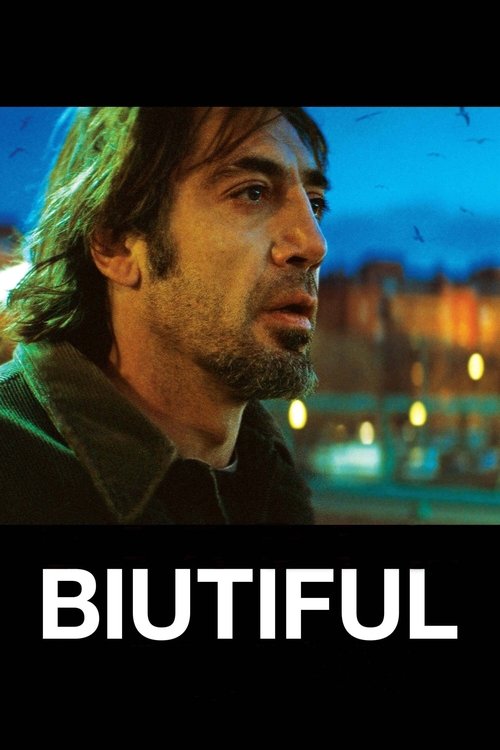
Biutiful
2010 · Alejandro G. Iñárritu
For when you want to be leveled by a film — a serious, challenging watch for a night you have the emotional room for it. Not comfort viewing; choose it when you want cinema that costs you something.
What it's about
In the immigrant underworld of Barcelona, a small-time fixer named Uxbal brokers work for undocumented Chinese laborers and Senegalese street vendors while raising two kids largely on his own, his marriage to their bipolar mother in ruins. Diagnosed with terminal cancer, he sets out to put his tangled affairs in order — a task complicated by his uneasy gift for sensing the recently dead.
The experience
Heavy, immersive, and unflinching — a slow descent through one man's conscience that holds your face to hardship without letting go. It's grueling in the moment and strangely tender underneath, the kind of film that leaves you wrung out and moved.
Performances
Javier Bardem is monumental — a full-body portrait of a man carrying guilt, illness, and love all at once. He shared the Best Actor prize at Cannes for it, and the film rests almost entirely on his shoulders.
The craft
Iñárritu strips out his signature fractured timelines for a single sustained line, shooting Barcelona's unseen margins with a grainy, handheld intimacy far from the postcard city. The realism is so dense you can practically smell the rooms.
Why it matters
It closed the chapter of Iñárritu's grief-laden early period before his reinvention, and it stands as one of the defining screen portraits of Europe's undocumented economy.
Snapshot
Biutiful is Alejandro González Iñárritu's fourth feature and the film that closed one chapter of his career while opening another. It follows Uxbal (Javier Bardem), a small-time fixer in the immigrant underworld of Barcelona who, diagnosed with terminal prostate cancer, tries to set his affairs in order — his two children, his bipolar estranged wife, the Chinese sweatshop laborers and Senegalese street vendors whose exploitation he brokers, and a fragile gift for communicating with the recently dead. Where Iñárritu's earlier work fractured time and braided multiple strangers' fates, Biutiful is comparatively linear and single-minded: a sustained descent through one dying man's conscience. The film premiered in competition at the 2010 Cannes Film Festival, where Bardem shared the Best Actor prize with Elio Germano; it went on to a Best Foreign Language Film nomination (as Mexico's submission) and a Best Actor nomination for Bardem at the 83rd Academy Awards. It is the director's first Spanish-language feature since his 2000 debut Amores Perros, and his first screenplay written without Guillermo Arriaga. The title is the phonetic spelling of "beautiful" as a child would render it — a small, aching emblem of the film's insistence that tenderness survives inside squalor.
Industry & production
Biutiful was made as a Mexico–Spain co-production, with Iñárritu's own company among the producing entities alongside Spanish partners, and international backing that connected it to Focus Features' orbit; it reached U.S. theaters through a specialty release. (Specific distribution deals and financing figures vary across sources, so I note the structure only in broad terms rather than asserting exact numbers.) The project marked Iñárritu's return to working principally in Spanish and on European ground after the globe-spanning, multi-territory logistics of Babel (2006). Production was based in Barcelona, but pointedly not the tourist Barcelona of Gaudí facades and Ramblas cafés; Iñárritu and his team worked in peripheral, working-class and immigrant districts — the Santa Coloma area and comparable neighborhoods — to render a city usually kept off-camera. Casting Bardem, then at the height of his post-No Country for Old Men international standing, gave the film its commercial and critical anchor; Iñárritu has spoken of building the film substantially around him. As an arthouse drama running nearly two and a half hours, in Spanish, on grim subject matter, Biutiful was never a mass-market proposition, and its theatrical performance was modest and festival-driven rather than broad — I'll refrain from citing box-office totals I cannot verify precisely.
Technology
Biutiful belongs to the late-film, early-digital transitional moment, and it reflects Iñárritu and cinematographer Rodrigo Prieto's preference in this period for a tactile, photochemical-feeling image rather than the polished digital sheen then emerging. The visual signature is grain, available or naturalistic light, and long handheld takes that demand agile camera support rather than heavy rigging. I am not certain of the precise capture format and will not assert a gauge I cannot confirm; what is safe to say is that the look was engineered toward texture and immediacy, not gloss. The film's more overtly "effects"-inflected passages — Uxbal's encounters with the dead, bodies hovering against ceilings — are handled with restraint, achieved through in-camera staging and subtle post work rather than spectacle, so that the supernatural registers as an extension of the physical world rather than a rupture from it. This technological modesty is itself a statement: the machinery stays invisible so that the human face and the degraded urban surface carry the film.
Technique
Cinematography
Rodrigo Prieto, Iñárritu's cinematographer since Amores Perros, shoots Biutiful in a cold, desaturated register — leaden blues, sodium-lit interiors, skin rendered sallow and mortal. The camera is predominantly handheld and close, pressing into Bardem's face and shoulders, so that the audience is held at the intimate, slightly unstable distance of someone attending a sickbed. Prieto favors shallow focus and cramped framings that mirror Uxbal's constricting world; the city is glimpsed obliquely, in stairwells, back rooms, markets, and rooftops rather than establishing vistas. Where light turns warm — a bedroom, a child's face — it reads as fragile grace against the surrounding chill. The recurring snowy-forest imagery that frames the film is shot with a different, dreamlike clarity, marking it off from the urban present.
Editing
Stephen Mirrione, who cut Babel and would become a fixture of Iñárritu's later work, edits Biutiful toward duration and immersion rather than the aggressive cross-cutting of the director's Arriaga-era triptychs. This is the crucial technical break: the montage no longer scrambles chronology across parallel lives. Instead, scenes are allowed to run, breathing in real time, so that mortality accrues weight. Mirrione still deploys ellipsis and association — the film moves fluidly between Uxbal's obligations to the living and his brushes with the dead — but the governing principle is continuity and accumulation, the slow tightening of a single life running out of time.
Mise-en-scène / staging
The film's staging is an argument about the invisible economies beneath a modern European city: sweatshop basements where Chinese workers sleep on the floor, the pavement stalls of Senegalese vendors, the cramped apartment where Uxbal raises his children. Production and location design foreground clutter, damp, and confinement; the frame is dense with the material evidence of poverty. Bodies are staged in proximity — crowded rooms, shared beds, the press of a market — so that intimacy and exploitation occupy the same physical space. Against this, small ritual objects (money folded into an envelope, a child's drawing, the sea) acquire outsized emotional charge.
Sound
Gustavo Santaolalla, the Argentine composer whose spare, guitar-and-drone scores defined 21 Grams and Babel (the latter an Oscar winner), again supplies music of great economy — held tones, minimal instrumentation, silence used as a structural element. The score does not swell to underline grief; it hovers, ambient and mournful. The sound design leans documentary, thick with the polyglot noise of the immigrant city — Spanish, Catalan, Mandarin, Wolof — so that language itself dramatizes displacement and the failure of full communication.
Performance
Biutiful is, more than any prior Iñárritu film, a vehicle for a single performance, and Javier Bardem meets it with a portrayal of physical and moral exhaustion that carries the entire runtime. His Uxbal is heavy, stooped, tender, and compromised — a man who profits from others' misery yet cannot stop trying to protect them, and whose body is visibly failing. Bardem plays illness from the inside: the sweat, the incontinence, the fear behind the paternal calm. The Cannes jury's Best Actor award (shared) recognized the achievement, as did the Academy. The surrounding cast — Maricel Álvarez as the volatile ex-wife Marambra, and the nonprofessional and lesser-known players filling the immigrant milieu — is directed toward raw naturalism, throwing Bardem's controlled interiority into relief.
Narrative & dramatic mode
Dramatically, Biutiful is a death-watch: a linear, tragic account of a man arranging the world for those he will leave behind. This is a decisive shift from the "hyperlink" or network narratives of Iñárritu's first three features, where meaning emerged from the collision of separate storylines across fractured time. Here the structure is essentially one continuous arc, bracketed by a framing device — a quiet, otherworldly encounter with Uxbal's dead father in a snowfield — that transforms the film into a kind of circle, ending where it begins and reframing the whole as a passage between the living and the dead. The mode is melodrama in the serious, classical sense: heightened suffering, moral stakes rendered through familial love, and a hero whose redemption is measured not in success but in the quality of his caring. The supernatural thread — Uxbal's ability to sit with the newly dead and relay their words — is handled as ambiguous fact rather than fantasy, a naturalized mysticism that keeps the film hovering between social realism and the metaphysical.
Genre & cycle
The film sits at the intersection of several currents: the social-realist drama of migration and precarity in fortress Europe; the mortality drama or "dying man" film; and the art-cinema tragedy of male suffering. It participates in a 2000s cycle of festival films attentive to globalization's undersides — undocumented labor, trafficking, the human cost of cheap goods — while filtering that material through an intensely personal, spiritual lens rather than a journalistic one. Within Iñárritu's own filmography it is often grouped as a coda to, or departure from, the so-called "Death Trilogy" (Amores Perros, 21 Grams, Babel): it shares their preoccupation with mortality and interconnection but abandons their formal fragmentation.
Authorship & method
Biutiful is the pivot of Iñárritu's authorship. After Babel, his celebrated partnership with screenwriter Guillermo Arriaga ended amid a public dispute over creative credit, and this film is the first Iñárritu wrote himself — sharing screenplay credit with Armando Bo and Nicolás Giacobone, collaborators who would continue with him through Biutiful's aftermath and into Birdman. The result is a stated reaction against the puzzle-box construction that Arriaga's scripts had made the director's signature: a deliberate turn toward a single protagonist, forward-moving time, and undiluted emotional immersion. Iñárritu's method — building the film around Bardem, embedding in real Barcelona neighborhoods, working with a mix of professional and nonprofessional actors, and retaining his long-standing craftspeople — reflects an author reconsolidating his voice under his own name. The continuity of collaborators is telling: cinematographer Rodrigo Prieto, editor Stephen Mirrione, and composer Gustavo Santaolalla had all been essential to the earlier films, so Biutiful changes the narrative architecture while preserving the sensory grammar. It is, in retrospect, the bridge between the fractured Iñárritu of the 2000s and the virtuoso long-take Iñárritu of Birdman and The Revenant.
Movement / national cinema
Biutiful is a landmark of transnational cinema and of the Mexican directorial generation — Iñárritu, Alfonso Cuarón, Guillermo del Toro — that reshaped global art film in the 2000s. Though set in Spain and steeped in European social reality, it is a Mexican-authored work and represented Mexico in the foreign-language Oscar race, underscoring how these filmmakers operate across national boundaries rather than within a single industry. It also engages Spanish cinema's own reckoning with immigration and the multicultural, post-boom city, contributing a Mexican outsider's gaze to a Spanish subject. The film's polyglot texture — its refusal to privilege a single national language or perspective — is itself an expression of the borderless, diasporic condition that defines this strand of world cinema.
Era / period
Made and released as the digital transition accelerated and as Europe absorbed the early shocks of the late-2000s financial crisis, Biutiful is very much a film of its moment: it registers the anxieties of migration, informal labor, and economic precarity that would only intensify through the decade. Within Iñárritu's career it belongs to the closing of his first phase — after the trilogy, before the American reinvention of the mid-2010s. Its aesthetic conservatism relative to the coming digital slickness, and its faith in the sustained dramatic take, place it at a hinge between two eras of production.
Themes
Death is the film's governing subject — not as event but as process, negotiated daily by a father who must teach himself how to leave. Around it cluster fatherhood and inheritance (what a parent can pass to a child besides money and fear), the ethics of complicity (Uxbal profits from exploitation even as he tries to soften it), and the invisibility of the poor and undocumented within the prosperous city. The film is also a meditation on the porous boundary between the living and the dead, using Uxbal's mediumship to literalize the idea that we remain bound to those we lose. Redemption here is unspectacular and incomplete: not salvation but the persistence of love and responsibility inside a compromised life. The title's misspelled "beautiful" crystallizes the theme — beauty as something imperfect, childlike, and defiantly present amid degradation.
Reception, canon & influence
Critical reception was admiring but divided, and the division is itself revealing. Bardem's performance drew near-unanimous praise and the film's two major awards nominations grew directly from it; the Cannes Best Actor prize and the Oscar nomination cemented the portrayal as one of his finest. Opinion split, however, over Iñárritu's tone: admirers found the film a wrenching, deeply humane tragedy and a mature turn away from formal trickery, while skeptics judged its relentless accumulation of suffering excessive — a critique of "misery" that had trailed the director since 21 Grams. That debate over emotional maximalism is central to the film's reputation.
Looking backward, the film's influences are legible: the mortality-and-conscience tradition of European art cinema, the social-realist attention to labor and migration associated with directors working in a documentary-inflected register, and the metaphysical strain of films that treat the afterlife as continuous with daily life. Its spiritual gravity and its portrait of a suffering father invite comparison to a long lineage of tragic-humanist drama, though Biutiful filters all of it through Iñárritu's own sensory intensity.
Looking forward, the film's most consequential legacy is internal to its author. By breaking with the fractured, multi-strand structure and proving Iñárritu could sustain a film on a single continuous arc and a single face, Biutiful prepared the ground for the radical formal experiments that followed — the "single-take" bravura of Birdman (2014) and the immersive endurance of The Revenant (2015), both made with the writing collaborators (Bo and Giacobone) he first partnered with here. The films that would win him consecutive Academy Awards are, in structural terms, unimaginable without this pivot. Biutiful also stands as one of the defining showcases of Javier Bardem's career and a durable reference point in debates about how far a serious drama can press its audience into grief. Its broader influence on other filmmakers is harder to trace with confidence, and I won't overstate it; its clearest and best-documented impact is as the turning point in the work of one of contemporary cinema's major directors.
A Deleuzian reading
A dead body is up near the ceiling of a cheap room.
The full Deleuzian reading of Biutiful →
Reception
Booed-and-cheered at Cannes and dismissed by many critics as two-and-a-half hours of miserabilism, it's since crept upward as the 'underrated Iñárritu' — the one people revisit for Bardem and quietly admit got under their skin.
How Biutiful was received, from release to now →
How to watch Biutiful: what to notice on a first viewing
- Watch how close Prieto's handheld camera stays to Bardem. It presses into his face and shoulders at the slightly unstable distance of someone sitting beside a sickbed. Shallow focus keeps the rooms cramped and close around him all film. You are held at the range of an attendant rather than an observer, which is exactly where the film wants you.
- Watch the color turn warm around the children. Prieto keeps Barcelona in leaden blues and sodium orange with skin rendered sallow. When a bedroom or a child's face goes warm, the warmth stands out and looks breakable. The palette marks what he stands to lose, so you can read the stakes off the color of a room.
- Look at which parts of Barcelona you never see. No Gaudi, no Ramblas, no postcard vista. Stairwells, back rooms, pavement stalls, a basement where Chinese laborers sleep on the floor. The film stays in the peripheral districts. The tourist city is deliberately absent, so what you see is only the economy that supplies it.
- Watch how the dead are filmed in the room. A body up near the ceiling carries the same grain and tired light as the furniture underneath it. No filter, no music cue, no cut to another world. Uxbal treats the visit as work. Nothing in the image sorts the living from the dead, so the film declines to tell you what is real.
- Listen for four languages inside one city. Spanish, Catalan, Mandarin, and Wolof cross in markets and back rooms while the subtitles keep triaging. Santaolalla's score holds single tones and lets silence stand where grief would usually get underlined. Nobody here understands everyone, and the only thing holding these populations in contact is one man taking a cut.
The whole guide to watching Biutiful, with the keys for a rewatch →
Influences: the films it descends from and the films it influenced
- Babel (2006) — Directly the negative template: Biutiful retains Santaolalla's minimalist ache and the polyglot, subtitle-heavy sound design of Babel but jettisons its Arriaga puzzle-box structure for one forward-moving arc.
- Amores Perros (2000) — Establishes the Iñárritu–Prieto grammar of grip-tight handheld cameras pushed into overcrowded urban interiors that Biutiful inherits and strips of its multi-strand scaffolding.
- 21 Grams (2003) — Source of Prieto's leached, cold-blue desaturation and the 'accumulated suffering around a dying body' register that Biutiful carries forward while abandoning the fractured chronology.
- Bicycle Thieves (1948) — Neorealist method of casting nonprofessionals in real streets and anchoring the film to a father-and-child dyad moving through a hostile labor economy — the staging playbook for Uxbal's Barcelona underworld.
- Umberto D. (1952) — Durational, unsentimental observation of a marginalized man's material decline that models Biutiful's patient continuity-editing over his failing body.
- Ikiru (1952) — Prototype of the linear death-watch: a terminal diagnosis reorganizes the protagonist's remaining time into a race to set his affairs and children in order, mortality treated as process rather than event.
- Ordet (1955) — Foundational 'naturalized mysticism' — the miraculous (the dead speaking, resurrection) admitted into an austere domestic realism without genre framing, the exact register of Biutiful's morgue visitations.
- Cries and Whispers (1972) — Bergman's deathbed intimacy and mortality-as-durational-suffering, filtered through saturated bodily interiors, feeds Biutiful's spiritual gravity and its refusal to look away from dying.
- La Promesse (1996) — The immigrant-underworld exploitation economy plus a father-and-son moral-complicity structure shot in tight verité handheld — the closest social-realist ancestor to Uxbal's people-smuggling guilt.
- The Death of Mr. Lazarescu (2005) — Near-real-time, handheld death-watch that subordinates plot to the physiological duration of one body failing, sibling to Biutiful's mortality-as-process pacing.
- The Spirit of the Beehive (1973) — Spanish tradition of a child's perception admitting the dead into the everyday frame, a naturalized-mysticism lineage Biutiful joins by making Uxbal's clairvoyance mundane.
- A Prophet (2009) — Sibling social-realist immersion in a migrant criminal economy, using handheld proximity and nonprofessional texture to naturalize an underworld labor market.
- Amour (2012) — Sibling in mortality-as-process: a single domestic space becomes an unbroken deathwatch that presses the audience into grief through duration, the same 'how far can drama press us' debate Biutiful provoked.
Similar films
- Amores Perros (2000) — influence & lineage · same viewing thread · often watched together
- Babel (2006) — influence & lineage · often watched together
- 21 Grams (2003) — influence & lineage · often watched together
- The Revenant (2015) — influence & lineage
- The Young and the Damned (1950) — same viewing thread
- Souleymane's Story (2024) — same viewing thread
- Pixote (1980) — same viewing thread
- Pain and Glory (2019) — shared sensibility
All the films related to Biutiful →
Watch it with: curated runs of related films
- Cinema of the Dispossessed — A run of slum-and-favela dramas — Rio, Mexico City, Mumbai, the Paris banlieue — where children survive by their wits and the city itself is the antagonist.