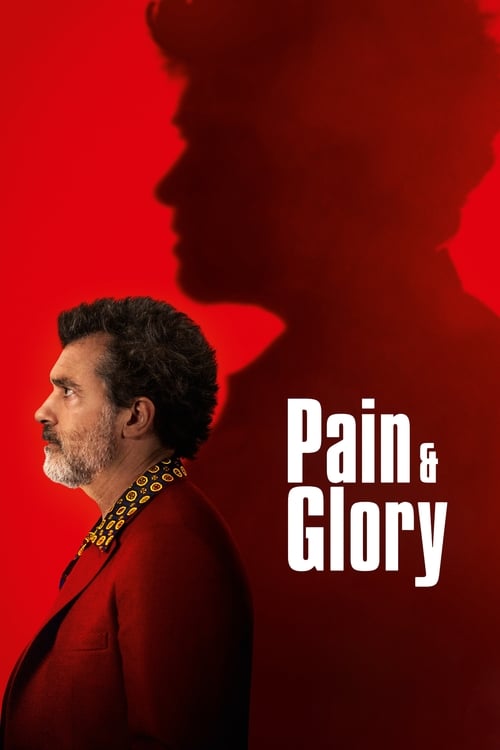
Pain and Glory
2019 · Pedro Almodóvar
Spain's institution entered his English-language era (The Room Next Door, Venice Golden Lion) amid discourse about late style and euthanasia on film; his refusal to soften political statements at ceremonies keeps him quotable.
For a contemplative night when you want something beautiful and adult about memory, regret, and getting older — a film to sit with over a glass of wine, not background viewing.
What it's about
A celebrated Madrid film director, his body failing and his inspiration stalled, drifts through the rooms of his own life: a poor, sunlit childhood in a Valencian cave house, a mother he can't stop returning to, an old lover, an estranged leading man, and the heroin he starts using to dull his chronic pain. It's a portrait of an artist trying to figure out whether he can make anything at all without cannibalizing everything he's lived.
The experience
Slow-burning, tender, and quietly devastating — the emotion accumulates rather than erupts, and the ending lands with a grace that stays with you. Less a tearjerker than a long exhale.
Performances
Antonio Banderas gives the performance of his life — hushed, physically pained, self-mocking — playing a version of the director who discovered him forty years earlier, and he won Best Actor at Cannes for it. Penélope Cruz glows as the mother in the childhood scenes.
The craft
Almodóvar's signature saturated reds and cobalts are all here (the apartment is nearly a replica of his own), but the melodrama has settled into something calm and precise. Every frame is composed like a painting, and the movement between past and present is seamless — late style from a master in full control.
Why it matters
Widely received as Almodóvar's most nakedly autobiographical film and a career summation, it joined the great tradition of directors turning the camera on their own creative lives and earned Banderas the finest notices of his career.
An aging Madrid filmmaker, body failing and inspiration stalled, drifts through memory — a childhood in a whitewashed cave house in Valencia, a mother played in youth by Penélope Cruz, an old lover, an estranged leading man — in Pedro Almodóvar's most nakedly autobiographical film. The provocateur of the Movida madrileña, who spent the eighties scandalizing post-Franco Spain in shrieking color, here works in a late style of astonishing calm: the reds and cobalts are still saturated (the protagonist's apartment is a near-replica of Almodóvar's own), but the melodrama has settled into rue and tenderness. Antonio Banderas, the director's discovery four decades earlier, gives the performance of his life as the alter ego — hushed, physically pained, self-mocking — and took Best Actor at Cannes for it. The film sits in a lineage with 8½ and other portraits of the artist as blocked man, but Almodóvar's twist is structural, a final movement that quietly reframes everything preceding it. Desire, he suggests, is what a filmmaker runs on; the film is the act of refueling. It completes an informal autobiographical trilogy with Law of Desire and Bad Education.
A Deleuzian reading
Sun on whitewash.
The full Deleuzian reading of Pain and Glory →
Reception
Hailed instantly at Cannes 2019 as a late-career peak — 'his best since Talk to Her' was the refrain — and it's only consolidated since, topping Cahiers du Cinéma's 2019 list and settling in as consensus late-Almodóvar canon.
How Pain and Glory was received, from release to now →
Influences: the films it descends from and the films it influenced
- 8½ (1963) — Supplies the template Almodóvar inherits wholesale: the blocked-artist-director protagonist whose creative paralysis dissolves the boundary between present-day reality, memory, and staged fantasy, structured as a mosaic of flashbacks summoned by desire rather than plot.
- Amarcord (1973) — Models the sun-drenched, sensory childhood-memory sequence — the whitewashed village, laundry drying, the awakening to adult sexuality — that Almodóvar restages in the Paterna cave-house flashbacks with Penélope Cruz as the idealized mother.
- Wild Strawberries (1957) — Pioneers the aging-artist road-of-memory structure where an old man's present journey triggers seamless walk-in flashbacks to his youth, the elder gazing into his own remembered past within the same frame.
- Spirit of the Beehive (1973) — Establishes the hushed Spanish-childhood-memory grammar of light through whitewashed interiors and a child's contemplative POV that Almodóvar's saturated flashbacks quote as national craft heritage.
- Douglas Sirk's Written on the Wind (1956) — Source of Almodóvar's lifelong melodrama method — emotionally charged primary-color art direction and lacquered mise-en-scène where saturated reds and greens carry feeling the dialogue withholds.
- Law of Desire (1987) — Almodóvar's own earlier film-director-protagonist study, casting Antonio Banderas in a story of desire and creation, establishing the Banderas-as-alter-ego and gay-artist autobiography he returns to and refines here.
- Sunset Boulevard (1950) — Ancestor of the artist-in-decline reframing twist — a story about filmmaking narrated from a position of creative death, closing by revealing itself as a constructed cinematic artifact, prefiguring the film's final reveal that we've been watching a scene being shot.
- Before Night Falls (2000) — A sensual, first-person autobiographical portrait of an artist in which color, the body and memory fragments stand in for chronology — extending the lyrical, testimonial artist-self-portrait into Spanish-language cinema with Bardem-era star intimacy.
- Talk to Her (2002) — Carries forward the displaced-emotion method and Iglesias-scored melancholy into autobiographical register, the late terminus of the thread begun here.
- Endless Poetry (2016) — Extends the aging-artist Künstlerroman in which the director confronts his own past and reconciles with the father/mother figure, using a doubled autobiographical surrogate as Jodorowsky does.
- Roma (2018) — Contemporary autobiographical memory-film by a fellow auteur, reconstructing childhood and a domestic-maternal figure with meticulous period mise-en-scène, sharing the desire to render personal memory as precisely composed cinema.
- The Hand of God (2021) — Explicitly Fellini-and-Almodóvar-descended coming-of-age memoir where a future director's adolescent awakening, family, and loss are staged in warm Mediterranean color as origin myth of his own filmmaking.
- Belfast (2021) — Late-style autobiographical childhood-memory film that follows Pain and Glory's post-2019 wave of directors mining their own youth, using heightened stylization to frame formative memory as the wellspring of vocation.
- Parallel Mothers (2021) — Almodóvar's own subsequent film continuing the late-style, Cruz-anchored maternal-memory craft and the confrontation with Spanish historical past that Pain and Glory reopened in his autobiographical mode.
- The Beloved (2026) — Almodóvar makes a director's own biography the material and casts collaborators as versions of themselves, setting the terms any Spanish film about an aging filmmaker's accounting must now meet.
- Bad Education (2004) — The prior panel of the autobiographical trilogy: religious-school childhood, a film-director stand-in, and a nested film-within-the-film reframing device that Pain and Glory echoes in its final pull-back-to-the-set twist.
- Broken Embraces (2009) — A blocked/blinded filmmaker reconstructing his past through memory, sharing the saturated-color cinematography (with DP Rodrigo Prieto/José Luis Alcaine lineage) and the meta-cinematic reframing of a life as edited footage.
- Volver (2006) — Same Penélope Cruz as the earthy, resilient Manchegan mother figure rendered in warm saturated palette, extending Almodóvar's craft of maternal iconography drawn from his own La Mancha childhood.
- All About My Mother (1999) — Refines the melodrama-as-autobiography engine and the practice of quoting other artworks (theater, film) as structuring mirrors, the technique Pain and Glory turns inward onto the director's own body of work.
- The Mirror (1975) — Parallel innovation in autobiographical film-form: dissolving an ailing artist's present into non-chronological, sensory childhood memories of the mother, prioritizing associative image-logic over narrative causality.
- Fanny and Alexander (1982) — Extends the same late-career autobiographical impulse — a filmmaker mythologizing his own childhood in richly colored, theatrically staged memory tableaux as a summation of a life's work.
- Sentimental Value (2025) — A reflexive aging director confronts his own art and his parent through memory inserts, dramatizing the ethics of converting lived intimacy into cinema alongside Trier's film.
Similar films
- All About My Mother (1999) — influence & lineage
- Volver (2006) — influence & lineage
- Law of Desire (1987) — influence & lineage
- Bad Education (2004) — influence & lineage
- Biutiful (2010) — shared sensibility
- The Skin I Live In (2011) — shared sensibility
- Close Your Eyes (2023) — shared sensibility
- Talk to Her (2002) — shared sensibility
All the films related to Pain and Glory →