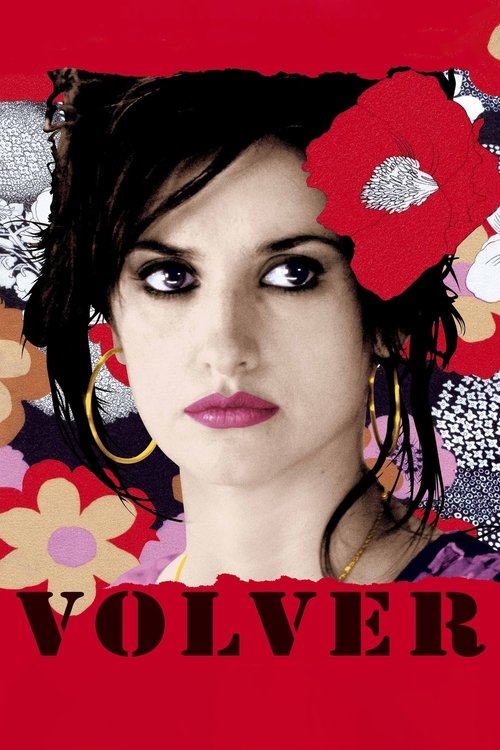
Volver
2006 · Pedro Almodóvar
Spain's institution entered his English-language era (The Room Next Door, Venice Golden Lion) amid discourse about late style and euthanasia on film; his refusal to soften political statements at ceremonies keeps him quotable.
For when you want a film with heart and juice — something about mothers, daughters, and survival that makes you laugh and leaves you moved rather than wrecked. Comfort viewing with real substance underneath.
What it's about
In Madrid and the windswept villages of La Mancha, three generations of women in one family navigate secrets, superstition, hard work, and men who fail them — while their dead matriarch seems reluctant to stay entirely gone. What starts as domestic survival slides, without a visible seam, into ghost story, comedy, and full-blooded melodrama.
The experience
Warm, funny, and sneakily profound — it glides between laughter and grief so smoothly you barely notice crossing the line. There's darkness in the material, but the film wraps it in color, music, and an almost defiant vitality.
Performances
Penélope Cruz is magnetic in the role that remade her international career and made her the first Spanish actress nominated for the Best Actress Oscar; at Cannes the entire female ensemble, including Carmen Maura and Lola Dueñas, shared the acting prize.
The craft
Almodóvar at the height of his powers, returning to the La Mancha of his childhood: saturated reds, a script that juggles ghost comedy and kitchen-sink melodrama without dropping either, and an affection for its women that saturates every frame. The tonal control — how much it holds together without ever feeling busy — is the real special effect.
Why it matters
A career summit for Almodóvar that fused his early ensemble comedies with his mature style, and the film that turned Penélope Cruz from international star into major dramatic actress.
Pedro Almodóvar's return — the title means exactly that — to the windswept La Mancha of his childhood and to the female ensembles of his early career, filtered through two decades of accumulated mastery. Three generations of one family contend with secrets, fire, superstition, and a dead matriarch whose presence refuses to stay figurative; the register glides between neorealist melodrama, ghost comedy, and something like a Mildred Pierce fever dream without a visible seam. Penélope Cruz, channeling Anna Magnani and Sophia Loren by way of the women Almodóvar grew up among, gives the performance that remade her international career and made her the first Spanish actress ever nominated for the Best Actress Oscar. At Cannes the entire female ensemble — Cruz, Carmen Maura, Lola Dueñas, Blanca Portillo among them — shared the acting prize, and Almodóvar took Best Screenplay. And amid the saturated reds staining every kitchen and hemline sits a reconciliation the film enacts offscreen: Maura, his great early muse, returning after an eighteen-year estrangement.
A Deleuzian reading
A woman who has been dead for years comes back, and the film's first instinct is not horror but housekeeping.
The full Deleuzian reading of Volver →
Reception
Rapturously received from its 2006 Cannes premiere onward, Volver never needed a reappraisal — it arrived as the warm, crowd-pleasing peak of Almodóvar's 2000s run and has simply held that spot, often called his most purely lovable film.
How Volver was received, from release to now →
Influences: the films it descends from and the films it influenced
- Jamon Jamon (1992) — Builds Penélope Cruz's earthy maternal star persona directly out of the carnal, working-class Iberian body she debuted in Jamón Jamón.
- Antonia's Line (1995) — Continues the matriarchal chronicle in which a dead mother returns as a benign ghost inside a female-only community, braiding comedy with death — Antonia's tonal balance of fable, mortality, and chosen matriarchy.
- Mildred Pierce (1945) — Supplies Volver's core mechanism: a working mother absorbs and conceals a killing to shield her daughter, the melodrama structured around a homicide that maternal love quietly buries.
- Bellissima (1951) — Anna Magnani's voluble, full-bodied working-class matriarch is the exact performance model for Cruz — the padded hips, the hands-on-waist stance, the grief pitched at operatic volume that Almodóvar has Cruz consciously reincarnate.
- Mamma Roma (1962) — Magnani again as the fierce mother preserving dignity amid squalor; Volver inherits the neorealist maternal icon whose earthiness gives melodrama documentary weight.
- Two Women (La Ciociara) (1960) — Sophia Loren's earthy peasant mother defines the Loren–Magnani womanhood Almodóvar cites directly; Cruz's dark-eyed, décolleté peasant look and maternal ferocity are lifted from this register.
- Imitation of Life (1959) — The template for unashamed mother–daughter tearjerking in saturated Technicolor, where emotional truth is carried by melodramatic excess rather than apologized for — Volver's tonal license.
- All That Heaven Allows (1955) — Sirk's coding of emotion through saturated reds and blues as visual signposts is the direct ancestor of Volver's 'saturated-reds' palette used to key desire, blood and shame.
- Psycho (1960) — The domestic-murder-cleanup as suspense set piece — the woman scrubbing blood and disposing of a body in real, tactile time — which Almodóvar restages when Cruz mops the kitchen and hides the corpse in the freezer.
- What Have I Done to Deserve This? (1984) — Almodóvar's own precursor: a working-class Madrid housewife kills her abusive husband and the crime is played as deadpan tragicomedy — the same fusion of kitchen-sink realism, female violence and dark humor.
- The Flower of My Secret (1995) — The literal seed of Volver — its La Mancha village, the mother returning from the country, and a nearly transplanted scene of women sweeping and gossiping — the earlier film from which Volver's setting and matriarchal texture were spun off.
- All About My Mother (1999) — Sister film in Almodóvar's female-ensemble melodrama mode: solidarity among women closing ranks around death, loss and secrets, staged as choral matriarchy rather than a single protagonist's arc.
- Far From Heaven (2002) — A parallel Sirk-revival sibling — reconstructing 1950s saturated-color melodrama with modern candor about what the genre once repressed, extending the same transnational Sirk craft Almodóvar mines.
- Talk to Her (2002) — Immediate sibling refining Almodóvar's braiding of the ghostly and the tender — bodies suspended between life and death treated with matter-of-fact intimacy, the register that lets Volver's returning 'ghost' read as comedy not horror.
Similar films
- Talk to Her (2002) — influence & lineage · often watched together
- All About My Mother (1999) — influence & lineage
- Pain and Glory (2019) — influence & lineage
- Pan's Labyrinth (2006) — same viewing thread
- Women on the Verge of a Nervous Breakdown (1988) — often watched together
- Babel (2006) — shared sensibility
- The Beloved (2026) — shared sensibility
- Bad Education (2004) — shared sensibility
All the films related to Volver →
Watch it with: curated runs of related films
- Where Children Meet the Dead — Watch these together and Coco's candlelit sweetness darkens by degrees into a run of folk fables where the dead won't stay buried and children bargain with mortality under the shadow of war and fascism.