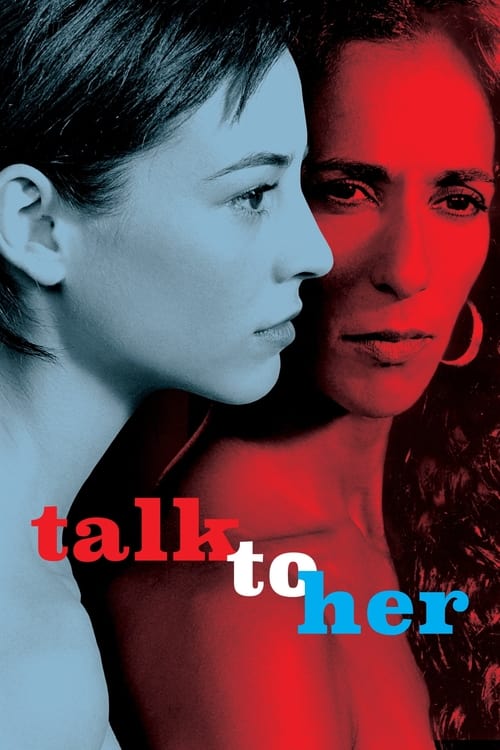
Talk to Her
2002 · Pedro Almodóvar
Spain's institution entered his English-language era (The Room Next Door, Venice Golden Lion) amid discourse about late style and euthanasia on film; his refusal to soften political statements at ceremonies keeps him quotable.
When you want a film to chew on for days — something beautiful that also makes you argue with yourself. Not a comfort watch; it's for a night when you're ready to feel conflicted.
What it's about
Two strangers — Marco, a travel writer, and Benigno, a male nurse — become friends at the bedsides of two comatose women: a bullfighter gored in the ring and a young ballet student hit by a car. As the men keep vigil, talking to women who cannot answer, the film becomes a study of loneliness, devotion, and how far the need to be heard can carry a person.
The experience
Tender and unsettling at once — it keeps drawing you into deep sympathy, then quietly asks whether that sympathy is safe to give. It's slow-burning, gorgeous, and morally slippery in a way that stays with you long after it ends.
Performances
Javier Cámara is extraordinary as Benigno, making a gentle, devoted, profoundly troubling man completely believable, with Darío Grandinetti's grief-heavy Marco as his perfect counterweight.
The craft
Almodóvar at his most controlled: saturated color, dance and song woven into the storytelling, and a famous silent-film-within-the-film that handles the story's most difficult material obliquely rather than head-on. The writing won him an Academy Award, and every structural choice earns it.
Why it matters
Widely considered one of Almodóvar's masterpieces, it cemented his standing as a world-cinema giant and remains one of the most debated films of the 2000s for the moral questions it refuses to resolve.
Snapshot
Hable con ella is Pedro Almodóvar's most formally controlled and morally vertiginous film, a melodrama of caregiving, loneliness, and the desperate human need to be heard. Two men — Marco, a travel writer, and Benigno, a male nurse — meet at the bedside of two comatose women: Lydia, a bullfighter gored in the ring, and Alicia, a ballet student struck by a car. Around these silent, sleeping bodies Almodóvar builds a study of speech and its failures, framed by the films-within-films, dance pieces, and song that have become his signature mode of emotional displacement. The film is best known — and most argued over — for the act at its center: Benigno's rape of the unconscious Alicia, an event Almodóvar narrates obliquely, through a black-and-white silent-film fantasia, refusing both prurience and easy condemnation. Released in 2002, it won the Academy Award for Best Original Screenplay and a Best Director nomination for Almodóvar (without a corresponding Best Picture or Foreign Language nod, an unusual configuration that itself became a talking point), marking the high point of his international critical canonization.
Industry & production
The film was produced by El Deseo, the company Almodóvar founded with his brother Agustín Almodóvar in 1985, which had by 2002 given the director near-total authorial control over his projects — financing, casting, and final cut. This independence is central to understanding how a film built around so transgressive a premise could be made without studio interference and marketed as prestige art cinema. Hable con ella arrived directly after All About My Mother (1999), which had won the Academy Award for Best Foreign Language Film and made Almodóvar a bankable global brand; the new film was among the most anticipated European releases of its year on the strength of that success.
Almodóvar wrote the screenplay alone, as he does nearly all his work. The production drew on collaborators who had become a stable repertory company behind the camera — composer Alberto Iglesias and editor José Salcedo chief among them — while in front of it the film notably did not center the director's familiar female stars (Carmen Maura, Victoria Abril, Penélope Cruz), instead foregrounding two men and casting the relatively less-established Javier Cámara in the pivotal role of Benigno. Specific budget and box-office figures I won't assert here, as the precise numbers vary across sources; what is secure is that the film performed strongly in the international art-house market and substantially outearned its costs.
Technology
Hable con ella was shot photochemically on 35mm, the standard for prestige European production in 2002, before digital capture displaced film. Its most conspicuous "technological" gesture is internal to the fiction: the black-and-white silent film El amante menguante ("The Shrinking Lover"), a pastiche of 1920s silent cinema that Benigno recounts to the sleeping Alicia. This sequence required period-specific visual construction — silent-era lighting, intertitle-like staging, and a forced-perspective set in which a shrunken man wanders across a giant woman's body — and functions as the film's emotional and ethical pivot. The deliberate reach back to silent technique is thematically motivated: the film is about communication without speech, and it locates its most charged event in the medium that had no spoken words at all.
Technique
Cinematography
Javier Aguirresarobe photographed the film, and his work marks a tonal shift from the high-keyed pop saturation of earlier Almodóvar toward a warmer, softer, more classically beautiful palette. The clinic interiors are rendered in calm creams and blues; the framing is patient and frequently symmetrical, granting the comatose women a still, almost devotional presence. Aguirresarobe's camera lingers on faces and on the choreography of care — hands washing, massaging, dressing inert bodies — so that the act of looking at the sleeping woman becomes its own sustained subject, implicating the viewer's gaze in ways the plot will later make unbearable. The "Shrinking Lover" interlude, by contrast, is shot in stylized monochrome with the soft contrast of vintage stock, a self-conscious break in the film's visual register.
Editing
José Salcedo, Almodóvar's editor across virtually his entire career until Salcedo's death in 2017, cut the film with the elliptical, time-shuffling structure that has become a hallmark of the director's mature work. The narrative braids two timelines and two couples, opening and closing on framing performances (Pina Bausch dance pieces) that bracket the story. The film's single most discussed editorial decision is its handling of the rape: rather than depict the assault, Salcedo and Almodóvar cut away into the silent-film fantasy, displacing the violation entirely into metaphor — the shrunken lover climbing into the giant woman's sex — and returning only to aftermath. The withholding is the meaning; the cut does the moral work the camera refuses to do directly.
Mise-en-scène / staging
The hospital room is the film's central stage, and Almodóvar choreographs it with the precision of theater. Benigno's monologues to Alicia turn the sickbed into a two-hander in which one party cannot answer, a staging that literalizes the film's title and its preoccupation with one-sided speech. Almodóvar's characteristic production design — saturated accent colors, framed reproductions, objects charged with meaning (Lydia's matador costume, the figurine, the books) — is present but tempered. The recurring motif of bodies arranged for viewing (the dancer, the bullfighter, the comatose patients, the giant woman of the silent film) organizes the staging around spectacle and the ethics of beholding.
Sound
Alberto Iglesias's score is among his finest for Almodóvar, lush and melancholy, deploying strings and a restrained romanticism that lends the unsettling material a tenderness the plot does not earn easily — a deliberate dissonance. The film's most celebrated musical moment is diegetic: Caetano Veloso performing "Cucurrucucú Paloma" live at a garden gathering, an extended musical pause during which the camera finds Marco weeping. The song stops the narrative to let pure feeling pool, a quintessential Almodóvar device in which music carries the emotion the characters cannot articulate. Sound design throughout contrasts the hush of the coma ward — breathing, monitors, soft footsteps — with the bursts of performance and song that punctuate it.
Performance
Javier Cámara's Benigno is the film's astonishing center: gentle, attentive, childlike, and quietly monstrous, a performance that asks the audience to feel for a man who commits an unforgivable act. Cámara never plays him as predator; the horror is precisely that his tenderness is sincere. Darío Grandinetti plays Marco with a held-in grief that makes him the film's surrogate for the spectator's discomfort. Rosario Flores brings a wary dignity to the bullfighter Lydia, and Leonor Watling, who spends most of the film unconscious, registers powerfully in flashback as the vital Alicia. Geraldine Chaplin appears as Alicia's ballet teacher, Katerina, a small role that connects the film to a lineage of dance and to cinema history through Chaplin's own presence.
Narrative & dramatic mode
The film operates as melodrama in the elevated, self-aware sense Almodóvar has made his own — emotionally maximalist, structured around coincidence and fate, yet held at an ironic distance by its formal play. Its dramatic engine is dramatic irony in the strictest sense: the audience and Benigno know things the comatose women cannot, and the film's central horror unfolds in a gap of consciousness. The structure is associative rather than linear, moving between past and present, between the two couples, and between the film proper and its embedded fictions. The framing dance pieces — Pina Bausch's Café Müller, in which blind women stumble among chairs cleared by an attendant, and Masurca Fogo — supply a wordless commentary on the action, a chorus in movement. The mode is finally tragic: a story about the impossibility of communion staged through bodies that cannot speak.
Genre & cycle
Hable con ella sits within Almodóvar's mature melodrama cycle — the run of films from The Flower of My Secret (1995) through All About My Mother (1999), Talk to Her, and Bad Education (2004) — in which the camp exuberance of his 1980s movida-era comedies gives way to grave, formally rigorous melodramas about grief, identity, and storytelling. It belongs to the broad tradition of the "woman's picture" and Sirkian melodrama that Almodóvar has openly claimed as inheritance, here inverted by placing men in the caregiving roles conventionally coded female. It also draws on the hospital film, the artist's romance, and, through its embedded silent movie, the history of cinema itself, making genre pastiche part of its texture rather than its frame.
Authorship & method
Almodóvar is the film's sole author in the fullest sense — writer, director, and, through El Deseo, producer — and Hable con ella exemplifies his method of building films around displaced emotion: the song that cries the tears a character can't, the film-within-a-film that enacts what the plot dare not show, the dance that speaks the unspeakable. His longtime collaborators are integral to this method: composer Alberto Iglesias, whose scores give Almodóvar's films their aching romantic undertow; editor José Salcedo, who realized the director's time-braided structures across decades; cinematographer Javier Aguirresarobe, whose softened light marks the film's tonal maturity; and producer Agustín Almodóvar, the brother whose company underwrites the director's freedom. Almodóvar's well-documented love of melodrama, classic Hollywood, and Spanish popular culture saturates the film's references, and his recurring preoccupations — desire, the porousness of identity, the redemptive and dangerous power of fiction — are all present.
Movement / national cinema
The film is a landmark of post-Franco Spanish cinema and of Almodóvar's singular position within it. Emerging from la movida madrileña, the cultural explosion that followed the end of dictatorship in the late 1970s, Almodóvar became by the 1990s the most internationally visible Spanish director since Buñuel, and Hable con ella consolidated that standing. The film is unmistakably Spanish in its materials — the bullfight as ritual and spectacle, the bolero and the Latin American song tradition, a Catholic-inflected iconography of bodily suffering and devotion — yet it speaks in a transnational art-cinema idiom that traveled freely to festival and arthouse audiences worldwide. It stands as a touchstone of European auteur cinema at the turn of the millennium.
Era / period
Set and made in contemporary, early-2000s Spain, the film captures a moment when Almodóvar had fully transitioned from enfant terrible to canonized auteur, and when European cinema still operated on a robust photochemical, festival-driven model. Its sensibility belongs to the post-2000 prestige art film — serious, formally elegant, internationally co-legible — even as its references reach back across the whole of the twentieth century, from silent comedy to mid-century melodrama to the Pina Bausch dance-theater of the 1970s and beyond. The film is of its moment and consciously out of time at once.
Themes
At its core the film concerns communication and its failures — the title is both Benigno's creed and the film's central irony, since the only "talking to her" possible is to a woman who cannot consent or reply. It probes loneliness and the human hunger for connection that can curdle into delusion and violation. Most provocatively, it stages a sustained meditation on consent, the gaze, and the ethics of care: the comatose female body becomes a screen onto which men project love, desire, and narrative, and the film implicates its own audience in that projection. It explores gender and role reversal, placing men in nurturing positions and watching what their tenderness conceals. And it is a film about fiction itself — about the stories we tell to the silent and the dead, and about cinema's power to displace, beautify, and obscure what it cannot face directly.
Reception, canon & influence
Hable con ella was received as a major work and won Almodóvar the Academy Award for Best Original Screenplay along with a Best Director nomination; it also took the BAFTA for Best Film Not in the English Language, a Golden Globe for Best Foreign Language Film, and multiple European Film Awards, among other honors. Critical response was strong and admiring, though serious critics and scholars have continued to debate the film's treatment of Benigno's crime — whether the film's tenderness toward him constitutes moral evasion or a deliberately uncomfortable refusal of judgment. That debate is itself a measure of the film's seriousness; it has become a standard case study in discussions of consent, spectatorship, and ethics in cinema.
Looking backward, the film draws on the Hollywood and Spanish melodrama traditions, on silent comedy (the "Shrinking Lover" pastiche evokes the trick-film fantasias of the medium's first decades), on the dance-theater of Pina Bausch, and on the bolero and Latin American song traditions embodied by Caetano Veloso's performance. Looking forward, it stands among the films that secured Almodóvar's place in the international canon and influenced a generation of filmmakers working in elevated melodrama and formally self-conscious art cinema; it is regularly cited in critics' polls of the best films of the 2000s and of the twenty-first century. Within Almodóvar's own career it forms a diptych with Bad Education, deepening his turn toward male protagonists and toward cinema's complicity in desire — a thread he would continue to pull through Volver, Broken Embraces, and Pain and Glory. The film's enduring power lies in its refusal to resolve: it remains genuinely difficult, and that difficulty is the source of its lasting place in the conversation about what cinema can be permitted to make us feel.
A Deleuzian reading
It opens on a stage.
The full Deleuzian reading of Talk to Her →
Reception
Rapturously received in 2002 — it swept critics' polls and won Almodóvar the Original Screenplay Oscar — and it's still widely called his masterpiece, but the modern conversation has grown thornier: what once read as daring empathy now gets re-litigated by every new generation of viewers.
How Talk to Her was received, from release to now →
Influences: the films it descends from and the films it influenced
- All That Heaven Allows (1955) — The model for Almodóvar's displacement of emotion into mise-en-scène — feeling that dialogue suppresses is rerouted into saturated color, decor, and symmetrical framing rather than spoken.
- Imitation of Life (1959) — Sirk's use of a performed song as the emotional climax that 'cries the tears' the repressed characters cannot — directly echoed by the Caetano Veloso 'Cucurrucucú paloma' interlude.
- A Trip to the Moon (1902) — The silent trick-film tradition of in-camera scale illusions and oversized prop sets that the 'Shrinking Lover' pastiche faithfully reconstructs.
- Vertigo (1958) — Builds an entire narrative around a man's desire projected onto an idealized, near-inert female body, foregrounding the ethics of the obsessive male gaze.
- Letter from an Unknown Woman (1948) — Supplies the template of one-sided, devotional obsession narrated with lush romantic fatalism — Benigno's worship of Alicia is its descendant.
- Belle de Jour (1967) — Spanish-surrealist braiding of fantasy and reality without marked transitions, the lineage behind the film-within-a-film standing in for what the plot dares not show.
- Peeping Tom (1960) — Implicates the spectator directly in a voyeuristic, predatory gaze — the formal strategy underlying the film's interrogation of consent and looking.
- Ali: Fear Eats the Soul (1974) — Recasts Sirkian melodrama as serious post-war art cinema using framing and held distance as emotional instruments — the bridge by which Almodóvar inherits Sirk.
- All About My Mother (1999) — His immediate precursor establishing the mature time-braided, performance-within-the-film structure and José Salcedo's elliptical editing that Talk to Her refines.
- Women on the Verge of a Nervous Breakdown (1988) — Pushes the disembodied-voice/communication-failure device to its logical extreme — the answering-machine message is replaced by comatose silence, the absent lover becomes a man speaking to a woman who cannot respond; the formal asymmetry of Women on the Verge is inverted, the comedy evacuated, and the same structural device darkened into tragedy.
- Tie Me Up! Tie Me Down! (1990) — Directly extends ¡Átame!'s consent-and-spectatorship provocation by centering love directed at an unconscious, captive object of desire, forcing the audience again to desire a relation it cannot ethically endorse.
- Kiss of the Spider Woman (1985) — A melodrama of two men bonding in confinement that shifts emotional register through an embedded film-within-a-film, extending Puig's cinema-as-refuge device.
- Bad Education (2004) — The explicit diptych partner — extends the film-within-a-film device and the turn to male protagonists to probe cinema's own complicity in desire.
- Broken Embraces (2009) — Continues the nested-cinema method, making filmmaking itself the engine of obsession and loss, with Alberto Iglesias scoring the romantic undertow.
- Pain and Glory (2019) — Carries forward the displaced-emotion method and Iglesias-scored melancholy into autobiographical register, the late terminus of the thread begun here.
- Portrait of a Lady on Fire (2019) — Extends the consent-and-the-gaze inquiry into the act of looking at and representing a desired body, with the same formally restrained, painterly framing.
- I Am Love (2009) — Elevated art-house melodrama driven, like Almodóvar's, by a swelling score and sensuous decor that carry the emotional weight the characters withhold.
- Pina (2011) — Opens on the rising curtain of Café Müller shot straight-on from the stalls, presenting a Bausch work as a film's prologue rather than as documentation — the framing convention Wenders quotes when he stages the same piece as his own first movement.
- Far from Heaven (2002) — A contemporaneous, equally self-conscious resurrection of Sirkian melodrama — period-precise color and framing deployed as deliberate formal homage rather than pastiche.
- In the Mood for Love (2000) — Shares the elliptical time-braiding and the repeated diegetic musical motif used to voice unspoken longing and communication failure between near-silent lovers.
- Volver (2006) — Immediate sibling refining Almodóvar's braiding of the ghostly and the tender — bodies suspended between life and death treated with matter-of-fact intimacy, the register that lets Volver's returning 'ghost' read as comedy not horror.
- The Skin I Live In (2011) — Almodóvar's prior study of a caretaker ministering obsessively to a silenced, immobile body in an antiseptic domestic-clinical space — the same ethics of tending-as-possession.
- The Sea Inside (2004) — The post-Almodóvar Spanish melodrama of tenderness and care staged around immobile bodies in a bed, sharing the blocking-as-argument and emotional operatic register two years before Amenábar.
Similar films
- All About My Mother (1999) — influence & lineage
- Pain and Glory (2019) — influence & lineage
- Bad Education (2004) — influence & lineage
- Volver (2006) — often watched together
- Women on the Verge of a Nervous Breakdown (1988) — often watched together
- Biutiful (2010) — shared sensibility
- Amour (2012) — shared sensibility
- The Skin I Live In (2011) — shared sensibility
All the films related to Talk to Her →
Watch it with: curated runs of related films
- Strangers Who Change Each Other — Watch these back-to-back when you want the warmth of two people who shouldn't have met becoming each other's whole world — a ladder from the multiplex hit down to its arthouse ancestors.