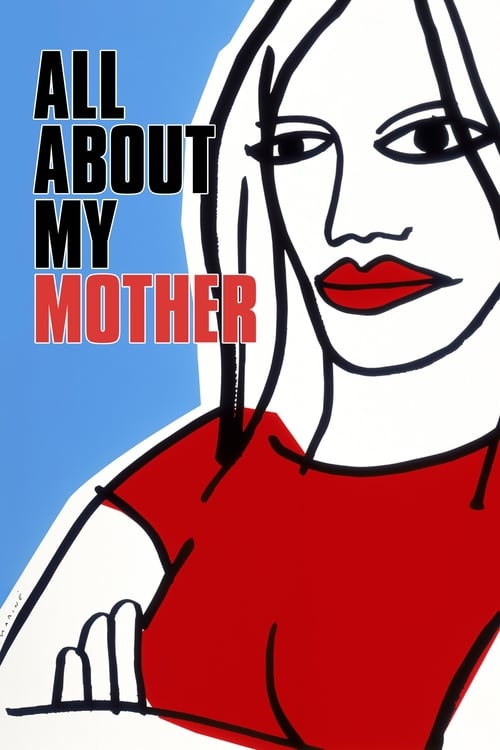
All About My Mother
1999 · Pedro Almodóvar
Spain's institution entered his English-language era (The Room Next Door, Venice Golden Lion) amid discourse about late style and euthanasia on film; his refusal to soften political statements at ceremonies keeps him quotable.
For when you need a good cry that leaves you feeling more human, not wrecked — grief transformed into warmth. Reach for it when you want a film that loves its characters as much as you will.
What it's about
Manuela, a Madrid nurse, loses her teenage son in an accident and travels to Barcelona to find the father he never knew. The search pulls her into a found family of extraordinary women — a fast-talking transgender sex worker who's an old friend, a fading stage actress, and a young pregnant nun — all of them carrying their own griefs and reinventions.
The experience
It starts in devastation and somehow becomes warm, funny, and gorgeously alive — sorrow and camp and tenderness braided together until you're laughing and crying in the same scene. Saturated color, big feelings, real earned emotion.
Performances
Cecilia Roth anchors the film as Manuela with enormous restraint and depth; Antonia San Juan is a scene-stealing marvel as Agrado, and a young Penélope Cruz brings luminous fragility to the pregnant nun.
The craft
Almodóvar at his peak: melodrama played completely straight and completely stylized at once, in bold reds and theatrical framing, with a screenplay that keeps folding life and stage performance into each other. Every frame is composed like a poster and every scene earns its emotion.
Why it matters
Winner of the Academy Award for Best Foreign Language Film and Best Director at Cannes, it was the film that made Almodóvar a global name and stands as a landmark of compassionate queer and trans representation in mainstream world cinema.
Snapshot
Pedro Almodóvar's thirteenth feature is a melodrama about grief, maternal love, and the performance of identity, following a Madrid nurse named Manuela whose seventeen-year-old son is killed while chasing an actress's autograph. Manuela travels to Barcelona to find his father — a transgender woman named Lola whom the boy never met — and is pulled into an orbit of wounded, resilient women: a flamboyant transgender sex worker, a fading stage actress, and a young nun carrying Lola's child. The film is simultaneously an act of mourning for the AIDS dead and a hymn to theatrical excess; it won the Academy Award for Best Foreign Language Film and the Best Director prize at Cannes 1999, marking the moment at which Almodóvar's cinema was absorbed into the global art-film canon.
Industry & production
The film was produced by El Deseo S.A., the Madrid-based production house founded by Pedro Almodóvar and his brother Agustín in 1986, which has functioned as the stable creative infrastructure for virtually all of Pedro's work since Law of Desire. El Deseo operates with characteristic independence from the major Spanish studios, allowing Almodóvar creative control over casting, final cut, and marketing. All About My Mother was co-produced with France's Renn Productions and France 2 Cinéma, an arrangement consistent with the pan-European co-production financing that distinguished quality European cinema in the late 1990s.
The Spanish film industry context is important: post-Franco cinema had matured through the 1980s Movida Madrileña and was by the late 1990s well-integrated into European prestige circuits. Spain's ICAA (Instituto de la Cinematografía y de las Artes Audiovisuales) provided domestic support. Sony Pictures Classics, which had distributed Almodóvar in North America since the early 1990s, handled the US release, consolidating the film's crossover reach. The budget was modest by Hollywood standards, though the precise figure has not been authoritatively published; El Deseo films of this period operated in a mid-range European register.
Technology
Shot on 35mm film, All About My Mother belongs to the last flourishing of photochemical production in European art cinema before digital intermediate workflows became standard. The film's bold, saturated palette — primary reds, cerulean blues, acid greens — was achieved through careful attention to production design, costume, and photochemical printing rather than digital color grading. The theatrical and clinical environments that dominate the mise-en-scène (hospital wards, backstage dressing rooms, Barcelona apartments) are rendered with an almost tactile density of surface and material that 35mm grain supports particularly well.
No significant technological novelties were deployed; the film's craft achievement lies in the mastery of conventional tools rather than in technical experimentation. Steadicam work is minimal; the cinematographic approach favors classical setup and motivated camera movement.
Technique
Cinematography
The director of photography was Affonso Beato, the Brazilian-born cinematographer who had shot The Flower of My Secret (1995) and Live Flesh (1997) for Almodóvar and whose collaboration with the director during this period was among the most creatively fruitful of Almodóvar's career. Beato's approach privileges a warm, slightly heightened color temperature that stops just short of expressionist excess — the hues are vivid but always grounded in plausible diegetic light sources. Hospital scenes employ cool fluorescents that contrast with the warmer domestic and theatrical spaces, a color grammar that tracks Manuela's emotional transit. Close-ups are held long enough to give actors room to breathe and think, respecting the Cassavetian influence Almodóvar openly acknowledges. The Barcelona cinematography exploits the city's modernist architecture — particularly the Eixample's grid — as a kind of orderly backdrop against which the characters' disordered lives play out.
Editing
The editor was José Salcedo, Almodóvar's long-standing collaborator across much of his mature work. The cutting in All About My Mother is notably unhurried by late-1990s commercial standards; scenes run to their emotional completion rather than being truncated for pace. The film's opening sequence — a near-wordless montage of the night Esteban is killed, cutting between rain, headlights, Manuela's face, and her son's body — demonstrates Salcedo's capacity for lyric compression. The transition between Madrid and Barcelona is handled through an ellipsis of extraordinary restraint: we jump over the weeks of Manuela's grief almost entirely, arriving in Barcelona already in motion. Salcedo and Almodóvar trust the audience to perform their own temporal bridging.
Mise-en-scène / staging
Almodóvar's staging draws consciously from the grammar of theatrical melodrama and the Hollywood "woman's picture," but it is inflected throughout by his awareness of performance as a theme as well as a technique. La Agrado's celebrated monologue — delivered directly to an audience that has paid to see Huma Rojo and been told the actress cannot perform — is staged as a scene within a scene, blurring the boundary between theatrical and cinematic spectatorship. The film is full of these reflexive frames: Manuela watching her son watch All About Eve on television, Esteban's death mirrored by Almodóvar's earlier short film La voz humana which the pair watches together, the stage of A Streetcar Named Desire appearing as both fictional location and emotional key.
Color coding of décor and costume is systematic. Manuela tends toward reds and warm earth tones; Sister Rosa moves through whites and pale blues connoting both religious vocation and medical vulnerability; Huma Rojo's dressing room glitters with the theatrical gilding of a vanishing world. Antxón Gómez's production design achieves a kind of heightened realism — recognizable apartments and hospitals made slightly more beautiful, slightly more color-coordinated, than plausible life would allow.
Sound
Alberto Iglesias, who became Almodóvar's composer following The Flower of My Secret (1995), wrote one of his most emotionally direct scores for the film. Iglesias uses chamber-scale forces with particular emphasis on strings and piano; the main theme associated with Manuela's grief has a circularity — a repeated melodic phrase that loops without resolution — that mirrors the film's structure of mourning. Iglesias's score avoids sentimentality by staying somewhat cool and formal, a counterweight to the melodramatic content that prevents the film from tipping into pathos.
Tennessee Williams's A Streetcar Named Desire operates as an extradiegetic sonic reference: Almodóvar does not use Alex North's famous 1951 film score directly, but the cultural resonance of Blanche DuBois and Stanley Kowalski's verbal violence permeates the film's emotional atmosphere. The staging of the play-within-the-film uses a different, original score for the production, maintaining diegetic plausibility.
Performance
The ensemble is dominated by Cecilia Roth in the central role of Manuela, giving a performance of enormous internal complexity — grief, practicality, warmth, and a residual theatricality (Manuela is revealed to have been an actress herself) in constant negotiation. Roth, Argentine by birth, had worked with Almodóvar since his debut feature and brings a lived familiarity with his style that makes her performance feel simultaneously natural and stylized. Antonia San Juan's La Agrado became one of the most celebrated supporting performances in Spanish cinema of its decade; the character's combination of frank vulgarity and profound dignity required a performer willing to play both simultaneously, and San Juan delivers without condescension. Penélope Cruz, at this point still primarily a Spanish star though beginning her international career, plays Sister Rosa with a vulnerability that avoids the saint/victim binary the role could easily fall into. Marisa Paredes, another long-standing Almodóvar collaborator, gives Huma Rojo a grandeur calibrated to reveal its own fragility.
Narrative & dramatic mode
The film operates within the register of melodrama as theorized by scholars from Geoffrey Nowell-Smith onward: a mode in which the emotional "excess" that cannot be resolved through narrative action is converted into spectacular mise-en-scène and performance. Peter Brooks's identification of melodrama as the dominant mode for navigating modern moral illegibility is everywhere operative. Manuela's grief cannot be explained or resolved; it can only be elaborated, transmuted, performed. The film refuses the therapeutic arc that Hollywood melodrama might impose (grief processed, protagonist healed), instead presenting loss as constitutive — something that becomes incorporated into identity rather than overcome.
The narrative structure is episodic and associative rather than tightly causal. Characters arrive and depart with something of the logic of theatrical repertory: Manuela accretes companions rather than pursuing a conventional quest. The death of Sister Rosa's child — and then the survival of her HIV-positive baby — functions as a kind of structural answer to the death of Esteban, though Almodóvar resists symmetry: the second child is named Esteban but is not a replacement, and the film ends on a note of prospective rather than resolved meaning.
Genre & cycle
All About My Mother belongs to the international art-film wave of queer-inflected melodrama that included work by François Ozon, Todd Haynes (Far from Heaven, 2002, which Almodóvar's film demonstrably influenced), and Fassbinder's legacy more broadly. Within Spanish cinema it represents the maturation of a post-Movida cinema that had metabolized both American pop culture and European art cinema into something distinctively Iberian. The film participates in what might be called a cycle of AIDS elegies — alongside films such as Philadelphia (1993) and the theater of Tony Kushner — though it approaches HIV/AIDS obliquely, as one catastrophe among several rather than as its central subject.
Almodóvar has situated the film within a tradition of "women's pictures" — the Hollywood melodramas associated with directors like Douglas Sirk and George Cukor — while critically refunctioning that tradition. Where the classical women's picture often operated to contain female desire within acceptable social structures, Almodóvar's women exceed every available container, and the film validates rather than punishes that excess.
Authorship & method
Almodóvar wrote the original screenplay himself, as he has done throughout his career — a practice that consolidates his auteur status and distinguishes him from most directors of comparable commercial reach. He has described the genesis of All About My Mother as accumulative over many years, with elements arriving separately: the image of a woman crossing a city to find the father of a dead son, the idea of rewriting Cassavetes' actress character from the outside, a desire to write something for Cecilia Roth. The screenplay is one of his most tightly structured, despite its apparent emotional looseness.
His method on set is known for extended rehearsal periods and a collaborative approach to performance — actors describe him as deeply involved in character psychology, often revising dialogue during preparation. The film's multiple theatrical references are not merely decorative but reflect Almodóvar's own formation: he came to filmmaking through amateur theater and Super-8 experimentation in the 1970s, and his films retain a theatricalized conception of space and character.
Alberto Iglesias's compositional approach complements Almodóvar's direction by providing musical scaffolding that is emotionally directive without being prescriptive. José Salcedo's editing partnership with Almodóvar spans decades and is characterized by a shared willingness to hold scenes past the point commercial cutting would abandon them. Antxón Gómez as production designer, and costume designer José María de Cossío, contributed equally to the film's chromatic system.
Movement / national cinema
The film is central to the post-Franco Spanish cinema that coalesced from the late 1970s onward and whose international visibility Almodóvar largely embodies. Spain's transition to democracy — the Transición — generated a cultural explosion that was particularly vivid in Madrid, and Almodóvar, though himself from La Mancha, became its most internationally legible representative. All About My Mother is in some respects the maturation of that project: less frantic than his 1980s work, more interested in mortality and resilience than in transgression as provocation.
The film's Barcelona setting — a departure from Almodóvar's habitual Madrid — aligns it with Catalan cultural specificity without making that specificity a subject; Barcelona functions primarily as a city of theatrical culture and coastal openness, contrasted implicitly with the capital's administrative gravity.
Within the category of Spanish national cinema, the film was supported by domestic awards (including multiple Goya nominations and wins) and has entered the institutional curriculum of Spanish film culture, taught in schools and screened in cinematheques as a canonical national text.
Era / period
The film arrives at the end of the 1990s, a decade of considerable ambivalence in European art cinema: the vitality of the Nouvelle Vague legacy was now thoroughly institutionalized, digital filmmaking was emerging as a possibility but not yet a dominant practice, and the European co-production system had created stable pathways for quality art cinema that did not exist in earlier decades. The AIDS crisis, which had devastated artistic communities through the late 1980s and early 1990s, was entering a new phase after the introduction of antiretroviral combination therapies in 1996; All About My Mother registers this transition — HIV is survivable in the film's world, but barely, and at great cost.
The film's frank treatment of transgender identity and transgender lives participates in a broader 1990s cultural negotiation with gender identity, coming after landmark texts like the publication of Judith Butler's Gender Trouble (1990) and before the more explicitly political transgender visibility movements of the following decade. Almodóvar's approach is neither documentary nor polemical; La Agrado and Lola are characters before they are representatives.
Themes
Maternal love and its mutations. The film proposes maternity as a structure of feeling rather than a biological fact. Manuela is a mother through grief; La Agrado mothers through loyalty; Sister Rosa mothers through faith that outlasts her body. Lola — the absent father who is also biologically male — is figured as a mother through destruction, fathering children (and transmitting illness) as a kind of compulsive generation. The film asks what it means to bear and sustain another life, and answers with maximum diversity.
Performance and authenticity. La Agrado's celebrated monologue — in which she catalogs her surgical modifications and declares herself "authentic" precisely because she has paid so much to become what she is — is the film's philosophical core. The argument is Butlerian before it is explicitly theoretical: gender, identity, selfhood are performances that become real through repetition and investment. Manuela's identity as transplant coordinator, actress, mother, immigrant in her own country, are all roles she inhabits with conviction; the film refuses any stable interiority beneath them.
Grief and the replication of loss. The mirroring of Esteban's death and Esteban's birth is handled without sentimentality: the film does not propose that new life redeems loss. What it proposes instead is that loss can be metabolized into care — that Manuela's experience of bereavement makes her capable of the attentiveness Sister Rosa and Huma Rojo require.
Queer kinship and chosen family. The network of women (and one transgender woman, and one transgender man in Lola) that Manuela assembles in Barcelona constitutes a family of mutual sustaining that is not organized by biology or law. The film treats this improvised kinship as both necessary and sufficient — not a poor substitute for normative family but a fully adequate, perhaps more demanding, form of love.
Reception, canon & influence
Critical reception. The film was received with widespread critical enthusiasm upon its Cannes premiere, where Almodóvar won the Best Director prize. The English-language critical establishment, which had sometimes held Almodóvar at an arm's distance as a provocateur, embraced All About My Mother as his most emotionally and formally achieved work. The Academy Award for Best Foreign Language Film (2000) confirmed and amplified this reassessment, giving the film an institutional consecration that accelerated its entry into syllabi and repertory programmers worldwide. Reviews consistently cited the depth of the ensemble performances and the film's capacity to sustain emotional intensity without sentimentality.
Influences on the film (backward). Almodóvar's dedications and public statements ground the film's backward genealogy explicitly. John Cassavetes' Opening Night (1977) — Gena Rowlands as an actress in crisis, shown within the film on a television screen — is a direct formal and emotional precursor: the theatrical performance frame, the actress navigating breakdown and redemption, the blurring of life and role. Joseph L. Mankiewicz's All About Eve (1950) supplies the title and the meta-theatrical meditation on actresses and ambition, though Almodóvar inverts Eve's competitive logic into solidarity. Tennessee Williams, particularly A Streetcar Named Desire, provides not merely plot material but a model for melodrama as serious tragic form. Rainer Werner Fassbinder's films about women in extremity — Ali: Fear Eats the Soul, The Bitter Tears of Petra von Kant — offer a European precedent for the Sirk-influenced melodrama Almodóvar adapts to contemporary Spain. George Cukor's direction of actresses in the Hollywood studio era, particularly his work with Bette Davis and Katharine Hepburn, is an acknowledged touchstone for Almodóvar's collaborative approach to female performance.
Legacy and forward influence. All About My Mother exercised a demonstrable influence on the subsequent development of melodrama in European and American art cinema. Todd Haynes, whose Far from Heaven (2002) undertook a systematic reconstruction of Sirkian melodrama, has cited Almodóvar's film as part of the intellectual context for that project. The film's treatment of transgender characters as fully realized protagonists — decades before mainstream cinema began to address this representation deficit — placed it among a small number of works that shaped how transgender identity might be narrativized without pathology. It remains among the most-cited reference points in academic discussions of queer cinema, gender performance, and melodrama. Within Almodóvar's own career, it initiates a trilogy of sorts with Talk to Her (2002) and Volver (2006) — films concerned with women's grief, resilience, and the reparative possibilities of narrative — that represents the formal and thematic apex of his mature period.
A Deleuzian reading
Start with a boy and his mother on a couch.
The full Deleuzian reading of All About My Mother →
Reception
No reappraisal needed — it swept Cannes (Best Director), the Oscars, and the BAFTAs on arrival, and instantly rebranded Almodóvar from La Movida provocateur to respectable world-cinema master. What's shifted since is its status as the gateway: now the default answer to 'where do I start with Almodóvar?'
How All About My Mother was received, from release to now →
Influences: the films it descends from and the films it influenced
- All About Eve (1950) — Almodóvar's title is a direct citation and his theatrical staging replicates Mankiewicz's scene-within-scene mechanics — an actress watched onstage by a protagonist in the wings — collapsing the boundary between theatrical and cinematic spectatorship.
- Written on the Wind (1956) — Sirk's systematic encoding of psychology in décor color — Dorothy Malone's acid yellows against Rock Hudson's cooler blues — supplies the explicit grammar for Almodóvar's color-coded mise-en-scène where every room and costume carries emotional charge rather than realistic neutrality.
- Imitation of Life (1959) — Sirk's transformation of the Hollywood woman's picture into melodramatic excess that exposes social contradiction gives Almodóvar the genre template he inherits and queers: maternal sacrifice, the performing body, and grief-as-spectacle are all Sirkian inheritances refunctioned here through AIDS and transgender subject matter.
- The Umbrellas of Cherbourg (1964) — Demy's radical commitment to color-saturated production design — every wall, coat, and surface coded to a chromatic emotional register — is the clearest precedent for Almodóvar's equally systematic palette, where saturated color is grammar rather than décor.
- Faces (1968) — Almodóvar openly cites Cassavetes as justification for his extended close-ups held long enough for actors to breathe and contradict themselves; Cassavetes' editing rhythm that subordinates pace to performance completeness is the direct model for Salcedo's unhurried cutting.
- The Bitter Tears of Petra von Kant (1972) — Fassbinder's refunctioning of the Hollywood woman's picture through theatrical color-coded stagecraft — figures posed against saturated flat surfaces, genre conventions made strange by queer subject matter — is the template Almodóvar inherits for fusing queer melodrama with color-saturated mise-en-scène.
- Longtime Companion (1989) — René's episodic structure — following a loose network across years of AIDS loss through accumulating vignettes rather than a single protagonist's arc — establishes the AIDS elegy as an associative rather than progressive narrative form, the grammar Almodóvar deploys for his own mourning of the epidemic's dead.
- Three Colors: Blue (1993) — Kieślowski's use of a circular melodic fragment (Van den Budenmayer's unfinished concerto) that returns involuntarily to overwhelm a grieving woman demonstrates how non-diegetic music can structure emotional memory across an anti-therapeutic arc, directly prefiguring Alberto Iglesias's recurring melodic motifs for Manuela's grief.
- Women on the Verge of a Nervous Breakdown (1988) — Extends the feminist ensemble melodrama form with Carmen Maura's multi-register performance method applied across a full female cast, theatrical staging, and Chekhovian prop-objects (the donated heart) bearing simultaneous comic and symbolic weight — the mature elaboration of the mode Women on the Verge established.
- Juliet of the Spirits (1965) — Antxón Gómez's production design uses accumulative chromatic intensity — deep reds and stage-influenced décor — to carry emotional interiority, extending Juliet's model of color-saturated total design as psychological notation into the register of grief and maternal loss.
- All That Heaven Allows (1955) — Built explicitly on the maternal woman's-picture tradition Sirk anatomized, recycling its emotional excess and self-aware melodramatic structure while foregrounding the genre's constructedness.
- Tie Me Up! Tie Me Down! (1990) — The culmination of the melodrama line ¡Átame! opened, retaining the Alcaine-Salcedo visual rhythm and high-chroma palette while purifying the genre's emotional craft into canonical form.
- Far from Heaven (2002) — Haynes explicitly inherits Almodóvar's method of refunctioning Sirkian melodrama through a queer lens — the saturated color palette, systematic color-coded mise-en-scène, and use of genre-coded décor to externalize the unspeakable are all derived from the Almodóvar style consolidated in this film, which Haynes has named as a direct model.
- I Am Love (2009) — Guadagnino adopts Almodóvar's approach to the woman's picture refunctioned — color-coded production design as psychological map, operatically unhurried cutting that treats bourgeois domestic surfaces as emotional landscapes — extending it into an Italian haute-bourgeois register with John Adams's score functioning as the circular melodic frame.
- Carol (2015) — Haynes deploys the same editing grammar — unhurried cutting that holds on faces past narrative necessity, elliptical time jumps between encounters, extended close-ups respecting the Cassavetian principle of not cutting before an actor finishes thinking — directly inheriting Almodóvar's performance-centered rhythm and queer melodrama's anti-therapeutic ellipsis.
- Moonlight (2016) — Jenkins adopts the episodic-associative triptych structure — three chapters mapping a queer identity across time through encounters rather than causally linked events — combined with the stylized naturalism in performance (actors directed to let reactions complete before cutting) that traces back through Almodóvar to Cassavetes.
- Portrait of a Lady on Fire (2019) — Sciamma systematically color-codes her mise-en-scène — the red of Marianne's dress, the white of Héloïse's — as a grammar for queer desire that cannot be spoken, inheriting Almodóvar's method of using chromatic saturation to articulate what melodrama's plot cannot; the anti-therapeutic hard ellipsis of the ending is also an Almodovarian formal signature.
- Talk to Her (2002) — His immediate precursor establishing the mature time-braided, performance-within-the-film structure and José Salcedo's elliptical editing that Talk to Her refines.
- Bad Education (2004) — Perfects the play-within-the-film (Streetcar) as emotional mirror and the actor who performs someone's biography — the nested-performance and transvestism motifs recur here as 'Zahara.'
- Laurence Anyways (2012) — Places a transgender character inside a maternal melodrama and lets theatrical costume and color excess carry the emotion — Dolan's costume-as-emotion and melodramatic register descend directly from this Almodóvarian mode.
- Dear Ex (2018) — Almodóvar's melodrama excavates society's caricatures — queer figures, chosen family — into full interiors and treats grief in a saturated, warm register, the excavated-caricature plus queer-kinship method.
- A Single Man (2009) — Almodóvar and Beato's practice of color-blocking sets and costume so that saturated red carries the affect the dialogue withholds is the syntax Ford borrows wholesale, down to designing interiors to be graded rather than merely photographed.
- In the Mood for Love (2000) — Released the same year, Wong independently deploys the same formal constellation: a circular melodic theme (Yumeji's Theme) that returns to structure longing, saturated color-coded mise-en-scène where costume patterns track emotional state, and unhurried editing that holds shots beyond narrative necessity to let feeling accumulate.
- Mulholland Drive (2001) — Lynch independently deploys scene-within-scene theatrical staging as a tool for blurring performance and reality — Club Silencio functions as a theatrical mise-en-abyme exposing cinematic spectatorship itself, a parallel move to La Agrado's monologue collapsing theatrical and cinematic address in the same year's art-film circuit.
- Volver (2006) — Sister film in Almodóvar's female-ensemble melodrama mode: solidarity among women closing ranks around death, loss and secrets, staged as choral matriarchy rather than a single protagonist's arc.
- Pain and Glory (2019) — Refines the melodrama-as-autobiography engine and the practice of quoting other artworks (theater, film) as structuring mirrors, the technique Pain and Glory turns inward onto the director's own body of work.
- Ghost World (2001) — Affonso Beato's immediately prior work, demonstrating the same discipline he brings to Ghost World: color-blocked interiors composed frontally so that a room's saturation and clutter read as a character dossier before the occupant speaks.
Similar films
- Women on the Verge of a Nervous Breakdown (1988) — same viewing thread · often watched together
- All About Eve (1950) — influence & lineage · same viewing thread
- Carol (2015) — influence & lineage · often watched together
- Volver (2006) — shared sensibility
- Pain and Glory (2019) — shared sensibility
- Talk to Her (2002) — shared sensibility
- Deaf (2025) — shared sensibility
- Law of Desire (1987) — shared sensibility
All the films related to All About My Mother →
Watch it with: curated runs of related films
- All the World's a Stage — Watch these together when you want the theater seen from the wings — faded stars angling for a comeback, hungry understudies, actresses in extremity, and a director who walked away — each film besotted with performance and clear-eyed about its cost.