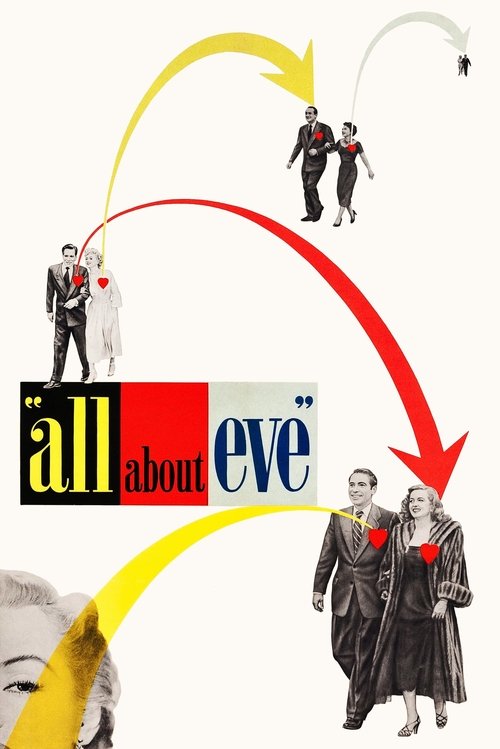
All About Eve
1950 · Joseph L. Mankiewicz
For when you want to watch brilliant people be brilliantly cruel to each other — a martini-dry evening of wit and scheming. Endlessly rewatchable comfort for anyone who loves great talk.
What it's about
A starstruck young fan named Eve Harrington appears at the stage door of Broadway legend Margo Channing — humble, devoted, seemingly harmless. Taken into Margo's inner circle, Eve begins quietly maneuvering toward everything Margo has: her roles, her friends, her man. Only Addison DeWitt, a venomously witty drama critic, sees exactly what's happening — and finds it entertaining.
The experience
Pure verbal fencing — two hours of the sharpest dialogue in American movies, delivered by people who use words like weapons. It's funny, then cutting, then quietly devastating about what fame costs women as they age.
Performances
Bette Davis is volcanic as Margo Channing — imperious, wounded, and self-aware all at once, in what many consider her greatest role. George Sanders won an Oscar as the silken, cynical critic Addison DeWitt, and Anne Baxter's Eve is chilling precisely because she never stops smiling.
The craft
Joseph L. Mankiewicz wrote and directed, and the screenplay is the star: layered flashback narration, epigrams that entered the language, and scene after scene built entirely on conversation that crackles. Shot in elegant black and white, it proves a film can be riveting with almost no action at all.
Why it matters
Fourteen Academy Award nominations — a record at the time — and a Best Picture win; its portrait of ambition disguised as devotion became the template every backstage drama and all-about-the-understudy story since has had to reckon with.
Snapshot
A backstage drama of extraordinary verbal intelligence, All About Eve follows the calculated ascent of Eve Harrington (Anne Baxter), a seemingly adoring fan who insinuates herself into the world of Broadway star Margo Channing (Bette Davis) and methodically dismantles everything Margo has built. Narrated in layered flashback by the acid drama critic Addison DeWitt (George Sanders), the film is at once a comedy of theatrical manners, a noir-tinted fable of predatory ambition, and a searching inquiry into the costs of fame for women in a culture that discards them as they age. Its dialogue remains among the most quotable in American cinema; its architecture of deceit prefigured a century of successor texts. Fourteen Academy Award nominations, the most for any single film to that point, announced its contemporary status as an event. Time has confirmed it as something closer to a masterwork.
Industry & production
The film originates in "The Wisdom of Eve," a short story by Mary Orr published in Cosmopolitan in May 1946, which Orr herself stated was loosely inspired by incidents involving the Austrian actress Elisabeth Bergner and a young admirer who exploited Bergner's trust. 20th Century Fox acquired the property, and Darryl F. Zanuck assigned it to Mankiewicz, who wrote the screenplay himself, departing substantially from Orr's relatively straightforward source to introduce the multi-layered narration and the pivotal figure of Addison DeWitt, absent from the original.
The production's most discussed contingency is the casting of Bette Davis. Claudette Colbert was set to play Margo Channing but suffered a back injury shortly before filming commenced, forcing the studio to recast at speed. Mankiewicz and Zanuck turned to Davis, who had spent several years in commercial difficulty after her peak Warner Bros. years. The role revitalized her career emphatically. The casting proved one of those fortunate accidents that seem inevitable in retrospect: Davis's combination of theatrical grandeur, evident intelligence, and willingness to play vulnerability mapped onto Margo with a precision Colbert, skilled comic actress that she was, might not have matched. On set, Davis and Gary Merrill, who played Margo's director companion Bill Sampson, fell in love and subsequently married.
Anne Baxter, under contract at Fox, plays Eve with a performance calibrated entirely to concealment — wide-eyed deference shielding calculating hunger. Celeste Holm provides moral lucidity as Karen Richards, Lloyd's playwright wife, whose fleeting complicity in Eve's rise becomes the film's central structural irony. Thelma Ritter, in a relatively brief role as Margo's wisecracking dresser Birdie, anchors the film's working-class counter-voice. A very young Marilyn Monroe appears in a small but memorable role as Miss Caswell, a starlet in Addison's orbit, and the film registers, even in this early encounter, something irreducible about her screen presence.
Technology
Shot in black and white on 35mm in the standard Academy ratio of 1.37:1, All About Eve belongs to the last years before the widescreen revolution transformed Hollywood's visual language. CinemaScope would arrive at Fox itself in 1953; the intimate, face-forward compositional logic of this film belongs to the earlier paradigm, and serves it: the drama lives in faces, in the precise disposition of bodies in rooms, in the orchestrated collision of close-ups during dialogue exchanges. The technical infrastructure is conventional classical Hollywood — no experimentation with color, no novel film stocks or lenses — which places the film's achievement firmly in the domain of writing, performance, and direction rather than apparatus.
Technique
Cinematography
Milton Krasner, an experienced Fox contract cinematographer, lights the film with a high-contrast black-and-white palette that shifts register across the film's social and emotional environments. The early scenes establishing Margo's glamour use chiaroscuro pools of light against deep shadow, giving the theatrical milieu a faint film noir undertow — an appropriate visual grammar for a film whose moral architecture is ultimately that of noir. Krasner deploys close-ups with exceptional precision during the long, multi-character dialogue sequences; the camera does not simply illustrate conversation but participates in it, pressing in on faces at moments of concealed duplicity and releasing to two-shots or wider compositions at moments of relative ease. The party sequence at Margo's apartment, in which Margo delivers her famous warning about "a bumpy night," is a study in how to sustain visual interest across a largely static social space: Krasner modulates depth of field to shift attention between foreground and background groupings, allowing Mankiewicz to conduct multiple threads of action simultaneously. Mirrors recur as a visual motif — at dressing tables, in backstage corridors — foregrounding the film's central preoccupation with performed identity and the gap between reflection and reality.
Editing
Barbara McLean, one of Fox's senior editors and a figure of considerable authority within the studio's cutting rooms, edited the film with a discipline appropriate to heavily scripted theatrical drama. Cuts are motivated primarily by dialogue — the editing rhythm is calibrated to verbal exchange rather than physical action — and McLean resists the temptation to over-cut the extended conversation scenes, allowing takes to breathe and performances to accumulate. The flashback structure, which the editing must render legible across multiple narrators, is handled with lucid economy: transitions in and out of flashback are clean and unambiguous, so the complex temporal architecture never disorients. McLean was nominated for the Academy Award for Film Editing for her work here.
Mise-en-scène / staging
Mankiewicz's mise-en-scène is fundamentally theatrical in the best sense: he understands how the geometry of a room can encode social hierarchy, and he moves his actors within carefully defined spatial fields that externalize power relations. The recurring backstage and dressing-room interiors — cramped, mirror-lined, theatrically lit — keep the film's self-reflexive consciousness of performance physically present. Margo's apartment, by contrast, is staged as a stage in itself, with characters entering and exiting as if making entrances, and Margo as habitually central figure around whom others orbit. Eve's progressive infiltration of these spaces — from stage-door supplicant to the dressing room, to the apartment, ultimately to the role itself — is charted with spatial precision. The final sequence, in which a girl named Phoebe is discovered in Eve's apartment mirror-image of Eve's own earlier adulation, closes the film with an image of infinite regress that is both geometrically elegant and metaphysically chilling.
Sound
Alfred Newman, Fox's longtime music director and a composer of immense institutional influence, provides a score that largely functions as punctuation — sentimental when the film permits sentiment, melodramatic in the passages of theatrical backstage excitement — without imposing a tonal framework on the drama. The film's real sonic achievement is Mankiewicz's dialogue, which operates at a density and speed that requires near-total silence in the underscore during critical exchanges. The sound design observes a classical restraint; there is no effort to use ambient sound expressionistically. The film trusts its language.
Performance
Davis gives what many critics have judged her finest screen performance, a claim that carries real weight given the range of her work. The technical achievement is the simultaneous projection of theatrical magnificence and genuine emotional exposure — Margo is never merely a grande dame figure but a woman who understands, with increasing clarity, that the culture she inhabits will not permit her to age into authority. The famous line about the bumpy night, delivered at the party scene, is not a grand flourish but a slightly drunk woman trying to reassert control she already senses slipping. Baxter plays against Davis's explicit theatricality with a performance of strategic blankness that only gradually reveals its calculation; the strategy is less immediately electrifying but structurally essential. George Sanders won the Academy Award for Best Supporting Actor for Addison DeWitt, and it is difficult to argue with the result: his performance of supreme, amused contempt — a man whose intelligence exempts him from nothing and protects him from nothing he would actually want — is among the great supporting turns of the classical era.
Narrative & dramatic mode
The film's narrative architecture is its most formally distinctive feature. It opens in medias res at the Sarah Siddons Award ceremony, at the end of the story, and then deploys two nested, partially overlapping first-person narrations — first Addison DeWitt's, then Karen Richards's — to reconstruct Eve's rise. This structure has several effects: it establishes irony as the film's governing mode (we know from the outset that Eve has succeeded), it introduces the question of narrative reliability in a film entirely about performed identity, and it displaces Margo from the center of the story she nominally inhabits. Margo is ultimately observed rather than narrating, which is itself a quietly devastating formal choice. The story's dramatic engine is deception: every scene in the first half conceals a second scene visible only in retrospect, once Eve's duplicity has been revealed. Mankiewicz sustains the double-coded quality of Eve's early scenes with exceptional control, particularly in his handling of Baxter's performance cues.
Genre & cycle
All About Eve belongs to the backstage drama cycle that runs from early sound films through the studio era, though it inflects the genre with a sophistication and moral darkness that sets it apart from more celebratory treatments of theatrical life. It participates simultaneously in the "women's film" tradition — a studio-era category defined roughly by female protagonist, domestic and professional conflict, and an explicit address to female experience — and in film noir's visual and moral vocabulary. Addison DeWitt is a noir figure: the detached, intelligent observer for whom cynicism is a mode of survival, delivering sardonic first-person commentary in the tradition of Chandler's Marlowe. The film's release in 1950, the same year as Billy Wilder's Sunset Boulevard, which traverses adjacent territory (an older woman in the entertainment industry, a younger interloper, delusion versus reality), marks a distinctive moment of Hollywood self-examination at the end of the classical era.
Authorship & method
Mankiewicz had won back-to-back Academy Awards for Best Director and Best Screenplay for A Letter to Three Wives (1949); All About Eve extended the streak and confirmed his identity as the preeminent writer-director of the Fox stable and, arguably, of the late studio system. His method was firmly text-centered: he composed long, intricate, rhetorically dense screenplays that he then directed with a primary obligation to the word. This placed him somewhat at odds with the emerging auteurist framework, which tended to privilege visual stylists, but it also made him an outlier whose sophistication resists easy categorization. His work anticipates the literary-theatrical traditions that would inform American drama in the 1950s and 1960s.
Krasner's cinematographic collaboration has already been discussed above. Newman's score, while not among his most celebrated work, serves the film's tonal requirements reliably. McLean's editorial contribution to the management of temporal complexity deserves continued attention from scholars of classical editing practice.
Movement / national cinema
All About Eve is canonical late classical Hollywood: a major studio production at the height of the studio system's technical and organizational maturity, made on the Fox lot by contract talent under producer oversight, governed by the Production Code. Its theatrical setting and its dense literary dialogue align it with the strand of American cinema that drew most heavily on East Coast stage traditions, and Mankiewicz's sensibility — ironic, verbally extravagant, unsentimental — belongs to a cosmopolitan New York intellectual formation that found a home in Hollywood's more literary production stream. There is nothing nationally self-conscious about the film's relationship to American culture; it simply is American culture at a specific moment of sophistication.
Era / period
The film sits at a transitional moment in Hollywood history. The studio system was under mounting pressure from the 1948 Paramount decrees, from HUAC, and from the approaching competition of television; none of this is directly visible in the film, but the milieu of theatrical professionalism it depicts — a world of strict hierarchy, institutional loyalty, and long careers — carries a retrospective elegiac quality. The Broadway world it portrays is itself an idealized counter-Hollywood, a place where art is presumed more authentic than entertainment. The film was made as the classical era was beginning to close, and it often reads as an implicit summation of what that era at its best could accomplish.
Themes
The film's central preoccupation is the predatory mimicry involved in cultural succession — the way in which ambition, particularly for women denied other avenues of advancement, manifests as a colonization of another woman's identity. Eve does not merely want Margo's role; she wants Margo's life, her lover, her social position, her very self. The film treats this not as pathology but as a structural consequence of a system that offers women fame as their only currency and then withdraws it as they age. Margo's famous line — her anxiety about turning forty in a profession that worships youth — is the film's emotional center, though it is expressed obliquely and with characteristic self-irony.
Identity and performance are inseparable in the film's moral universe: every character performs a version of themselves, some more successfully than others. The theater, which might be expected to offer the film a stable definition of authentic versus performed selfhood, provides no such stability. Even the most honest characters — Karen, Birdie — are positioned within theatrical social codes they cannot entirely exit. Aging, gender, and institutional power intersect throughout: the film is acutely conscious that Bill Sampson faces no equivalent erosion of professional authority, and that Lloyd Richards's work is evaluated independently of his body in a way Margo's never can be.
Reception, canon & influence
Backward influences. Mankiewicz drew on the theatrical backstage-drama tradition with an awareness of its conventions that allowed him to inflect rather than simply reproduce them. The film noir vocabulary — both visual and narratorial — derives from the cycle that had been building through the 1940s. Bette Davis's screen persona, built through a decade of Warner Bros. dramas, is itself a source material: Margo Channing is partly a performance of Davis's public image as imperious, technically brilliant, emotionally turbulent.
Critical reception. The film was received as a major achievement on release, praised extravagantly by most critics for its writing, its performances, and its intellectual seriousness. Its 14 Academy Award nominations — at the time the most in Oscar history — ratified a sense of event. George Sanders's win for Best Supporting Actor and Mankiewicz's wins for Direction and Screenplay were widely endorsed. The film did not win Best Picture; the award went elsewhere, and the loss has been revisited frequently by historians as one of the Academy's recurring failures of judgment.
Legacy and forward influence. The influence of All About Eve is both canonical and pervasive. The "Eve Harrington figure" — the ambitious supplanter who weaponizes apparent devotion — has become a stable archetype in English-language narrative. The film's structure of competitive female ambition in a male-controlled entertainment industry anticipates and informs a long line of successors, from The Boy Friend and Showgirls at varying registers of seriousness to Robert Altman's The Player in its theater of institutional cynicism. Single White Female (1992) and Black Swan (2010) engage the doubling logic directly, transposing it into thriller and psychological horror registers respectively. The 1970 Broadway musical Applause, starring Lauren Bacall, adapted the film's story with considerable fidelity and became a significant commercial and critical success, extending the film's cultural reach into a second medium with pleasing recursiveness.
The film's dialogue has had an unusually durable afterlife in popular culture — individual lines recurring in contexts far removed from theatrical drama — which attests both to Mankiewicz's verbal precision and to the accuracy with which the film identified structural conditions that have not substantially changed. The 2019 anthology television series Feud: Bette and Joan explicitly invoked the film as a prism for reading mid-century Hollywood's treatment of its female stars. All About Eve remains in active circulation as a reference point for anyone writing about performance, female ambition, or the entertainment industry's appetite for its own mythology.
A Deleuzian reading
The first thing you remember about Eve Harrington is her face at the stage door — turned up, rain-damp, rapt, waiting in the alley for a glimpse of the woman whose life she intends to take.
The full Deleuzian reading of All About Eve →
Reception
No reappraisal needed — it landed a then-record 14 Oscar nominations and won Best Picture in 1951, and it's never left the canon. The only shift: it's now permanently twinned with Sunset Boulevard as 1950's dueling showbiz masterpieces, a double feature film fans treat as a single event.
How All About Eve was received, from release to now →
Influences: the films it descends from and the films it influenced
- A Letter to Three Wives (1949) — Mankiewicz's direct formal rehearsal: an absent omniscient female narrator organizes three parallel embedded flashbacks — the multi-narrator architecture, dialogue-over-score mixing, and retrospective irony that All About Eve scales to the theatrical world are all developed here first, by the same director.
- Citizen Kane (1941) — Establishes the in-medias-res opening with the subject already established as fallen, multiple eyewitness flashbacks each partial and self-serving, and a frame narrator whose investigative movement structures the film's temporal architecture — the blueprint All About Eve adapts directly for Addison DeWitt's orchestration of competing testimony.
- Double Indemnity (1944) — Establishes the confessional first-person noir flashback with a self-knowing, morally compromised narrator addressing the audience retrospectively from the moment of his doom — the precise narrative register and tonal authority that Addison DeWitt's voiceover inherits.
- The Letter (1940) — Bette Davis in noir-lit close-ups performing calculated surface deference that conceals cold calculation — the specific performance grammar and close-up discipline that Anne Baxter's Eve inherits directly; Wyler's staging of social ritual as concealment provides the model for All About Eve's unreliable-performance mode.
- Mildred Pierce (1945) — Noir-inflected women's film using a police-interrogation frame to organize multiple flashback testimonials anatomizing a woman's fatal ambition — the genre marriage of melodrama and noir investigation, with the flashback used to indict female aspiration through male institutional authority, that All About Eve borrows wholesale.
- Stage Door (1937) — Establishes the backstage theatrical boarding house as a social arena of competing female ambition, charting spatial power hierarchies across rehearsal room, director's office, and greenroom — the ensemble genre template, with its logic of who rises and who is destroyed, that All About Eve inherits and corrupts.
- Laura (1944) — Film noir structured around a narrator who reconstructs a woman's identity through others' testimonials, deploying chiaroscuro portraiture and mirror imagery to figure the gap between projected and actual female identity — a visual and structural ancestor of All About Eve's identity-as-performance architecture and Krasner's noir-inflected lighting grammar.
- The Little Foxes (1941) — Hands Davis another dialogue-driven, well-made-play vehicle, foregrounding the sharp theatrical script and a calculating woman as the engine of the drama.
- The Bad and the Beautiful (1952) — Directly adapts All About Eve's multi-narrator flashback architecture — three separate embedded testimonials, each delivered by a figure the protagonist betrayed, organized by an overarching frame narrator — and applies the structure to Hollywood studio predation rather than Broadway theater.
- What Ever Happened to Baby Jane? (1962) — Casts Davis herself as an aging performer imprisoned by past fame in a system that has discarded her, extending All About Eve's female-aging-and-fame theme into Gothic horror with inverted predatory power dynamics — the younger woman now the captor, the spatial grammar of theatrical ruin preserved.
- Sleuth (1972) — Mankiewicz's own extension of the Eve template: a two-character theatrical chamber drama in which a young working-class interloper methodically destabilizes an established figure through performed identity and class mimicry, applying the same dialogue-dominated, stage-derived spatial logic and spatial power hierarchy to a male arena.
- All That Jazz (1979) — Inherits All About Eve's backstage spatial grammar and in-medias-res death-framed flashback structure, organizing a choreographer's retrospective self-indictment as an intercut theatrical production — the dying-artist confessional flashback as Fosse's direct absorption and rerouting of Mankiewicz's architecture.
- Mulholland Drive (2001) — Hollywood backstage drama in which an unknown actress systematically displaces an established star through predatory doubling, with nested unreliable narration (the second half retroactively invalidates the first as false memory) and mirror imagery as psychological fragmentation — All About Eve's identity-theft infiltration structure extended into surrealist register.
- Black Swan (2010) — Backstage drama obsessively deploying mirror motifs as instruments of identity dissolution and predatory doubling between established star and young rival, with the rehearsal studio's spatial power hierarchy — artistic director, principal, corps — as the social arena of destruction; extends All About Eve's mirror motif and backstage-infiltration geography into body-horror register.
- All About My Mother (1999) — Almodóvar's title is a direct citation and his theatrical staging replicates Mankiewicz's scene-within-scene mechanics — an actress watched onstage by a protagonist in the wings — collapsing the boundary between theatrical and cinematic spectatorship.
- Cat on a Hot Tin Roof (1958) — Mankiewicz's editorial restraint preserves Bette Davis's extended theatrical speeches in sustained multi-figure compositions rather than fragmenting them into reaction-shot coverage—the performance-duration editing philosophy Ferris Webster applies to the Newman-Ives confrontations.
- Opening Night (1977) — The film codified the backstage-theater grammar of the aging actress threatened by a younger replacement; Opening Night inherits this structural armature but strips away Mankiewicz's ironic theatrical wit, exposing only the existential crisis underneath.
- Molly's Game (2017) — Mankiewicz's model of writer-auteur cinema in which verbal sophistication so thoroughly dominates the formal system that directorial style becomes transparent — the precedent for how Sorkin's debut organizes every technical collaborator (cinematographer, editor, composer) in service of screenplay architecture rather than visual invention.
- The Substance (2024) — The younger double supplanting the older within the performance industry establishes the doppelganger-as-existential-threat structure and the competitive female identity contest as show-business satire that Fargeat radicalizes into literal body horror.
- Birdman or (The Unexpected Virtue of Ignorance) (2014) — The backstage theater-of-ego template — aging vanity, ingénue rivalry, and the poisonous theater critic — that Birdman directly inherits and updates.
- Sunset Boulevard (1950) — Deploys first-person flashback narration from a dead narrator, an aging female star whose theatrical past becomes a psychological trap, and a younger interloper caught in predatory co-dependency — the most direct formal parallel to All About Eve, released the same year, using the same noir-inflected backstage grammar to dissect show-business ambition as a death drive.
- Stage Fright (1950) — Set in the theatrical milieu and featuring a deliberately false embedded flashback — a lying character's fabricated account shown as visually 'real' — the closest formal experiment of the period to All About Eve's unreliable nested narration, where the audience's trust in a narrator's account is systematically exploited.
- The Ghost and Mrs. Muir (1947) — The full flowering of Mankiewicz's literate, performance-forward two-handers and voice-over authorship that Mrs. Muir shows in embryo, built on privileging verbal persona over spectacle.
- Bellissima (1952) — Parallel backstage-industry drama built on the hunger for stardom and the machinery of performance, sharing Bellissima's anatomy of ambition curdling into exploitation.
Similar films
- Sunset Boulevard (1950) — influence & lineage
- Mildred Pierce (1945) — influence & lineage
- Double Indemnity (1944) — influence & lineage
- Stage Fright (1950) — influence & lineage
- What Ever Happened to Baby Jane? (1962) — influence & lineage
- All That Jazz (1979) — influence & lineage
- The Band Wagon (1953) — same viewing thread
- The Devil Wears Prada (2006) — shared sensibility
All the films related to All About Eve →
Watch it with: curated runs of related films
- All the World's a Stage — Watch these together when you want the theater seen from the wings — faded stars angling for a comeback, hungry understudies, actresses in extremity, and a director who walked away — each film besotted with performance and clear-eyed about its cost.