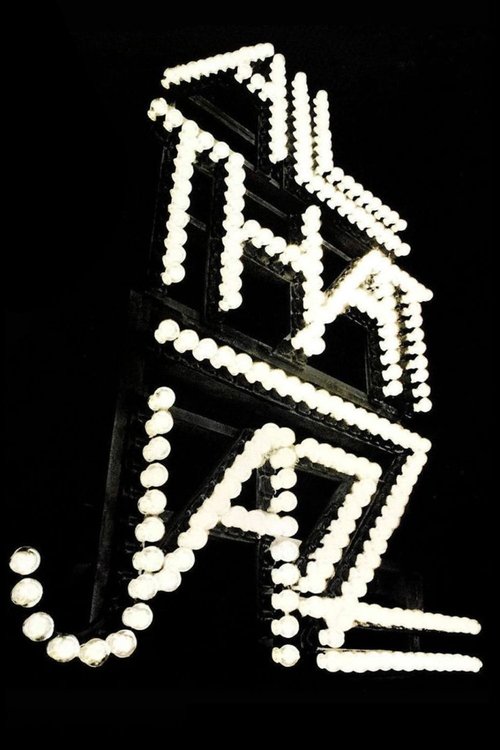
All That Jazz
1979 · Bob Fosse
For when you want to be overwhelmed — a maximalist night where the movie grabs you by the collar. Reach for it when you're up for something brilliant and dark about ambition, not when you need comfort.
What it's about
Joe Gideon is Broadway's hottest director-choreographer, and he's running on fumes: chain-smoking through rehearsals for a big new musical by day, editing a stand-up comedy film by night, held upright by pills, eye drops, and sheer ego. His marriage is over, his girlfriend and young daughter get whatever's left of him, and his body is starting to send warnings he refuses to hear. Between the dance numbers, he keeps drifting into flirtatious conversations with a beautiful woman in a white veil who seems to be waiting for him.
The experience
Dazzling and punishing at once — razzle-dazzle numbers cut against hospital fluorescents, with editing so quick and musical it feels like the film itself is showing off and confessing at the same time. It's funny, sexy, and genuinely harrowing, often within the same scene.
Performances
Roy Scheider, cast wildly against type, is electric as Gideon — charming, cruel, and self-aware enough to know exactly what he's doing to himself. Jessica Lange gives death itself a seductive warmth.
The craft
Bob Fosse turns his own life into choreography: the cutting is as rhythmic as the dancing, whole sequences are built like musical numbers even when nobody's dancing, and the staging swings from grimy rehearsal rooms to full hallucinatory spectacle. It rewards a big screen and loud speakers — the finale is designed to flatten you.
Why it matters
One of the boldest self-portraits ever put on film, it redefined what a movie musical could confess and set the template for every backstage story where the show and the self-destruction are the same thing. It cemented Fosse's legend as the artist who put his own obituary on screen.
Snapshot
All That Jazz is Bob Fosse's lacerating, semi-autobiographical musical about a Broadway director-choreographer dancing himself to death. Roy Scheider plays Joe Gideon, a chain-smoking, pill-popping, womanizing workaholic who is simultaneously editing a stand-up comedy film and staging a big Broadway musical while his body fails him. The film fuses backstage musical, confessional art film, and hospital melodrama into a single hallucinatory structure, organized loosely around the Kübler-Ross stages of dying and punctuated by Gideon's flirtatious dialogues with a white-veiled angel of death named Angelique (Jessica Lange). It is at once one of the most self-flagellating self-portraits in American cinema and a virtuoso demonstration of montage, choreography, and tonal control. Released by Columbia and 20th Century-Fox in a co-financing arrangement, it won the Palme d'Or at Cannes (shared) and four Academy Awards, and it remains the definitive screen statement of Fosse's sensibility — sweat, sex, cynicism, and showmanship at the edge of the grave.
Industry & production
The project emerged directly from Fosse's own life. In the mid-1970s he had been editing the film Lenny (1974) while simultaneously mounting the original Broadway production of Chicago (1975); the overwork precipitated a serious heart attack and open-heart surgery. All That Jazz dramatizes precisely this convergence: the film-within-the-film, "The Stand-Up," is a thinly veiled Lenny, and Gideon's stage musical "NY/LA" stands in for Chicago. The screenplay was written by Fosse with producer Robert Alan Aurthur, a veteran television and film writer who also produced; Aurthur died in 1978 before the film's release.
The production passed between studios. Columbia Pictures developed the film but balked at the escalating budget and the morbid, uncommercial material; 20th Century-Fox came in to co-finance, an unusual two-studio arrangement that allowed the picture to be completed. Casting was eventful: Richard Dreyfuss was initially attached to play Gideon and withdrew, reportedly uneasy about the dance demands and the role's narcissism. Roy Scheider, then best known for The French Connection and Jaws, took the part and delivered the performance of his career. Several roles were filled by people close to the autobiography: Ann Reinking, Fosse's real-life partner, plays Gideon's girlfriend Kate Jagger; Leland Palmer plays his ex-wife Audrey Paris, a figure modeled on Gwen Verdon, Fosse's actual ex-wife and muse; and Erzsebet Foldi plays his daughter. Cliff Gorman, who had played Lenny Bruce on Broadway, plays the comedian whose film Gideon is cutting. The film was shot largely in and around New York.
Technology
All That Jazz is a conventionally photographed 35mm film of its period; its technological signature lies not in novel hardware but in the intensity of its post-production craft. The most consequential "technology" is the editing apparatus itself, which the film foregrounds diegetically: we repeatedly watch Gideon at a flatbed editing table, running and re-running the same few seconds of stand-up footage, the Moviola/flatbed becoming both a literal tool and a metaphor for obsessive self-revision. The film's montage aesthetic — rapid, rhythmic, music-driven cutting — anticipates the visual grammar that video and, later, digital editing would make ubiquitous, but it was achieved here through traditional optical and photochemical means. The "Bye Bye Life" finale and the surgical/hallucination sequences make heavy use of staged theatrical lighting and set construction rather than optical effects, keeping the spectacle grounded in the physical.
Technique
Cinematography
The cinematographer was Giuseppe Rotunno, the great Italian director of photography long associated with Federico Fellini (Amarcord, Fellini's Casanova) and Luchino Visconti. His presence is telling: All That Jazz aspires to the self-reflexive, carnival-of-the-self register of Fellini's 8½, and Rotunno brings a painterly control of light to material that could have been merely garish. The audition number "On Broadway" is shot to emphasize bodies in deep, crowded space; the intimate scenes carry a warmer, more naturalistic palette; and the death fantasies move toward stylized, theatrical illumination — pools of light, smoke, the white of Angelique's costume against darkness. Rotunno received an Academy Award nomination for the film's cinematography.
Editing
Editing is the film's beating heart, both as subject and as method. Alan Heim won the Academy Award for Best Film Editing, and the win is unusually self-justifying: the movie is about editing. The celebrated opening, set to George Benson's recording of "On Broadway," intercuts a vast cattle-call audition with Gideon's brutal morning ritual — Dexedrine, eye drops, shower, cigarette, the look in the mirror, "It's showtime, folks." This montage establishes the film's pulse: image cut to music and to gesture rather than to continuity logic. Later, Heim and Fosse fragment time freely, splicing rehearsal, memory, fantasy, and the imagined open-heart surgery into a single accelerating stream as Gideon's life contracts. The editing is the formal analog of Gideon's psyche — compulsive, rhythmic, unable to stop cutting and recutting itself.
Mise-en-scène / staging
As Broadway's preeminent choreographer-director, Fosse stages dance with an instantly recognizable vocabulary: turned-in knees, rolled shoulders, splayed "jazz hands," sharp isolations, bowler hats and gloves, a sexualized angularity that is both inviting and faintly mechanical. The film's set-piece, the rehearsal number "Take Off with Us" / "Airotica," begins as a chipper airline jingle and transforms, under Gideon's direction, into an explicit, sweat-slicked erotic ballet that scandalizes his backers — a scene that dramatizes Fosse's own willingness to push commercial material into transgression. Throughout, the staging blurs the line between the proscenium and the cinema: theatrical space (the bare rehearsal studio, the hospital corridor reimagined as a stage) is repeatedly reframed as a movie set, culminating in the full theatrical apparatus of the "Bye Bye Life" finale.
Sound
The film's score and song program were arranged and adapted by Ralph Burns, who won the Academy Award for the music (the "Original Song Score and Its Adaptation" category of the era). The soundtrack is a knowing pastiche: pop recordings ("On Broadway"), a vaudeville-inflected book of numbers, and the climactic "Bye Bye Life," a death-as-show-stopper built on Ben Vereen's emcee-from-hell performance and patterned on the Everly Brothers' "Bye Bye Love." Sound is used to collapse registers — the beep of cardiac monitors, the patter of stand-up comedy, and the brassy attack of show tunes are woven so that mortality and entertainment become indistinguishable.
Performance
Roy Scheider's Gideon is the film's gravitational center: charismatic, cruel, exhausted, and ruthlessly honest about his own vanity. He was nominated for the Academy Award for Best Actor. Around him, the ensemble functions as a chorus of the wronged and the loving — Ann Reinking and Leland Palmer dance with the authority of genuine Broadway professionals (Reinking's number with the daughter, "Everything Old Is New Again," is a highlight), Jessica Lange gives Death a serene, seductive calm in an early major role, and Ben Vereen turns the finale into a grinning danse macabre. The performances are pitched to Fosse's tonal knife-edge between sincerity and showbiz artifice.
Narrative & dramatic mode
The film's dramatic mode is confessional and anti-naturalistic. Its spine is the Kübler-Ross model of dying — denial, anger, bargaining, depression, acceptance — which Gideon literally discusses and which structures his decline. Rather than a linear backstage story, the narrative is a braided present (the two productions, the failing heart) wrapped around a recurring dialogue with Angelique, to whom Gideon narrates and rationalizes his life. This framing device turns the whole film into a deathbed reverie: we are never sure how much is "happening" and how much is Gideon editing his own life as he would a film. The mode is therefore both musical (numbers erupt as expression) and modernist (the self-aware artist examining his own myth), and its honesty is structural — the movie refuses to redeem its protagonist, ending not in catharsis but in a body bag.
Genre & cycle
All That Jazz belongs to the backstage musical, the oldest of Hollywood musical subgenres, but it detonates the form from within. Where the classic backstage musical (the Warner Bros. Busby Berkeley cycle, 42nd Street) celebrates the redemptive magic of "putting on a show," Fosse's film exposes the human cost of that machinery — the exploitation, addiction, and self-destruction beneath the sequins. It arrives at the tail end of the 1970s, a fallow and revisionist period for the screen musical, and stands as one of the few ambitious original musicals of the decade alongside such darker, more adult experiments as Scorsese's New York, New York (1977) and Fosse's own Cabaret (1972). It is best understood as part of a small revisionist musical cycle that treated song-and-dance not as escape but as autopsy.
Authorship & method
The film is unmistakably Fosse's autobiography and aesthetic testament, the third panel of a loose self-reflexive trilogy after Cabaret and Lenny. His method here is total: he directed, co-wrote, and choreographed, folding his own near-death, his marriages, his affairs, and his working compulsions into the text. Crucially, the authorship is collaborative in ways the film acknowledges. Co-writer and producer Robert Alan Aurthur shaped the screenplay's structure. Cinematographer Giuseppe Rotunno imported the Fellini-esque visual grammar that lets the film float between reality and fantasy. Editor Alan Heim is, in effect, a co-author of the film's consciousness, since the movie's central metaphor is editing. Composer-arranger Ralph Burns stitched the eclectic musical fabric. The result is one of the most thoroughgoing fusions of theatrical and cinematic authorship in American film — a stage artist using the resources of the cinema to dissect himself.
Movement / national cinema
The film is an American work, a product of New York's theatrical world rather than Hollywood's studio musical tradition, and it bears the imprint of the "New Hollywood" license of the 1970s — the era's permission for downbeat endings, sexual frankness, and formal experiment in mainstream features. Yet its deepest affinities are European: the self-reflexive autobiographical art film of Fellini's 8½, mediated through Rotunno's camera, makes All That Jazz a hybrid of Broadway showmanship and Continental modernism. It is American cinema reaching, self-consciously, for the prestige and interiority of the European auteur film.
Era / period
Made and set in the late-1970s, the film is saturated in the textures of its moment: the grind of the New York commercial theater, the casual pharmaceutical culture of high-pressure creative work, and the New Hollywood's appetite for morally unresolved protagonists. It also captures a transitional instant in the musical's history — after the genre's classical decline and before its much later revival — and it would, in retrospect, look prophetic about the rhythmic, music-driven editing that the MTV era was about to normalize.
Themes
At its core the film is about the inseparability of creation, performance, and self-destruction — the idea that the artist's compulsion to perform is continuous with his compulsion to die. Mortality is treated not as tragedy but as the ultimate show, staged and choreographed. Related themes braid through it: the egotism and cruelty of the charismatic director; the betrayal of the people (wife, lover, daughter, dancers) who love a man married to his work; sex as both vitality and evasion; and the perfectionist's terror of being merely good ("To be on the wire is life," Gideon quotes; "the rest is waiting"). The film is also a sustained meditation on honesty in art — whether self-examination can be anything but another performance — and it answers that question by making its own brutal candor indistinguishable from showmanship.
Reception, canon & influence
On release the film was divisive: some critics found it monumentally self-indulgent — a director lavishing two-plus hours on his own narcissism — while others hailed it as a masterpiece of nerve and craft. The institutional verdict was emphatic. All That Jazz shared the Palme d'Or at the 1980 Cannes Film Festival (with Akira Kurosawa's Kagemusha), and it received nine Academy Award nominations, winning four: Film Editing (Alan Heim), Original Song Score/Adaptation (Ralph Burns), Art Direction, and Costume Design (Albert Wolsky); its nominations included Best Picture, Best Director, Best Actor (Scheider), Best Original Screenplay, and Best Cinematography. It has since entered the canon as Fosse's most personal and formally daring film and was selected for preservation in the United States National Film Registry as a culturally significant work.
The influences on the film are clear and openly worn: Fellini's 8½ as the model for the self-reflexive artist's confession; the Warner Bros. backstage-musical tradition it both invokes and subverts; and Fosse's own stage choreography and his earlier films Cabaret and Lenny. Its influence forward has been substantial and slow-burning. The percussive, music-synced montage of the "On Broadway" opening prefigured the editing language of the music-video era. Its vision of the musical number as psychological and mortal rather than escapist reverberates in later self-aware musicals and backstage films, from Rob Marshall's screen Chicago (2002) — itself a Fosse property — to the show-business-as-death-spiral structure of works like Birdman (2014). For the biographical record of Fosse himself, the film became the primary lens through which later accounts (including the Fosse/Verdon revival of interest in the 2010s) understood his self-destructive genius. It remains the rare musical that treats its own art form as both glory and disease — and survives as the most honest thing its maker ever staged.
A Deleuzian reading
Every morning it's the same cut.
The full Deleuzian reading of All That Jazz →
Reception
Critics in 1979 split hard — many called it self-indulgent and morbid even as it racked up nine Oscar nominations and shared the Palme d'Or with Kagemusha. Today the 'indulgence' is the point: it's canonized as one of the greatest movie musicals and a landmark of editing.
How All That Jazz was received, from release to now →
Influences: the films it descends from and the films it influenced
- 8½ (1963) — Supplies the self-reflexive artist-confession structure in which a blocked creator's memories, fantasies and present dissolve into one continuous stream — a grammar imported directly through cinematographer Giuseppe Rotunno, who shot both films.
- Cabaret (1972) — Establishes Fosse's rule of confining song strictly to the diegetic stage and cross-cutting the numbers against the dramatic action, the editing principle Joe Gideon's life-as-revue extends.
- Lenny (1974) — Provides the nonlinear confessional-biography template — a life reconstructed from intercut interview fragments and stark retrospection — that becomes Gideon's deathbed dialogues with Angelique.
- Sweet Charity (1969) — Fosse's film debut where he first translated his stage vocabulary into jump cuts, freeze-frames and fragmenting close-ups that isolate the choreographed body part-by-part.
- 42nd Street (1933) — The Warner Bros. 'show-must-go-on' backstage-musical template, complete with the understudy-saves-the-show finale, that All That Jazz quotes and inverts into a death spiral.
- The Red Shoes (1948) — Codifies art-as-fatal-compulsion — the performer consumed and killed by the very discipline that makes the work great — staged through a self-contained dream ballet.
- Citizen Kane (1941) — Models the fragmented retrospective in which a life is assembled from competing testimonies as its subject confronts death and an unrecoverable wholeness.
- The Seventh Seal (1957) — Personifies Death as a conversational figure the protagonist negotiates with throughout — the device behind Jessica Lange's Angelique as Gideon's serene, interviewing angel of death.
- All About Eve (1950) — Inherits All About Eve's backstage spatial grammar and in-medias-res death-framed flashback structure, organizing a choreographer's retrospective self-indictment as an intercut theatrical production — the dying-artist confessional flashback as Fosse's direct absorption and rerouting of Mankiewicz's architecture.
- They Shoot Horses, Don't They? (1969) — Builds dread of death through flash-forward/fantasy intercutting around a performer's physical collapse, the same montage-of-foreboding structure applied to exhaustion-unto-death.
- Limelight (1952) — The showman-director stages his own artistic decline and death as autobiographical spectacle, the ultimate extension of Chaplin filming his obsolescence as a deliberate final statement.
- The Band Wagon (1953) — Turns the reflexive show-business musical inward — the aging showman, art-vs-entertainment, mortality — extending Kidd-lineage choreography into self-critical autobiography.
- Flashdance (1983) — Builds its dance sequences as percussive, music-synced montages of fragmented bodies and rhythmic cuts — the 'On Broadway' opening's editing grammar industrialized into the MTV idiom.
- Chicago (2002) — A Fosse property that stages its numbers as the protagonist's interior fantasies intercut with grim reality, directly applying All That Jazz's interiorized-musical editing logic.
- Dancer in the Dark (2000) — Erupts into musical numbers as psychological escape from a death-bound narrative, treating song as a defense against mortality rather than as spectacle.
- Synecdoche, New York (2008) — Extends the creation-as-self-destruction premise to its limit — an artist obsessively staging his own life and approaching death as his unfinishable magnum opus.
- Black Swan (2010) — Literalizes the performer destroyed by perfectionist discipline, rendering the rehearsal-to-collapse arc as bodily horror and treating the art form itself as a disease.
- Birdman (2014) — Reworks the backstage show-business-as-death-spiral, collapsing the aging performer's ego, hallucination and mortality into the mounting of the show itself.
- Whiplash (2014) — Cuts to the beat of the music as a structural principle and equates artistic greatness explicitly with self-annihilation, the percussive montage carrying the film's argument.
- La La Land (2016) — A revisionist backstage musical that treats the form with melancholy self-awareness — numbers that acknowledge the cost of the dream rather than deliver uncomplicated escape.
- Rocketman (2019) — Fosse's device of the showman-protagonist narrating his own dissolution to a spectral interlocutor while musical fantasy sequences erupt around him establishes the confessional-therapy-frame and diegetic/non-diegetic slippage that Rocketman's rehabilitation-group structure directly inherits.
- Confessions of a Dangerous Mind (2002) — Proscenium-staged numbers and fantasy interludes that externalize an autobiographical subject's divided consciousness, splitting the film into two tonal registers.
- Soul (2020) — A musician's reckoning with death staged as a stylized show-business afterlife, an early template for scoring a life-review through the artist's own idiom.
- Moulin Rouge! (2001) — Its rapid-fire, fragmentary montage cutting of performance and its mortality-haunted, retrospective-confessional framing of a showman's life prefigure Jill Bilcock's kinetic editing and the dying-narrator confession structure.
- Pennies from Heaven (1981) — A near-contemporary revisionist musical that likewise weaponizes the escapist number against its source, letting bright song-and-dance expose the despair underneath rather than relieve it.
- Opening Night (1977) — Both films construct their backstage drama around a protagonist whose creative identity and mortality are structurally inseparable, and both use theatrical rehearsal sequences as spaces where the performer's psychological collapse becomes visible — though Fosse's showbiz maximalism inverts Cassavetes' unornamented restraint.
- Memories of Matsuko (2006) — A self-destructive life reconstructed as a series of increasingly delirious musical fantasy numbers, culminating in death staged as a show-stopping production — the biography-as-song-cycle blueprint.
- The Wiz (1978) — Takes fragmented dance coverage to its terminus, cutting numbers into shards synchronized to editing rhythm rather than musical phrase, and shares The Wiz's condition — a studio musical made at the moment the form's economics had already failed.
Similar films
- Whiplash (2014) — influence & lineage · same viewing thread · often watched together
- La La Land (2016) — influence & lineage · same viewing thread
- 8½ (1963) — influence & lineage · often watched together
- Lenny (1974) — influence & lineage
- Cabaret (1972) — influence & lineage
- Chicago (2002) — influence & lineage
- Sweet Charity (1969) — influence & lineage
- Synecdoche, New York (2008) — influence & lineage
All the films related to All That Jazz →
Watch it with: curated runs of related films
- Burning to Be the Best — Watch these together for the shared fever of ambition — musicians, dancers and one table-tennis obsessive driving themselves past exhaustion toward a greatness that keeps costing more.