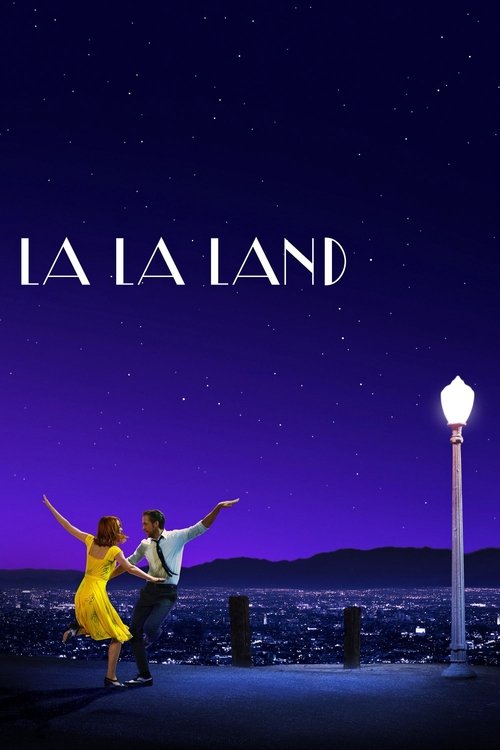
La La Land
2016 · Damien Chazelle
Babylon's spectacular flop became the era's favorite "ambitious failure" debate — maudit masterpiece or coke-fueled indulgence — a genuine Letterboxd litmus test.
For when you want romance with a lump in the throat — date night, a good cry, or a love letter to anyone chasing something hard. Comforting on the surface, quietly wrenching underneath.
What it's about
In present-day Los Angeles, an aspiring actress slinging lattes between failed auditions falls for a purist jazz pianist scraping by on cocktail gigs. They push each other toward their dreams — and then success starts arriving, with a price tag neither of them saw coming. It's a full-blown musical: people burst into song on gridlocked freeways.
The experience
Swooning and bittersweet in equal measure — it starts as pure candy-colored joy and gradually deepens into an honest ache about ambition and love pulling in different directions. You leave humming the melodies and nursing a bruise.
Performances
Emma Stone won the Oscar for a performance that peaks in a single audition scene, and her chemistry with Ryan Gosling — charming, bickering, wistful — powers the whole film.
The craft
Shot on celluloid in widescreen CinemaScope, drenched in magic-hour color, with an opening number staged as one apparent take on a real freeway interchange — one of the decade's great logistical flexes. Justin Hurwitz's score builds the entire emotional arc from a couple of obsessively reworked melodies. This one genuinely deserves the biggest screen and best sound you can find.
Why it matters
It single-handedly revived the Hollywood musical when the genre was presumed dead, swept awards season, and made Damien Chazelle the youngest Best Director winner ever.
Damien Chazelle's love letter to the Hollywood musical arrived when the genre was presumed dead and briefly resurrected it single-handedly. An aspiring actress and a purist jazz pianist fall in love across a candy-colored Los Angeles where people burst into song on gridlocked freeways — the opening number, staged as one apparent take on a real interchange ramp, remains one of the decade's great logistical flexes. Chazelle and cinematographer Linus Sandgren shot in CinemaScope on celluloid, drenching magic-hour Griffith Park in the saturated palettes of Jacques Demy, whose Umbrellas of Cherbourg supplies the film's bittersweet emotional blueprint: this is a musical about the cost of dreams, not just their pursuit. Justin Hurwitz's score, built from two or three obsessively reworked melodies, does the heavy narrative lifting. Emma Stone won an Oscar; Chazelle became the youngest Best Director winner ever; and the film itself became the center of the most famous envelope mix-up in Academy history, announced as Best Picture for a full two and a half minutes before Moonlight's name was read.
A Deleuzian reading
Two people walk up a hill in Griffith Park at magic hour, bickering about how little they like each other, and somewhere in the middle of a sentence they are dancing.
The full Deleuzian reading of La La Land →
Reception
It swept into 2016 awards season as an instant juggernaut (a record-tying 14 Oscar nominations), then hit a fierce backlash as the 'safe' frontrunner against Moonlight — and the envelope fiasco froze that rivalry in amber. A decade on, the backlash-to-the-backlash has kicked in and it's increasingly owned, unironically, as a modern musical classic.
How La La Land was received, from release to now →
Influences: the films it descends from and the films it influenced
- The Umbrellas of Cherbourg (1964) — Pastel color-blocked production design plus a wall-to-wall Michel Legrand score whose recurring love-theme leitmotif and downbeat 'years later' reunion coda Chazelle transplants directly into the epilogue.
- The Young Girls of Rochefort (1967) — Sun-washed anamorphic musical staged on real town locations with primary-color costume choreography and a jazz-pianist romance; the single-take freeway opening echoes its bridge-crossing group dance.
- Singin' in the Rain (1952) — The solo joy-dance in a public exterior — Gosling swinging on the lamppost — quotes Kelly's rain number, alongside the shared Hollywood-about-Hollywood subject.
- Swing Time (1936) — Established the unbroken full-body two-shot duet that keeps the dancers' feet in frame; 'A Lovely Night' is built on this Astaire-Rogers staging grammar.
- An American in Paris (1951) — The climactic wordless fantasy ballet on stylized soundstage sets in saturated Technicolor, reprised as La La Land's 'what-might-have-been' epilogue montage.
- The Band Wagon (1953) — The moonlit park pas de deux 'Dancing in the Dark,' which models the Griffith Observatory number's drift from walking into dance at magic hour.
- New York, New York (1977) — The jazz-saxophonist-and-singer romance whose careers pull apart, marrying studio artifice to New Hollywood realism with an unhappy ending — Chazelle's explicit structural model.
- West Side Story (1961) — Brought anamorphic, on-location dance choreography into real urban space, the widescreen-plus-street template Chazelle uses for his Los Angeles numbers.
- A Star Is Born (1954) — The showbiz-couple whose success and failure diverge, staged as musical melodrama about the cost of a performing dream — the career-asymmetry engine La La Land inherits.
- Guy and Madeline on a Park Bench (2009) — Chazelle's 16mm debut musical with composer Justin Hurwitz, establishing the tap-numbers-in-a-jazz-idiom and the bittersweet-couple template he later scales up.
- Whiplash (2014) — Same Hurwitz jazz score and 'cost of obsessive artistry' thesis, with the drummer's devotion recast as Sebastian's purist reverence for the form.
- All That Jazz (1979) — A revisionist backstage musical that treats the form with melancholy self-awareness — numbers that acknowledge the cost of the dream rather than deliver uncomplicated escape.
- First Man (2018) — Reunites Hurwitz's leitmotif scoring, Gosling, and format-as-texture celluloid capture, carrying forward the collaborator method built on La La Land.
- Babylon (2022) — Extends the jazz-scored cost-of-Hollywood-dreams argument and the closing montage-of-cinema-history device into a maximalist register.
- Annette (2021) — An art-pop, near-through-sung musical about a doomed performer couple and the destructive cost of ambition, pushing the Demy inheritance into avant-garde territory.
- Wicked (2024) — Modeled the unbroken-take musical number — song, blocking, and sweeping crane/Steadicam fused so the cut respects vocal integrity — the long-take-vocal-integrity device Wicked builds its 'Defying Gravity' finale around.
- tick, tick... BOOM! (2021) — Chazelle's revival of the original screen musical pairs a heightened, saturated palette against naturalistic scenes to dramatize ambition versus love — the two-register cinematography and central theme tick tick BOOM! shares.
- The Artist (2011) — A pastiche revival of classic-Hollywood musical/silent form pitched at Academy nostalgia, part of the same 2010s wave that made a throwback song-and-dance idiom viable again.
- Sing Street (2016) — A 2010s musical-revival built on original songs and a bittersweet dreamers-in-love arc, sharing the ethos of chasing an artistic dream at the expense of the romance.
- Baby Driver (2017) — Chazelle stages original musical numbers using pre-recorded playback in a contemporary dramatic film otherwise obeying naturalistic register, achieving the same generic-hybrid form — dramatic film containing musical-film conventions — as Baby Driver by independent means.
- Chicago (2002) — Extends the imagined/fantasy-number device — numbers that erupt from and comment on characters' inner longing — within the same musical-revival lineage Chicago reignited.
- Memories of Matsuko (2006) — CinemaScope primary-color production numbers framing a bittersweet romance, closing on a fantasy montage that rewrites a doomed love as the life-that-might-have-been — Matsuko's 'performed happiness' device.
- Soul (2020) — A jazz-purist protagonist whose devotion-versus-livelihood conflict mirrors Joe's; both stage the musician's dream against the mundane gig economy.
- Us and Them (2018) — Its counterfactual 'what if we'd stayed together' imagined-alternate-life coda is precisely the device Us and Them stages in its black-and-white sequence — a montage of the future the lovers didn't get.
- Blue Giant (2023) — Frames jazz purism as existential stakes and shoots performance in sustained, camera-mobile takes that ride the music — kin to Blue Giant's roaming stage camerawork.
- The Greatest Showman (2017) — The immediate commercial permission for an original (non-adapted) movie musical, sharing the choreographic long-take camera and the post-2016 revival's bet that new songs, not IP, could carry a musical.
- CODA (2021) — Shares music supervisor-producer Marius de Vries and his method of embedding live, imperfect vocal performance into scene texture instead of polished playback.
- Wonka (2023) — Revived the original-songbook film musical with crane-mounted long-take production numbers cut for readability, the same 'make the dance legible in wide framing' editing logic Wonka adopts.
- Better Man (2024) — Revived the ostentatious unbroken-take musical set piece with processional crowd choreography as a bravura calling card, the continuous-take number craft Better Man deploys in its street sequences.
Similar films
- Babylon (2022) — influence & lineage · same viewing thread
- Whiplash (2014) — influence & lineage · same viewing thread
- The Artist (2011) — influence & lineage
- First Man (2018) — influence & lineage
- The Young Girls of Rochefort (1967) — influence & lineage
- Singin' in the Rain (1952) — influence & lineage
- The Umbrellas of Cherbourg (1964) — influence & lineage
- Rocketman (2019) — same viewing thread
All the films related to La La Land →
Watch it with: curated runs of related films
- Burning to Be the Best — Watch these together for the shared fever of ambition — musicians, dancers and one table-tennis obsessive driving themselves past exhaustion toward a greatness that keeps costing more.