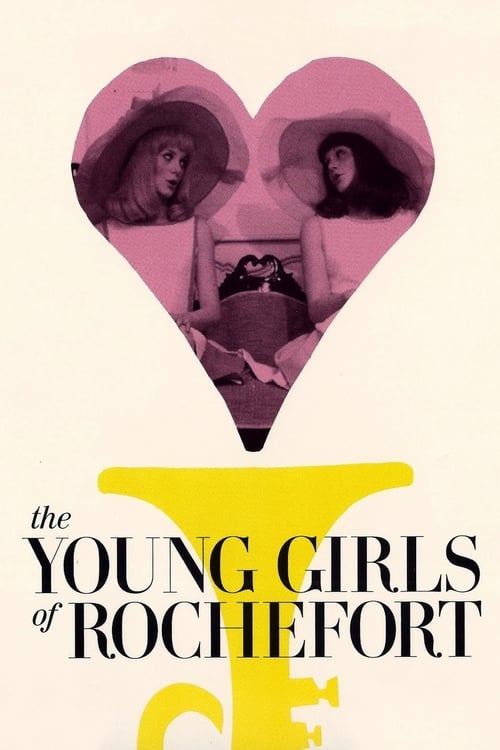
The Young Girls of Rochefort
1967 · Jacques Demy
For when you need joy on tap: a bad week, a gray Sunday, a cozy night when you want to fall in love with the idea of falling in love. Comfort viewing of the highest order.
What it's about
In the seaside town of Rochefort, twin sisters — a composer and a dance teacher — dream of Paris, art, and ideal love, while a weekend fair fills the streets with sailors, painters, and musicians. Each sister's perfect match keeps circling within blocks of her, and the whole town seems to conspire in the near-misses.
The experience
Pure effervescence — sherbet pinks, lemon yellows, and people who burst into song and dance because walking is too small for how they feel. It's sunshine in movie form, with just enough shadow at the edges to keep the sweetness from cloying.
Performances
Catherine Deneuve and her real-life sister Françoise Dorléac play the twins with a chemistry no casting director could fake, and Gene Kelly turns up as a visiting American composer, bringing Hollywood's golden age with him.
The craft
Jacques Demy had the actual town's façades repainted to match his candy palette and shot it all in gliding widescreen, set to Michel Legrand's jazz-inflected score — the twins' theme has become a standard. It's one of the most gorgeous color films ever made and begs for the biggest, brightest screen you can find.
Why it matters
The fullest expression of Demy's one-of-a-kind project — New Wave freedom fused with Hollywood-musical ardor — and a touchstone that later screen musicals have been openly in love with ever since.
After the heartbreak of The Umbrellas of Cherbourg, Jacques Demy composed its radiant inverse: a widescreen musical in sherbet pinks and lemon yellows, where twin sisters — Catherine Deneuve and her real-life sister Françoise Dorléac — dream of Paris, art, and ideal love while their perfect partners circle within blocks of them, forever nearly colliding. Demy had whole façades of the actual town of Rochefort repainted to match his palette, imported Gene Kelly as a visiting American composer, and set it all to Michel Legrand's jazz-inflected score, whose twins' theme has since become a standard. The film is the fullest expression of Demy's singular position in French cinema — New Wave in freedom, Hollywood in ardor, and entirely his own in its belief that chance is a choreographer. Beneath the sun there are shadows, including a bizarre crime subplot played almost as a shrug; Demy always knew sweetness needs salt. Dorléac died in a car accident months after the premiere, sealing the film forever as the record of two sisters dancing together in the town square.
A Deleuzian reading
Two sisters dance across the square of a real seaside town in the same pinks and lemons as the walls behind them.
The full Deleuzian reading of The Young Girls of Rochefort →
Reception
Received in 1967 as the lighter, more 'artificial' follow-up to The Umbrellas of Cherbourg — charming but slight was the verdict — it's since been fully canonized, helped along by the 1990s restoration overseen by Agnès Varda and a new generation who discovered it via La La Land. Now it's routinely called one of the most joyful films ever made.
How The Young Girls of Rochefort was received, from release to now →
Influences: the films it descends from and the films it influenced
- Lola (1961) — Founds Demy's interlocking 'cinematic universe' of recurring characters and chance-crossing lovers in a coastal town, plus the first Demy–Legrand collaboration whose waltz motifs Rochefort inherits.
- An American in Paris (1951) — Gene Kelly's cameo is a direct citation of this film's integrated MGM dream-ballet aesthetic, where extended dance replaces plot and painterly color design governs the frame.
- Singin' in the Rain (1952) — Model for Kelly's athletic, street-level choreography and the buoyant self-delight of the studio musical that Rochefort transplants onto French pavement.
- The Band Wagon (1953) — Supplies the saturated Technicolor palette and the backstage-troupe-of-performers structure, with romance sorted out through numbers rather than dialogue.
- Meet Me in St. Louis (1944) — Precedent for dressing an entire town into a hermetic pastel dreamscape where seasons and set-color choreograph the emotional register.
- On the Town (1949) — Pioneers taking the musical on location into a real port full of sailors on leave — the exact narrative engine of Rochefort's visiting fair-and-navy transients.
- West Side Story (1961) — Demonstrates ensemble dance choreographed across actual streets in anamorphic widescreen, snapping between everyday movement and full number that Rochefort adopts.
- Seven Brides for Seven Brothers (1954) — Michael Kidd's muscular, acrobatic male-ensemble dancing is the template for Rochefort's fairground carnies who move as a virile chorus.
- Swing Time (1936) — Demy builds numbers on crane and lateral tracking that keep whole bodies in wide frame against colored architecture, and casts Kelly as a living citation of the Astaire lineage he is quoting.
- It's Always Fair Weather (1955) — Demy imports the Kelly–Donen integrated musical wholesale — casting Kelly himself, using location streets choreographed as one continuous mobile-camera space — while keeping Fair Weather's melancholy premise that the reunion may not happen.
- Donkey Skin (1970) — Carries forward the candy-colored artificial palette, Deneuve as fairy-tale ingénue, and Legrand's score into overt storybook fantasy.
- Une chambre en ville (1982) — Returns to the fully through-sung Demy–Legrand recitative of Umbrellas/Rochefort, proving the operatic dialogue-as-music method a durable authorial form.
- Golden Eighties (1986) — An explicit Demy homage relocating the on-location song-and-dance ensemble to a shopping mall, with a Legrand-style score and chance-crossed lovers among the boutiques.
- 8 Women (2002) — Reunites Deneuve inside artificial candy-colored single-set staging with a crime plot resolved through individual musical numbers — a knowing gloss on Demy's genre-blending.
- La La Land (2016) — Openly quotes Rochefort and Umbrellas: CinemaScope pastel palette, jazz score in the Legrand idiom, near-miss chance romance, and the bittersweet coda where sweetness needs salt.
- Everyone Says I Love You (1996) — Revives Demy's integrated musical using untrained singing voices woven into naturalistic scenes, treating song as an extension of everyday romantic chance.
- Annette (2021) — Extends the through-sung Demy model into contemporary opera-film, scoring nearly all dialogue as continuous music in the lineage of the Demy–Legrand recitative.
- Jacquot (1991) — Varda quotes the fairground and dance numbers to trace them back to the traveling carnival and puppet theater that dazzled the boy, making the citation an argument about craft transmission.
- White Noise (2022) — Stages a full musical number in a working commercial space with non-dancer principals, choreography arranged as a social diagram of the crowd — the structural model for the LCD Soundsystem supermarket dance that resolves the film in movement rather than dialogue.
- The Umbrellas of Cherbourg (1964) — The immediate companion piece: same Demy–Legrand method of scoring dialogue as music and repainting a real port town into a color-coordinated set, here loosened from full recitative into spoken scenes bracketed by song.
- Dancer in the Dark (2000) — Inverts the Demy musical by keeping the fantasy numbers but pushing the 'sweetness needs salt' undertow into full tragedy, exposing the melancholy Demy hid beneath his color.
- Memories of Matsuko (2006) — Sunlit ensemble street choreography where whole town squares break into coordinated primary-colored production numbers, the sourcebook for Matsuko's fields-of-flowers dance interludes.
- A Woman Is a Woman (1961) — A Legrand-scored, Gene-Kelly-featuring homage to the MGM musical that, like Godard's film, inhabits the Freed-unit form self-consciously as cinephile tribute.
Similar films
- The Umbrellas of Cherbourg (1964) — influence & lineage · same viewing thread · often watched together
- Donkey Skin (1970) — influence & lineage · same viewing thread
- Lola (1961) — influence & lineage · same viewing thread
- La La Land (2016) — influence & lineage
- Singin' in the Rain (1952) — influence & lineage
- Amélie (2001) — same viewing thread · often watched together
- Dancer in the Dark (2000) — influence & lineage · often watched together
- Céline and Julie Go Boating (1974) — often watched together
All the films related to The Young Girls of Rochefort →
Watch it with: curated runs of related films
- Storybook France in Full Color — A run of saturated, big-hearted French confections that rhyme on candy-box color, romantic longing, and the magic hiding in an ordinary day.