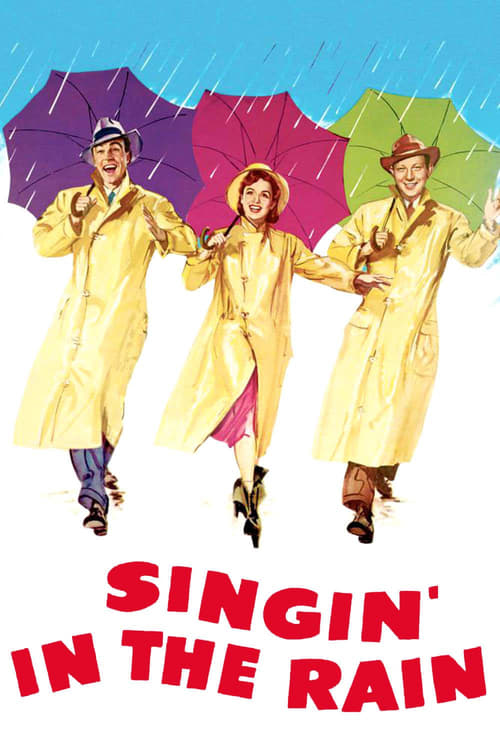
Singin' in the Rain
1952 · Stanley Donen
For when you need your spirits lifted, guaranteed — a rainy-day, whole-family, restore-your-faith-in-movies pick that works equally well as a first musical or a hundredth rewatch.
What it's about
Hollywood, 1927: the movies are learning to talk, and silent-film idol Don Lockwood is in trouble — his glamorous screen partner has a voice like a fire alarm, and their first talkie is shaping up as a disaster. His way out involves a sharp, unimpressed chorus girl he's falling for, a scheme to dub one voice with another, and some of the greatest song-and-dance numbers ever filmed.
The experience
Pure uncomplicated joy — fast, funny, and generous, with musical numbers that still produce an involuntary grin. It's a comedy about show business that never stops being a great show itself.
Performances
Gene Kelly's title number is the most famous dance on film for a reason, Donald O'Connor's 'Make 'Em Laugh' is a demolition-derby of physical comedy, and Jean Hagen is riotous as the star whose voice could curdle milk — a performance funny enough to earn an Oscar nomination.
The craft
The Technicolor is candy-bright, the choreography is shot in long, legible takes that let you see every step, and the screenplay — wittily built around a back catalog of existing songs — doubles as a sly history lesson about the chaos of the sound transition. On a big screen with the volume up, it's euphoric.
Why it matters
By broad consensus the greatest of the Hollywood musicals, it became the standard against which the genre is measured and the movies' fondest joke about their own history.
Snapshot
Singin' in the Rain is the most durable of the MGM Freed Unit musicals and, by broad critical consensus, the most fully realized integration of song, dance, comedy, and self-reflexive filmmaking Hollywood produced in its studio-system prime. Set in the Hollywood of 1927–28, it dramatizes the coming of sound through the fortunes of silent stars Don Lockwood (Gene Kelly) and the shrill-voiced Lina Lamont (Jean Hagen), and the chorus girl Kathy Selden (Debbie Reynolds) whose voice — and love — rescue Don's first talkie. Its reputation rests less on narrative ambition than on a rare density of first-rate numbers, a witty screenplay built out of an existing song catalog, and a governing joke that lets a musical be about the very technology that made the movie musical possible. One caveat on the credit line above: the film is a genuine co-direction by Gene Kelly and Stanley Donen, and much of its choreographic authorship belongs to Kelly; treating Donen as sole director understates a partnership.
Industry & production
The film was a product of Arthur Freed's semi-autonomous production unit at MGM, the studio's — and Hollywood's — premier musical operation of the late 1940s and early 1950s. Its origin is unusual and well documented: Freed, who before becoming a producer had been a successful lyricist, wanted a picture built around the songbook he had written in the late 1920s and early 1930s with composer Nacio Herb Brown. The songs came first; the story was reverse-engineered to house them. Freed assigned the screenplay to Betty Comden and Adolph Green, who — casting about for a frame that would justify a catalog of vintage numbers — settled on the industry's own transition to sound as both setting and subject, a period that happened to coincide with when most of the Freed–Brown songs were written.
Production followed on the heels of the Freed Unit's An American in Paris (1951), which would win the Academy Award for Best Picture, and it drew on the same reservoir of talent and confidence. Kelly, fresh from that success, was given wide latitude over the musical staging. The budget was substantial by musical standards but the film was not treated at the time as the unit's flagship prestige project — that mantle belonged to the more overtly artistic An American in Paris. Contemporary accounts and later memoirs (notably Comden and Green's own writing and Donen's interviews) describe a demanding shoot, with Reynolds, a teenaged non-dancer, drilled hard to keep pace with Kelly and Donald O'Connor. Beyond that, specific production budget and schedule figures should be treated cautiously; the widely repeated anecdotes deserve more skepticism than the documented creative process.
Technology
Technologically the film sits at two removes: it was made in the mature Technicolor sound era, and it depicts the birth of that era. It was shot in three-strip Technicolor, the saturated dye-transfer process that gave MGM musicals their characteristic richness, and recorded with the postwar sound apparatus that made elaborate playback-and-mime musical shooting routine. That maturity is precisely what lets the film mine comedy from 1927's primitive conditions — the immobilized microphone hidden in a bush, the actor's every rustle amplified, the desynchronized reel that turns a melodrama into a farce. These gags are broadly faithful to the real growing pains of early sound: fixed mics, the loss of camera mobility, the sudden tyranny of the recording engineer, and the career casualties among performers whose voices betrayed them. The film compresses and caricatures this history for comic effect rather than documenting it, but its underlying account of sound as a disruptive technology that reshuffled stardom is historically sound.
Technique
Cinematography
Harold Rosson, a veteran MGM cameraman, photographed the film. The visual approach is bright, high-key, and legible — the house style of the Freed Unit — designed to keep bodies and color fully readable in motion rather than to impose an auteurist look. Rosson's most demanding assignment was the title number, staged on a purpose-built street set under a downpour, which required lighting rain so that individual droplets and splashes register against a dark night street without the water going invisible or the figure going murky; the sequence's clarity of silhouette and sparkle is a real cinematographic achievement, whatever the apocryphal on-set legends. Throughout, the camera serves the choreography: wide framings that preserve the dancer's whole body and long takes that let a number's spatial logic play out are chosen over fragmentation.
Editing
Adrienne Fazan edited the film. The cutting embodies the integrated-musical principle that a dance should be shown in space and time, not manufactured in the cutting room: numbers favor sustained takes and full-figure framing, with cuts placed at musical and choreographic joints rather than used to fake movement or hide the performers' limits. The comic sequences, by contrast — the sound-era gags, the desynchronized preview — depend on precise editorial timing, and the film modulates fluently between the patient rhythm of the dance numbers and the snap of the comedy.
Mise-en-scène / staging
The film's staging is its signal strength. Kelly's choreography is built for the camera, using the width of the frame, the depth of sets, and props (an umbrella, a couch, a plank wall, a studio backlot) as active partners. "Good Morning" travels through a house, converting furniture and rooms into a course; "Make 'Em Laugh" turns a soundstage into an obstacle gymnasium; the title number choreographs a whole street, curb, lamppost, and gutter. The Freed Unit's design resources — Cedric Gibbons's art department, elaborate costuming, and the recreation of late-1920s Hollywood — give the numbers a solid, inhabitable world rather than an abstract void, even as the climactic "Broadway Melody" ballet departs into stylized fantasy.
Sound
Sound is the film's subject and one of its finest jokes. Musically, Lennie Hayton served as musical director, arranging and adapting the Freed–Brown catalog. But the film's most sophisticated move is diegetic and thematic: it is a sound film obsessed with voices and their ownership. Its central irony is layered almost past untangling — Reynolds's Kathy dubs Lina's voice within the story, while in production Reynolds herself was reportedly dubbed in places (Jean Hagen's own, actually cultured, voice used for some of Kathy's "dubbing" of Lina, and singer Betty Noyes for some vocals). The film thus stages the question of whose voice we are really hearing at the very moment it moralizes about authenticity, a self-consuming irony scholars have returned to for decades.
Performance
The performances are unusually complete. Kelly combines athletic, grounded masculinity with romantic ease and directs his own numbers from inside them. Donald O'Connor's "Make 'Em Laugh" is a tour de force of physical comedy — pratfalls, wall-runs, and clowning executed at full commitment. Debbie Reynolds, not trained as a dancer, holds the screen through sheer drilled energy and charm. But the performance most singled out by critics is Jean Hagen's Lina Lamont, a comic creation of grating voice and vain stupidity that is both hilarious and, in its own way, technically precise; Hagen was Oscar-nominated for it. Millard Mitchell (studio head R.F. Simpson) and Rita Moreno (Zelda) fill out the world; Cyd Charisse appears as the vamp of the "Broadway Melody" ballet, a purely choreographic role that supplies the film's one note of adult eroticism.
Narrative & dramatic mode
Dramatically the film is a backstage romantic comedy in the classical Hollywood mode: a public-facing romance (Don and Kathy), a professional crisis (the failing talkie The Dueling Cavalier, salvaged as the musical The Dancing Cavalier), and a comic antagonist (Lina) whose exposure resolves both plots at once in the final unmasking. The construction is efficient and self-aware: obstacles are as much technological and industrial as emotional, and the happy ending is achieved by an act of theatrical revelation — the curtain rising on Kathy behind Lina's lip-synced performance — that literalizes the film's concern with authentic versus borrowed voice. It is a comedy of professional and romantic reconciliation, low on genuine menace and high on wit, in which the numbers do much of the emotional work the dialogue leaves implied.
Genre & cycle
The film belongs to the integrated musical, the form in which songs and dances advance character and story rather than interrupting them, and specifically to the Freed Unit's early-1950s high cycle — the run that includes On the Town (1949), An American in Paris (1951), The Band Wagon (1953), and others. Within that cycle it is the exemplary "backstage" or show-business musical, a subgenre the studio favored because it motivated performance diegetically and let Hollywood flatter its own history. Its nostalgia for the 1920s, its self-reflexive setting, and its catalog-based score all mark it as a late, knowing entry in the studio musical — a form already sensing that its own golden age was finite.
Authorship & method
Authorship here is corporate and collaborative in the best Freed Unit sense, and it resists reduction to a single name. Gene Kelly and Stanley Donen co-directed; Kelly additionally choreographed and starred, and his conception of dance-for-camera is the film's aesthetic spine, while Donen's contribution to the staging, pacing, and cinematic construction was substantial and is often underweighted in Kelly-centric accounts. Betty Comden and Adolph Green wrote a screenplay of real wit under the constraint of a predetermined song list, and their solution — the sound-transition premise — is arguably the film's most important single creative decision. Arthur Freed produced and, as the original lyricist (with Nacio Herb Brown), supplied the songbook that generated the whole enterprise; the score is a catalog assembled by Lennie Hayton rather than a purpose-written work, with the notable near-exception of "Make 'Em Laugh," a new Freed–Brown number whose close resemblance to Cole Porter's "Be a Clown" has long been noted. Harold Rosson photographed and Adrienne Fazan edited. The method, in short, was assembly under a strong house style: existing material, specialized craft departments, and a star-director with unusual creative control, fused by a producer with a coherent vision of what a musical should be.
Movement / national cinema
The film is a paradigm of classical Hollywood at the peak of the studio system — American mass entertainment produced by a vertically integrated major (MGM) through a specialized in-house unit. It has no relation to a self-declared art movement; its "movement," if any, is the Freed Unit's own project of elevating the musical to a self-conscious craft. Its Americanness is thematic as well as industrial: it celebrates Hollywood's own mythology, and later French critics — for whom the Hollywood musical became an object of serious cinephile attention — helped install it in the international canon partly as an exemplar of American vernacular art.
Era / period
Made in 1952, the film arrives at a hinge moment for its own industry. The studio system was entering decline: the 1948 Paramount antitrust decree had forced the majors to divest their theater chains, television was drawing away the mass audience, and the lavish in-house musical would within a decade become economically unsustainable. Singin' in the Rain thus looks back nostalgically at one technological upheaval (silent to sound) from the threshold of another (cinema versus television), and part of its poignancy in retrospect is that it captures a mode of filmmaking near its zenith and near its end. Its period recreation of 1927 Hollywood is affectionate caricature rather than history, but its account of an industry convulsed by new technology carries an unintended contemporary charge.
Themes
The film's controlling theme is authenticity versus artifice — specifically, the ownership of the voice and the gap between image and reality that cinema itself institutionalizes. Almost every plot turn concerns a mismatch between a body and its sound: Lina's glamorous face and grotesque voice, Kathy's voice lent to Lina's image, the desynchronized preview. Around this sits a set of related concerns: the labor and illusion behind stardom (the film repeatedly shows how effects are faked); nostalgia and the passing of one era into another; and the redemptive power of talent and honesty over manufactured fame. There is a genuine reflexivity here — a movie musical using the birth of the movie musical to think about what movies conceal — that has made the film unusually rewarding to critical and theoretical analysis despite its featherweight surface.
Reception, canon & influence
On release the film was well received but not immediately anointed; it was popular and admired, yet initially overshadowed by An American in Paris, which had swept the prior year's Oscars. Its two Academy Award nominations (Jean Hagen for supporting actress; the scoring of a musical) reflect solid rather than triumphant contemporary standing. Its canonization was gradual and then overwhelming. Over subsequent decades — aided by revival screenings, television, the serious critical rehabilitation of the Hollywood musical, and Kelly's growing stature — it rose to be regularly named the greatest of all movie musicals and one of the greatest films of any kind, a fixture near the top of institutional lists and a recurring presence in the Sight & Sound critics' and directors' polls. (Exact poll placements have shifted from edition to edition; I'd verify any specific ranking rather than assert one from memory.)
Its influences run backward to the whole tradition of the backstage musical and to the specific 1920s–30s songbook it recycles; the title song itself predates the film, having originated in MGM's early-sound The Hollywood Revue of 1929, so the movie is in a literal sense built from the era it depicts. Forward, its legacy is pervasive: it fixed the popular image of the sound-transition, made the title number one of the most quoted images in cinema (endlessly parodied, homaged, and — as in A Clockwork Orange — grimly inverted), and set a benchmark for the integrated, camera-conscious dance sequence that later filmmakers of the musical, from Bob Fosse's generation onward to contemporary revivalists, have measured themselves against. It endures less as a template to be copied than as a demonstration of how completely song, dance, comedy, and cinematic self-awareness can be fused — the standard against which the form is still judged.
A Deleuzian reading
Start with the lamppost.
The full Deleuzian reading of Singin' in the Rain →
Reception
In 1952 it was just another solid MGM musical — a modest hit with only two Oscar nominations, overshadowed by the previous year's Best Picture winner An American in Paris. It has since climbed all the way to consensus greatest-movie-musical status, even cracking Sight & Sound's critics' top ten in 2002.
How Singin' in the Rain was received, from release to now →
How to watch Singin' in the Rain: what to notice on a first viewing
- Count how few cuts a dance number actually gets. Adrienne Fazan places cuts at musical and choreographic joints and otherwise leaves the take running. Bodies stay in frame from head to feet. Nothing is faked by assembly. You are watching what the dancers really did, in one space, in real time. The difficulty stays visible, which is where the pleasure comes from.
- Watch how little ground Kelly covers during the title number. He folds the umbrella, hooks a lamppost, stamps in a gutter, tips his face into the downpour. He barely travels. The rain, the awnings, and the whole soaked street supply the motion. Nothing is being accomplished for three minutes. The plot sets itself down and lets a man be carried by weather.
- Listen to what the hidden microphone picks up on set. The 1927 sequences turn recording into the joke. A mic buried in a bush catches every rustle and heartbeat, and a reel slips out of sync until the words land on the wrong mouths. A 1952 talkie is laughing at the birth of talkies. The film keeps showing you the machinery it is made of.
- Look at what ordinary object each number turns into equipment. An umbrella, a couch, a plank wall, a curb, the rooms of a house. Kelly choreographs for whatever the set already contains and uses the depth and width of the frame as part of the routine. The numbers happen in a world you could walk through. That solidity is what keeps them funny rather than abstract.
- Look at how the rain catches light on the night street. Rosson had to make individual droplets and splashes read against a dark backlot street without losing the figure in it. The rest of the film runs bright and high-key so every color and body stays legible in motion. The clarity is a technical decision, not a given. You can see the water and the man at once, which is the entire shot.
The whole guide to watching Singin' in the Rain, with the keys for a rewatch →
Influences: the films it descends from and the films it influenced
- The Broadway Melody (1929) — MGM's first all-talking backstage musical pioneered pre-recorded playback so numbers could be shot to a prior vocal track — the very dubbing technology whose comic exposure drives Singin' in the Rain's plot.
- The Hollywood Revue of 1929 (1929) — Introduced the actual Freed–Brown song 'Singin' in the Rain,' so the film literally recycles its title number from the sound-era revue format it depicts.
- 42nd Street (1933) — Codified the backstage-musical narrative engine (the show in peril, the last-minute substitution, 'you're going out a nobody but you've got to come back a star') that Comden and Green retool into Kathy's rescue of The Dancing Cavalier.
- Gold Diggers of 1933 (1933) — Busby Berkeley's overhead kaleidoscopic mass geometry is quoted directly in the 'Beautiful Girl' fashion montage and the abstract passages of the Broadway Melody Ballet.
- Top Hat (1935) — Astaire's insistence on full-figure framing and unbroken long takes for a dance — body entire, minimal cutting — is the dance-for-camera doctrine Kelly inherits and muscularizes in the title number.
- Cover Girl (1944) — Kelly's 'alter-ego' double-exposure number let him choreograph against trick photography, an early self-directed experiment in dancing for the camera rather than the proscenium.
- Anchors Aweigh (1945) — Kelly's dance with the animated Jerry the Mouse proved he could choreograph to optical effects and precise camera geometry, extending his athletic, grounded style into cinematic space.
- On the Town (1949) — The first Kelly–Donen co-direction established their division of labor — Kelly's choreography, Donen's cinematic construction and pacing — the exact partnership method that builds Singin' in the Rain.
- The Red Shoes (1948) — The 'Broadway Melody' dream-ballet abandons narrative space for impossible studio geography choreographed to pre-recorded music — the Archers' montage-of-impossible-space applied to the MGM musical.
- Sherlock Jr. (1924) — Fuses cinema-about-moviemaking with virtuosic physical comedy staged in unbroken takes, carrying Keaton's principle that the body's precise choreography, not the cut, sells the gag.
- Swing Time (1936) — The title number's sustained full-figure take, and the wholly manufactured soundstage weather it dances in, descend directly from Swing Time's artificial-snow exterior and its refusal to cut away from the dancer.
- The Band Wagon (1953) — The next major Freed Unit backstage musical reuses the same catalog-score method (Dietz–Schwartz songbook) and self-reflexive 'that's entertainment' address to the making of a show.
- It's Always Fair Weather (1955) — The Kelly–Donen reunion pushes dance-for-camera further with Kelly's roller-skate solo shot in sustained full-figure takes on a real street, extending the title number's lit-location choreography.
- A Clockwork Orange (1971) — Kubrick grimly inverts the title number by having Alex sing 'Singin' in the Rain' as diegetic accompaniment to assault, weaponizing the song's association of performance and joyous self-expression.
- Cabaret (1972) — Fosse defines his aesthetic against the seamless integrated number — confining song to the stage and cross-cutting it against reality — a deliberate rebuttal that measures itself on Kelly's benchmark.
- Moulin Rouge! (2001) — Builds its backstage romance from a jukebox of pre-existing songs assembled rather than purpose-written, the same catalog-construction logic as the Freed–Brown songbook underpinning Singin' in the Rain.
- The Artist (2011) — Centers its entire drama on the silent-to-sound transition and the star undone by his voice, the coming-of-sound subject and voice-ownership anxiety Singin' in the Rain turned into comedy.
- La La Land (2016) — Chazelle revives the full-figure CinemaScope long-take dance-for-camera and explicitly homages the studio-era integrated musical, staging numbers in continuous takes as Kelly and Donen did.
- Hail, Caesar! (2016) — The Coens' studio-system pastiche stages a Donald O'Connor–style athletic comic ensemble number ('No Dames') and recreates Freed-Unit production craft as loving forensic homage.
- Hard Boiled (1992) — Woo has cited Gene Kelly's choreographic architecture—the precise mapping of acrobatic movement through screen space, integrating physicality with emotional expressivity—as a direct model for staging gunfights as dance sequences rather than combat exchanges.
- Baby Driver (2017) — Every number was filmed to pre-recorded playback tracks locked before shooting, requiring camera movement, choreography, and cutting to be built around fixed musical durations — the industrial prototype for Wright's music-first production method.
- Rocketman (2019) — The embedded 'Broadway Melody' fantasy sequence — a self-contained eruption that comments on the protagonist's psychology rather than advancing the plot within an otherwise realistic backstage narrative — models the device Rocketman extends into its whole formal logic, including the Crocodile Rock schoolyard sequence.
- Zatoichi (2003) — The exuberant ensemble tap idiom Kitano quotes directly in the anachronistic tap-dance curtain-call finale that fuses chanbara with the Hollywood musical.
- An American in Paris (1951) — The immediately prior Freed Unit Kelly vehicle set the template of a climactic integrated dream-ballet in saturated three-strip Technicolor, directly answered by the 'Broadway Melody' ballet-within-the-film.
- The Umbrellas of Cherbourg (1964) — Demy takes the integrated-musical principle to its limit — every line sung, song fully dissolved into narrative — the total-integration ideal Singin' in the Rain approaches through its diegetically motivated numbers.
- Chicago (2002) — Self-reflexive showbiz backstage musical about celebrity manufacture and media image — Chicago's media-spectacle theme in a classical MGM register.
- Meet Me in St. Louis (1944) — A Freed Unit production built on the same prerecorded-playback craft and the integrated musical's principle that numbers erupt from character and situation, plus a shared nostalgic reverie for an earlier Hollywood era.
- A Woman Is a Woman (1961) — The Freed-unit Technicolor exuberance and the impulse to break into number at any domestic moment is the object of Godard's loving pastiche — he quotes the form's joy then withholds its seamless integration.
- Bellissima (1952) — Same-year movie-about-movies whose central dubbing/post-synchronization gag mirrors Bellissima's own post-synced sound and its projection-booth reveal of the gap between voice and image.
Similar films
- The Umbrellas of Cherbourg (1964) — influence & lineage · often watched together
- It's Always Fair Weather (1955) — influence & lineage
- La La Land (2016) — influence & lineage
- The Band Wagon (1953) — influence & lineage
- Cabaret (1972) — influence & lineage
- Moulin Rouge! (2001) — influence & lineage
- The Artist (2011) — influence & lineage
- Some Like It Hot (1959) — often watched together