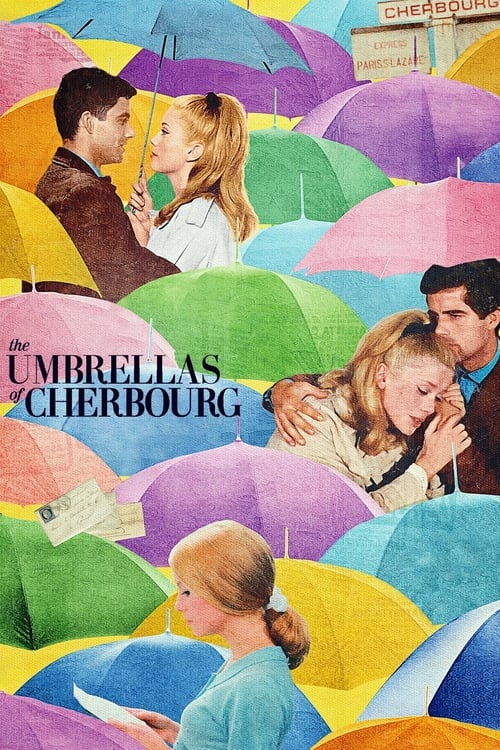
The Umbrellas of Cherbourg
1964 · Jacques Demy
For a good cry — when you want to fall in love and have your heart gently, beautifully broken. Comfort and ache in the same package; perfect for a rainy evening, fittingly enough.
What it's about
Cherbourg, 1957: a twenty-year-old garage mechanic and the seventeen-year-old daughter of a struggling umbrella-shop owner are dizzyingly in love. Then he is drafted to the war in Algeria, and she is left behind with her anxious mother, a pregnancy, and an impossible choice about how long a person can wait. Every single line of it — every hello, every argument, every goodbye — is sung.
The experience
Candy-colored and swooning at first, then quietly devastating — the melodies lodge in your chest and the story breaks your heart without a single villain in sight. It's the rare musical where the singing makes everything feel more true, not less.
Performances
Catherine Deneuve, luminous at twenty, in the role that made her a star — she carries the film's innocence and its slow disillusionment on her face.
The craft
Michel Legrand's wall-to-wall score turns ordinary conversation into music, while Demy drenches every wall, dress, and wallpaper in saturated color that makes a gray port town look like a dream. It's ravishing on a big screen, and the central love theme is one of the most famous melodies in movie history.
Why it matters
Winner of the top prize at Cannes, a touchstone for generations of movie musicals since, and the film that launched Catherine Deneuve — its influence is audible any time a musical dares to be sad.
Snapshot
Les Parapluies de Cherbourg is a paradox made luminous: a wall-to-wall sung melodrama, every line of dialogue set to music by Michel Legrand, that nonetheless tells one of the most unsentimental stories in the French cinema of its decade. Jacques Demy called it a film "en chanté" — both "sung" and "enchanted" — and the pun captures its method. Across three movements ("Departure," "Absence," "Return"), it follows the love between Geneviève, a provincial shopgirl, and Guy, a garage mechanic, as it is broken not by villainy but by time, conscription, pregnancy, and the quiet arithmetic of economic survival. The Algerian War sends Guy away; Geneviève, pregnant and pressed by her mother, marries a kind diamond merchant; Guy returns and builds a separate life. The film withholds the reunion the genre promises, and when the former lovers finally meet by chance in the last scene, the ache is in everything left unsaid. Winner of the Palme d'Or at Cannes in 1964, the film fused the candy-colored utopianism of the Hollywood musical with the disenchantment of the postwar European art film, and it remains the central achievement of Demy's "enchanted realism."
Industry & production
The film emerged from the production milieu surrounding the French New Wave, though Demy stood somewhat to the side of the movement's polemics. It was produced by Mag Bodard, a pivotal figure who became one of the most important producers of auteur cinema in 1960s France (she would go on to back Bresson, Godard, Varda, and others); Les Parapluies was an early and risky venture for her. Financing an all-sung film with a relatively unknown young lead was not an obvious commercial proposition, and the project reportedly struggled to find backing before coming together as a French–West German co-production (Parc Film / Madeleine Films with Beta Film). The budget was modest by the standards of the spectacle it conjures.
The casting of Catherine Deneuve, then around twenty and not yet a star, proved decisive; the film made her an international figure. Her singing voice, like that of the entire cast, was dubbed — a structural necessity given the through-composed score — with Danielle Licari providing Geneviève's vocals. Nino Castelnuovo played Guy, Anne Vernon the mother, and Marc Michel the diamond merchant Roland Cassard (a character Demy had introduced in his debut feature Lola, threading the film into his interconnected cinematic world). The production shot on location in the actual port city of Cherbourg, a choice that grounds the artifice of the musical form in a recognizable working town.
Technology
The film was shot in color — Eastmancolor — at a moment when color was becoming the norm for prestige European production but still carried expressive weight as a choice rather than a default. Demy and his team exploited the saturated, sometimes unstable Eastmancolor palette deliberately, pushing toward a heightened, near-artificial chromatic intensity. The most consequential "technology" of the film, however, was not photographic but procedural: the music was pre-recorded in full, and the actors performed to playback on set, lip-syncing to the dubbed vocal tracks. This pre-scoring discipline — standard for musical numbers in classical Hollywood but here extended to every spoken-sung exchange of an entire feature — dictated the rhythm of staging, camera movement, and editing throughout. The widescreen frame (the film was composed for a wide aspect ratio) gave Demy room for the lateral tracking and the planar, frieze-like compositions that define the look.
Technique
Cinematography
Jean Rabier, who had worked as a camera operator for Henri Decaë and shot for Chabrol and Varda, photographed the film, and his work is inseparable from its meaning. The camera is mobile in a particular, gliding way — long lateral tracks that follow figures along streets and counters, craning and floating movements that lend even mundane errands a lyric continuity. Rabier and Demy treat color as a compositional system: walls were repainted, the famous wallpapers chosen, and the production design coordinated so that costume and décor rhyme or clash by design. Geneviève's clothes are matched to the patterned walls behind her; the umbrella shop is a riot of pastel. The cinematography refuses naturalism without ever tipping into pure abstraction — it is recognizably Cherbourg, only intensified.
Editing
Cut by Anne-Marie Cotret, the film's editing is governed by the pre-recorded score; cuts fall to musical phrasing rather than to conventional dramatic beats, so that scenes breathe in long musical paragraphs. The three-part structure ("Le Départ," "L'Absence," "Le Retour") imposes an almost symphonic architecture, with title cards and seasonal/temporal ellipses doing the work of large-scale transition. The most celebrated editorial-emotional gesture is the elision at the heart of the story: the film leaps over years, so that the gap of Guy's absence and Geneviève's capitulation registers as a wound in the film's very form.
Mise-en-scène / staging
This is the film's signature dimension. Demy stages a working town as a coordinated color field. The repainted streets of Cherbourg, the patterned interiors, the umbrellas themselves — every surface participates. Blocking tends toward the lateral and the choreographic without ever becoming dance; characters move through space to musical tempo, and the camera partners them. The famous opening overhead shot of umbrellas crossing a rain-slicked square announces the program: ordinary life rendered as pattern, weather as choreography. The staging continually finds the formal in the everyday — a gas station, a shop counter, a train platform — so that realist content and stylized form hold in tension.
Sound
Sound is the film. There is no spoken dialogue in the conventional sense; every utterance, from declarations of love to a request for a particular grade of petrol, is sung to Legrand's continuous score. This through-composition (closer to the recitative-and-aria logic of opera than to the number-based Broadway musical) is the film's boldest formal wager. It risks absurdity — banalities elevated to melody — and instead achieves the opposite: the music dignifies and aches through the ordinary, and the absence of any "normal" speech to contrast against the singing naturalizes the convention completely. The recurring love theme (later famous as "I Will Wait for You") functions leitmotivically, returning transformed across the three acts.
Performance
Performance here is doubled: the actors act and lip-sync to other singers' voices, a split that could have produced uncanniness and instead produces a peculiar transparency. Deneuve's Geneviève is the great instance — her face, very young, registers desire, fear, and resignation with a clarity the dubbed voice frees her to inhabit. Castelnuovo's Guy moves from ardor to bitterness to a chastened steadiness. Anne Vernon's mother grounds the economic pragmatism that drives the plot. The performances are calibrated to the musical line, gestures shaped to phrasing, so that acting and song fuse rather than compete.
Narrative & dramatic mode
The film operates in a melodramatic register stripped of melodrama's usual machinery. There is no villain, no betrayal in the moral sense, no catastrophe — only the ordinary attrition of circumstance. Its dramatic engine is the gap between romantic absolutism (the lovers swear eternal fidelity) and the contingencies of money, war, and biology that erode it. Demy's mode is fundamentally ironic and elegiac: he honors the intensity of young love while showing, without judgment, how people survive its loss by building other, lesser, sufficient lives. The refusal of reconciliation in the final scene — the two meet, exchange a few words, part — is the film's ethical and aesthetic signature. It is a happy-ending genre turned toward the bittersweet truth that life goes on, which is both consolation and defeat.
Genre & cycle
Les Parapluies belongs to the musical, but it radically rewrites the form. Where the classical Hollywood musical (the Freed Unit at MGM above all) used song to mark moments of heightened emotion against a base of ordinary speech, Demy eliminates the base entirely, making song the universal medium. And where that tradition bent toward utopian resolution, Demy keeps the bright surfaces but routes them to an unhappy, grown-up ending. The film is thus both homage and critique — a European art-cinema interrogation of an American popular form. Within Demy's own oeuvre it forms a loose cycle with Lola (1961), which shares a character, and Les Demoiselles de Rochefort (1967), a more conventionally choreographed, sunnier companion piece; together these constitute Demy's distinctive contribution to the genre.
Authorship & method
(director plus key collaborators — cinematographer, composer, editor, writer) The film is the fullest expression of Demy as auteur: he wrote the screenplay and lyrics and directed, conceiving the through-sung form from the outset. His sensibility — a fascination with chance, fate, fairy-tale structure, and the interweaving of characters across films, all suffused with melancholy beneath bright surfaces — is fully present.
But it is also, emphatically, a collaboration. Michel Legrand, the composer, is effectively co-author; the film cannot be separated from his score, and the Demy–Legrand partnership (extending across several films) is one of the great director–composer collaborations in cinema. Jean Rabier's cinematography realized the color program. Editor Anne-Marie Cotret shaped the musical-temporal architecture. The production design and the meticulous coordination of color across costume and décor were central to the method, as was producer Mag Bodard's willingness to back the conceptual gamble. Demy's wife, the filmmaker Agnès Varda, was a close part of his artistic world, and the two careers illuminate each other, though the films remain distinct. Demy's working method here — pre-scoring the entire film and then building the visual world to its rhythm — inverts the usual hierarchy of image over sound.
Movement / national cinema
The film is adjacent to the French New Wave without being fully of it. Demy shared the Cahiers/New Wave generation's auteurism, location shooting, and reverence for Hollywood genre, and he moved in the same circles (his connection to Varda placed him at the heart of the period's filmmaking community). But he diverged sharply from the movement's documentary-leaning realism, its jump-cut improvisations, and its self-conscious modernism. Against the handheld immediacy of early Godard or the casual naturalism of Truffaut, Demy offered total stylization and emotional sincerity. He represents a distinct strand of 1960s French cinema — one that took the New Wave's freedoms and turned them toward enchantment rather than disenchantment, even as the content stayed clear-eyed. The film is sometimes grouped with the "Left Bank" sensibility (Varda, Resnais, Marker) more than with the Cahiers group proper.
Era / period
Released in 1964 and set across 1957–1963, the film is precisely historical. Its romantic tragedy is structured by the Algerian War: Guy's two-year conscription is the agent of separation, and the film quietly registers the way that conflict reached into ordinary French lives — a notably unspoken political fact in much French cinema of the moment, here woven directly into the plot's mechanics. The period also marks France's postwar consumer modernity: the chic umbrella shop, the diamond merchant's affluence, the gleaming new gas station Guy eventually runs all locate the story within a society organizing itself around commerce and respectability. The film's bittersweetness is partly the bittersweetness of that settling: passion accommodated to bourgeois stability. Made at the height of the New Wave and at a moment of cultural optimism, it nonetheless carries the period's undercurrent of melancholy about what modern life asks people to give up.
Themes
The governing theme is the collision of romantic absolutism with time and circumstance — the discovery that "forever" is spoken in good faith and unmade by ordinary life. Around it cluster several others: the determining power of money and class (the mother's debts, the merchant's security, the pragmatic calculus that overrides desire); absence and waiting as conditions that corrode as much as they sanctify; the gap between the idealized and the lived life. War operates as the impersonal force that scatters intimate plans. And there is a pervasive meditation on consolation — the film's final tenderness toward characters who did not get what they wanted but made tolerable, even loving, lives anyway. Demy refuses both cynicism and sentimentality; his theme, finally, is the dignity of ordinary compromise, observed without contempt.
Reception, canon & influence
(critical reception; influences ON the film (backward); its legacy / what it shaped (forward)) The film won the Palme d'Or at the 1964 Cannes Film Festival and brought Demy and Deneuve international acclaim; Legrand's score (and the song that became "I Will Wait for You") entered the wider culture, and the film received Academy Award nominations in subsequent categories including its music. It was a critical landmark, and its reputation has only grown; it is now routinely cited among the canonical films of the 1960s and the supreme example of the art-house musical. The film was restored in later decades (a restoration overseen with the involvement of Agnès Varda, who became the custodian of Demy's legacy after his death in 1990), reaffirming its status.
Backward, the film draws on the classical Hollywood musical — the integrated, color-saturated MGM tradition associated with the Freed Unit, and choreographic-cinematic models such as those of Minnelli and the dance films Demy loved — while reaching back further to operetta and opera for its recitative-style through-composition. Its visual stylization absorbs lessons from both that Hollywood color tradition and the European stylized melodrama.
Forward, its influence is broad and durable. It stands behind virtually every subsequent attempt at a serious or stylized film musical, and its DNA is explicit in works that pair bright musical surfaces with melancholy — Damien Chazelle's La La Land (2016) openly cites it, in its color, its bittersweet non-reconciliation, and its very palette. Its example licensed later filmmakers to treat the musical as a vehicle for adult emotional complexity rather than escapism. More broadly, Demy's marriage of stylized artifice to emotional sincerity, and his coordinated use of color as an expressive system, have been claimed as an influence by a range of directors drawn to heightened, designed worlds. The film's standing as the defining instance of the "enchanted realist" musical is secure; it remains the work against which ambitious film musicals are measured.
A Deleuzian reading
Start with the shot everyone remembers: the camera looking straight down on a wet square, umbrellas blooming and sliding past each other to Michel Legrand's theme.
The full Deleuzian reading of The Umbrellas of Cherbourg →
Reception
A sensation on release — it won the Palme d'Or at Cannes in 1964 and was a genuine popular hit in France — but for decades some critics wrote it off as candy-colored kitsch; the gorgeous 1990s restoration overseen by Demy's family flipped the consensus back to 'devastating masterpiece', and La La Land's open devotion to it sent a whole new generation its way.
How The Umbrellas of Cherbourg was received, from release to now →
Influences: the films it descends from and the films it influenced
- Meet Me in St. Louis (1944) — Freed Unit model of embedding song inside domestic melodrama and using Technicolor as an emotional register rather than decoration — the integrated-color tradition Demy openly loved and absorbed.
- Lola (1961) — Demy's own seedbed: the interwoven-character universe (Roland Cassard recurs into Cherbourg), the dockside town, and melancholy-beneath-brightness sensibility he then sets fully to music.
- Children of Paradise (1945) — A through-composed romantic tragedy of lovers separated by timing and circumstance, Demy's avowed homage to the Carné–Prévert fusion of stylization and heartbreak.
- Dancer in the Dark (2000) — Deploys the musical as vehicle for adult tragedy rather than escape, with score-driven sequences puncturing realism — heir to Demy's anti-melodrama license to make the musical emotionally devastating.
- Moulin Rouge! (2001) — Cuts image to musical phrasing inside a hyper-designed saturated color world — the editing-to-the-score and total color-coordination program scaled to maximalism.
- La La Land (2016) — Openly cites Cherbourg in palette and primary-color staging and reproduces its withheld-reconciliation structure in the final what-might-have-been montage — the most direct modern descendant.
- All About My Mother (1999) — Demy's radical commitment to color-saturated production design — every wall, coat, and surface coded to a chromatic emotional register — is the clearest precedent for Almodóvar's equally systematic palette, where saturated color is grammar rather than décor.
- Women on the Verge of a Nervous Breakdown (1988) — Deploys fully saturated primary-color environments as emotional temperature gauges in a melodrama of romantic abandonment, the palette declaring feeling that characters cannot articulate — the direct chromatic precedent for Alcaine's supersaturated warm primaries, where color calibration replaces naturalism as the emotional instrument.
- Punch-Drunk Love (2002) — Demy's score dissolves the boundary between diegetic and non-diegetic sound so completely that romantic feeling is delivered through musical texture rather than narrative event — the structural model for Jon Brion's technique of letting the harmonium motif absorb and replace ambient sound.
- The Royal Tenenbaums (2001) — Demy's integrated chromatic design — costume, set dressing, and props coordinated into a unified emotional color system rather than naturalistic décor — is the direct antecedent of Anderson's character-coding through wardrobe, where Richie's tennis whites, Margot's fur coat, and Royal's chalk-stripe suit each function as a semiotic unit.
- Tokyo Drifter (1966) — Demy's radical chromatic design — walls, costumes, and furniture color-coordinated in non-naturalistic primaries and secondaries to code emotional states rather than describe physical space — is the source Suzuki draws on for his artificial primary-color set design as emotional notation rather than location.
- The Thomas Crown Affair (1968) — Michel Legrand's wall-to-wall melodic scoring established the lyrical, recurring-theme method that produced 'The Windmills of Your Mind' and Crown's emotional surface.
- Cold War (2018) — Doomed romance whose entire architecture rests on a single melody re-orchestrated across the film and on lovers severed by the pressures of war/history — the source-music structural engine Cold War inherits and literalizes through its migrating folk tune.
- Jacquot (1991) — Varda cuts directly from her staged reconstruction of young Jacquot's shoe-shop and garage childhood to Demy's own footage, using the film as the 'art' half of the life-into-art braid that shows where the umbrella shop and sung-through melody were sourced.
- One Sings, the Other Doesn't (1977) — Demy's method of setting the unglamorous facts of women's lives — unplanned pregnancy, separation, waiting — to purpose-written melody, which Varda borrows by scoring feminist consciousness through the Orchidée band's original songs.
- Love Me Tonight (1932) — Establishes the wholly through-sung integrated film, with rhymed dialogue glided into recitative and a single melody ('Isn't It Romantic') passed across characters and locations — the recitative-opera logic Demy systematizes.
- The Pirate (1948) — Pushes the MGM musical toward frank theatrical artifice and saturated coordinated color, licensing the stylized-artifice-over-realism surface Demy builds his whole town from.
- An American in Paris (1951) — Treats color and décor as a designed compositional system and fuses dance to camera movement — the choreographic-cinematic, color-as-system method Demy translates from ballet into staging and costume.
- Singin' in the Rain (1952) — Foregrounds the playback/pre-recording apparatus and dramatizes lip-sync doubling (Kathy dubbing Lina) — the pre-scoring-then-lip-sync technique Demy inverts into his governing production method.
- The Earrings of Madame de... (1953) — Lateral and circular tracking that follows objects and lovers through a melancholy machinery of chance and fate — the gliding camera and bittersweet determinism Demy inherited (he dedicated Lola to Ophüls).
- Carmen Jones (1954) — A through-composed opera (Bizet) transposed to widescreen color cinema with sung-throughout structure and dubbed operatic voices — direct precedent for opera-logic recitative carried entirely by score.
- The Young Girls of Rochefort (1967) — Direct sibling — same Demy–Legrand authorship, coordinated color fields across costume and décor, and lateral-tracking staging, now opened out into overt dance.
- Une chambre en ville (1982) — Demy's return to the entirely sung, no-spoken-word recitative form of Cherbourg, with Colette Magny/Legrand-style through-composition applied to working-class tragedy.
- Pennies from Heaven (1981) — Stages an anti-escapist musical where lip-synced numbers ironize a bleak melodrama — extends Demy's use of musical surface against withheld emotional resolution.
- One from the Heart (1982) — A wholly studio-built neon dreamworld where color is an expressive system and a continuous Tom Waits score precedes and shapes the image — Demy's pre-scored, designed-world method in Vegas register.
- 8 Women (2002) — Builds a single coordinated-color-field set with Deneuve at its center and stylized song numbers — an explicit homage to Demy's color staging and his anti-naturalist artifice.
- Black Orpheus (1959) — Demy extended Black Orpheus's wager of making narrative music entirely diegetic by scoring every line of dialogue as sung recitative, creating a European art-cinema equivalent of the all-musical world Camus pioneered for a non-Western urban setting — both films treat diegetic score as the primary carrier of emotional register rather than supplementary underscore.
Similar films
- The Young Girls of Rochefort (1967) — influence & lineage · same viewing thread · often watched together
- Lola (1961) — influence & lineage · same viewing thread
- Singin' in the Rain (1952) — influence & lineage · often watched together
- La La Land (2016) — influence & lineage
- Amélie (2001) — same viewing thread · often watched together
- Donkey Skin (1970) — same viewing thread
- Dancer in the Dark (2000) — influence & lineage · often watched together
- The Cranes Are Flying (1957) — often watched together
All the films related to The Umbrellas of Cherbourg →
Watch it with: curated runs of related films
- Storybook France in Full Color — A run of saturated, big-hearted French confections that rhyme on candy-box color, romantic longing, and the magic hiding in an ordinary day.