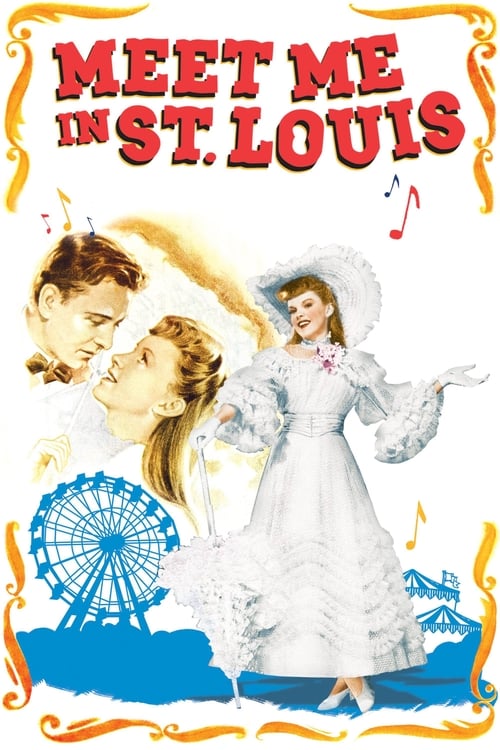
Meet Me in St. Louis
1944 · Vincente Minnelli
For a cozy night in — holidays especially — when you want to be wrapped in something beautiful and sung to. Comfort viewing of the highest order, with more feeling under the surface than you expect.
What it's about
A year with the middle-class Smith family of St. Louis, from the summer of 1903 to the spring of 1904, as the whole city buzzes with anticipation for the World's Fair. Daughters fall for the boy next door, sisters scheme through parties and trolley rides, and the youngest runs gloriously wild — until Father announces a promotion that would move them all to New York, threatening the little world the film so lovingly builds.
The experience
Pure warmth in saturated Technicolor — funny, tuneful, and drenched in seasonal nostalgia, with one Halloween stretch that goes strange and dark enough to remind you real childhood lives in here. It's the definition of a glow you can bask in, with a genuine lump-in-the-throat waiting near the end of the year.
Performances
Judy Garland at the height of her early stardom, singing 'The Trolley Song' and 'Have Yourself a Merry Little Christmas' with a directness that still stops the room; young Margaret O'Brien nearly steals the film as the morbid, fearless little sister Tootie.
The craft
Vincente Minnelli, new to features, turns the Freed unit's resources into some of the most ravishing Technicolor ever put on screen — the film is structured by seasons rather than plot, all atmosphere, texture, and songs that grow out of family life instead of stopping it. It rewards the biggest, most color-faithful screen you can find.
Why it matters
It crystallized the nostalgic Americana musical, launched Minnelli as a major director, and gave the culture Christmas standards it never gave back — a template for musicals where the numbers express character rather than spectacle.
Snapshot
Meet Me in St. Louis is the MGM Technicolor musical that crystallized both the nostalgic Americana musical and the directorial signature of Vincente Minnelli, then a newcomer to feature films. Produced by Arthur Freed's celebrated unit and starring Judy Garland at the height of her early stardom, it chronicles a year in the life of the middle-class Smith family of St. Louis, from the summer of 1903 to the spring of 1904, as the city anticipates the Louisiana Purchase Exposition (the 1904 World's Fair). Its dramatic engine is deceptively small: the father's plan to move the family to New York for a promotion threatens the domestic world the film so lovingly builds. Adapted from Sally Benson's autobiographical New Yorker sketches, the film substitutes atmosphere, seasonal texture, and character for conventional plot, and in doing so helped define the "integrated" musical in which song emerges organically from story. It introduced three standards — "The Trolley Song," "The Boy Next Door," and "Have Yourself a Merry Little Christmas" — and remains a touchstone of Golden Age Hollywood craft.
Industry & production
The film was a flagship production of Metro-Goldwyn-Mayer's Arthur Freed Unit, the semi-autonomous production group that would dominate the American film musical through the late 1940s and 1950s. Freed acquired Sally Benson's stories — originally published in The New Yorker under titles keyed to the family address on Kensington Avenue and later collected as Meet Me in St. Louis — and shepherded the project despite internal skepticism. By multiple accounts, studio chief Louis B. Mayer and others questioned a "plotless" family picture, and Garland herself was initially reluctant to play another adolescent role so soon after establishing herself as an adult star; Freed and Minnelli are generally credited with persuading her. The screenplay went through several hands before Irving Brecher and Fred Finklehoffe received screen credit.
Production placed the film squarely in the prestige tier: three-strip Technicolor, elaborate period sets, and a substantial shooting schedule and budget consistent with MGM's top musicals of the era. The picture proved an enormous commercial success — widely described as one of MGM's most profitable releases of the decade and among the studio's biggest earners of the 1940s. (Precise inflation-era figures vary across sources, so I note the scale of its success rather than cite a single number.) Its performance validated Freed's instincts and cemented the unit's autonomy. The production is also famous for its offscreen consequence: Minnelli and Garland's collaboration led to their marriage in 1945 and, in 1946, to the birth of Liza Minnelli.
Technology
Meet Me in St. Louis was photographed in three-strip Technicolor, the dye-transfer process that required the bulky three-negative camera and the close supervision of Technicolor's color consultants. The film is a landmark example of the process used not for spectacle but for controlled, painterly nuance — muted autumnal browns, the deep blues and blacks of the Halloween night sequence, and the warm interior palettes of the Smith home. Minnelli, who had a background in stage and window design, pushed Technicolor toward subtlety rather than the saturated brightness the process was often criticized for. The production also relied on the standard apparatus of the mature studio musical: pre-recorded playback for the song numbers, a large in-house orchestra and arranging staff, and MGM's extensive backlot and soundstage resources, on which the St. Louis street and the World's Fair grounds were constructed.
Technique
Cinematography
George Folsey, an MGM veteran, photographed the film, working within the exacting constraints of three-strip Technicolor. The cinematography is notable for its mobility and its integration with Minnelli's staging: rather than the locked-down, evenly lit tableaux common to early color films, Folsey and Minnelli favor moving camera, deep and layered compositions within the Smith house, and dramatic tonal shifts across the film's four seasonal panels. The Halloween sequence is the standout achievement — a stylized, shadow-heavy nocturne shot in a lower, more expressionistic key than the rest of the film, giving a child's-eye adventure genuine menace. Throughout, the color is keyed to season and mood, and the camera frequently follows performers through the architecture of the home rather than cutting between static setups.
Editing
Albert Akst edited the film. Its most distinctive structural device is the division into four seasonal chapters — Summer 1903, Autumn 1903, Winter 1903, and Spring 1904 — each introduced by a still "greeting card" image, rendered in the manner of a Currier-and-Ives or Thomas Eakins–style genre painting, that dissolves into live action. This device organizes the episodic material into a legible annual cycle and reinforces the film's nostalgic, album-like address. Within scenes, the editing tends to be unobtrusive, deferring to Minnelli's long takes and internal staging, particularly in the musical numbers, where cutting is minimized so that performance and camera movement carry the number.
Mise-en-scène / staging
Mise-en-scène is the film's true medium and Minnelli's signature strength. The Smith house is conceived as a lived-in, multi-level environment through which the camera and characters move continuously, and much of the drama is blocked to exploit its staircases, parlors, and thresholds. Art direction by Cedric Gibbons with Lemuel Ayers and Jack Martin Smith, and Irene Sharaff's period costumes, build a densely detailed turn-of-the-century world in which color, décor, and dress carry meaning. Minnelli stages several numbers as continuous, choreographed movements through space — most famously "The Trolley Song," performed largely in and around a moving streetcar. The design consistently privileges the domestic interior as the emotional center of the film, so that the threat of leaving the house registers as a genuine loss of world.
Sound
The film's sound design is dominated by its score and songs, delivered through MGM's high studio standard of pre-recorded playback and lush orchestration. Beyond the numbers, sound is used pointedly in the Halloween sequence, where the hush and sudden noises of the night amplify the children's terror, and in the intimacy of the domestic scenes, where overlapping family chatter builds the sense of a bustling household. The integration of dialogue, ambient life, and music is central to the film's realism-within-artifice.
Performance
Judy Garland anchors the film as Esther Smith with a performance that balances romantic longing, comedy, and vocal command; it is among the definitive showcases of her adult MGM period. Margaret O'Brien is the film's other revelation as the youngest daughter, Tootie, whose morbid imagination and emotional volatility give the film its darker undertow; O'Brien received a special juvenile Academy Award, and her Halloween and "Snowman" scenes are frequently cited as extraordinary child performances. Mary Astor and Leon Ames ground the family as the parents, with Lucille Bremer, Tom Drake (as the boy next door, John Truett), Marjorie Main, and Harry Davenport rounding out an ensemble whose interplay sustains the film's episodic structure.
Narrative & dramatic mode
The film's narrative mode is episodic and seasonal rather than goal-driven, a deliberate departure from classical Hollywood's tight causal plotting. It proceeds as a series of vignettes — a dinner and a long-distance telephone call, a trolley ride to the fairgrounds, a Halloween expedition, a Christmas ball — bound together by the calendar and by the family unit rather than by a single protagonist's quest. The nearest thing to a central conflict, the father's planned relocation to New York, is introduced late and functions less as suspense than as a pressure that clarifies what the family stands to lose. The dramatic stakes are emotional and domestic: courtship, sibling life, and the fear of change. This "slice of life" construction, held together by tone and recurrence, was itself part of the film's innovation and its initial risk.
Genre & cycle
Meet Me in St. Louis is a landmark of the integrated book musical, in which songs arise from and advance dramatic situation rather than being staged as detachable performances. It belongs to the Freed Unit cycle of the mid-1940s that moved the film musical away from backstage revues toward story-driven works, and it is arguably the foundational entry in the specifically nostalgic, Americana strain of the genre — small-town or turn-of-the-century family life rendered in warm period color. That subgenre would recur through the 1940s and 1950s. The film also blends comfortably into family comedy-drama and romance, and its seasonal, domestic framing links it to the broader Hollywood tradition of home-and-hearth pictures.
Authorship & method
The film is central to the auteurist case for Vincente Minnelli, whose fusion of design, color, camera movement, and emotional interiority is on full display in only his third feature. Minnelli's theatrical background as a designer informs the film's pictorialism and his tendency to think in terms of continuous, choreographed space. His key collaborators are essential to the achievement: producer Arthur Freed, whose unit and taste made the film possible; cinematographer George Folsey, who realized the film's restrained Technicolor palette; and editor Albert Akst. The songwriting team of Hugh Martin and Ralph Blane wrote the film's original standards — "The Trolley Song," "The Boy Next Door," and "Have Yourself a Merry Little Christmas" — while Roger Edens and MGM's music department arranged and adapted the score, which also incorporates period songs including the 1904 title tune, "Skip to My Lou," and "Under the Bamboo Tree." Screenwriters Irving Brecher and Fred Finklehoffe adapted Sally Benson's stories, and designers Cedric Gibbons, Lemuel Ayers, Jack Martin Smith, and costumer Irene Sharaff built the period world. A frequently recounted detail of the film's method concerns "Have Yourself a Merry Little Christmas": Martin's original lyric was markedly more despairing, and Garland (with support from others on the production) requested revisions to soften it — an account that is well established in the film's history.
Movement / national cinema
The film is a product of the Hollywood studio system at its zenith — specifically the MGM house style of high-gloss production values, in-house craft departments, and star cultivation, refined further by the Freed Unit's particular investment in the musical as a serious form. It is quintessentially American in subject and sensibility, a self-consciously nostalgic portrait of national life at the turn of the twentieth century, produced during World War II for a home-front audience. Though not part of any avant-garde movement, it exemplifies the classical studio musical as a distinctly American genre, and it later became a key exhibit for critics — including French and American auteurists — arguing for Minnelli as an artist rather than a studio functionary.
Era / period
Released in late 1944, the film arrived at the height of the war, and its backward-looking warmth is often read as consonant with a wartime audience's longing for stability, home, and an idealized American past. Its diegetic period — 1903 to 1904, culminating in the St. Louis World's Fair — situates it at a moment of national optimism and technological display, which the film treats with affectionate irony (the father's skepticism, the children's fixations) rather than triumphalism. The tension between the settled domestic world and the pull of modernity and mobility, embodied in the New York move and the coming Fair, gives the period setting thematic charge.
Themes
The film's governing theme is home — its value, its fragility, and the fear of losing it. Around this cluster several others: the primacy of family and the domestic interior as the true center of life; nostalgia and the idealization of the past; courtship and the passage of the daughters toward adulthood; and change versus continuity, dramatized through the threatened relocation. A notable countercurrent is the film's willingness to admit darkness into its warmth, chiefly through Tootie — her preoccupation with death, the genuinely frightening Halloween sequence, and the wrenching "Have Yourself a Merry Little Christmas" scene, in which the child destroys her snow family rather than leave it behind. This admixture of sentiment and unease is central to the film's lasting emotional power.
Reception, canon & influence
Meet Me in St. Louis was both a major commercial success and a critical one, praised for its charm, its performances, and its Technicolor craftsmanship, and it earned several Academy Award nominations (including for the screenplay, cinematography, scoring, and the song "The Trolley Song"), with Margaret O'Brien honored by a special juvenile Oscar. Over subsequent decades its reputation rose further as auteurist critics elevated Minnelli, and it entered the American canon: it was selected for preservation in the National Film Registry by the Library of Congress in 1994, and it appears regularly on institutional lists of the greatest American films and musicals.
Influences on the film (backward): Its most direct source is Sally Benson's autobiographical New Yorker stories, which supplied the family, the setting, and the episodic, memoir-like structure. The film also draws on a broader visual tradition of turn-of-the-century American genre painting and popular imagery — the "greeting card" transitions consciously evoke that idiom — and on the period's own popular song, including the 1904 title tune. It builds on the Freed Unit's ongoing project of maturing the film musical beyond the backstage format.
Legacy (forward): The film established the template for the nostalgic Americana musical and demonstrated that a musical could be organized around mood, family, and season rather than plot, strengthening the case for the fully integrated form. It launched Minnelli as MGM's foremost musical director, leading to An American in Paris, The Band Wagon, and Gigi, and it deepened the Garland persona in ways that resonate across her later career. "Have Yourself a Merry Little Christmas" became one of the most enduring standards in the American holiday songbook, and "The Trolley Song" a signature Garland number. More broadly, the film's marriage of design, color, and emotional interiority became a reference point for how a studio musical could aspire to art — an influence felt in later celebrations and pastiches of the Golden Age Hollywood musical.
A Deleuzian reading
A painted card of a house on a summer street, the kind of thing that used to sit on a mantelpiece.
The full Deleuzian reading of Meet Me in St. Louis →
Reception
No rediscovery needed — it was a massive hit in 1944, one of MGM's biggest earners since Gone with the Wind. What's changed is its standing: once filed under 'nostalgic family musical,' it's now routinely ranked among the greatest American musicals and treated as the film where Minnelli became Minnelli.
How Meet Me in St. Louis was received, from release to now →
How to watch Meet Me in St. Louis: what to notice on a first viewing
- Notice each season open on a still, painted image. A greeting-card picture in a Currier-and-Ives style holds for a moment before the paint dissolves into the living, moving scene. You have to read the picture as a picture before the film lets you watch it as a scene.
- Watch the camera glide through the house instead of cutting. Folsey and Minnelli follow characters through staircases and rooms in continuous moves rather than breaking the space into separate setups. The house starts to feel like one connected body instead of a set of separate rooms.
- Notice the camera stay with Esther through the whole song. 'The Trolley Song' is staged as one continuous movement in and around a moving streetcar, with the editing kept out of the way almost entirely. She isn't performing on a stage; the whole moving world seems to carry the song along with her.
- Notice the light turn dark and shadowy for Halloween. The Halloween sequence drops into a much lower, more expressionistic key than anything around it, all deep blues and sudden shadow. The lighting alone tells you this is genuine childhood fear, not just a costume party.
- Watch Esther's face carry longing through a song. Garland balances romantic yearning, comedy, and vocal command in the same performance, often within a single number. You believe the feeling because the singing never once looks like effort.
The whole guide to watching Meet Me in St. Louis, with the keys for a rewatch →
Influences: the films it descends from and the films it influenced
- The Wizard of Oz (1939) — Established the MGM/Freed-orbit template of narrative-motivated Technicolor and the Garland persona of longing-through-song ('Over the Rainbow') that Minnelli deepens into 'The Boy Next Door' and 'Have Yourself a Merry Little Christmas.'
- Cabin in the Sky (1943) — Minnelli's debut worked out his signature crane-and-dolly moves through continuous choreographed domestic space, the very technique that lets the camera glide through the Smith house as if it were a single expanding stage.
- For Me and My Gal (1942) — An early Freed Unit vehicle that began pushing Garland from backstage-format numbers toward character-embedded song, the maturation Minnelli completes by dissolving the 'performance' frame entirely.
- Alexander's Ragtime Band (1938) — Fox's turn-of-the-century period-song jukebox pioneered the nostalgic Americana musical's use of vintage popular tunes (rather than original book songs) to summon a bygone national past — the idiom Roger Edens mines with 'Under the Bamboo Tree' and 'Skip to My Lou.'
- Little Women (1933) — Its episodic, memoir-like structure of a family of daughters organized around domestic ritual and seasonal passage supplies the plotless, mood-driven slice-of-life architecture Benson's stories and Minnelli's film adopt.
- Becky Sharp (1935) — The first three-strip Technicolor feature established the expressive-restraint approach to the process that George Folsey refines here into a muted period palette punctuated by dramatic color accents rather than garish saturation.
- An American in Paris (1951) — Extends St. Louis's fusion of production design, painterly color, and camera movement into fully pictorial dream-space, the Freed/Minnelli 'musical as art' ambition scaled up to the climactic ballet.
- The Band Wagon (1953) — Carries forward the continuous choreographed-space staging — numbers built to travel through an environment (the 'Girl Hunt' and 'Dancing in the Dark' walk-throughs) rather than be framed as a proscenium act.
- Gigi (1958) — The culmination of the Freed Unit period-nostalgia mode — turn-of-the-century design, Cecil-Beaton-style pictorialism, and song used to render emotional interiority, all lineal from St. Louis's method.
- The Umbrellas of Cherbourg (1964) — Demy's saturated seasonal-chapter structure and wholly sung emotional interiority explicitly extend the Minnelli/Freed idea that color design and music can carry the domestic drama of parting and time passing.
- On Moonlight Bay (1951) — A direct Warner Bros. imitation of the St. Louis formula — a turn-of-the-century family, courtship at the front door, and holiday-through-seasons vignettes — confirming St. Louis as the nostalgic-Americana-musical template.
- La La Land (2016) — Its Technicolor-homage palette, unbroken-take musical staging that lets the camera choreograph through space, and elegiac love of the Golden Age studio musical are a conscious pastiche of the Minnelli/Freed aesthetic.
- The Young Girls of Rochefort (1967) — Precedent for dressing an entire town into a hermetic pastel dreamscape where seasons and set-color choreograph the emotional register.
- Crooklyn (1994) — Warm, plot-light chronicle of a bustling multi-kid household anchored by songs of its era, where the drama is the family unit's daily friction rather than an external conflict.
- Distant Voices, Still Lives (1988) — Davies lifts the Hollywood musical's device of the family gathered around domestic communal song and seasonal ritual as the emotional architecture organizing remembered life.
- Flipped (2010) — The ur-text of Technicolor golden-memory Americana whose idealized turn-of-century family suburb defines the nostalgic lighting and set palette Flipped reaches for.
- Pearl (2022) — Provides the MGM Technicolor Americana of picture-book period framing and warm domestic tableaux that Pearl adopts sincerely before violating.
- Cabaret (1972) — The integrated MGM book-musical (by Liza's own father) where characters burst spontaneously into song — the exact convention Cabaret pointedly revises by banishing music from lived reality to the stage.
- Singin' in the Rain (1952) — A Freed Unit production built on the same prerecorded-playback craft and the integrated musical's principle that numbers erupt from character and situation, plus a shared nostalgic reverie for an earlier Hollywood era.
- Summer Holiday (1948) — A near-simultaneous Freed Unit adaptation of turn-of-the-century Americana (from 'Ah, Wilderness!') that mirrors St. Louis's seasonal-chapter structure and greeting-card-period visual idiom of family and small-town memory.
- State Fair (1945) — Rodgers & Hammerstein's contemporaneous Americana musical organizes itself around family, seasonal event, and rural nostalgia rather than a backstage plot — the same integrated slice-of-life form emerging in parallel.
- Yolanda and the Thief (1945) — Minnelli's immediately following film pushes the same crane-driven continuous-space choreography and expressionistic color into surreal dream-ballet territory, showing the technique developed in St. Louis being extended.
- The Palm Beach Story / Freed-era design work of Cedric Gibbons (1944) — Gibbons's MGM art-department house style of deep, dressable domestic interiors gave Minnelli the buildable multi-room Smith house that makes the film's continuous choreographed staging physically possible.
- How Green Was My Valley (1941) — A nostalgic memory-film assembled as a seasonal episodic chronicle of one close family, with song integrated into communal life and warm tableau framing of the home.
- A Tree Grows in Brooklyn (1945) — A near-contemporary period family portrait built as a seasonal string of vignettes rather than plot, centering a young girl's emotional education — the same episodic, child-anchored nostalgic structure.
- Heaven Can Wait (1943) — Period Technicolor Americana in the same low-saturation register — turn-of-the-century decor lit for warmth rather than brightness — with a family's chronicle segmented into title-and-dissolve episodes staged almost entirely inside one house.
Similar films
- The Wizard of Oz (1939) — influence & lineage
- Singin' in the Rain (1952) — influence & lineage
- The Band Wagon (1953) — influence & lineage
- It's a Wonderful Life (1946) — shared sensibility
- The Greatest Showman (2017) — shared sensibility
- The Sound of Music (1965) — shared sensibility
- Mary Poppins (1964) — shared sensibility
- Remember the Night (1940) — shared sensibility