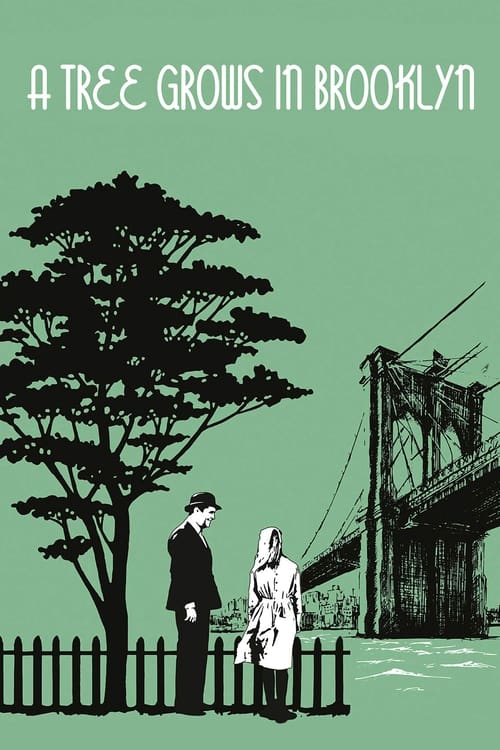
A Tree Grows in Brooklyn
1945 · Elia Kazan
For when you want a good, honest cry and to come out feeling more tender toward your own family. Pure comfort viewing with real weight underneath — nostalgic, not saccharine.
What it's about
Brooklyn, around 1900: the Nolan family gets by on pennies in a Williamsburg tenement, rich in affection and short on everything else. At the center is Francie, a bookish adolescent who hungers for a better school and a bigger life, torn between her charming, unreliable father — a singing waiter undone by drink — and her mother, who holds the household together through sheer flinty will. Around them swirl small dramas: a scandalous aunt with a string of 'husbands', the lone tree outside the window, and the daily arithmetic of poverty.
The experience
Warm without being soft — it earns its tears honestly, through small kindnesses and quiet disappointments rather than big speeches. It moves at the unhurried pace of remembered childhood, and by the end it has snuck up on you completely.
Performances
James Dunn is heartbreaking as the father — all charm and shame at once — in a role that won him an Academy Award, and young Peggy Ann Garner gives one of the great child performances, watchful and utterly unaffected, honored with a special juvenile Oscar.
The craft
Elia Kazan's first feature already shows his gift with actors: every scene is built on behavior, not sentiment, which is why the emotion lands so hard. It's also a model of how to adapt a beloved, sprawling novel — trimming without cheapening — in handsome black-and-white studio craftsmanship that makes one tenement block feel like a whole world.
Why it matters
It launched the directing career of Elia Kazan, one of the most consequential in American film, and set the template for humane, actor-driven studio drama about ordinary working people.
Snapshot
A Tree Grows in Brooklyn is the feature directorial debut of Elia Kazan, a 20th Century-Fox adaptation of Betty Smith's enormously popular 1943 autobiographical novel of the same name. Set in the Williamsburg district of Brooklyn in the first decade of the twentieth century, it follows the Nolans — a poor Irish-American tenement family — through the eyes of adolescent Francie Nolan, whose fierce hunger to learn and to rise collides with the charm and failure of her alcoholic singing-waiter father, Johnny, and the flinty endurance of her mother, Katie. The film is remembered on three counts: as the launching point of one of American cinema's most consequential directorial careers; as a model of tactful, unsentimentalizing literary adaptation in the studio "prestige" mode; and for two celebrated performances — James Dunn as Johnny, who won the Academy Award for Best Supporting Actor, and the child actress Peggy Ann Garner as Francie, honored with a special Academy Award as the outstanding child performer of the year. It is a quiet, interior domestic drama rather than a plot-driven one, and it stands slightly apart from the tougher social realism Kazan would soon become famous for, even as it already shows his defining gift for performance.
Industry & production
The film was produced by 20th Century-Fox during the final year of the Second World War, when Darryl F. Zanuck's studio was heavily invested in prestige adaptations of best-selling and literary properties. Smith's novel had been a major commercial success, and the screen rights promised a built-in audience; the challenge was to translate an episodic, first-person coming-of-age book, frank about poverty, alcoholism, and sexuality, into a releasable studio picture under the constraints of the Production Code. The producer was Louis D. Lighton, a veteran of literary and family material. The decisive industry fact of the production, however, is Kazan's hiring: an established Broadway director out of the Group Theatre, with only documentary short-subject work behind him in film, he was brought west by Fox to make his first feature. Casting a stage director of his reputation on a high-profile property reflected Hollywood's mid-1940s appetite for theatrical talent, and it gave Kazan a strong professional craft apparatus around him to compensate for his inexperience with the camera. Production was studio-based, built on Fox's facilities and standing sets rather than shot on location in Brooklyn — a point worth flagging, since the film's celebrated sense of place is a constructed one.
Technology
The picture was made and released in 1945 as a black-and-white film in the standard Academy aspect ratio of roughly 1.37:1, with a monaural optical soundtrack — the ordinary technical baseline for a Fox prestige drama of the period. Black-and-white was an aesthetic as much as an economic choice here: it suited the film's tenement grays and its nostalgic, remembered-past register, and it aligned with the era's association of monochrome with serious, unglamorous drama (color at Fox was largely reserved for musicals and spectacle). The production relied on studio soundstage lighting and constructed exteriors, the mature deep-focus-capable optics and panchromatic stock of mid-1940s Hollywood, and standard continuity sound recording. There is no notable technological novelty in the film; its accomplishment is entirely in the deployment of a fully developed studio toolkit toward intimacy rather than display.
Technique
Cinematography
Cinematography is credited to Leon Shamroy, one of Fox's most decorated house cinematographers. Shamroy's work here is restrained and interior, keyed to cramped domestic spaces — stairwells, kitchens, the family's rooms, the view from a tenement window toward the single tree that gives the story its title. The lighting favors soft, unshowy modeling of faces over dramatic chiaroscuro, appropriate to a naturalistic family drama, and the camera is generally unobtrusive, holding on performers rather than calling attention to itself. Where the film reaches for emotional emphasis it does so through composition and proximity — the framing of Francie's face, the spatial relationships within the tenement flat — rather than through conspicuous camera movement. This is a cinematographer of enormous range working in a deliberately modest key.
Editing
The editing is credited to Dorothy Spencer, an experienced Fox cutter. The film's construction is essentially classical and continuity-based, prioritizing legibility of performance and emotional beat over montage effect. Because the source novel is episodic, the adaptation's rhythm depends heavily on how scenes are shaped and paced against one another; the cutting serves the actors, holding on reactions long enough to let feeling register, and manages the film's shifts between comic vignette (Aunt Sissy's romantic entanglements), domestic strain, and set-piece emotion. There is little that draws attention to the cutting as such — a mark of the invisible-editing ideal of the studio era rather than a limitation.
Mise-en-scène / staging
This is the department where Kazan's theatrical training is most visible. The film's dramatic world is largely confined to the Nolan tenement, and Kazan stages the family's life within those tight rooms with a stage director's attention to how bodies occupy and move through a space — who stands where, who is excluded from a group, how a room's geography expresses a relationship. The constructed Brooklyn exteriors, the fire escape and the courtyard tree, function as an emotional landscape as much as a setting: the ailanthus "tree of heaven" pushing up through pavement is the film's governing metaphor for growth against odds, and it is placed and returned to with deliberate weight. The period detail — clothing, tenement furnishings, the textures of turn-of-century working-class Brooklyn — is handled for lived-in plausibility rather than picturesque nostalgia.
Sound
The sound design is conventional for its moment: dialogue-forward recording, naturalistic domestic ambience, and Alfred Newman's score. Music is one of the film's more pointed tools — Johnny Nolan is a singing waiter, and song is bound up with his character, his charm, and the film's memory-tinged tone. Newman, as head of the Fox music department, provides orchestral underscoring that supports the domestic emotion without overwhelming it. The record on precise sound choices is thin, and I won't overstate what can be documented; the overall approach is the transparent, dialogue-and-score model of studio drama.
Performance
Performance is the film's summit and the clearest early signature of Kazan the director. James Dunn's Johnny — tender, weak, self-deceiving, genuinely loving — is a portrait of alcoholic failure that refuses both condemnation and sentimentality, and it revived Dunn's flagging career, winning him the Best Supporting Actor Oscar. Peggy Ann Garner's Francie is the film's center of consciousness, and Kazan draws from her a performance of unusual inwardness and gravity for a child actor of the era, recognized with a special juvenile Academy Award. Dorothy McGuire's Katie supplies the hard, unsentimental counterweight — the parent who must be practical because Johnny cannot be — and Joan Blondell's Aunt Sissy provides warmth and comic vitality. The ensemble balance, and the refusal to let any performance tip into melodramatic excess, is precisely what Kazan would become renowned for.
Narrative & dramatic mode
The film's mode is domestic realism organized as a coming-of-age chronicle rather than a goal-driven plot. Adapted from a first-person novel, it retains an episodic, memory-like structure: a sequence of "big and little troubles" — money, school, Sissy's scandalous serial "marriages," the loss of the visible tree, and above all the arc of Johnny's decline — accreting into a portrait of a family and a girl's passage toward understanding. There is no conventional antagonist; the conflict is between aspiration and circumstance, and between love and unreliability within a single household. The dramatic register is closely observed and interior, privileging the texture of ordinary life and the emotional education of its protagonist over incident.
Genre & cycle
A Tree Grows in Brooklyn sits at the intersection of several 1940s currents: the sentimental-but-serious family drama, the coming-of-age story, and the wave of prestige adaptations of best-selling novels. It belongs recognizably to a mid-decade cycle of nostalgic Americana looking back to turn-of-the-century domestic life — a vein also worked, in the musical register, by Meet Me in St. Louis (1944), and continued shortly after by family chronicles such as I Remember Mama (1948). Against the more escapist or picturesque entries in that cycle, this film is distinguished by its willingness to keep poverty and paternal failure genuinely in view, positioning it as a bridge between studio-era sentiment and the grittier social realism that would define postwar American cinema.
Authorship & method
As authorship, the film is a hinge object. Elia Kazan would become one of the central figures of postwar American film — director of A Streetcar Named Desire (1951), On the Waterfront (1954), and East of Eden (1955), and a co-founder of the Actors Studio whose championing of psychologically intense, naturalistic acting reshaped screen performance. In hindsight, his debut already announces the durable Kazan preoccupations: working-class urban milieu, the family as a crucible, fathers and children, and above all the primacy of the actor. It is milder and more classically studio-bound than his later work, but the throughline is unmistakable.
His key collaborators were seasoned Fox professionals: cinematographer Leon Shamroy, one of the studio's premier image-makers; composer Alfred Newman, head of the Fox music department and one of Hollywood's foundational film composers; and editor Dorothy Spencer. The screenplay, adapting Betty Smith's novel, is credited to Tess Slesinger and Frank Davis — a significant authorial contribution, given the difficulty of shaping an episodic first-person book into dramatic screen form within Production Code limits; it earned an Academy Award nomination for its writing. The overall method is collaborative studio craft: a strong technical team executing at a high level, harnessed by a first-time director whose distinctive contribution lay in performance and staging.
Movement / national cinema
The film is a product of the classical Hollywood studio system at its mature height, made inside 20th Century-Fox's vertically integrated apparatus. It is not part of a formal movement, but it can be read as an early American answer to the impulses that were surfacing internationally in the same years — a turn toward the everyday lives of ordinary, poor people that runs parallel (though not equivalent) to the emergence of Italian neorealism. Kazan's own trajectory would make him a key American conduit for a more European-influenced, actor-centered realism; this debut is an early, still studio-bound instance of that sensibility within mainstream American national cinema.
Era / period
The picture belongs to the last year of wartime Hollywood, 1945 — a moment when audiences favored both escape and reassuring images of American continuity, and when studios leaned on literary prestige to signal seriousness. Its backward glance to turn-of-century Brooklyn is characteristic of the era's nostalgia, but its clear-eyed treatment of hardship also anticipates the postwar appetite for social realism and psychological complexity that would define the later 1940s. It thus straddles two moments: the sentimental wartime homefront picture and the tougher cinema to come.
Themes
The film's central theme is aspiration against material constraint — the possibility of growth, embodied in the tree of heaven forcing its way up through concrete, as a figure for Francie's mind and future. Bound to this is the tension between dreaming and doing: Johnny's fatal charm lies precisely in his dreams, while Katie's love expresses itself as unromantic practicality, and Francie must reconcile the two inheritances. Poverty and its daily arithmetic are treated with unusual concreteness for a studio film. Education and literacy figure as instruments of escape and self-making. And running under it all is the theme of love entangled with disappointment — the recognition that one can love someone, a father especially, who is also a failure — which the film handles with a moral tact that resists both easy sympathy and easy judgment.
Reception, canon & influence
Contemporary reception was strongly favorable, with the film received as a sensitive and honest adaptation of a beloved novel and, in particular, as a showcase for its performances; the Academy recognition — James Dunn's Supporting Actor Oscar, Peggy Ann Garner's special juvenile award, and the screenplay nomination — reflects that standing. (Precise critical citations and box-office figures I won't fabricate; the durable, well-documented facts are the awards and the film's reputation as a distinguished adaptation.)
Influences on the film (backward): its most direct source is Betty Smith's autobiographical novel, and behind that the broader tradition of American literary realism about immigrant and working-class urban life. Formally, it draws on the classical Hollywood family melodrama and the studio's prestige-adaptation house style, while Kazan imported from the Group Theatre and the Broadway stage an ensemble, naturalistic approach to acting and a director's discipline in staging.
Legacy (forward): the film's largest historical importance is as the origin point of Kazan's directorial career, and thus as a seed of the enormous influence he would exert on American acting and on socially serious postwar filmmaking through Streetcar, On the Waterfront, and East of Eden and through the Actors Studio. Within its own genre, it stands as a benchmark for how to adapt a sentimental best-seller without sentimentality, and as a model of the child-centered coming-of-age drama. It remains a respected, frequently revived title — valued both on its own terms as a tender, unsparing family portrait and as the first chapter in a major body of work.
A Deleuzian reading
Out the Nolans' window there is one tree.
The full Deleuzian reading of A Tree Grows in Brooklyn →
Reception
A solid hit and awards player in 1945, it's since become the answer to a trivia question — Kazan's debut — before getting reclaimed on its own terms as one of the great American tearjerkers, with many arguing it's warmer and more humane than anything in his prestige era.
How A Tree Grows in Brooklyn was received, from release to now →
How to watch A Tree Grows in Brooklyn: what to notice on a first viewing
- Watch where each family member stands in the kitchen. Kazan blocks the cramped flat so that who is near the stove, who drifts to the edge of a group, quietly states each person's standing. Money and shame get expressed through where people put their bodies, before anyone says a word.
- Watch how long the camera holds on Francie's face. Shamroy's camera returns again and again to Peggy Ann Garner watching her father, holding well past the point where the scene's information has arrived. The feeling has nowhere left to go once the scene is over, so the camera just lets it sit there.
- Notice the single tree visible from the tenement window. The ailanthus tree keeps appearing in the same view from the Nolans' window, returned to with obvious deliberateness across the film. One object ends up carrying the film's whole idea about growth against odds.
- Watch Johnny charm the room even when he's failed again. James Dunn plays the singing waiter as tender and self-deceiving at once, never letting the charm curdle into something the film asks you to condemn. You are left loving a man the plot keeps proving cannot be relied on.
- Listen for Johnny singing in ordinary domestic scenes. As a singing waiter, his voice keeps surfacing in the household's everyday moments, tying his charm and his unreliability to the same instrument. The music that makes him lovable is the same music that means he isn't home earning a wage.
The whole guide to watching A Tree Grows in Brooklyn, with the keys for a rewatch →
Influences: the films it descends from and the films it influenced
- How Green Was My Valley (1941) — Established the Fox prestige-adaptation template Kazan inherits: an episodic memory-play of a working-class family narrated through a child's vantage, staged in deep-focus interiors that make the household the drama's crucible.
- The Grapes of Wrath (1940) — Modeled the studio-realist treatment of American poverty — Gregg Toland-style hard-key naturalism applied to the destitute — that Fox's house style, including Shamroy's restrained lensing here, carried into Kazan's tenement world.
- Dead End (1937) — Brought Sidney Kingsley's stagecraft to film — a single tenement block blocked like a theatrical set with layered ensemble action — the same proscenium-derived blocking discipline Kazan imported from Broadway.
- Make Way for Tomorrow (1937) — Demonstrated how to play domestic melodrama about family economic ruin without sentimentality, refusing the tidy resolution — precisely the tonal restraint Kazan applies to Betty Smith's tearful material.
- The Crowd (1928) — Pioneered treating the anonymous urban working family as tragic subject, using the city apartment as pressure-chamber — the sociological-domestic frame Kazan's debut extends.
- Our Town (1940) — Set the template for nostalgic-Americana screen adaptation of an episodic, memory-structured stage source with a plain-lives-observed reverence that Kazan's evocation of turn-of-century Brooklyn echoes.
- A Streetcar Named Desire (1951) — Kazan escalates the naturalistic, psychologically saturated ensemble acting he first drew from James Dunn here into full Method performance, harnessing the actor as the primary expressive instrument.
- On the Waterfront (1954) — Extends the debut's working-class milieu and father-figure/child dynamics into location-shot social realism, still built on the primacy of behavioral, interior-driven Actors Studio performance.
- East of Eden (1955) — Directly continues Kazan's core motif introduced here — the wounded child straining against a flawed father within the family as moral crucible — now with Dean's Method spontaneity foregrounded.
- Marty (1955) — Carries forward the unsentimental working-class domestic naturalism and the ensemble-acting-over-plot ethic that Kazan's Group Theatre approach helped legitimize for the screen.
- To Kill a Mockingbird (1962) — Perfects the child's-eye literary-adaptation-of-a-beloved-novel — episodic, memory-toned black-and-white Americana filtered through a young girl's growing awareness — that Tree Grows in Brooklyn pioneered.
- Splendor in the Grass (1961) — Returns Kazan's authorship to adolescent emotional awakening and the family's repressive weight, deploying the heightened-naturalist Actors Studio performance style that traces back to his debut's actor-first method.
- A Raisin in the Sun (1961) — Inherits the theatrical-transfer model of confining a poor family's aspiration-versus-poverty struggle to cramped domestic space, sustained by staged ensemble blocking and dialogue-driven performance.
- Meet Me in St. Louis (1944) — A near-contemporary period family portrait built as a seasonal string of vignettes rather than plot, centering a young girl's emotional education — the same episodic, child-anchored nostalgic structure.
- The Member of the Wedding (1952) — Another Broadway-to-film transfer centered wholly on an adolescent girl's coming-of-age consciousness, preserving stage blocking and trusting a child performer (Julie Harris/Brandon deWilde) to carry sustained naturalistic scenes.
- Bicycle Thieves (1948) — Realizes independently the neorealist impulse Kazan's film prefigures: a poverty narrative organized around a father-child pairing and observed daily hardship rather than melodramatic incident.
Similar films
- On the Waterfront (1954) — influence & lineage
- A Streetcar Named Desire (1951) — influence & lineage
- East of Eden (1955) — influence & lineage
- How Green Was My Valley (1941) — influence & lineage
- The Grapes of Wrath (1940) — influence & lineage
- Minari (2021) — shared sensibility
- Long Day's Journey Into Night (1962) — shared sensibility
- Hamnet (2025) — shared sensibility