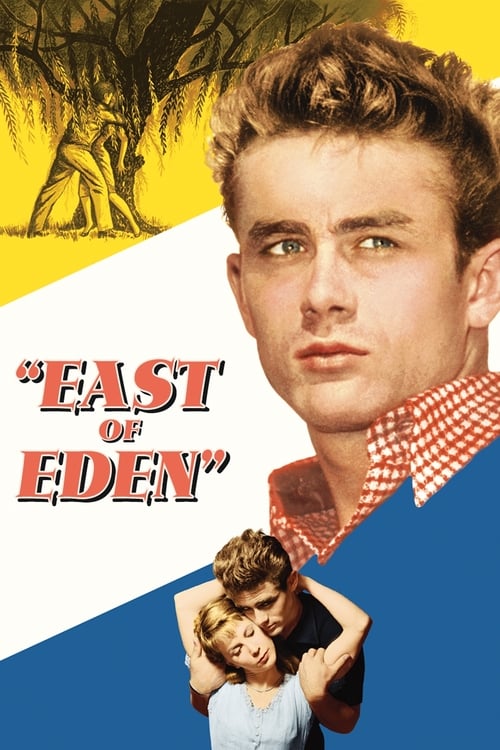
East of Eden
1955 · Elia Kazan
For when you need a good cry about fathers and sons — or when you want to watch a legend being born in real time. A rich, serious evening rather than a light one.
What it's about
In California's Salinas Valley around the First World War, Cal Trask — the restless, unloved son — competes with his golden-boy brother for the approval of their stern, righteous father. A modern retelling of Cain and Abel, it follows Cal as he schemes to win his father's love through business, wrestles with the war fever around him, and digs into a buried family secret about the mother he never knew.
The experience
Emotionally raw under its handsome surface — a family drama where every dinner-table scene feels like it could crack open. It builds toward moments of naked, almost embarrassing need that still land hard, and it's the kind of film that can leave you wrung out.
Performances
James Dean, in his only starring role released while he lived, is astonishing — twitchy, wounded, physically improvisational in a way that made everyone else on screen look like they were acting. Raymond Massey's rigid rectitude opposite him is the perfect foil.
The craft
Kazan's first film in color and widescreen, and he uses the huge frame expressively — tilted angles, bodies pressed to the edges, the lush valley landscape dwarfing the family's cold house. It's studio-era craftsmanship in service of a startlingly modern acting style, and it's gorgeous on a big screen.
Why it matters
One of the defining documents of Method acting's arrival in mainstream Hollywood, and the film that made James Dean an icon — the template for every brooding, misunderstood young rebel since.
Snapshot
East of Eden is Elia Kazan's adaptation of the final movement of John Steinbeck's 1952 novel, a Cain-and-Abel allegory transposed to the Salinas and Monterey valleys of California around the United States' entry into the First World War. Cal Trask (James Dean), the "bad" son, competes for the love of his austere, righteous father Adam (Raymond Massey) against his favored brother Aron (Richard Davalos), and is driven by a wound he cannot name: the discovery that the mother he was told was dead is in fact alive, running a brothel in nearby Monterey. The film is remembered above all as the screen debut of James Dean in a leading role — the only one of his three star vehicles released in his lifetime — and as one of the defining documents of Method acting's arrival in mainstream Hollywood. It is also Kazan's first film in color and widescreen, a deliberately expressionistic, off-kilter work that uses the new CinemaScope frame against the grain of its intended spectacle. Dean's performance, the picture's biblical scaffolding, and its anguished study of paternal rejection have made it a touchstone of 1950s American cinema and a foundational text in the iconography of the sensitive, rebellious postwar youth.
Industry & production
East of Eden was a Warner Bros. production, with Kazan both directing and producing — a mark of the autonomy he had accrued after a string of successes culminating in On the Waterfront (1954), which would sweep the Academy Awards in the same season this film was being prepared and released. Steinbeck's sprawling generational novel was effectively unfilmable whole, so the adaptation, scripted by playwright Paul Osborn, confined itself to roughly the last quarter of the book, the story of Adam and his twin sons. This compression is the single most consequential production decision: it converted a multi-generational saga into a tight family melodrama centered on one son's craving for love.
Casting was central to the film's identity. Kazan, a co-founder of the Actors Studio, drew his principals from the New York stage and Method milieu rather than from the established Hollywood star system: Julie Harris (Abra) and Jo Van Fleet (Kate, the mother) were stage-trained Studio-adjacent actors, and Dean himself had come up through New York theater and live television. Dean was a near-unknown when Kazan cast him; the director has recounted recognizing in the young actor the same raw, narcissistic woundedness the role of Cal required, and Steinbeck reportedly endorsed the choice. The film was shot largely on location in the Salinas Valley and Mendocino (standing in for Monterey of the period) as well as on the Warner lot. Precise budget and box-office figures should be confirmed against a reliable source, but the film was a notable commercial and critical success, and its release in March 1955 — months before Dean's death in a car crash that September and the subsequent release of Rebel Without a Cause — meant it was the public's first encounter with the actor who would become a posthumous icon.
Technology
East of Eden was photographed in CinemaScope, the anamorphic widescreen process Twentieth Century-Fox had introduced in 1953 and licensed across the industry, and in WarnerColor, the studio's branding for Eastmancolor single-strip color stock. It was Kazan's first film in either, and the pairing is significant: CinemaScope had been promoted chiefly as a vehicle for landscape, spectacle, and the horizontal sweep of historical and biblical epics, and its early proponents often complained that the wide frame was hostile to intimate drama and to expressive composition. Kazan and cinematographer Ted McCord treated this supposed limitation as an opportunity, bending the format to psychological ends rather than spectacular ones. The film thus stands as an early and influential demonstration that the wide color frame could serve interior, character-driven storytelling and not merely the panorama. The move to color likewise let McCord work with a painterly palette — the warm greens and golds of the agricultural valley against the cold institutional interiors — that would have been impossible in the black-and-white idiom of Kazan's earlier social-realist pictures.
Technique
Cinematography
Ted McCord's photography is the film's most discussed formal element. Working in the unfamiliar wide frame, he and Kazan repeatedly employ canted, tilted compositions — Dutch angles that throw the horizon and the architecture off-balance — to externalize Cal's psychological disequilibrium and his sense of being out of joint with a rectilinear, morally ordered world. The technique is used pointedly rather than constantly, reserved for moments of acute emotional pressure. McCord also exploits the deep, warm color of the valley exteriors and contrasts them with shadowed, expressionistic interiors, and he is willing to place figures at the extreme edges of the CinemaScope frame, leaving expanses of unbalanced negative space that isolate Cal within the picture. The result is a visual scheme in which the camera itself seems to take the side of the wounded son, distorting the stable world the father inhabits.
Editing
Owen Marks's editing serves the performances and the film's emotional rhythm rather than any showy cutting pattern. Kazan, who built scenes around the behavioral truth of his actors, tended to favor sustained takes that allowed an emotional state to develop and crest, and the cutting honors that approach, holding on Dean's improvisatory physical business and on the slow tightening of confrontations. Set pieces — the carnival and Ferris-wheel sequence, the father's birthday party, Cal's offering of his earnings — are constructed to build to a single devastating beat, and the editing's restraint is what gives those beats their force.
Mise-en-scène / staging
Kazan's staging is rooted in the physical and the behavioral. Bodies, props, and the manipulation of objects carry meaning: Cal swinging on a porch swing, crouching on top of a moving railway car, curling into a fetal crouch, or thrusting a bundle of cash at his father. The film's blocking constantly dramatizes the family's emotional geometry — the favored Aron and the disapproving Adam aligned against the excluded Cal. The recurring environments (the icehouse, the lettuce fields, the bean field, Kate's establishment) are staged as moral terrains, the productive land of the father set against the illicit world of the mother. Kazan's well-documented willingness to engineer real tension on set — exploiting the genuine awkwardness between the classically trained Massey and the Method-trained Dean to sharpen the father-son antagonism on screen — is itself a form of staging, a directorial method that bled the conditions of production into the drama.
Sound
The film's sonic identity is shaped most distinctively by its score (discussed below) and by Kazan's attention to the textures of place — the agricultural valley, the carnival, the train. As with the editing, the sound design is in service of performance and atmosphere rather than calling attention to itself; the record on its specific sound-recording practices is thin, and it is most useful to note that the film predates the kind of expressive sound design that later decades would foreground.
Performance
Performance is the film's reason for being. Dean's Cal is the archetypal Method turn: mumbling, physically restless, emotionally raw, oscillating between adolescent tenderness and explosive grief. The performance is built from behavioral detail and apparent improvisation — gestures, hesitations, and sudden physical collapses that read as spontaneous psychic overflow rather than rehearsed line readings. Its most famous moments — Cal's writhing, inarticulate breakdown when his father refuses his gift of money — became instantly iconic and remain a reference point for screen acting. Jo Van Fleet's Kate, the hardened mother, is a controlled study in damage that earned her the Academy Award for Best Supporting Actress. Julie Harris brings warmth and intelligence to Abra, and crucially functions as a sympathetic mediator for Dean's volatility, while Raymond Massey's rigid, scripture-quoting Adam supplies the immovable object against which Cal breaks himself. The friction between Massey's old-school technique and Dean's improvisatory approach is legible on screen and, by Kazan's account, deliberately cultivated.
Narrative & dramatic mode
The film's narrative mode is intimate domestic melodrama elevated by mythic scaffolding. Steinbeck's novel openly retells the story of Cain and Abel — the brothers' names, Cal and Aron, echo Cain and Abel, and Adam Trask carries the name of the first father — and the film foregrounds this allegory: the central crisis is a son's gift refused by the father, a direct transposition of the biblical offering God rejects. The dramatic engine is psychological need rather than external event; the question is not whether Cal will succeed in business or war but whether he can win, or survive the withholding of, his father's love. The mode is confessional and expressionistic, privileging interior states made visible through performance and camera distortion. Its resolution — Adam, felled by a stroke, finally asking the son he rejected to care for him — offers a guarded, hard-won movement toward grace rather than tidy reconciliation.
Genre & cycle
East of Eden sits at the intersection of the literary prestige adaptation, the family melodrama, and the emerging cycle of "troubled youth" pictures that would define the mid-1950s. As a Steinbeck adaptation it belongs to a line of respectable, socially serious literary films; as a study of generational conflict and a misunderstood young man it stands at the head — chronologically — of the James Dean triptych completed by Rebel Without a Cause and Giant, and of the broader Hollywood discovery of the alienated teenager as a central dramatic subject. It is also a domestic melodrama in the tradition that Hollywood was elevating to high art in the same decade, sharing with the films of that cycle an interest in repression, familial dysfunction, and the violence of withheld feeling.
Authorship & method
The film is doubly authored — by Steinbeck's source and by Kazan's direction — but it bears Kazan's stamp most strongly. Kazan's method, formed in the Group Theatre and the Actors Studio, centered on psychological realism, the cultivation of authentic emotion from actors (often by personal and even manipulative means), and a belief in drama as the externalization of inner conflict. East of Eden applies that theatrical method to the resources of color and widescreen film. His key collaborators each contributed decisively. Playwright Paul Osborn performed the essential structural surgery on Steinbeck's novel, isolating the father-son story. Cinematographer Ted McCord devised the canted, color-expressionist visual scheme that translated Cal's psychology into images. Composer Leonard Rosenman — a friend and former piano teacher of Dean's — wrote his first film score for the picture, a lush, restless, and at times dissonant orchestral work that would help establish him as a significant film composer. Editor Owen Marks shaped the film's actor-centered rhythm. Above all, the collaboration between Kazan and James Dean defined the film: Kazan's casting and handling of the inexperienced actor produced a performance that fused director's method and performer's persona into something genuinely new for the screen.
Movement / national cinema
The film is a product of American studio cinema at the moment it absorbed two transformative imports: the technological one of widescreen color, and the artistic one of the Method, the American adaptation of Stanislavskian acting institutionalized by the Actors Studio. Kazan was a principal conduit for the latter, and East of Eden is among the clearest mainstream demonstrations of how Method performance reshaped Hollywood naturalism. It belongs to no avant-garde, but it represents a strain of serious, psychologically ambitious filmmaking within the studio system, made by a director whose roots were in the politically engaged American theater of the 1930s.
It is impossible to discuss Kazan's authorship in this period without noting its political shadow: in 1952 he had testified as a cooperative witness before the House Un-American Activities Committee, naming former associates from his Communist Party days. On the Waterfront is routinely read as a coded defense of informing; East of Eden, his next film, is more often read in personal and biblical than political terms, but it arrives from the same fraught period of Kazan's career, and the theme of a flawed son seeking forgiveness has invited biographical interpretation. The record here is interpretive rather than documentary, and the dossier flags it as a line of reading rather than established fact.
Era / period
The film is set around 1917, on the eve of and into America's First World War, and that period setting is dramatically active rather than decorative: Cal's speculation in beans is a bet on wartime price inflation, and the war's arrival fractures the town along lines of patriotism and ethnic suspicion (the German immigrant neighbor is menaced by a mob), while Aron's idealism collapses against it. But the film is equally a document of its production moment, the mid-1950s — an era preoccupied with the generation gap, juvenile delinquency, suburban conformity, and the anxieties of fathers and sons in postwar America. The story's 1917 frame allowed those contemporary concerns to be explored at a safe historical remove, and audiences in 1955 plainly received Dean's Cal as a figure of their own present.
Themes
The governing theme is the hunger for a parent's love and the destructive force of its withholding. Cal's every action — his speculation, his resentment of Aron, his pursuit of the truth about his mother — flows from the need to be seen and valued by Adam. Around this center cluster the film's other preoccupations: the biblical inheritance of guilt and the question of whether character is fated or chosen (Steinbeck's timshel, "thou mayest," the idea that one may choose to master sin, animates the source though the film handles it implicitly); the binary of good and bad sons and the moral simplifications it inflicts; the figure of the absent, "fallen" mother and the secret that poisons the family; and the broader tension between a rigid moral code and the messier reality of human need. Money and gift-giving recur as the currency of love — Cal literally tries to buy his father's affection, and the rejection of that gift is the film's emotional climax. Beneath all of it runs the theme of forgiveness and the possibility, never guaranteed, of reconciliation.
Reception, canon & influence
East of Eden was well received critically on release and was a strong commercial performer, and it earned significant awards recognition: Jo Van Fleet won the Academy Award for Best Supporting Actress, James Dean received a posthumous nomination for Best Actor — the first posthumous acting nomination in the Academy's history — and Kazan and Osborn were nominated for direction and screenplay respectively. The film's stature was magnified, inevitably and permanently, by Dean's death six months after its release; what had been the promising debut of a gifted young actor became the first chapter of a myth. Some contemporary and later critics have found the film's biblical schematism heavy-handed and Massey's father a caricature of rigidity, and the relative thinness of the female roles outside Van Fleet's has drawn comment; these are part of a balanced critical record.
Looking backward, the film draws on Steinbeck's literary naturalism and his explicit reworking of Genesis, on the European-derived expressionism that informs McCord's tilted, shadowed images, and on the theatrical traditions of the Group Theatre and the Actors Studio that shaped Kazan's whole practice. Looking forward, its influence is large and specific. It helped establish, with Rebel Without a Cause months later, the enduring archetype of the sensitive, misunderstood, father-haunted young man, an image that would echo through decades of American film and across the iconography of youth culture far beyond cinema. It was a high-profile proof that Method acting could command the mainstream screen, accelerating the style's dominance through the careers of Dean's contemporaries and successors. And it demonstrated that CinemaScope and color could serve intimate psychological drama, an example not lost on later filmmakers who sought expressive rather than merely spectacular uses of the wide color frame. More than any single formal legacy, though, the film endures as the founding text of the James Dean legend and as one of the most concentrated screen studies of the wound between a father and a son.
A Deleuzian reading
Start with the body.
The full Deleuzian reading of East of Eden →
Reception
A hit in 1955 with four Oscar nominations, it was instantly mythologized when James Dean died just months after release — and while some now find Kazan's Steinbeck melodrama a bit heavy, Dean's raw, twitchy performance has only grown in stature, with many cinephiles calling it his best work.
How East of Eden was received, from release to now →
Influences: the films it descends from and the films it influenced
- The Cabinet of Dr. Caligari (1920) — Its canted sets and tilted, shadow-warped framing established the German Expressionist visual grammar that Ted McCord transposed into color dutch angles to externalize Cal's psychology.
- The Grapes of Wrath (1940) — The first major Steinbeck adaptation, it set the screen idiom of literary naturalism — landscape-rooted moral parable — that Osborn's structural surgery on the novel worked inside.
- A Streetcar Named Desire (1951) — Kazan imported the Group Theatre/Actors Studio Method whole, proving Brando's emotionally raw 'inner conflict externalized' acting could anchor a film — the method he then applied to Dean.
- On the Waterfront (1954) — Immediately prior, it refined Kazan's behavioral blocking and intimate Method close-work, building actor-centered editing rhythms (Marks would carry into Eden).
- Viva Zapata! (1952) — Kazan's collaboration with Brando here tested the manipulative, personal director-actor coaxing of authentic emotion that he replicated with the inexperienced Dean.
- A Place in the Sun (1951) — Its tight, shallow-focus close-ups and overlapping dissolves modeled the intimate psychological melodrama — emotion read off the face — that Eden scaled up to the wide frame.
- A Tree Grows in Brooklyn (1945) — Directly continues Kazan's core motif introduced here — the wounded child straining against a flawed father within the family as moral crucible — now with Dean's Method spontaneity foregrounded.
- Rebel Without a Cause (1955) — Released months later with the same Dean persona and a Leonard Rosenman score, it co-founded the sensitive, father-haunted youth archetype and the CinemaScope-as-intimate-melodrama approach.
- A Face in the Crowd (1957) — Kazan continues his Group Theatre Method practice, coaxing a volcanic naturalistic performance (Griffith) as the externalization of inner pathology.
- The 400 Blows (1959) — It inherits the misunderstood, parentally-rejected adolescent at the film's emotional center, observed through behavioral detail rather than plot mechanics.
- Splendor in the Grass (1961) — Kazan reworks his own template — Actors Studio youth (Beatty/Wood), repressive parents, melodrama of thwarted feeling in widescreen color.
- Five Easy Pieces (1970) — Nicholson's Method-rooted, father-haunted prodigal son — the unreconciled return to a rejecting patriarch — directly extends Cal Trask's emotional architecture.
- Ordinary People (1980) — A studied screen anatomy of the wound between a parent and a favored/unfavored child, built on Actors Studio-lineage ensemble realism.
- The Master (2012) — Phoenix's contorted, behaviorally extreme performance and the surrogate father-son rupture push the Method-as-externalized-conflict tradition Kazan mainstreamed to its furthest edge.
- Warrior (2011) — Kazan's construction of sibling rivalry around a father's unequal dispensation of affection — one son visibly favored, one excluded — is the melodramatic architecture Warrior inherits for the Brendan/Tommy/Paddy triangle, where parental failure is the originating wound that structures every subsequent scene.
- Hud (1963) — Stretches a father-son rupture across anamorphic widescreen with a Method-trained young star (Dean) as the charismatic prodigal — the formal and performative template for Newman's Hud.
- The Iron Claw (2023) — Foundational American melodrama of inherited masculinity — sons competing for a withholding father's approval — that Durkin restages as a dynastic curse passed down the household.
- Giant (1956) — Dean's final, mannered Method performance extends the same fused director-handled/persona-driven screen acting across a generational family epic.
- Bigger Than Life (1956) — It pushes Eden's lesson that expansive CinemaScope color could serve claustrophobic domestic psychology, using widescreen and saturated hue expressively rather than spectacularly.
- Written on the Wind (1956) — A parallel widescreen-color family melodrama where heightened color and framing carry the emotional subtext of a poisoned patriarchal household.
- The Outsiders (1983) — Kazan's lush color adaptation of a literary novel built around a brooding, inarticulate young outsider (and Dean's Method tenderness) models the prestige-melodrama register Coppola applies to Hinton.
- Tea and Sympathy (1956) — CinemaScope Method melodrama centered on a sensitive son failing his father's masculine expectations, the same wound Tea and Sympathy locates in John Kerr's 'sister-boy.'
- Bad Day at Black Rock (1955) — Released the same year, it likewise bends the new CinemaScope frame away from spectacle toward intimate psychological menace, proving widescreen could isolate a single tense face rather than fill a vista.
- The Breaking Point (1950) — Ted McCord carrying the same lighting argument into color and scope — naturalistic exteriors that tilt into canted, hard-shadowed expressionism precisely at the moments of family rupture, confirming that the *Breaking Point* scheme was the cinematographer's method and not a studio default.
Similar films
- Rebel Without a Cause (1955) — influence & lineage
- A Streetcar Named Desire (1951) — influence & lineage
- On the Waterfront (1954) — influence & lineage
- The Grapes of Wrath (1940) — influence & lineage
- A Place in the Sun (1951) — influence & lineage
- A Tree Grows in Brooklyn (1945) — shared sensibility
- One-Eyed Jacks (1961) — shared sensibility
- Red River (1948) — shared sensibility
All the films related to East of Eden →