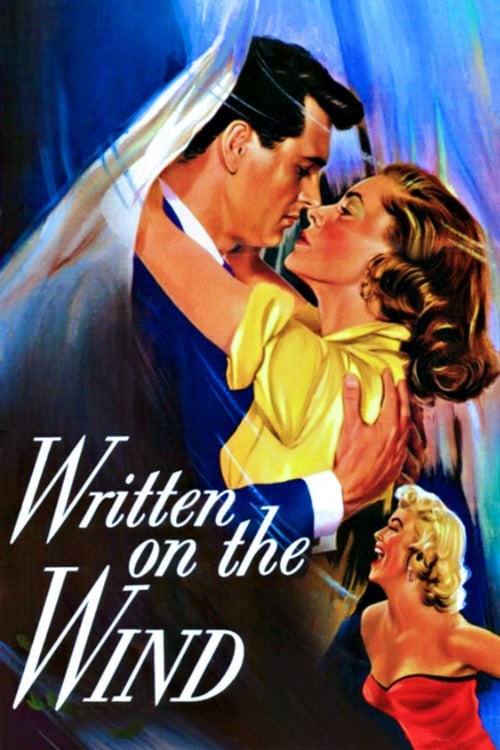
Written on the Wind
1956 · Douglas Sirk
For when you want big, gorgeous, unashamed emotion — a martini-hour melodrama to sink into, not a subtle slow burn. Comfort viewing for lovers of old Hollywood glamour, with a bitter center that keeps it from being merely cozy.
What it's about
A Texas oil dynasty is coming apart at the seams. The heir, Kyle Hadley, is a charming alcoholic playboy who marries a levelheaded New York secretary, Lucy, while his sister Marylee burns through the town's men chasing the one she can't have. Watching it all is Mitch Wayne, the family's steady geologist friend, who quietly loves Lucy and gets pulled deeper into the Hadleys' jealousies than any outsider should be.
The experience
It plays like a fever dream of wealth and want — lush, feverish, and openly emotional, with every color and gesture turned up past realistic. It moves fast for a 1950s drama, and under the gloss there's real ache: these people have everything and can't be satisfied, and you feel the trap closing.
Performances
Dorothy Malone is the live wire — reckless, wounded, and magnetic as Marylee, a role that won her an Oscar — and Robert Stack makes Kyle's swagger and self-loathing genuinely painful to watch, with Rock Hudson and Lauren Bacall as the calm center the storm spins around.
The craft
Douglas Sirk composes in saturated Technicolor like a painter: mirrors, staircases, blazing sunsets, and rooms whose decor tells you what the characters can't say out loud. The style is deliberately excessive — the surfaces are so beautiful they become their own commentary on money and emptiness. It absolutely rewards a big, bright screen.
Why it matters
Dismissed in its day as a glossy soap opera, it was rediscovered as one of the sharpest critiques of American wealth ever smuggled into a studio picture, and it became a foundation stone for later filmmakers who build drama out of stylized emotion.
Snapshot
Written on the Wind is the most concentrated distillation of Douglas Sirk's 1950s melodrama cycle at Universal-International: a lurid, formally exquisite study of a Texas oil dynasty rotting from within. Adapted from Robert Wilder's 1945 novel, it tracks the implosion of the Hadley family — alcoholic heir Kyle (Robert Stack), nymphomaniac sister Marylee (Dorothy Malone), Kyle's unhappy wife Lucy (Lauren Bacall), and the loyal, upright geologist Mitch Wayne (Rock Hudson) caught between them. Beneath a glossy surface of Technicolor wealth, the film is a sustained anatomy of impotence, jealousy, and inherited entitlement. For decades dismissed as a "women's picture" or high-end soap opera, it became, from the 1970s onward, a touchstone for critics who recognized in Sirk's stylized excess a coded, ironic critique of postwar American prosperity. It won Dorothy Malone an Academy Award for Best Supporting Actress and remains, with All That Heaven Allows and Imitation of Life, central to the Sirk reassessment.
Industry & production
The film was produced by Albert Zugsmith for Universal-International, the studio where Sirk spent the most productive phase of his American career under producer Ross Hunter on several earlier melodramas; here Zugsmith took the producing credit. By 1956 Sirk and Hudson had an established working relationship — Magnificent Obsession (1954) and All That Heaven Allows (1955) had made Hudson a major star and proven Sirk's commercial reliability in glossy melodrama. Universal-International's house style in this period favored mid-budget, handsomely mounted genre pictures aimed squarely at a broad (and largely female) audience, and the melodrama was one of its most dependable products.
The source novel by Robert Wilder was understood as a roman à clef drawing on the real scandals of the Reynolds tobacco dynasty — the wealthy Southern family whose troubles, including the 1932 death of Zachary Smith Reynolds, had been tabloid material. The screenplay was written by George Zuckerman, who transposed the milieu to Texas oil, a setting that resonated with mid-1950s fascination with new petroleum wealth (the same year as George Stevens's Giant). The picture was a commercial success for Universal and is generally regarded as one of Sirk's biggest hits, though precise box-office figures are not something I can cite reliably here.
Technology
Written on the Wind was photographed in Technicolor, the saturated, high-chroma color process that is inseparable from the film's meaning — Sirk and his cinematographer used color not for realism but as an emotional and ironic register. The film was shot in the widescreen idiom standard at Universal by the mid-1950s rather than in anamorphic CinemaScope; Sirk generally preferred a frame he could compose tightly with depth staging and foreground objects rather than the wide, shallow scope rectangle, and the picture's compositional density reflects that. (Readers should treat the exact projection ratio as a technical detail best confirmed against a primary source rather than asserted firmly here.) The production was studio-bound in the classical manner, relying on sound stages, process work, and controlled lighting that allowed the precise color and reflective surfaces the film depends on.
Technique
Cinematography
The cinematography by Russell Metty is among the most celebrated in the Sirk filmography. Metty — who would also shoot Sirk's Imitation of Life and later win an Oscar for Spartacus — renders the Hadley world in deep, jewel-toned Technicolor and a near-expressionist vocabulary of mirrors, reflections, and framing-within-framing. Characters are repeatedly caught in glass, in mirrors, behind banisters and bottles, visually imprisoned by the mansion and the wealth that defines them. Color is psychologically coded: Marylee is associated with hot, aggressive hues, and the autumnal palette of falling leaves and amber light underscores decay. Camera movement is fluid but purposeful, often craning through the great staircase of the Hadley house, which becomes the film's central architectural and symbolic space.
Editing
The editing (by Russell Schoengarth) serves Sirk's controlled, theatrical rhythm rather than calling attention to itself, but it is decisive at key moments. The film famously opens with a compressed, almost feverish prologue — a yellow sports car racing through the night, a gunshot, calendar pages blowing in the wind — before flashing back to recount how the tragedy came to pass. This framing device hands the audience the catastrophe in advance, so that the body of the film plays as ironic, foreordained descent. The celebrated late sequence in which Marylee dances wildly in her room, intercut with her father's collapse and death on the staircase, is a model of melodramatic montage, drawing a brutal causal line between her abandon and his fatal heart attack.
Mise-en-scène / staging
Mise-en-scène is where Sirk's authorship is most legible. The Hadley mansion — its grand staircase, heavy drapes, gilt mirrors, and oppressive ornament — functions as a pressurized container in which the characters are trapped and exposed. Sirk stages in depth, loading the frame with objects that comment on the action: the phallic oil derricks visible through windows, the toy car and miniature derrick on Marylee's desk, decanters and bottles that mark Kyle's dependency. The recurring image of the model oil derrick on the desk, fingered by Marylee in the film's notorious final shot, condenses the film's fusion of sexual frustration and inherited money into a single object. Doorways, staircases, and reflective surfaces continually divide and frame the characters, externalizing emotional states that the censored, repressed dialogue cannot voice directly.
Sound
Frank Skinner composed the score, with a title song ("Written on the Wind") by Victor Young and lyricist Sammy Cahn that recurs as a motif; the song was nominated for an Academy Award. The music works in the lush, emphatic register characteristic of 1950s Hollywood melodrama — swelling strings that heighten and sometimes ironize the emotion on screen. Diegetic sound, including the period's pop and jazz idioms heard during Marylee's escapades, helps mark the gulf between the Hadley children's hedonism and the older order their father represents.
Performance
Performance style is calibrated to the heightened melodramatic mode. Rock Hudson, as Mitch, anchors the film with the stolid, decent masculinity that was his Sirkian persona; his very steadiness throws the Hadleys' dysfunction into relief. Lauren Bacall plays Lucy with a watchful restraint that contrasts with the surrounding hysteria. The two supporting performances dominate, however. Robert Stack's Kyle is a study in brittle, self-loathing weakness — the "playboy" hollowed out by drink and a fear of impotence and sterility — earning him a Best Supporting Actor nomination. Dorothy Malone's Marylee is the film's incendiary center: predatory, wounded, and electric, a performance of large gestures held just short of camp, which won her the Best Supporting Actress Oscar. Both performances exemplify how Sirk channeled excess into pointed characterization rather than mere histrionics.
Narrative & dramatic mode
The film operates squarely in the mode of family melodrama, organized around secrets, thwarted desire, and the catastrophic return of the repressed. Its dramatic engine is a quadrangle of misdirected love: Mitch loves Lucy, who is married to Kyle; Marylee loves Mitch, who does not want her. Around this turns a plot of jealousy, suspected infertility, alcoholism, and finally a fatal shooting and a courtroom-style reckoning. The flashback structure converts the narrative into tragedy-as-inevitability, and the dramatic register is one of intensification: emotions are pitched high, coincidences are fateful, and private psychology is repeatedly displaced onto objects and décor. Crucially, Sirk's irony complicates the surface sincerity — the melodrama is fully felt and simultaneously held at a critical distance, so that the spectacle of suffering doubles as a diagnosis of the world that produces it.
Genre & cycle
Written on the Wind belongs to the 1950s Hollywood family melodrama, the cycle of color, domestic, and "women's" pictures that included Sirk's own Magnificent Obsession, All That Heaven Allows, and Imitation of Life, as well as work by Vincente Minnelli (Some Came Running, Home from the Hills) and Nicholas Ray. Within that cycle it is the prime example of the dynastic melodrama — the saga of a wealthy family undone by its own pathologies, a strain that connects it thematically to Stevens's Giant (also 1956) and looks ahead to the television lineage of Dallas and Dynasty. It is also a key text in any account of melodrama as a mode that articulates social and psychic tensions which a censored, conformist cinema could not state plainly.
Authorship & method
The dossier's authorial center is Douglas Sirk (born Hans Detlef Sierck), a German émigré with a background in theater and in German cinema before his flight from Nazi Germany. That European, theatrically literate sensibility informs his American melodramas, which he approached with a deliberate, distanced craft — using the constraints of the studio "weepie" to smuggle in social criticism and formal sophistication. Sirk later articulated this method in interviews, most influentially in Jon Halliday's book-length conversation Sirk on Sirk (1971), which gave critics the framework of irony, distanciation, and the "happy end" as something undercut by style.
His key collaborators here form a recognizable Universal unit: cinematographer Russell Metty, whose deep-focus Technicolor is integral to the film's design; screenwriter George Zuckerman, adapting Robert Wilder's novel; composer Frank Skinner, with the Young/Cahn title song; and editor Russell Schoengarth. The recurring presence of Rock Hudson, by this point Sirk's signature leading man, is itself part of the method — a stable, iconic surface against which the films' turbulence registers.
Movement / national cinema
The film is a product of the Hollywood studio system at its late-classical height, made within the genre economy of Universal-International. It is not part of any contemporaneous movement; rather, its significance to film history is retrospective and transnational. It became central to the European-led critical re-evaluation of Hollywood — first by the Cahiers du cinéma auteurists, then decisively in the British and Anglo-American film theory of the 1970s — and a direct inspiration to the New German Cinema, above all Rainer Werner Fassbinder, who adopted Sirk as a model. In that sense the film sits at the hinge between American studio melodrama and the international art cinema that later claimed it.
Era / period
Made in 1956, Written on the Wind is a document of mid-1950s American prosperity and its anxieties. Its preoccupations — new oil wealth, conspicuous consumption, suburban and dynastic affluence, and the strain these place on the nuclear family — speak directly to the Eisenhower-era contradiction between surface abundance and repressed discontent. The film's coded treatment of alcoholism, female sexual desire, and male sexual insecurity is shaped by, and pushes against, the Production Code still governing what could be shown and said; much of Sirk's displacement onto objects and color is a strategy for addressing the unspeakable within those limits.
Themes
The film's governing themes are impotence and sterility — sexual, generational, and moral. Kyle's fear that he cannot father a child literalizes a broader incapacity at the heart of inherited wealth: the dynasty cannot reproduce itself except through dysfunction. Money is shown as corrosive rather than redemptive; the Hadley fortune buys only decay. Repressed and misdirected desire structures every relationship, and gender runs throughout: Marylee's sexuality is pathologized as "nymphomania" even as the film grants her the most vivid life on screen, while Mitch's wholesome masculinity is set against Kyle's collapse. Above all there is the theme of surface versus substance — the gleaming Technicolor world as a lie that the film's style both indulges and exposes. The title image, words "written on the wind," names the transience and emptiness beneath the spectacle.
Reception, canon & influence
On release the film was received as a successful, high-gloss melodrama and was recognized at the Academy Awards, where Dorothy Malone won Best Supporting Actress, Robert Stack was nominated for Best Supporting Actor, and the title song was nominated. Contemporary middlebrow criticism tended to treat Sirk's melodramas as commercially effective but artistically minor — the condescension that long attached to "weepies."
The decisive shift came later. Building on French auteurist appreciation, the 1970s brought a thoroughgoing reappraisal: Jon Halliday's Sirk on Sirk (1971) supplied the director's own account of his ironic method; Thomas Elsaesser's influential essay "Tales of Sound and Fury" (1972) theorized family melodrama as a vehicle of social critique; and feminist and Screen-school film theory (including work by Laura Mulvey) found in Sirk a key case study of how style can subvert ideological content. Written on the Wind became one of the canonical objects of this turn and is now firmly established in the academic film canon and in major critical retrospectives.
Influences on the film run backward to Robert Wilder's novel and the real dynastic scandals behind it, to Sirk's German theatrical and cinematic formation, and to the broader tradition of literary and stage melodrama. Its legacy forward is extensive: Rainer Werner Fassbinder explicitly modeled his own melodramas on Sirk, and the lineage extends to Pedro Almodóvar's heightened color melodrama and, most directly, to Todd Haynes's Far from Heaven (2002), a conscious homage to the Sirkian style. Its dynastic-family template also anticipates the prime-time soap operas of later television. More broadly, the film helped legitimize melodrama as a serious critical category, reshaping how scholars read the relationship between Hollywood genre, style, and ideology.
A Deleuzian reading
The last thing Sirk leaves you with is a woman alone at a desk, running her hand along a small bronze oil derrick.
The full Deleuzian reading of Written on the Wind →
Reception
In 1956 it was a hit but critics wrote it off as glossy, overheated soap opera; two decades later the auteurists and Rainer Werner Fassbinder's famous championing of Sirk turned it into a canonical masterpiece of Hollywood melodrama.
How Written on the Wind was received, from release to now →
Influences: the films it descends from and the films it influenced
- The Little Foxes (1941) — Continues the family melodrama of dynastic greed, staging the rot of a wealthy clan through composed, status-laden interiors.
- Ali: Fear Eats the Soul (1974) — Fassbinder's explicit Sirk homage adopts the framing-within-doorways, distanced performance and entrapping decor to turn melodramatic style into overt social critique.
- The Bitter Tears of Petra von Kant (1972) — Applies Sirk's theatrical staging, mirror compositions and stylized color interiors to a chamber melodrama of erotic power, learned directly from studying Sirk.
- Far from Heaven (2002) — A conscious reconstruction of Sirk's craft — Metty-style color-coding, swelling Elmer Bernstein strings, autumnal palette and 1950s mise-en-scène — pointed at race and sexuality.
- All About My Mother (1999) — Almodóvar's heightened, saturated color melodrama and surface-versus-substance theatricality descend from Sirk's reclamation of the 'weepie' as serious form.
- Vertigo (1958) — Sirk's male melodrama form — male obsessive projection onto a woman rendered through Russell Metty's expressive color cinematography and a narrative logic of fatal non-possession — establishes the genre register Hitchcock inhabits and subverts in Vertigo.
- Cat on a Hot Tin Roof (1958) — Sirk and Russell Metty develop the saturated amber-gold Metrocolor palette in CinemaScope domestic melodrama—deploying color as psychological externalization rather than neutral record—establishing the chromatic approach Daniels applies to the Pollitt plantation interiors as expressive pressure.
- Paris, Texas (1984) — Sirk's deployment of domestic architecture, saturated color, and framing composition to externalize psychological states characters cannot speak aloud; the melodrama grammar Paris, Texas learns from and then strips of its artifice.
- The Marriage of Maria Braun (1979) — Sirk's Technicolor excess—colors saturated beyond verisimilitude to encode psychological and moral states rather than serve period accuracy—is the precise chromatic methodology Ballhaus employs in tracking Maria's moral trajectory, shifting the palette from postwar gray through the warm, seductive tones of Wirtschaftswunder prosperity.
- Lady Vengeance (2005) — Sirk's hyper-saturated Technicolor deployed as ironic commentary — surface glamour encoding moral corruption — is the methodological ancestor of Chung Chung-hoon's palette logic, where Geum-ja's blood-red eyeshadow and confectionery-white environments code social performance as self-conscious, hollow artifice.
- Punch-Drunk Love (2002) — Anderson inherits Sirk's technique of loading saturated color and heightened mise-en-scène with melodramatic emotional weight that the narrative refuses to carry — genre deployed as a container for formal excess rather than a mechanism of audience comfort.
- Blue Velvet (1986) — Sirk's expressionist color-coding — lurid reds and yellows designating psychological corruption beneath a family mansion's façade — is the formal precedent for Lynch's deployment of velvet textures and saturated props to mark Frank's underworld as the American interior made visible.
- Rendez-vous (1985) — Sirk's elevation of 'lurid' melodrama into formally serious cinema via saturated color and emotional excess is the conversion strategy — feeling fully committed to despite ironic self-awareness — at the core of Téchiné's method.
- Magnificent Obsession (1954) — The Sirk–Metty–Hudson Universal unit's first Technicolor weepie established the saturated palette and glossy-surface-as-irony method that Written on the Wind perfects.
- All That Heaven Allows (1955) — Sirk's preceding film codified the color-coded mise-en-scène (autumnal reds vs. cold blues) and the trapped-woman-framed-in-glass motif that recurs in the later film's mirror and window compositions.
- La Habanera (1937) — Sirk's UFA melodrama with Zarah Leander shows the German theatrical distanciation and decorative excess he later smuggled into Hollywood studio constraints.
- Letter from an Unknown Woman (1948) — Fellow German émigré's fluid, mirror-laden mise-en-scène and tragic-inevitability structure model the émigré melodramatic style Sirk extends with deep-focus Technicolor.
- Stella Dallas (1937) — Defines the Hollywood maternal 'weepie' whose emotional mechanics and class-coded sacrifice Sirk inherits and then ironizes through style.
- The Bad and the Beautiful (1952) — Flashback-prologue framing of a corrupt dynasty and high-gloss studio melodrama supply the structural and tonal template Zuckerman's screenplay reworks.
- Giant (1956) — Contemporaneous Texas oil-dynasty epic, also starring Rock Hudson, shares the wealth-as-rot critique and widescreen color spectacle of new-money America.
- Bigger Than Life (1956) — A sibling 1956 color melodrama using CinemaScope, deep-focus staging and expressionist domestic lighting to expose the pathology beneath Eisenhower-era prosperity.
- The Tarnished Angels (1957) — Sirk's immediate follow-up reunites Hudson, Stack and Malone with Metty, reworking the same triangle of impotence and self-destruction in deep-focus widescreen.
- Some Came Running (1958) — Extends Sirkian color-coding and small-town family-melodrama excess, choreographing emotional collapse through saturated set design and CinemaScope staging.
- Imitation of Life (1959) — Sirk's capstone melodrama, with Metty's mirror reflections and the ironic 'happy end' undercut by style, completes the formal program of Written on the Wind.
- In the Mood for Love (2000) — Extends the Sirkian craft of color-coded repression and mirror-/frame-bounded longing, staging emotional impotence through saturated decor and recurring musical motif.
Similar films
- All That Heaven Allows (1955) — influence & lineage
- Imitation of Life (1959) — influence & lineage
- Far from Heaven (2002) — influence & lineage
- A Place in the Sun (1951) — shared sensibility
- Sunset Boulevard (1950) — shared sensibility
- A Streetcar Named Desire (1951) — shared sensibility
- Hud (1963) — shared sensibility
- Gone with the Wind (1939) — shared sensibility
All the films related to Written on the Wind →