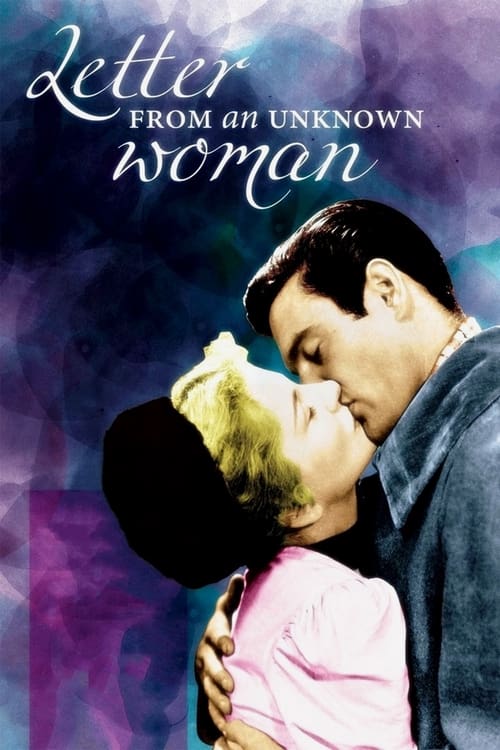
Letter from an Unknown Woman
1948 · Max Ophüls
For a night when you want to be swept away and don't mind being wrecked a little — the classic-Hollywood equivalent of a beautiful sad song on repeat. A good cry, dressed in candlelight and snow.
What it's about
In the small hours before a duel he intends to flee, a Viennese concert pianist receives a letter from a woman he cannot place. As he reads, her story unfolds: a lifetime of devotion that began when she was a teenager living across the courtyard, carried through years and chance reunions — a love he was at the center of without ever truly noticing. The film is her voice, his reckoning, and a portrait of romantic obsession told with devastating elegance.
The experience
Swooning and quietly crushing — it has the surface of a lush period romance and the undertow of a tragedy you can see coming and can't look away from. It builds an ache scene by scene until the final minutes land like a held breath released.
Performances
Joan Fontaine is extraordinary, convincingly playing Lisa from starstruck adolescent to grown woman, letting devotion shade into something obsessive without ever losing our sympathy; Louis Jourdan makes the pianist's charm and carelessness inseparable.
The craft
Max Ophüls's camera glides through a studio-built Vienna of staircases, train platforms, and winter streets — movement so fluid it makes memory itself feel like choreography. The letter-narration structure turns a romance into something closer to a ghost story of the heart, and every image is composed like an heirloom.
Why it matters
Overlooked on release, it's now regarded as one of the supreme melodramas of the studio era — the touchstone for how a 'women's picture' can be both ravishing and ruthlessly intelligent, and the peak of Ophüls's Hollywood years.
Snapshot
Letter from an Unknown Woman is the central achievement of Max Ophüls's brief, embattled Hollywood interlude and one of the supreme melodramas of the studio era. Adapted from Stefan Zweig's 1922 novella Brief einer Unbekannten, it tells of Lisa Berndle (Joan Fontaine), who loves the concert pianist Stefan Brand (Louis Jourdan) from adolescence to death, surrendering her life to a man who forgets her three times over. The film is framed as a letter read in the small hours by Stefan, a careless seducer about to flee a duel; the woman's words force a retrospective reckoning that arrives too late to redeem him and just in time to destroy him. Modestly received on release, the film has since become a touchstone of melodrama studies, women's-film scholarship, and the auteurist reclamation of Ophüls — admired above all for the gliding camera, the sumptuous re-creation of fin-de-siècle Vienna, and the merciless precision with which it anatomizes romantic illusion.
Industry & production
The film was produced by Rampart Productions, the independent unit Joan Fontaine had formed with her then-husband, producer William Dozier, and released through Universal-International in 1948. John Houseman — the Mercury Theatre collaborator of Orson Welles — served as producer, and his theatrical sophistication and literary instincts were decisive in shaping the project's tone. Fontaine, fresh from her Hitchcock successes (Rebecca, Suspicion), was both star and a guiding commercial force; her prestige made an expensive, period-bound European subject viable within a Hollywood otherwise wary of such material.
Ophüls — a German-Jewish émigré who had built distinguished careers in Germany and France before fleeing the Nazi advance — had struggled to gain a foothold in Hollywood through most of the 1940s. Letter was his decisive American breakthrough, the film on which Houseman entrusted him with a congenial Viennese world and the room to realize his style. The production was studio-bound, recreating turn-of-the-century Vienna on the Universal backlot and soundstages — a controlled, artificial environment that suited Ophüls's taste for enclosure and theatrical design. The exact budget and box-office figures are not something I can state with confidence; the film is generally described as a commercial disappointment in its day, but I would treat precise numbers as unverified.
Technology
The film was made in standard late-1940s studio technology: 35mm black-and-white photography in the Academy ratio (1.37:1) and monaural optical sound. There is nothing technologically novel in its apparatus; its distinction lies entirely in the virtuosity with which conventional tools — dolly, crane, painted backdrops, glass shots, process work — are deployed. The recurring set-piece at the Prater, in which Lisa and Stefan "travel" through a series of European landscapes in a stationary fairground railway car while painted panoramas are cranked past the window, is itself a knowing meditation on cinema's own machinery of illusion: a fake journey produced by moving scenery past a fixed point, which is precisely how the movie behind it works.
Technique
Cinematography
Franz Planer's camerawork is the film's signature. Working with Ophüls, Planer realized the director's famous mobile long takes — fluid tracking and craning movements that follow characters up staircases, through doorways, along the windows of the Berndle courtyard. The camera does not merely observe; it participates in the rhythm of longing and pursuit, gliding alongside Lisa as she ascends the spiral stair toward Stefan's apartment, framing her perpetually at the threshold of a happiness she is never permitted to keep. Planer's high-key Viennese interiors and soft, romantic lighting build a world of plush surfaces and gauzy light, against which the cold facts of abandonment register all the more sharply.
Editing
Ted J. Kent's editing serves Ophüls's preference for sustained takes rather than fragmentation; cutting is largely subordinated to camera movement and to the architecture of the flashback. The film's structure is built on the voiceover letter, which dissolves the present-tense frame (Stefan reading) into the long retrospective of Lisa's life and folds it back at the close. The transitions between the three phases of their encounters — girlhood, the single consummated night, the final non-recognition at the opera — are managed so that time seems to circle back on itself, the same staircase and the same street recurring with devastating variation.
Mise-en-scène / staging
Staging is where Ophüls is most himself. The film is organized around vertical space — staircases above all — and around framing devices: windows, doorways, lace, gates, and the recurrent motif of glass that separates Lisa from the object of her devotion. Vienna is rendered as a gilded cage of social ritual. The Prater sequence, the opera house, the white-gloved waiters and military officers all compose a milieu in which desire is choreographed and contained. Objects accrue terrible meaning across the film's span — a single white rose, the carousel music, the recurring stair — so that the mise-en-scène itself becomes the memory the protagonists fail to keep.
Sound
The score by Daniele Amfitheatrof saturates the film with Viennese romanticism, and music is thematically central: Stefan is a pianist, and his art is both his seduction and his evasion. A recurring piece of Romantic piano repertoire (associated in the film with Liszt) functions as a leitmotif of Lisa's devotion and Stefan's squandered gift. I'd flag the precise attribution of individual cues as a point to verify rather than assert. Equally important is the use of voice: Fontaine's narration, addressed to "you," gives the film its intimate, posthumous tone — a dead woman speaking — and binds the spectator into the position of the man being addressed and indicted.
Performance
Joan Fontaine's performance is a tour de force of physical and vocal modulation, persuasively spanning Lisa from infatuated adolescent to grieving woman without resort to heavy makeup tricks; the transformation is carried in carriage, voice, and gaze. Her Lisa is neither pathetic nor simply victimized — Fontaine grants her a willed, almost terrifying constancy. Louis Jourdan's Stefan is the necessary counterweight: charming, sincere in each moment and incapable of memory, a man whose superficial warmth is precisely the engine of cruelty. Strong supporting work comes from Mady Christians as Lisa's mother and Art Smith as Stefan's mute manservant John, whose silent final act of recognition — writing Lisa's name — delivers the film's closing turn.
Narrative & dramatic mode
The film's dramatic mode is retrospective tragic irony built on an epistolary frame. Because Lisa's letter is read by a man who cannot remember her, the spectator possesses a knowledge the male protagonist lacks throughout, and the suspense is moral rather than eventful: we wait not to learn what happens but to see whether Stefan will finally understand. The structure of triple repetition — three encounters, three failures of recognition — gives the narrative an almost ritualistic, fatalistic shape. The first-person female voice governs the telling, an unusual and powerful inversion in a period cinema where women were more often looked at than listened to. The ending closes the circle: recognition arrives, and it sends Stefan out to the duel and his death, so that comprehension and annihilation become the same act.
Genre & cycle
Letter belongs to the woman's picture or "weepie" — the prestige melodrama of female sacrifice and unrequited love that flourished in 1940s Hollywood. It shares DNA with the maternal-melodrama and renunciation films of the cycle, but it elevates the form through European literary pedigree and Ophüls's stylistic rigor. It also sits within a transnational lineage of Viennese romance — the Schnitzler-inflected world of doomed liaisons that Ophüls had already drawn on in his German Liebelei (1933) and would return to in La Ronde (1950). The film thus straddles the Hollywood melodrama cycle and a Mitteleuropean tradition of erotic fatalism.
Authorship & method
This is an auteur's film in the fullest sense, but a collaborative one. Max Ophüls (credited in his American films as "Max Opuls") brought a fully formed sensibility — the moving camera, the obsession with time, memory, and women's experience, the conviction that style is meaning. His method favored elaborate, rehearsed long takes and a designed world over realist looseness. Screenwriter Howard Koch — a Casablanca veteran soon to be blacklisted — supplied a literate, tautly constructed adaptation of Zweig that preserved the novella's epistolary conceit while reshaping its incident for the screen. Producer John Houseman lent theatrical and literary judgment. Cinematographer Franz Planer, a fellow émigré, was the essential technical partner in realizing Ophüls's camera. Composer Daniele Amfitheatrof and art director Alexander Golitzen built the film's Viennese atmosphere, with costuming by Travis Banton. The convergence of European émigré talent — Ophüls, Planer, and a Continental subject — gives the film its distinctively un-Hollywood texture.
Movement / national cinema
The film is a hybrid: an American studio production made by a European exile, and it is best understood through the lens of the émigré cinema that the Nazi diaspora brought to Hollywood. Ophüls belongs with Lang, Wilder, Sirk, and others who carried Mitteleuropean styles and themes into the American system. Letter is not part of a domestic movement so much as a node in that transplantation — a Viennese sensibility realized in California. In Ophüls's own career it is the bridge between his pre-war European work and the great French films of his final period (La Ronde, Le Plaisir, The Earrings of Madame de…, Lola Montès), and many critics read his entire oeuvre as continuous across national borders.
Era / period
Produced in 1948, the film arrives at the high tide of the prestige woman's melodrama and amid the postwar vogue for psychologically inflected, flashback-structured narratives. Yet its diegesis is resolutely turned away from contemporary America: it reconstructs a Vienna of around 1900, a vanished imperial world of operas, duels, and rigid social forms. That doubled temporality — a 1948 film mourning a 1900 milieu, itself adapted from a 1922 novella — gives the work an unusually deep sense of historical loss, as if the film were elegizing not only Lisa but an entire civilization swept away by the wars its makers had fled.
Themes
At its core the film is about memory and its failure — the asymmetry between a love that defines one life entirely and barely registers in another. It anatomizes romantic illusion: Lisa's devotion is both sublime and self-annihilating, and the film refuses to flatter it as simply noble. Time and repetition structure everything; the recurring staircase and street stage the way the past returns unrecognized. There are sustained meditations on art and seduction (Stefan's music as the instrument of both his charm and his self-betrayal), on the gendered economy of desire in a patriarchal order, and on fate — the sense that these lives move on rails as fixed as the Prater's fairground train. Critics have long debated whether the film endorses Lisa's sacrifice or exposes its tragedy; the richest readings hold that it does both at once.
Reception, canon & influence
On release the film earned respectful reviews but no great commercial success, and Ophüls's American sojourn ended shortly after with Caught and The Reckless Moment (both 1949) before his return to France. Its canonization came later. The rise of auteurist criticism — Andrew Sarris in America, the Cahiers du cinéma writers in France — elevated Ophüls to the front rank of directors and Letter to the status of a masterpiece, frequently named among the finest of all Hollywood melodramas. It became a privileged object for academic film studies from the 1970s onward, particularly in feminist and melodrama scholarship, where its female narration, its play of looking and recognition, and its treatment of female desire made it a recurring case study.
Backward, the film draws on Zweig's novella and the broader Viennese literary culture of Schnitzler and the fin-de-siècle, on Ophüls's own earlier Schnitzlerian films, and on the Hollywood woman's-picture conventions it both honors and transcends. Forward, its influence runs through directors devoted to the expressive moving camera and to the melodrama of memory and desire — Stanley Kubrick admired Ophüls openly, and the film's DNA is visible in later filmmakers working in the romantic-melodramatic key, from the consciously revivalist melodramas of Todd Haynes to the long-take romanticism of Paul Thomas Anderson and others who cite Ophüls as a model. As both a summit of classical Hollywood melodrama and a personal statement by one of cinema's great stylists, Letter from an Unknown Woman endures as a study of how love can be at once the meaning of a life and a story the beloved never even knew he was in.
A Deleuzian reading
A staircase, climbed three times.
The full Deleuzian reading of Letter from an Unknown Woman →
Reception
A box-office disappointment dismissed in 1948 as just another 'women's picture', it was rescued by French critics and later academics, and is now routinely called the greatest film of Ophüls's Hollywood exile — a textbook flop-to-canon story, sealed by its 1992 National Film Registry induction.
How Letter from an Unknown Woman was received, from release to now →
Influences: the films it descends from and the films it influenced
- Casablanca (1943) — Ophüls inherits the flashback as the film's entire structural frame — the confession letter as romantic memory counterpoint to a present-tense reckoning — and photographs Joan Fontaine in gaslit Vienna with the same diffused idealization Edeson applied to Bergman; the sacrifice arc pushes Casablanca's melodramatic structure to its ironic extreme: she dies for a man incapable of remembering her.
- Now, Voyager (1942) — The canonical 'melodrama of the unknown woman' (per Cavell), structuring unspoken female desire and self-sacrifice around a recurring romantic motif and staircase mise-en-scène — the same critical-feminist lineage Now, Voyager anchors.
- Holiday (1938) — Planer's American continuation of the same visual thesis: a stairwell as the film's vertical spine, ascents and descents standing in for changes of fortune, and low-key interiors where the key light rakes across a face rather than fronting it.
- La Ronde (1950) — Returns to the Schnitzler/Vienna source and perfects the circling, self-aware camera and the structure of romantic repetition — desire passed hand to hand and never landing.
- The Earrings of Madame de... (1953) — The mature crystallization of Letter's method — triple-repetition of a circulating object, waltzing crane choreography, and retrospective irony where a love is recognized only when it is already lost.
- The Age of Innocence (1993) — Restless tracking-and-craning camera through fin-de-siècle drawing rooms, a literary retrospective voiceover, and a love thwarted by social convention and recognized too late.
- In the Mood for Love (2000) — Builds romantic longing from triple-repetition of staged encounters, glass-and-doorway separation framing, and a recurring musical leitmotif — Ophüls's memory-melodrama in another key.
- Carol (2015) — Extends Letter's glass-separation motif and looking-and-recognition play — lovers framed through windows, reflections and thresholds — within a memory-haunted woman's romance.
- Vertigo (1958) — Ophüls's tragic-ironic narrative structure — the audience's privileged knowledge of the woman's feelings producing pathos from the man's structural blindness — is the emotional and narratological grammar that Vertigo inherits for its double-narrative irony.
- Wild Strawberries (1957) — Ophüls's technique of a frame-narrative document triggering clean cuts into remembered sequences — with chamber-scored restraint letting performance carry pathos rather than orchestral underscoring — is the direct formal model for Wild Strawberries' voiceover-activated temporal architecture and its acoustic economy.
- 2046 (2004) — Ophüls's melodrama engine — one lover who remembers everything, one who has repeatedly forgotten — is the direct structural template for 2046's pattern of women who invest more fully than Chow returns; doorway and threshold architecture spatializes desire as obstruction.
- Last Year at Marienbad (1961) — Ophüls and cinematographer Franz Planer develop the unhurried crane-and-dolly movement through ornate European stairwells and ballrooms as the formal expression of obsessive, unrequited memory — the specific vocabulary of fluid architectural tracking through Viennese interiors that Sacha Vierny inherits and applies to the baroque corridors of the Bavarian palaces.
- Hiroshima Mon Amour (1959) — Ophüls's voiceover memory structure — a narrator recounting the past in a letter read in the present, while images illustrate scenes the letter cannot fully contain — prefigures Hiroshima's image-voice counterpoint, where Duras's dialogue describes what the images refuse to confirm and the gap between saying and showing generates the film's epistemological pressure.
- A Place in the Sun (1951) — Ophüls's dissolve-montage sequences — compressing subjective romantic time into a rhythm of close-ups that idealize experience against the social reality surrounding it — directly inform Stevens's romantic interludes between Clift and Taylor, which use the same optical technique and the same tactic of rendering desire as an edited rhythm rather than a represented event.
- Le Plaisir (1952) — Ophüls's Hollywood collaboration with Franz Planer on the sustained-take exploration of female interiority through a literary epistolary voice-over is the American template that Le Plaisir's Matras partnership reconceives in naturalist European light in 'La Maison Tellier.'
- Liebelei (1933) — Ophüls's own prototype: the same Schnitzlerian fin-de-siècle Vienna, the gliding camera through ballrooms and staircases, and the structure of a woman's love consummated and then destroyed by a careless man's duel-bound code.
- La Signora di Tutti (1934) — Establishes Ophüls's retrospective-tragic architecture — a woman's whole life recovered in flashback at the point of death — with the restless tracking camera as the engine of memory rather than mere decoration.
- Sunrise (1927) — The German 'entfesselte Kamera' (unchained camera) that Ophüls and émigré DP Franz Planer inherit — fluid crane and tracking moves binding lovers within a designed, theatrical world.
- The Marriage Circle (1924) — Continental Viennese sophistication staged through doorways, mirrors and glass thresholds — the looking-and-not-seeing geometry Ophüls turns tragic via his glass-separation motif.
- Stella Dallas (1937) — The Hollywood woman's-picture template of female sacrifice observed through windows and across thresholds, the genre conventions Letter both honors and refines into the epistolary register.
- Camille (1936) — Star-driven doomed-romance melodrama built on the heroine's renunciation and a man's belated recognition — the prestige woman's-picture mode Joan Fontaine's performance answers.
- Caught (1949) — Sibling from the same American sojourn: female subjectivity trapped in a gilded interior, the camera tracking a woman's entrapment by a man who cannot truly see her.
- The Reckless Moment (1949) — Companion American melodrama of a woman's hidden devotion and self-erasure, sustaining the mobile-long-take staging of domestic space as a cage of unspoken feeling.
- Barry Lyndon (1975) — Kubrick's avowed debt to Ophüls: period fatalism narrated with ironic retrospect, candlelit interiors, and slow reframing camera moves that make decor the instrument of a doomed romantic arc.
- Far from Heaven (2002) — Consciously revivalist woman's-picture melodrama that resurrects the classical genre's emotional grammar of repressed female desire that Letter exemplified and Haynes cites.
- Atonement (2007) — Epistolary frame and retrospective tragic irony — a love known fully only through a written account — paired with bravura sustained tracking takes in the Ophülsian manner.
- Phantom Thread (2017) — PTA's long-take romanticism applied to obsessive love and a designed period world, with the gliding camera and leitmotif scoring turning couture interiors into the medium of desire.
Similar films
- The Earrings of Madame de... (1953) — influence & lineage
- La Ronde (1950) — influence & lineage
- In the Mood for Love (2000) — influence & lineage
- Amour (2012) — often watched together
- Love Letter (1995) — often watched together
- Hiroshima Mon Amour (1959) — shared sensibility
- Gertrud (1964) — shared sensibility
- Lola Montès (1955) — shared sensibility
All the films related to Letter from an Unknown Woman →