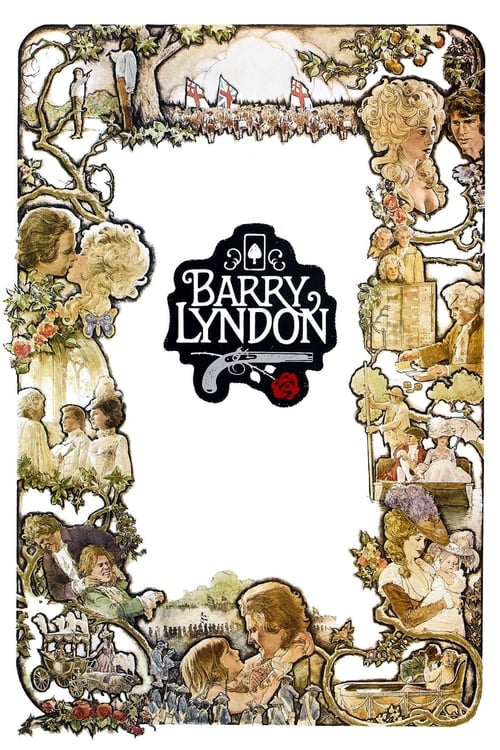
Barry Lyndon
1975 · Stanley Kubrick
For a long, unhurried evening when you want to sink into sheer beauty — a film to pour a drink with and surrender to, not squeeze between other things. Comfort viewing for the eyes, with a sting for the heart.
What it's about
An 18th-century Irish nobody — charming, brave, and endlessly self-serving — schemes, duels, gambles, and marries his way up through the armies and aristocracies of Europe, remaking himself as the gentleman Barry Lyndon. A wry narrator follows his rise through wars and card tables and his long, costly attempt to hold on to what he's won. It's a rags-to-riches adventure told with a raised eyebrow, always aware of what the climb costs.
The experience
Stately, gorgeous, and quietly devastating — three hours that move like a slow procession through paintings, with an ironic narration that keeps you at a bemused distance until, late on, the feeling floods in. It's funny in a dry way, melancholy in a deep way, and hypnotic if you give yourself over to its pace.
The craft
This is one of the most beautiful films ever photographed: interiors lit entirely by candlelight using ultra-fast lenses built for space photography, landscapes and drawing rooms composed like 18th-century paintings, slow zooms that pull faces back into their world. Handel and Schubert on the soundtrack do as much storytelling as the script. It won four Oscars for its craft, and it demands the biggest screen you can find.
Why it matters
Coolly received in 1975, it's since been re-evaluated as one of Kubrick's supreme achievements and the benchmark for natural-light period filmmaking — the film every ravishing costume drama since gets measured against.
Snapshot
Barry Lyndon is Stanley Kubrick's adaptation of William Makepeace Thackeray's 1844 picaresque novel The Luck of Barry Lyndon, tracing the rise and ruin of an 18th-century Irish adventurer. It arrived between the cultural detonation of A Clockwork Orange (1971) and the horror austerity of The Shining (1980), and it confounded the expectations both raised. Where Kubrick had been the provocateur of the early 1970s, here he made a film of glacial patience and painterly stillness — a three-hour costume drama narrated with cool ironic detachment, structured as a deliberate ascent and an equally deliberate fall. It is among the most visually celebrated films ever made, renowned for sequences shot by candlelight and compositions modeled on 18th-century painting, and it stands as one of the supreme examples of cinema pursuing the textures of the past as a sensory and moral problem rather than a backdrop. Initially received with respect more than enthusiasm, it has since risen steadily in critical estimation to be regarded by many as Kubrick's masterpiece.
Industry & production
Barry Lyndon emerged from the wreckage of an abandoned dream. Kubrick had spent years preparing an epic biography of Napoleon, amassing an enormous research archive and a vast card-catalog of Napoleonic life; when that project collapsed — undone by budget anxieties at the studios and by the commercial failure of Sergei Bondarchuk's Waterloo (1970), which spooked financiers about period military epics — Kubrick redirected his 18th-century research and ambitions toward Thackeray. The choice let him deploy the historical immersion he had accumulated within a more containable narrative.
The film was made for Warner Bros., the studio with which Kubrick had built his durable, autonomy-granting relationship. Production was famously protracted and demanding, shot largely on location across Ireland, England, and what was then West Germany, drawing heavily on stately homes, castles, and landscapes to supply authentic period interiors and grounds. The Irish shoot was reportedly cut short amid security concerns during the Troubles, prompting a relocation. Ryan O'Neal, then a major box-office star off Love Story (1970) and What's Up, Doc? (1972), was cast as Redmond Barry — a commercial bid for a film whose form was otherwise resolutely uncommercial — opposite Marisa Berenson as Lady Lyndon. The picture's reputation as an expensive, painstaking undertaking is well established, though specific budget and box-office figures vary across sources, and I won't assign numbers I can't reliably attribute. Its domestic reception was muted relative to Kubrick's prior films, while European audiences and critics were warmer.
Technology
Barry Lyndon is inseparable from a single technical pursuit: the desire to photograph interiors lit only by natural and period-appropriate sources, principally candlelight. To shoot scenes at light levels approaching actual candlelit rooms, cinematographer John Alcott and Kubrick employed exceptionally fast lenses — most famously Zeiss Planar 50mm f/0.7 lenses, originally developed for NASA, adapted for cinema use with the help of optical technicians. These lenses, with their extraordinary light-gathering capacity, allowed exposure by candle flame, but at the cost of a razor-thin depth of field, which shaped the look and the staging of those scenes: actors had to move with great discipline to remain in focus, and compositions tended toward stillness.
This was not novelty for its own sake but a thesis about historical seeing — the conviction that a pre-electric world should be rendered in its own light. Beyond the lenses, the production made extensive use of zoom lenses for its signature slow reverse zooms, and built much of its aesthetic on practical and available light supplemented carefully rather than the conventional heavy artificial lighting of studio costume pictures. The achievement is generally credited as a landmark in the technical history of cinematography, demonstrating possibilities at the extreme low end of the exposure scale.
Technique
Cinematography
John Alcott's photography — which won wide acclaim — is the film's most discussed element, and deservedly so. Two devices dominate. The first is the slow reverse zoom: again and again the camera begins on a detail — a face, a figure, a duel — and retreats, gradually revealing the landscape or the architecture that frames and dwarfs the human action. This movement enacts the film's governing irony, pulling back from individual striving to disclose the indifferent order of nature and society in which it is embedded. The second is the candlelit interior, where compositions take on the burnished, golden, slightly diffuse quality of period painting. Exteriors, by contrast, are staged like landscape canvases, with figures arranged within sweeping vistas. The cumulative effect is of a world observed from a measured, contemplative distance — beautiful, ordered, and faintly melancholy.
Editing
Edited by Tony Lawson, the film unfolds at a pace that is famously, deliberately slow — a tempo that is itself an argument. Scenes are allowed to breathe; the cutting rarely hurries the eye, instead holding on compositions long enough for the viewer to read them as paintings. The structure is bipartite, divided by an intermission and by two title-card "parts," the first charting Barry's rise, the second his decline — a symmetry that frames the whole as a moral arc rather than a momentum-driven plot. The rhythm is governed less by dramatic acceleration than by the cadence of the narration and the music.
Mise-en-scène / staging
The film's mise-en-scène is its most lavish achievement. Costumes (the work of Ulla-Britt Söderlund and Milena Canonero, who shared recognition for the design) and the production and art direction reconstruct the 18th century with painterly fidelity, drawing on the visual record of Hogarth, Gainsborough, Watteau, Reynolds, Stubbs, and Chardin among others. Interiors are dressed and lit to resemble specific traditions of period portraiture and genre painting; exteriors echo landscape art. Staging is frequently frontal and tableau-like, the frame composed as a self-conscious picture. This is not decoration but method: Kubrick treats the look of the past as a way of thinking about it, the elaborate surfaces both seducing the viewer and holding the characters at an analyzable remove.
Sound
The soundtrack is one of the most influential in film. Kubrick, characteristically, built it largely from pre-existing music rather than a conventional original score. The most indelible recurring theme is the Sarabande from Handel's Keyboard Suite in D minor, arranged and reused as a grave, fateful motif that returns across the film and accompanies its duels. Schubert, Mozart, Vivaldi, Bach, and others appear, alongside Irish traditional music performed by The Chieftains, which grounds Barry's origins. Leonard Rosenman adapted and arranged the music, work for which he received recognition. The score's deployment — repetition of a small set of themes, the Sarabande tolling toward catastrophe — turns music into the film's instrument of fate.
Performance
Performance in Barry Lyndon is stylized toward restraint, in keeping with the film's distanced register. Ryan O'Neal's Barry is opaque and largely reactive — a deliberate choice that has divided viewers, some finding it inexpressive, others reading it as exactly right for a character who is more vessel of circumstance than agent of will. Marisa Berenson's Lady Lyndon is a study in beautiful, sorrowful passivity, her face often held in near-portrait stillness. The supporting cast supplies the film's wit and menace, with Patrick Magee as the Chevalier de Balibari, Hardy Krüger as Captain Potzdorf, Leon Vitali as the vengeful Lord Bullingdon (Vitali would become Kubrick's longtime assistant thereafter), and Murray Melvin and others filling out a richly inhabited social world. The performances are calibrated to the camera's coolness rather than to emotional projection.
Narrative & dramatic mode
The film is a picaresque turned tragic, and its defining narrative device is the third-person narrator (voiced by Michael Hordern), whose dry, omniscient commentary continually intervenes between the viewer and the action. The narrator ironizes Barry, withholds suspense (most famously by announcing outcomes before we see them — telling us a character will die, for instance, in advance), and converts what might have been melodrama into a contemplation of fate and folly. Thackeray's novel uses a first-person unreliable narrator — Barry himself, self-justifying and vain — and Kubrick's substitution of a detached third person fundamentally changes the irony, replacing the rogue's self-flattery with an Olympian judgment. The dramatic mode is thus elegiac and deterministic: the two-part structure (rise, then fall) and the foreknowledge dispensed by narration tell us from early on that ascent will be punished, that Barry's luck is a loan called due. The concluding epilogue card, observing that the people of the story are now all equal, seals the film's vanitas theme.
Genre & cycle
Barry Lyndon sits within the costume drama and historical-epic traditions but stands at a deliberate angle to them. Where the genre typically offers romantic identification, spectacle, and forward momentum, Kubrick offers distance, irony, and stasis. It belongs to a small lineage of art-cinema period films that treat history as an aesthetic and philosophical inquiry rather than as adventure. In the context of 1970s Hollywood — the New Hollywood era of personal, often revisionist filmmaking — it can be read as a revisionist costume picture, dismantling the genre's conventions even as it perfects its surfaces. Its emphasis on authenticity of light, music, and material culture also marks it as a touchstone for later "immersive" period filmmaking, even where that later work pursued energy rather than Kubrick's calm.
Authorship & method
Barry Lyndon is a quintessential Kubrick film in its method: total control, exhaustive research, technical problem-solving in pursuit of an idea, and emotional coolness mistaken by some for coldness and recognized by others as a distinctive moral vision. Kubrick wrote the screenplay himself, distilling Thackeray's sprawling novel and crucially altering its narrative voice. His collaborators were central to the result. John Alcott, his cinematographer (who had also shot 2001 and A Clockwork Orange in part, and would shoot The Shining), executed the candlelight and the zooms. Tony Lawson edited. Leonard Rosenman arranged the music from period sources Kubrick selected. Production designer Ken Adam — Kubrick's collaborator from Dr. Strangelove — and the costume designers built the material world. Leon Vitali crossed from actor to lifelong assistant during this production, later overseeing the stewardship of Kubrick's films. The film exemplifies the Kubrickian conviction that style is argument: every formal choice — the light, the music, the narration, the pace — serves a unified thesis about human vanity and the indifference of time.
Movement / national cinema
The film does not belong to a national movement so much as to the international art cinema of the auteur. Kubrick, an American expatriate working in England with European crews and locations, occupied a singular position — a Hollywood-financed director operating with the autonomy and ambition of a European art filmmaker. Barry Lyndon reflects this hybridity: a Warner Bros. production with the patience and painterly seriousness associated with European cinema, its Irish, English, and German settings and its pan-European musical sources reinforcing a transnational sensibility. It is best understood within the tradition of the international auteur film of the 1960s–70s rather than within any one nation's cinema.
Era / period
Made in 1975, the film is doubly periodized: it is a New Hollywood–era work that looks back to the 18th century. The mid-1970s gave directors unusual latitude, and Kubrick used his to make something commercially risky and artistically uncompromising. Its depicted period — roughly the era of the Seven Years' War and after — is rendered with an unusual ambition toward total reconstruction, encompassing warfare conducted in the formal lines of the period, the rituals of the aristocracy, gambling, dueling codes, and class hierarchy. The film treats the 18th century not as quaint but as a rigid social machine, and its formality of style mirrors the formality of the world it depicts.
Themes
The film's central theme is the vanity of worldly ambition and the indifference of fate and time. Barry's relentless climb — from provincial Irish youth through soldiering, desertion, espionage, gambling, and a marriage of convenience into the aristocracy — is shown to be hollow, and his fall is as mechanical as his rise. Class is examined as an impermeable structure that Barry can enter but never truly belong to; his Irishness and origins mark him permanently as an outsider in English aristocratic society. Chance and luck — the "luck of Barry Lyndon" — govern human affairs more than merit or will, and the narration repeatedly underscores this determinism. Dueling and codes of honor recur as both plot engine and emblem of a society ordered by ritualized violence. Money, debt, and inheritance drive the human relations. Underlying all is a vanitas meditation: the closing observation that the figures of the story are now all dead and equal frames the entire spectacle as a reflection on mortality and the futility of status.
Reception, canon & influence
Initial reception was mixed-to-respectful rather than rapturous: many critics admired the visual achievement while finding the film cold, slow, or emotionally remote, and it was a more muted commercial proposition in the United States than Kubrick's preceding films, though it found stronger favor in Europe. It was recognized at the major awards principally in the craft categories — cinematography, production/art direction, costume design, and music adaptation — affirming the consensus that its surfaces were extraordinary even among those uncertain about its drama.
Its influences run backward into the history of painting more than of cinema: the 18th-century portraitists and landscape and genre painters whose compositions and light Kubrick studied are the film's true source images, alongside Thackeray's novel. Forward, its legacy has grown enormously. The candlelight cinematography became a landmark reference point for filmmakers and cinematographers pursuing naturalistic period light, and the film is regularly cited as an influence by directors drawn to painterly composition and historical immersion — its imprint is widely acknowledged on later period filmmaking that prizes authenticity of light and material culture. Critical reappraisal has been steady and pronounced: once regarded as a magnificent oddity, Barry Lyndon now appears near the top of many assessments of Kubrick's career and recurs on major critics' polls of the greatest films. It endures as the definitive demonstration that style, pursued with total rigor, can itself constitute a complete and devastating vision of human life.
A Deleuzian reading
Start with the move everyone remembers, even if they can't name it.
The full Deleuzian reading of Barry Lyndon →
Reception
Dismissed by many 1975 critics as gorgeous but glacial — a 'coffee-table movie,' Pauline Kael sniffed — and a box-office disappointment in the US, it's since been reappraised so completely that plenty of cinephiles (Scorsese among its loudest champions) now call it Kubrick's finest film.
How Barry Lyndon was received, from release to now →
Influences: the films it descends from and the films it influenced
- The Earrings of Madame de... (1953) — Models the ironic-fatalist costume drama Kubrick admired, where elegant camera movement and an aristocratic milieu observe a doomed protagonist with cool emotional distance rather than identification.
- Lola Montès (1955) — Frames a rise-and-fall biography as ironic spectacle, using tableau composition and a foreknowing structure that, like Barry Lyndon's narrator, drains suspense to foreground vanity and decline.
- Senso (1954) — Builds period interiors and costumes from direct study of 19th-century painting, establishing the painting-as-source-image method Kubrick applied to 18th-century portraiture and landscape.
- The Leopard (1963) — Sustains slow, contemplative tableau staging of aristocratic decadence as a vanitas meditation on time's indifference, the same thesis-through-pace Kubrick pursues.
- Tom Jones (1963) — Adapts an 18th-century picaresque of a social-climbing rake using an ironic omniscient narrator who comments on the hero's fortunes — the narrative-voice device Kubrick reworked from Thackeray.
- The Taking of Power by Louis XIV (1966) — Pioneers slow motorized (Pancinor) zooms within austere, materially authentic historical reconstruction, anticipating Kubrick's signature slow reverse zoom from detail to landscape.
- The Scarlet Empress (1934) — Treats the costume drama as an argument made entirely through visual excess and surface, demonstrating that décor and light can carry meaning where drama is deliberately stylized.
- Lawrence of Arabia (1962) — John Alcott's extreme telephoto compositions flatten natural candlelight and landscape into Old Master pictorial planes, extending the formal principle Young established in the Nefud sequences — focal length as a device to make psychological distance literal — while the film's ironic treatment of a self-constructed social climber consumed by the myth he performs is a direct descendant of Lawrence's anti-heroic deconstruction.
- The Magnificent Ambersons (1942) — Kubrick's period prestige tragedy of a social climber destroyed by the aristocratic world he entered is staged in deliberately slow cutting rhythms — extended lateral takes that enforce duration as the grammar of historical weight — descending directly from Welles and Wise's insistence on long breath and unhurried accumulation over narrative efficiency.
- Spartacus (1960) — Kubrick develops the candlelight chiaroscuro he employed in Spartacus's intimate slave-quarters scenes into a complete visual system — NASA-developed lenses shooting by actual candlelight — while the static geometric tableau of figures in landscape evolves directly from Spartacus's symmetrical Roman interior compositions.
- Satyricon (1969) — John Alcott's development of candlelit theatrical illumination and Kubrick's systematic use of very long telephoto focal lengths to produce static frieze-compositions of costumed figures in historical interiors constitutes the non-Italian parallel development of Satyricon's core cinematographic vocabulary, arriving at near-identical visual results by independent means.
- Oliver! (1968) — Kubrick and John Alcott extended the Morris principle—historical period requires photographic aging rather than photographic correction—to its technical limit, using candlelight and wide-aperture NASA lenses to produce the muted amber low-contrast tones that Morris had achieved through lens-gauze and color-timing, tracing the same aesthetic logic to a different technical endpoint.
- Days of Heaven (1978) — Néstor Almendros shoots period interiors and magic-hour exteriors by naturalistic available light, extending Barry Lyndon's candlelit-authenticity program into the American pastoral.
- The Duellists (1977) — Explicitly models its Napoleonic-era light and painterly framing on Barry Lyndon, composing diffused window-lit interiors and landscape tableaux after the same 18th-century painters.
- Tess (1979) — Geoffrey Unsworth and Ghislain Cloquet render period rural life in soft naturalistic light and painterly wide landscapes, pursuing the same authenticity-of-light period immersion.
- The Draughtsman's Contract (1982) — Stages an 18th-century estate in rigorously symmetrical frontal tableaux with an ironic, schematic distance, sharing Kubrick's formal staging and detached view of aristocratic vanity.
- Amadeus (1984) — Scores an 18th-century world with pre-existing period music as structural argument rather than underscore, the same use of selected source compositions Kubrick made of Handel and Schubert.
- The Age of Innocence (1993) — Deploys an ironic omniscient female narrator and obsessive material-culture detail to expose passion suppressed beneath formal surfaces — a direct heir to Barry Lyndon's narration and tableau.
- The Assassination of Jesse James by the Coward Robert Ford (2007) — Roger Deakins pairs a literary omniscient narrator and elegiac slow pace with painterly natural light and edge-distorting anamorphic vignetting that echoes Kubrick's withdrawing zoom.
- Marie Antoinette (2006) — Immerses the viewer in 18th-century material excess and uses a curated anachronistic pre-existing-music score, foregrounding surface and décor as Kubrick did to render vanity.
- Phantom Thread (2017) — Sustains stylized performative restraint and a slow, deliberate observational pace around obsessive craftsmanship, treating controlled surface and texture as the film's emotional argument.
- The Favourite (2018) — Lights court interiors by candle and natural window light and turns the period costume drama to ironic, detached ends, inheriting Kubrick's authentic-light staging and cool moral distance.
- Portrait of a Lady on Fire (2019) — Composes 18th-century interiors as paintings lit by candle and hearth with shallow focus, directly extending Barry Lyndon's painterly composition and natural period light.
- Train Dreams (2025) — An omniscient literary narrator carries the source's voice while human figures are dwarfed inside painterly wide compositions, landscape as framing presence.
- Apocalypse Now (1979) — Kubrick and DP John Alcott pioneered a planned chromatic arc—natural-light clarity in the youth sequences yielding to candlelit amber decay—as a formal argument about historical corruption, a technique Storaro was simultaneously developing for Coppola.
- The Godfather Part II (1974) — Kubrick and Alcott's radical constraint of period-accurate candlelight — refusing artificial illumination as a cinematographic discipline — runs parallel to Willis's equally extreme low-key innovations; both films demonstrate simultaneously that period epic can be a laboratory for formal extremity in available and motivated light.
- The Man Who Would Be King (1975) — Direct contemporary literary prestige adaptation deploying the identical picaresque-to-tragedy arc — a man rises through imposture, is installed as a quasi-royal figure, and is destroyed by the gap between self-image and reality — with temporal ellipsis editing (Tony Lawson) compressing years of accumulated status with the same aristocratic economy as Russell Lloyd's work here.
- Kagemusha (1980) — Kubrick uses period-accurate pigments as a visual taxonomy of rank — the red of English regimentals, the blue of Prussian officers — solving the same problem Kagemusha solves through clan color-coding: how to make faction and hierarchy instantly legible across a widescreen frame without dialogue.
- Letter from an Unknown Woman (1948) — Kubrick's avowed debt to Ophüls: period fatalism narrated with ironic retrospect, candlelit interiors, and slow reframing camera moves that make decor the instrument of a doomed romantic arc.
- Napoleon (2023) — Kubrick's painterly natural- and candle-lit tableaux composed after period canvases, plus the cool ironic distance toward a social-climbing protagonist, supplies Scott's chiaroscuro interiors and the deflationary anti-heroic register; Kubrick's own unmade Napoleon haunts the project.
- Doctor Zhivago (1965) — Long-lens, painterly historical epic of an individual carried by history's currents — the ironic, cool counter-tradition to Lean's romanticism using the same widescreen landscape compression.
- Howards End (1992) — Kubrick's commitment to natural and available-light period interiors and painterly composition set the visual benchmark for the soft, unforced naturalism of Pierce-Roberts' lighting in Howards End.
- Frankenstein (2025) — Openly cited reference for the lighting: Dan Laustsen emulates its painterly available-light/candlelit large-format compositions to render the period interiors as living old-master canvases.
- Pride & Prejudice (2005) — Established the painterly available-light 18th-century interior lit as if by candle and window, the naturalistic-glow palette Roman Osin echoes over Wright's grubby, lived-in Longbourn.
- Chess of the Wind (1976) — A same-era experiment in candlelit, natural-light interiors composed after old-master painting, a parallel pursuit of the Vermeer tableau on screen.
- Little Women (2019) — Its available-light, painterly period cinematography established candlelit natural-light interiors as a formal organizing principle for the literary costume drama Le Saux works within.
Similar films
- The Scarlet Empress (1934) — influence & lineage
- Marie Antoinette (2006) — influence & lineage
- Phantom Thread (2017) — influence & lineage · often watched together
- Portrait of a Lady on Fire (2019) — influence & lineage · often watched together
- Lawrence of Arabia (1962) — often watched together
- Eyes Wide Shut (1999) — often watched together
- Spartacus (1960) — often watched together
- Brazil (1985) — often watched together
All the films related to Barry Lyndon →
Film essays and courses that include it
- Stanley Kubrick
- The Wound of Time: Cinema's Elegiac Masters
- The Painted Frame: Cinema's Conversation with the Canvas
- The Ones Who Stay to Watch: A Course in the Cinema of the Seer
- Commanded Vision: The Auteur Epic
- The Immense Frame: Cinema's 70mm Obsession from VistaVision to IMAX
- Light Made Visible: Cinema's Great Image
- The Frame as a Trap
- The Move That Fell Out of Favor