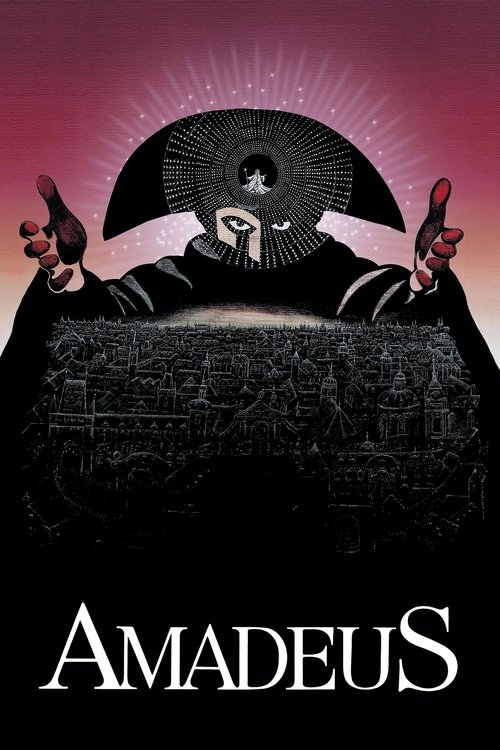
Amadeus
1984 · Miloš Forman
For a big, immersive evening when you want grandeur with real teeth — a film to sink into and argue about afterward. If you've ever burned with jealousy over someone else's effortless talent, this one will read your mail.
What it's about
In the court of Emperor Joseph II in Vienna, the disciplined, devout composer Antonio Salieri has clawed his way to the top of his profession — and then Mozart arrives: vulgar, giggling, effortless, and touched by a genius Salieri would kill for. Told by an aged Salieri looking back from an asylum, it's the story of a man who recognizes God's voice in music and can't forgive that it speaks through someone else. What follows is a duel only one of them knows is happening.
The experience
Sumptuous and surprisingly funny for the first hour, then it tightens into something dark and obsessive — envy played as slow-burn tragedy. Nearly three hours that move like far less, carried on wall-to-wall Mozart.
Performances
F. Murray Abraham won the Oscar for Salieri and earns every frame of it, playing envy, awe, and self-loathing all at once — often just with his eyes while music plays. Tom Hulce's Mozart is a shock: a braying, childish brat whose crassness makes his genius feel almost cruel.
The craft
Forman mounts eighteenth-century Vienna with candlelit opulence — powdered wigs, opera houses, gilded courts — and lets Mozart's own music do the emotional heavy lifting, staged and mixed so the compositions become plot. The opera sequences are among the best filmed performances of classical music ever put on screen; this one genuinely rewards the biggest screen and best speakers you can find.
Why it matters
It swept the Oscars, made Mozart a pop phenomenon all over again, and became the definitive movie about the gap between ambition and gift. 'Salieri' entered the language as shorthand for the talented person doomed to watch a genius from the second row.
Snapshot
Amadeus is Miloš Forman's adaptation of Peter Shaffer's 1979 stage play, a costume drama that doubles as a parable about the cruelty of mediocrity in the presence of genius. Its narrative engine is not Mozart but his rival: Antonio Salieri, court composer to Emperor Joseph II, who recounts from a Viennese asylum decades later how he came to recognize in the vulgar, giggling young Wolfgang Amadeus Mozart the voice of a God who had passed Salieri over. The film converts a quasi-historical anecdote — the long-discredited rumor that Salieri poisoned Mozart — into a theological and psychological fable about envy, vocation, and the unbearable arbitrariness of talent. Lavishly mounted, scored almost entirely with Mozart's own music, and built around F. Murray Abraham's Oscar-winning Salieri and Tom Hulce's manic Mozart, it became one of the most decorated and commercially durable "prestige" films of the 1980s, sweeping eight Academy Awards including Best Picture, Director, Actor, and Adapted Screenplay.
Industry & production
Amadeus was a Saul Zaentz production, financed and released through Orion Pictures — the same independent-minded producer–distributor pairing behind Forman's One Flew Over the Cuckoo's Nest (1975). Zaentz, a former record-industry executive, was precisely the producer suited to a film whose budget and identity were bound up with music rights and orchestral recording. The project originated with Shaffer's play, which had been a major stage success in London (National Theatre, 1979) and on Broadway; Shaffer adapted his own work for the screen in close collaboration with Forman, restructuring it substantially for film rather than transcribing it.
The decisive production choice was to shoot in Prague and the surrounding Czechoslovak locations rather than in Vienna or on sound stages. This was both an aesthetic and a biographical decision: Forman, a Czech émigré who had left after the 1968 Soviet invasion, returned to a Communist-bloc country to make the film, and Prague's relatively unmodernized Baroque and Rococo architecture offered period interiors and streetscapes that Vienna had largely lost. Crucially, the production was able to film in the Tyl Theatre (the Estates Theatre), the very house where Mozart's Don Giovanni had its 1787 premiere — a rare instance of a film staging an opera in its authentic historical room. The shoot reportedly came with the friction one would expect of a Western prestige production operating under a surveillance state, though Forman's standing and Zaentz's organization carried it through.
Commercially, Amadeus was an unusually successful "difficult" subject — a three-hour period film about eighteenth-century composers — translating critical prestige into substantial theatrical returns and a long afterlife on home video and in classroom use. In 2002 Zaentz and Forman released a re-edited Director's Cut running roughly twenty minutes longer and carrying an R rating, restoring material (including a more pointed humiliation of Constanze) that sharpened the film's sexual and economic undercurrents.
Technology
Amadeus is a conventional photochemical production of its era — 35mm anamorphic capture, designed for the widescreen frame — with no pretension to technological novelty in the image. Its real technological ambition lay in sound. The film's spine is Mozart's music performed and recorded specifically for the production by Neville Marriner conducting the Academy of St Martin in the Fields, with vocal soloists and choral forces for the operatic and Requiem sequences. Marriner is said to have accepted on the condition that not a note of Mozart be altered, which made the recording itself the load-bearing element: the picture had to be cut and staged around fully realized musical performances rather than the reverse. This places Amadeus among the films where the score is not accompaniment but pre-existing text — the music is the evidence the drama interrogates. The opera sequences, integrating recorded orchestra and singers with staged action in real theaters, represent the film's most demanding technical synthesis of period performance and cinema.
Technique
Cinematography
The film was photographed by Miroslav Ondříček, Forman's countryman and longtime collaborator going back to the Czech New Wave. Ondříček's work here is candlelit and painterly without tipping into the chilly self-consciousness of, say, Kubrick's Barry Lyndon; the palette favors warm interiors, gold and amber against the dark of Salieri's confessional present. The camera is generally classical and unobtrusive — long, stable framings for the court and the concert hall — but it shifts register decisively in the music: during performances and especially in the climactic Requiem dictation sequence, the shooting and cutting tighten into the rhythm of the score. Ondříček lights the operas as spectacle to be watched from within the diegetic audience, so that we share the period spectator's vantage while Salieri, isolated in his box, supplies the agonized counter-reading.
Editing
The editing (by Nena Danevic and Michael Chandler, Oscar-winning) is organized around the framing device: an aged Salieri narrates, and the film cuts between the asylum confession and the dramatized past. This structure lets the editors treat memory as argument — scenes are summoned as exhibits in Salieri's case against God. The most celebrated passage, in which a dying Mozart dictates portions of the Requiem to a feverishly transcribing Salieri, is essentially an editing and sound problem solved with great precision: the cutting follows the layering of the Confutatis, isolating instrumental lines as Mozart "hears" them, so that the audience is taught to listen the way the film insists genius listens. It is one of cinema's most effective dramatizations of the act of composition.
Mise-en-scène / staging
Production design by Patrizia von Brandenstein (the first woman to win the Academy Award for Art Direction) and costumes by Theodor Pištěk (also an Oscar winner) give the film its sumptuous, lived-in materiality. The staging exploits authentic Prague interiors and real theaters rather than building Vienna anew, and the opera-within-the-film sequences are mounted as period productions — The Abduction from the Seraglio, The Marriage of Figaro, Don Giovanni, and The Magic Flute — each staged to characterize Mozart's evolving art and his social descent from court favor to the popular Schikaneder theater. Forman repeatedly uses physical comportment as staging: the rigid verticality of the court versus Mozart's sprawling, undignified physicality. The recurring image of Mozart's father, Leopold, in a black hooded costume from a masquerade migrates into Don Giovanni's stone Commendatore, a piece of visual psychology that ties the opera's accusing father-figure to Mozart's own guilt.
Sound
Beyond the recorded score, the film's sound design weaponizes music as characterization and as plot. Salieri's "proof" of Mozart's divinity is delivered through our own hearing — the celebrated scene in which Salieri reads Mozart's original manuscripts and the music swells in his head, narrating that to alter a single note would diminish perfection. Mozart's infamous, donkey-bray laugh (Hulce's invention) is a deliberate sonic affront, the vulgar body attached to the celestial gift. Diegetic performance, voice-over confession, and non-diegetic Mozart are braided so that the audience can never fully separate the man's music from the film's judgment of him.
Performance
F. Murray Abraham, then little known, anchors the film as Salieri in two registers — the desiccated, vengeful old man under prosthetic age makeup in the asylum, and the controlled, courtly younger composer whose smoothness curdles into malice — and won the Academy Award for Best Actor. Tom Hulce plays Mozart as a hyperactive, scatological prodigy whose genius is inseparable from his immaturity, a reading that drew both admiration and complaint for its broadness but is essential to the film's thesis: that God poured the sublime into an undeserving vessel. The supporting playing is sharply comic where it could have been stiff — Jeffrey Jones as the well-meaning, musically limited Emperor Joseph II ("too many notes"), Simon Callow as the showman Schikaneder, Roy Dotrice as the looming Leopold, and Elizabeth Berridge as Constanze, whose pragmatism grounds Mozart's flightiness.
Narrative & dramatic mode
The film's defining formal choice is the unreliable confessional frame. Everything is filtered through Salieri's retrospective narration to a young priest, which means the "Mozart" we see is explicitly Salieri's Mozart — a portrait shaped by envy, awe, and self-justification. This is a tragic-ironic mode rather than a biographical one: the film is candid that it dramatizes a legend (the poisoning rumor) it does not historically endorse. The dramaturgy is essentially that of a courtroom or a theodicy — Salieri arraigns God for distributing the gift unjustly, and offers his own life as the prosecution's evidence. The structure produces dramatic irony at scale: we, like Salieri, can hear Mozart's greatness, which makes us complicit in his anguish even as we judge his cruelty.
Genre & cycle
Amadeus sits at the intersection of the prestige period biopic, the filmed-play adaptation, and the artist's-life tragedy. It belongs to a 1980s cycle of literate, awards-oriented adaptations of serious theater and fiction, and within Zaentz's own filmography it stands between Cuckoo's Nest and the later The English Patient as an "important picture." But it deliberately subverts the biopic's conventions: it refuses the cradle-to-grave hagiography, centers the rival rather than the genius, and foregrounds its own status as myth. As a music film it is closer to opera than to the conventional composer biopic, structured around set-piece performances that advance theme rather than mere chronology.
Authorship & method
The film is a genuine two-author work: Forman's direction and Shaffer's writing. Shaffer supplied the central conceit — Salieri as narrator and antagonist — and the intellectual architecture of grace withheld; his screenplay is a substantial reconception of his stage play, opening it up cinematically while preserving its rhetorical drive. Forman brought his New Wave instinct for the human and the unruly, resisting the temptation toward stately reverence; he insisted on Mozart's vulgarity and on the comedy that makes the tragedy land. The key collaborators are unusually legible in the result: Miroslav Ondříček (cinematography), Neville Marriner (music direction, the irreplaceable element), editors Danevic and Chandler, designer von Brandenstein, and costumer Pištěk. Producer Saul Zaentz functioned as the enabling author, securing the freedom and resources for a long, music-driven film. The casting of relatively unknown American actors in the leads, speaking in contemporary American cadence rather than faux-European accents, was a defining Forman choice — a deliberate refusal of "heritage" stiffness that some critics found jarring and others found vivifying.
Movement / national cinema
Though an American studio production in English, Amadeus is shadowed by the Czech New Wave. Forman and Ondříček were central figures of that 1960s movement (Loves of a Blonde, The Firemen's Ball) before the Prague Spring's suppression scattered it; making this film in Prague was, in effect, a homecoming for both. The New Wave's interest in ordinary human behavior, improvisatory comedy, and skepticism toward institutional authority survives in the film's portrait of the court as a vain, mediocre bureaucracy and in its refusal to ennoble its subjects. Amadeus thus occupies a hybrid national position: Hollywood capital and distribution, Central European location and craft, and an émigré sensibility that knows both the grandeur and the pettiness of imperial culture from the inside.
Era / period
Set in the Vienna of Joseph II in the 1780s and early 1790s, the film is also a document of its own moment — the 1980s appetite for high-gloss, high-middlebrow prestige cinema and the period's prosthetic-and-makeup realism (Dick Smith's aging of Salieri). Its setting allows it to stage a clash between Enlightenment court formality and an emergent Romantic idea of the artist as inspired, ungovernable individual — Mozart as proto-Romantic genius colliding with a hierarchical patronage system that cannot accommodate him. The film's sympathies with the bourgeois popular theater (Schikaneder's Magic Flute) over aristocratic taste reflect this transitional historical reading.
Themes
The governing theme is mediocrity confronting genius — Salieri's tragedy is that he is gifted enough to recognize greatness but not to possess it, making him, in his own bitter phrase, the patron saint of mediocrities. Around this orbit several others: divine injustice and theodicy, the scandal that God would lodge perfection in a profane vessel; envy as a spiritual condition, corrosive precisely because it is born of genuine appreciation; the body versus the spirit, dramatized through Mozart's coarse physicality and sublime output; patronage, money, and artistic survival, as Mozart's refusal to flatter the court drives him into poverty; and fathers and judgment, with Leopold's accusing presence haunting both Mozart's life and his music. The film is finally less about music history than about the human cost of self-knowledge in the shadow of the unattainable.
Reception, canon & influence
Critical reception was strong and its awards standing immense: eight Academy Awards, including Best Picture, Best Director, Best Actor (Abraham), and Best Adapted Screenplay (Shaffer), plus design and sound categories — one of the most honored films of the decade. Critics praised its intelligence, design, and central performances, while a recurring strand of dissent objected to Hulce's broad characterization and to the historical liberties; classical-music purists noted, correctly, that the Salieri-as-murderer premise is dramatic legend, not fact, and that the real Salieri was a respected composer and teacher rather than a villain. The film has generally answered this by being open about its fictiveness — it dramatizes Salieri's myth, not the archival record.
Influences on the film (backward): the primary source is Shaffer's play, which itself drew on Aleksandr Pushkin's 1830 dramatic poem Mozart and Salieri (later set as an opera by Rimsky-Korsakov), the literary origin of the poisoning legend. Behind that stands the broader nineteenth- and twentieth-century mythologization of Mozart as the type of the divinely touched, doomed prodigy. Cinematically, Forman's New Wave training and the prestige-adaptation tradition shape its method; comparisons to Barry Lyndon are inevitable, though Amadeus is warmer and more theatrical.
Legacy (forward): Amadeus became the reference point for the "serious composer film" and a durable touchstone in music education, even as scholars use it as a case study in how popular cinema constructs and perpetuates historical myth — its outsized cultural footprint arguably rehabilitated public interest in Salieri precisely by defaming him. Its framing of genius-versus-envy entered general culture, and its model of the artist biopic told through a resentful witness can be felt in later films that decline straightforward hagiography. Within Forman and Zaentz's careers it cemented a particular brand of literate, internationally produced prestige filmmaking. The 2002 Director's Cut extended its life with home audiences, and the film remains, four decades on, the dominant popular image of Mozart — a measure of both its artistry and the interpretive responsibility that comes with so thoroughly displacing the historical record.
A Deleuzian reading
A man sits in a candlelit room turning over loose sheets of music written in another man's hand.
The full Deleuzian reading of Amadeus →
Reception
A rare case of a Best Picture behemoth (8 Oscars) that never curdled into 'homework' — it swept in 1985 and has only grown more loved, with Letterboxd-era cinephiles reclaiming it as gleefully punk rather than stuffy prestige.
How Amadeus was received, from release to now →
Influences: the films it descends from and the films it influenced
- Citizen Kane (1941) — Reconstructs a great man's biography through the partial, retrospective testimony of associates who envied or misjudged him — the fallible-witness framing structure Amadeus hands to Salieri.
- The Red Shoes (1948) — Stages an entire performed art-form (the ballet) inside the narrative as an extended dramatic set-piece, music and spectacle as character — the model for Amadeus's opera-within-film sequences.
- Tom Jones (1963) — Strips heritage solemnity from costume drama with bawdy comedy and vulgar bodily life, licensing the irreverent earthiness Forman gives the giggling, scatological Mozart.
- The Firemen's Ball (1967) — Forman's own Czech New Wave method — naturalistic faces and comic vulgarity wrung from human folly — carried directly into Mozart's coarseness and the refusal of period stiffness.
- The Music Lovers (1971) — Fuses recorded classical score with psychological melodrama so the music dramatizes the composer's inner life, the anti-hagiographic composer-biopic template Amadeus inherits.
- Death in Venice (1971) — Deploys a recurring Mahler adagio as score-as-text mapping an artist's relation to genius, beauty and death across slow, painterly period images.
- A Clockwork Orange (1971) — Makes pre-existing classical music (Beethoven) a character's defining diegetic trait — recorded-score-as-text rather than mood underscoring.
- Barry Lyndon (1975) — Candlelit, painting-derived photography of 18th-century interiors plus classical repertoire used as structural narrative voice — the explicit cinematographic precedent for Ondříček's candlelit-painterly look.
- Equus (1977) — Shaffer adapting his own anti-naturalist play again, but with a director who invents cinematic equivalents for theatrical conceits — the deliberate counter-solution to Equus, retaining the confessional frame and worship-versus-mediocrity theme.
- The Life and Death of Colonel Blimp (1943) — An entire life narrated retrospectively by an aged rival, using aging-across-decades makeup and a confessional framing device — the same one-life-in-flashback architecture Blimp built around the Turkish-bath frame.
- Farinelli (1994) — Builds its drama around reconstructed baroque opera performance as the centerpiece, extending Amadeus's opera-within-film as the engine of period-music spectacle.
- Immortal Beloved (1994) — Reconstructs Beethoven's life through an investigator interviewing surviving witnesses, recorded works cued as biographical text — directly modeled on Amadeus's witness-confession frame.
- Shine (1996) — Renders a musician's fracturing psyche through performance itself, recorded Romantic repertoire (Rachmaninov) functioning as characterization rather than illustration.
- Topsy-Turvy (1999) — Dramatizes the unglamorous craft-labor of mounting an operetta scene by scene, taking the opera-within-film staging into the workshop of creation.
- The Pianist (2002) — Makes recorded/performed classical playing the literal spine of the narrative, the musician's body at the keyboard as text in the Amadeus manner.
- The Social Network (2010) — Narrates a prodigy through the depositions of resentful near-equals, transposing Salieri's mediocrity-recognizing-genius confessional structure into legal testimony (Sorkin has cited the debt).
- Whiplash (2014) — Dramatizes mediocrity straining toward genius through the physical act of music-making, performance exertion and tempo as the field of conflict.
- The Shawshank Redemption (1994) — The observer-narrator who witnesses and frames another man's genius (Salieri/Mozart ≈ Red/Andy), plus the diegetic deployment of Mozart as transcendent rupture — echoed precisely in the broadcast aria.
- The Imitation Game (2014) — The retrospective-investigative frame — an authority figure interrogating a witness about a genius's downfall, which organizes the entire past-tense narrative — is the formal template Moore's screenplay adapts directly for Turing's police-interview framing device.
- Bohemian Rhapsody (2018) — Full-scale period set replicas of historically documented performance spaces, used to stage recreations of events that exist in cultural memory; the prestige-biopic 'misunderstood genius vindicated posthumously' arc that Bohemian Rhapsody compresses into a living-subject format.
- A Complete Unknown (2024) — Salieri's retrospective-ironic narration formalizes the music biopic's consciousness problem — a witness who cannot explain genius, whose account is structurally partial — that ACU's title-card retrospective structure performs without the explicit unreliable narrator.
- Oppenheimer (2023) — Forman structures the biopic entirely around retrospective institutional interrogation — Salieri's confession as a competing-testifier framing device through which fragmented biography is delivered — establishing the template of a rival institutional voice controlling and distorting access to the dead genius.
- Tár (2022) — Constructs a film around a conductor's interpretive authority, with music-as-characterization and the dramatized act of rehearsal/composition driving the drama.
- The Name of the Rose (1986) — Shares the framed-memoir device of an aged narrator confessing a buried past plus the mid-1980s prestige period-adaptation mode, the same narrative frame as Adso recalling his youth.
Similar films
- The Pianist (2002) — influence & lineage
- Death in Venice (1971) — influence & lineage
- 8½ (1963) — often watched together
- Casablanca (1943) — often watched together
- The Red Shoes (1948) — influence & lineage · often watched together
- Whiplash (2014) — influence & lineage · often watched together
- Life Is Beautiful (1997) — often watched together
- Schindler's List (1993) — often watched together
All the films related to Amadeus →