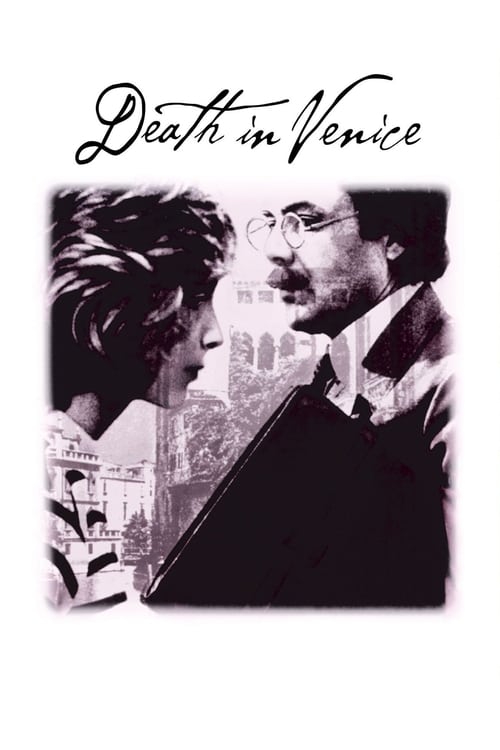
Death in Venice
1971 · Luchino Visconti
For when you want to surrender to something beautiful and melancholy — a patient, heavy, contemplative evening, not a comfort watch. Best when you're in the mood to feel time slow down.
What it's about
Gustav von Aschenbach, an aging German composer, comes to Venice to recover his health and checks into a grand hotel on the Lido. There he becomes transfixed by Tadzio, a Polish teenager of almost unreal beauty staying with his family — an obsession he can neither act on nor renounce. Meanwhile rumors of a cholera epidemic creep through the city, and the authorities keep smiling and denying everything.
The experience
Slow, ravishing, and suffocating — long wordless stretches of watching, set against Mahler on the soundtrack and a Venice that is both gorgeous and sickly. It's less a story than a mood of longing and decay that settles over you and doesn't lift.
Performances
Dirk Bogarde carries the film almost silently as Aschenbach; with barely any dialogue he charts a man's entire unraveling through posture, glances, and a face fighting to stay composed.
The craft
Visconti stages it with overwhelming opulence — the hotel dining rooms, the beach, the fog on the lagoon — with a camera that drifts and zooms like a wandering gaze. Mahler's music is so fused to the images that the film permanently changed how people hear it. This one genuinely deserves a big screen and good speakers.
Why it matters
The centerpiece of Visconti's late period and one of cinema's most famous literary adaptations; its pairing of Mahler with Venice became a cultural touchstone far beyond the film itself.
Snapshot
Death in Venice (Morte a Venezia) is Luchino Visconti's adaptation of Thomas Mann's 1912 novella, a slow, ravishing study of an aging artist undone by his contemplation of an unattainable beauty. Gustav von Aschenbach, here a composer rather than Mann's writer, arrives at the Grand Hôtel des Bains on the Venetian Lido to recover his health and instead becomes fixated on Tadzio, an adolescent Polish boy of almost abstract loveliness. As a cholera epidemic spreads through the city — concealed by authorities anxious to protect the tourist season — Aschenbach declines to flee, surrendering to an obsession he can neither act on nor renounce, and dies in a deckchair on the beach as the boy wades into the shimmering Adriatic. The film is the centerpiece of Visconti's late "German trilogy," and one of the most sustained attempts in narrative cinema to render the experience of contemplation itself: beauty, mortality, decadence, and the cost of the artist's pursuit of perfection.
Industry & production
The film was produced by Visconti's own Alfa Cinematografica in association with Warner Bros., which handled international distribution — a co-financing arrangement typical of European prestige cinema at the turn of the 1970s, when American majors funded the "auteur" projects of established European directors. Visconti, an aristocrat by birth and a Marxist by conviction, occupied a singular position: a director of grand, expensive literary spectacle who could command international stars and lavish period reconstruction. Death in Venice followed The Damned (1969), which Warner had also been involved with, and the studio's continued backing reflected both Visconti's prestige and the commercial hope attached to a handsome adaptation of a canonical text.
The production reconstructed Belle Époque Venice circa 1911, shooting on the Lido at the Hotel des Bains — the actual hotel Mann had stayed in and fictionalized — and across recognizable Venetian locations. Costuming and the painstaking re-creation of period dress and interiors were central to the budget and to Visconti's method; the casting search for Tadzio became part of the film's lore. Visconti and his collaborators auditioned boys across Europe before settling on the fifteen-year-old Swedish actor Björn Andrésen, whose appearance prompted the director's much-quoted superlatives about his beauty. The pressures of that casting and the exploitation Andrésen experienced as a result were revisited, far more critically, in the 2021 documentary The Most Beautiful Boy in the World.
Technology
Death in Venice was shot on 35mm color film in a standard widescreen format, and its technological signature lies less in novelty than in the expressive use of long-focal-length lenses. Visconti and cinematographer Pasqualino De Santis made the telephoto zoom a primary instrument of meaning. The slow optical zoom — pushing in on Aschenbach's face or on Tadzio across the hotel dining room — was a relatively recent staple of late-1960s and 1970s cinema, and here it becomes the very grammar of obsessive looking: the camera reaches across space the protagonist cannot cross. Long lenses also compress the planes of the Lido and the hotel, flattening figures into the decorative tableau Aschenbach perceives. The film's lush, slightly desaturated palette — sea-mist grays, whites, and the gilded interiors — depended on careful color control in cinematography and processing rather than on any new capture technology.
Technique
Cinematography
Pasqualino De Santis's photography is among the film's most celebrated achievements; it was honored at the British Academy Film Awards. The visual scheme is built on diffusion, haze, and the milky luminance of the lagoon, lending the whole film an atmosphere of dissolution that mirrors both Aschenbach's physical decline and the unseen plague. De Santis favors long takes and slow, gliding camera movements over cutting; the recurrent zooms enact desire as optics. Compositionally the film is painterly, arranging figures in friezes on the beach and in the hotel's salons, recalling late-nineteenth-century genre painting and Pre-Raphaelite stillness. The light is consistently soft and northern despite the southern setting, reinforcing the German-Austrian sensibility transplanted to Italy.
Editing
Ruggero Mastroianni, Visconti's regular editor and one of Italian cinema's finest, cut the film to a deliberately unhurried rhythm. Editing here works against conventional dramatic economy: scenes are held past the point of narrative necessity so that duration itself becomes expressive of stasis and yearning. The principal structural intervention is the interpolation of flashbacks — to Aschenbach's life, his marriage and the death of his child, a humiliating concert failure, and, crucially, philosophical arguments with his friend Alfried about the nature of beauty and art. These memory sequences, absent from Mann's largely interiorized novella, are woven into the present-tense action, giving the film a counterpoint structure between Venice and the past.
Mise-en-scène / staging
Visconti was the supreme metteur en scène of decor, and Death in Venice is staged as a procession of meticulously appointed spaces: the hotel lobby and dining room thick with potted palms, mirrors, and overdressed guests; the beach with its row of cabanas and parasols; the labyrinthine, fetid alleys of the plague city. The famous costume and production design, with Piero Tosi's costumes especially admired, are not mere backdrop but the substance of a dying world's surfaces. Staging emphasizes separation and the geometry of looking — Aschenbach always at a remove, watching from a deckchair, a café table, a gondola. The recurring image of Tadzio framed against sea and sky, often turning to return Aschenbach's gaze, organizes the entire mise-en-scène around the dynamics of the look.
Sound
The film's sound world is dominated by music. Visconti drew on the symphonies of Gustav Mahler — above all the Adagietto from the Fifth Symphony, which functions as Aschenbach's leitmotif and accompanies the film's most rapturous and most mournful passages, and the choral "O Mensch! Gib Acht!" setting from the Third Symphony. The decision to make Aschenbach a composer rather than a writer, and to model him visibly on Mahler, fused the borrowed score to the protagonist's identity in a way few literary adaptations attempt. Beyond the music, the soundtrack is sparse and atmospheric — the wash of the sea, the murmur of the hotel, the disinfectant-laden silences of the stricken city — with dialogue used sparingly. The film was shot and post-synchronized in the Italian tradition, with an international cast performing largely in English.
Performance
Dirk Bogarde's Aschenbach is the film's anchor and one of the landmark performances of European art cinema. Working with minimal dialogue, Bogarde conveys an entire inner collapse through posture, restraint, and the eventual grotesquerie of the dyed hair and rouged face with which Aschenbach pathetically tries to recapture youth — makeup that runs in the heat as he dies. His performance is built on suppression: the agony of feeling that cannot be spoken or enacted. Björn Andrésen's Tadzio is deliberately a near-silent presence, an object of contemplation more than a character, though his occasional returned glances introduce an unsettling reciprocity. Silvana Mangano, as Tadzio's elegant, watchful mother, lends the family scenes their patrician chill. Mark Burns plays Alfried in the flashback debates.
Narrative & dramatic mode
The film operates in a contemplative, anti-dramatic mode. Its "plot" is minimal — an arrival, a fixation, a refusal to leave, a death — and conflict is internalized almost entirely. Visconti externalizes some of Mann's interior philosophizing through the Alfried flashbacks, which stage as dialogue the novella's debate (itself derived from Plato's Phaedrus and Nietzschean aesthetics) over whether beauty is reached through the spirit or the senses, and whether the artist can possess beauty without being destroyed by it. The present-tense narrative proceeds by accumulation and repetition rather than causation: the same beach, the same glances, the same music returning. This durational structure asks the viewer to inhabit Aschenbach's suspended, obsessive temporality. The result is a film that resists the conventions of dramatic progression in favor of mood, decline, and elegy.
Genre & cycle
Death in Venice belongs to the genre of the prestige literary adaptation and, more specifically, to the European art-film tradition of the late 1960s and 1970s, with its tolerance for slowness, ambiguity, and aestheticism. Within Visconti's own work it forms the middle panel of the loosely defined "German trilogy," flanked by The Damned (1969), about a German industrial dynasty's corruption under Nazism, and Ludwig (1973), on the mad Bavarian king — three films preoccupied with decadence, the decline of an old order, and the entanglement of beauty with death. It also extends Visconti's lifelong cycle of films about doomed aristocracies and historical twilight, from Senso (1954) through The Leopard (1963).
Authorship & method
Visconti adapted the novella with Nicola Badalucco, his co-writer on The Damned. The most consequential authorial decisions were the transformation of Aschenbach from writer to composer and his modeling on Mahler — a move that has a basis in Mann's own creative process, since Mann had drawn on Mahler's appearance and death for the character. This allowed Visconti to make Mahler's music the film's emotional engine and to graft onto Mann's text additional material, including the Alfried debates that echo Mann's later novel Doctor Faustus. Visconti's method was that of total environmental reconstruction: he and his long-standing collaborators built a complete, inhabitable period world. The key creative partnership extended to cinematographer Pasqualino De Santis, editor Ruggero Mastroianni, costume designer Piero Tosi, and production designer Ferdinando Scarfiotti, whose contributions defined the film's surfaces as decisively as Visconti's direction. The "score" was not composed but curated — an act of musical authorship through selection.
Movement / national cinema
The film is a product of Italian cinema at the height of its international auteurist prestige, yet its sensibility is profoundly Mittel-European, looking to German literature and Austrian music rather than to Italian neorealism, the movement in which Visconti himself had been a founding figure with Ossessione (1943) and La terra trema (1948). By 1971 Visconti's trajectory had carried him far from neorealism's documentary austerity toward operatic literary spectacle, and Death in Venice exemplifies the "calligraphic," decorative strain of Italian filmmaking concerned with style, history, and high culture. As an international co-production with English-language dialogue and a transnational cast, it also reflects the increasingly borderless production economy of European prestige cinema in the period.
Era / period
Made in 1971, the film arrived at the close of cinema's great modernist decade, when art films could still command serious budgets and wide critical attention. Its subject, however, is the Europe of 1911 — the long Edwardian-Belle Époque afternoon just before the First World War, a civilization of leisure, propriety, and unacknowledged rot. The cholera that authorities suppress to protect commerce serves as a figure for that hidden decay, and the film's elegiac tone reads the prewar moment as a doomed idyll. Made six decades after its setting and a decade before the director's own death, Death in Venice is doubly a meditation on endings.
Themes
At its center is the conflict, inherited from Mann via Plato and Nietzsche, between Apollonian discipline and Dionysian surrender — the artist who has subordinated life to form, ambushed by a beauty that overthrows his self-control. Beauty and death are inseparable: Tadzio is repeatedly associated with images of mortality, and the contemplation of the ideal proves fatal. The film examines the artist's relationship to his material — whether beauty can be approached chastely through art or only through the dangerous senses — and stages this as Aschenbach's tragedy. Other persistent themes include decadence and the decline of a bourgeois-aristocratic order, the corruption beneath civilized surfaces (the plague, the bribes, the running dye), aging and the indignity of desire, and the dynamics of the gaze. The question of the homoerotic — desire fixed on an adolescent — has made the film a perennial and contested object of analysis, read variously as sublimated Platonic idealism and as something more troubling.
Reception, canon & influence
Death in Venice premiered in 1971 and received the 25th Anniversary Prize at the Cannes Film Festival. Critical reception was strong if not unanimous: admirers praised its visual splendor, Bogarde's performance, and its courage in pursuing a near-plotless contemplative mode, while detractors found it static, airless, or excessively aestheticized — the recurring charge that the film mistook beauty of surface for depth of feeling. It was a notable success at the British Academy Film Awards, where it won several craft honors including cinematography, art direction, costume, and soundtrack, and Piero Tosi's costumes were recognized with an Academy Award nomination. (Precise contemporary box-office figures are not something I can state reliably and will not invent.)
The influences on the film run backward through a deep cultural lineage: Mann's novella first of all, and behind it the Platonic Phaedrus, Nietzsche's Birth of Tragedy, and the broader fin-de-siècle aesthetic of beauty-and-death; Mahler's music, made structurally integral; and Visconti's own prior work on aristocratic decline. Looking forward, the film's most immediate cultural effect was a revival of interest in Mahler, and especially in the Adagietto of the Fifth Symphony, which the film helped install in popular consciousness as a byword for elegiac longing. Within film history its legacy lies in its validation of an extreme contemplative aesthetic — the long held look, duration as meaning, beauty rendered with such patience that it borders on stasis — an approach that resonates through later "slow cinema" and through any film that organizes itself around the act of looking at an unattainable object. It remains a touchstone in queer film studies and in writing on the gaze, and a defining example of the literary art film at its most opulent and most austere. The afterlife of its production — particularly the experience of Björn Andrésen — has more recently become its own subject, reframing the film's pursuit of ideal beauty as a story with a human cost.
A Deleuzian reading
He never crosses the room.
The full Deleuzian reading of Death in Venice →
Reception
Divisive at Cannes '71 — some found it ravishing, others found it inert kitsch — and it settled into the canon as peak late-Visconti; but the 2021 documentary about its young star, The Most Beautiful Boy in the World, has reframed how a whole generation now approaches it.
How Death in Venice was received, from release to now →
Influences: the films it descends from and the films it influenced
- Senso (1954) — Visconti's first feature in color establishes his method of operatic period reconstruction in which painterly tableau and decaying aristocratic interiors carry the drama, the visual template Death in Venice austerely refines.
- The Leopard (1963) — The forty-minute ballroom finale pioneers Visconti's durational editing — letting an event play in near-real time so that aristocratic decline is felt as the slow exhaustion of duration itself, the rhythm Death in Venice extends to a whole film.
- The Damned (1969) — Co-written with Nicola Badalucco (who returns for Death in Venice), it builds the immersive decadence-decline aesthetic and the inserted ideological 'debate' scenes that reappear as the Alfried flashbacks.
- The Earrings of Madame de... (1953) — Ophüls's belle-époque world organized around objects of looking and circulating glances — the camera's continuous, mannered attention to a beautiful surface — is the gaze-architecture Visconti inherits and freezes into stasis.
- L'Avventura (1960) — Antonioni's 'dead time' — holding on figures after the dramatic beat has passed, with performance suppressed to opacity — is the contemplative durational grammar Death in Venice adopts wholesale.
- Barry Lyndon (1975) — Kubrick's signature slow zoom-out from a face to reveal a painterly composition, plus durational candlelit tableaux animating period painting, extends Visconti's telephoto-haze and tableau staging into prestige literary adaptation.
- The Last Emperor (1987) — Scarfiotti's production design again renders imperial decline as opulent enclosure, carrying Visconti's lineage of beauty-as-decay forward through the same designer's hand.
- Mirror (1975) — Tarkovsky's long held takes and flashback-interpolation of memory, where duration itself becomes meaning rather than plot delivery, advance the contemplative-mode Death in Venice validated.
- Mother and Son (1997) — Sokurov pushes the diffusion-haze further with distorting anamorphic glass and painterly filters, building entire compositions around watching a beloved figure decline — Visconti's beauty-and-death rendered as moving canvas.
- Werckmeister Harmonies (2000) — Tarr's extreme long takes scored to a single recurring elegiac theme institutionalize the 'slow cinema' aesthetic of duration-as-meaning that Death in Venice prefigured.
- Goodbye, Dragon Inn (2003) — Tsai's static held frames organized around furtive looking at an unattainable object, with dialogue stripped and performance reduced to presence, descend directly from the film's geometry-of-looking and suppression.
- The House of Mirth (2000) — Davies adapts a literary tale of social decline through painterly tableau and a curated classical score, pursuing the same opulent-yet-austere prestige-literary mode Visconti defined.
- A Single Man (2009) — Ford restages the aestheticized contemplation of beauty-and-death around an aging man's gaze at idealized youth, with a suppressed Colin Firth performance directly echoing Bogarde's Aschenbach.
- Call Me by Your Name (2017) — Guadagnino's Italian-summer choreography of longing — the durational gaze at an unattainable object of beauty, scored as elegiac rather than narrated — is a contemporary heir to the Venice-beach looking.
- Portrait of a Lady on Fire (2019) — Sciamma builds the entire film on the geometry-of-looking — the exchange of glances at a beautiful, unreachable subject composed as living painting — extending Visconti's gaze-and-tableau craft into the cinema of the gaze.
- TÁR (2022) — Visconti's use of Mahler's Adagietto as an ironic frame for an aging aesthete's self-destruction is TÁR's primary intertext: both films deploy classical music as simultaneously the medium of the protagonist's identity and the evidence of his aestheticized moral failure, and Field's Mahler-conducting conceit is a direct transposition of the Aschenbach figure.
- Don't Look Now (1973) — Released two years earlier, it fixed Venice as a decaying mortuary labyrinth, the city-as-death iconography Roeg's location work inherits and weaponizes.
- 2001: A Space Odyssey (1968) — Kubrick's needle-drop of pre-existing classical works (Strauss, Ligeti) as the film's structural emotional engine models the 'curated score,' which Visconti applies to Mahler's Adagietto as authorship-by-selection.
- The Conformist (1970) — Shares production designer Ferdinando Scarfiotti, whose period-decadent surfaces define both films; Bertolucci independently develops the geometry-of-looking through doorways and framed glances Visconti deploys on the Venice beach.
- Satyricon (1969) — Pasqualino De Santis's use of long telephoto lenses holding Bogarde static against slowly moving Venice crowds achieves the same frieze-quality spectatorship — viewer observing rather than accompanying — that Rotunno cultivates throughout Satyricon; historical period made alien through aestheticized stillness rather than dramatic action.
- Caravaggio (1986) — Visconti's slow, pictorially composed tableaux fusing an artist's decline with art-and-decadence prefigure Caravaggio's static painterly compositions and theme of art-and-money.
- A Special Day (1977) — Another De Santis collaboration whose elegiac desaturated period palette and slow, watchful camera define the muted historical-chamber visual language Scola inherits from the same DP.
Similar films
- The Leopard (1963) — influence & lineage
- Senso (1954) — influence & lineage
- L'Avventura (1960) — influence & lineage
- Call Me by Your Name (2017) — influence & lineage
- White Nights (1957) — shared sensibility
- Nostalgia (1983) — shared sensibility
- Rocco and His Brothers (1960) — shared sensibility
- The Great Beauty (2013) — shared sensibility
All the films related to Death in Venice →