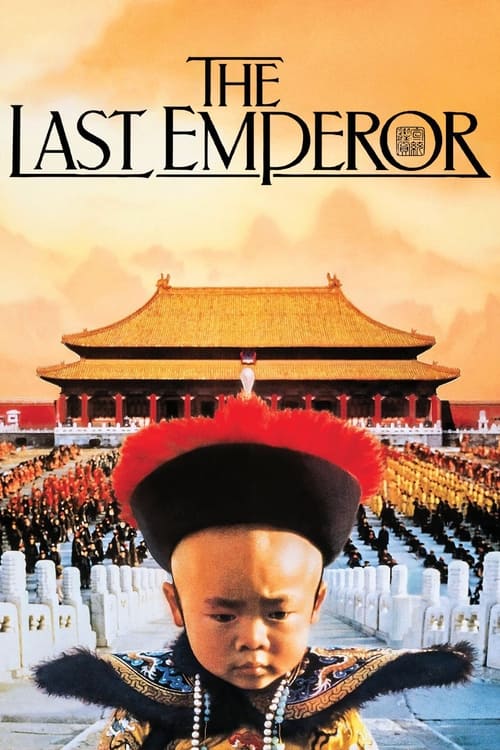
The Last Emperor
1987 · Bernardo Bertolucci
For a night when you want to be swept somewhere vast and strange — a lush, patient epic to surrender an entire evening to. It rewards attention rather than demanding energy: challenging in length, comforting in beauty.
What it's about
A boy of three is carried into the Forbidden City and crowned Emperor of China, worshipped by half a billion people yet forbidden to walk out the gate. The film follows Pu Yi across six decades — his gilded, imprisoned childhood, his abdication, his exploitation by the invading Japanese, and his final years as an ordinary worker in Mao's People's Republic — told through his memories as an aging prisoner undergoing re-education.
The experience
Stately and immersive, it moves like a slow tide: you sink into ravishing color and ceremony while a quiet melancholy builds underneath. It's less a rush of events than the long ache of watching a man live his whole life inside walls other people built for him.
Performances
John Lone charts Pu Yi from arrogant young monarch to humbled old man with remarkable restraint, and Peter O'Toole brings dry warmth as the emperor's Scottish tutor.
The craft
Bertolucci shot inside the actual Forbidden City — the first Western production allowed to — and it shows in every frame: thousands of extras, saturated golds and reds, and Vittorio Storaro's cinematography that shifts color with each era of Pu Yi's life. The Sakamoto–Byrne–Su score is haunting. This one genuinely demands the biggest screen you can find.
Why it matters
It swept all nine Academy Awards it was nominated for, including Best Picture, and stands as one of the defining prestige epics of the 1980s and the peak of Bertolucci's international career.
Snapshot
Bernardo Bertolucci's The Last Emperor is among the most formally ambitious historical epics in cinema: a non-linear portrait of Aisin-Gioro Pu Yi, who ascended to the Dragon Throne at three years old in 1908 and died in 1967 as an unremarkable citizen of the People's Republic of China. The film spans six decades of Chinese history — the dying Qing dynasty, the warlord republic, Japanese-occupied Manchukuo, and Maoist re-education — and does so with a visual grandeur inseparable from its moral argument. Shot partly inside the Forbidden City, the first Western production granted such access, The Last Emperor won all nine Academy Awards for which it was nominated, including Best Picture and Best Director. It stands as the summation of Bertolucci's mature period and one of the defining prestige films of the 1980s — a work that made world-historical scale feel intimate.
Industry & production
The film was produced by Jeremy Thomas, whose Recorded Picture Company co-produced with the Chinese state film apparatus — an arrangement that granted access to the Forbidden City and its courtyards, corridors, and ceremonial spaces in exchange for participation and approval. This collaboration was unprecedented: no Western crew had been permitted to film inside the imperial palace complex. The production also drew on Chinese crew members and, reportedly, tens of thousands of extras organized through official channels, figures that gave crowd sequences a documentary weight that no studio backlot could have simulated.
Financing came from a consortium including Hemdale Film Corporation and Italian backers, with a budget widely reported in the range of $25 million — substantial for the period. The logistical scale required months of preparation and coordination with Chinese authorities. Locations extended beyond Beijing to include Manchuria (representing the Manchukuo sequences), as well as studios in the United Kingdom and Italy for controlled interior work. The production effectively became a geopolitical event as well as a filmmaking one, a fact Bertolucci was conscious of; his longstanding leftist politics gave him a complicated admiration for the Chinese revolution even as the film scrutinizes its mechanisms of power over the individual.
Technology
The Last Emperor was shot in anamorphic 35mm, yielding the 2.39:1 widescreen aspect ratio that cinematographer Vittorio Storaro used to compose images in which Pu Yi is perpetually dwarfed by architectural or institutional frames. The anamorphic format allowed Storaro to exploit the full breadth of Forbidden City spaces while keeping faces legible within the same image — a technical choice with direct thematic consequence.
The production made extensive use of large-format Panavision optics and, for certain outdoor sequences, employed filtered natural light supplemented by massive artificial sources to maintain color temperature consistency across the enormous exterior spaces. The period before digital color grading meant all tonal work was photochemical — Storaro's precise calibration of color temperature, filter choice, and stock selection was embedded in the negative itself. Storaro developed his theories of "Chromatics" — the idea that specific color temperatures carry specific emotional and narrative meanings — and The Last Emperor is among the fullest realizations of that system.
Technique
Cinematography
Storaro constructs a color grammar in which historical epoch is rendered as temperature. The sequences set within the Forbidden City during Pu Yi's childhood and early reign are suffused in amber, gold, and deep ochre — the chromatic signature of imperial China, but also of warmth, confinement, and unreality. As the film progresses into the republican period, Manchukuo, and eventually the 1950s Communist re-education camp at Fushun, the palette cools: blue-grays dominate the prison sequences, while the Manchukuo years carry a peculiar artificial brightness — incandescent interior light that reads simultaneously as modernity and falsehood.
The camera's relationship to the child Pu Yi is one of the film's formal revelations. Bertolucci and Storaro frequently place the camera at the child's eye level within spaces designed for adult ceremony, so that the gigantic becomes visible through a perspective that cannot comprehend it. Conversely, the adult Pu Yi is often shot from angles that reinstate the grandeur his adult understanding has demystified. The Forbidden City's corridors and courtyards are used as mise-en-scène in themselves, with Storaro finding geometries of perspective that recede to vanishing points the emperor can never reach.
Editing
Gabriella Cristiani won the Academy Award for film editing, and her work on The Last Emperor is a sustained exercise in temporal counterpoint. The film's architecture is built on nested flashback: it opens in 1950, with Pu Yi's arrival as a prisoner of war and his interrogation by a Communist Party functionary, then moves in long dissolves back to 1908 and the child emperor's investiture. The past illuminates the present and vice versa; editorial rhythm controls the emotional pressure of each juxtaposition. Cristiani's cuts between time periods are rarely sharp — dissolves and slow fades soften chronological seams in a way that mirrors Pu Yi's own unreliable self-narration. The film asks us to understand a man's life retrospectively, and the editing insists on that retrospective quality in every transition.
Mise-en-scène / staging
Bertolucci stages crowd and ceremony with a theatrical rigor descended from Visconti. The investiture sequence, in which the tiny Pu Yi is set upon his throne while thousands of courtiers kowtow in a sea that extends to the horizon, is one of cinema's great images of institutional power — and it is achieved through straightforward staging and composition rather than optical trickery. Throughout the film, architecture does the ideological work: the Forbidden City's walls that prevent exit as much as entrance; the prison compound's walls that enforce re-entry into Chinese history; the Manchukuo palace's Western furnishings that signal puppet-state inauthenticity.
Bertolucci's handling of the child performers — three boys play Pu Yi at different young ages — is notably patient. The child emperor's confusion, boredom, and loneliness are rendered through observation rather than direction toward conventional acting. The film's most affecting early images are behavioral: the child grasping at the sleeve of a departing mother, a beetle cupped in small hands, a cricket in a box that returns decades later.
Sound
The sound design calibrates silence to power: the hush of the Forbidden City is a controlled absence, the silence of a space from which ordinary sound has been evacuated. Crowd noise in the investiture and departure sequences is used as physical pressure rather than background texture. The Fushun re-education scenes are acoustically spare — interrogation-room reverb, distant institutional sounds — in deliberate contrast to the sonic plenitude of the imperial sequences.
The score was composed collaboratively by Ryuichi Sakamoto, David Byrne, and Cong Su — an unusual arrangement that reflected both the film's international production context and a deliberate aesthetic ambition. Sakamoto handled most of the orchestral and traditional Chinese-influenced material; Byrne contributed textures that slide between ethnographic pastiche and postmodern irony (most audible in the Manchukuo sequences); Su provided traditional Chinese musical elements. The score won the Academy Award and remains influential for its synthesis of East Asian tonality with Western orchestral and ambient forms.
Performance
John Lone carries the adult Pu Yi across three decades of screen time, navigating the film's core challenge: rendering a man whose interiority was systematically suppressed by his circumstance. Lone's performance is characterized by a physical reticence — a stillness appropriate to a figure who was always watched — broken in moments of genuine bewilderment or, occasionally, rage. Peter O'Toole as Reginald Johnston, the Scottish tutor who served the real Pu Yi, brings the film's only consistent wit and warmth; his scenes with the young emperor function as The Last Emperor's most conventional character drama. Joan Chen as Wan Rong, the Empress, traces an arc from composed aristocrat to opium-addicted figurehead with an economy that the script's elliptical treatment of her story requires. Ying Ruocheng plays the re-education camp commandant with authority and even grace — one of the film's deliberate gestures toward complexity in its portrait of the Communist state.
Narrative & dramatic mode
The film adopts a frame-narrative structure in which the 1950s interrogation sequences serve as the film's present tense, with Pu Yi's life rendered as a series of extended flashbacks — his testimony, in effect, though the film does not literalize this as voiceover. The narrative mode is retrospective and elegiac rather than teleological: we know the end of Pu Yi's story before we understand it. Bertolucci is interested not in suspense but in the accumulation of historical irony — the way each phase of Pu Yi's life is prepared by forces he cannot see and concluded by forces he cannot resist. The film's structural metaphor is the puppet: Pu Yi is used by the Qing court, the warlords, the Japanese, and finally the Communist Party's re-education apparatus, and Bertolucci stages each phase of manipulation with similar formal clarity.
Genre & cycle
The Last Emperor belongs to the prestige historical epic, a genre experiencing a significant revival in the mid-to-late 1980s: Gandhi (1982), A Passage to India (1984), Out of Africa (1985), and The Mission (1986) had re-established epic biography as a viable awards-circuit form. These films shared certain features — a Western perspective on non-Western history or landscape, large-scale production values, literary ambitions, and a tendency toward the politically liberal. The Last Emperor participates in this cycle while complicating it: Bertolucci's Marxist framework means the film's sympathy for Pu Yi coexists with a structural endorsement of the forces that unmade him. It is among the most critically self-aware films in the cycle.
Authorship & method
Bertolucci's career from the late 1960s through The Last Emperor constitutes one of European art cinema's sustained engagements with the question of how individual psychology and political history are mutually constituting. The Conformist (1970) and 1900 (1976) explored fascism through psychoanalytic and Marxist lenses respectively; Last Tango in Paris (1972) submitted the private self to the same scrutiny. The Last Emperor extends this project to a subject whose self has been evacuated by institution from childhood — a case where the psychoanalytic and the political are not in tension but in complete alignment. The screenplay, written by Mark Peploe with Bertolucci (and based on Pu Yi's autobiography From Emperor to Citizen), preserves the source text's strange flatness — Pu Yi's own account of his life is notably unself-pitying and unself-aware — and the film turns that flatness into method.
Storaro has been Bertolucci's primary visual collaborator across many of his major works, and their partnership on The Last Emperor represents the fullest expression of Storaro's color-grammar system at narrative scale. Gabriella Cristiani, who also edited several of Bertolucci's subsequent films, shaped the film's temporal architecture. The score's collaborative structure — Sakamoto, Byrne, Su — reflects Bertolucci's interest in productive friction between artistic sensibilities.
Movement / national cinema
The Last Emperor sits at the intersection of multiple national cinemas without belonging fully to any. It is an Italian director's film, financed partly with Italian capital, made within a Chinese state co-production framework, with a British producer, a cast mixing Western and Chinese actors, and post-production completed in Europe. It is neither Italian cinema nor Chinese cinema nor British cinema, but a product of the internationalized prestige production model that European directors of Bertolucci's generation helped develop. Insofar as it anticipates a Chinese cinema opening to international co-production, it belongs to a transitional moment. The film predates the Fifth Generation's international breakthrough — Zhang Yimou's Red Sorghum was released the same year — but participates in the same historical opening of China to global cultural exchange.
Era / period
The film appears at the peak of the 1980s prestige epic cycle and reflects that era's investment in world-historical grandeur as an antidote to what critics perceived as Hollywood's blockbuster infantilism. It also reflects a specific political moment: China under Deng Xiaoping was cautiously opening to Western economic and cultural engagement, and Bertolucci's access to the Forbidden City was a consequence of that opening. The film's political ambivalence — its sympathy for Pu Yi alongside its structural validation of the Communist state's reformative project — is characteristic of a leftist European intellectual's complicated relationship to actually-existing socialism in the 1980s.
Themes
Power as environment: the film's persistent argument is that Pu Yi never exercised real power and yet was shaped entirely by proximity to it. The Forbidden City is not a seat of authority but a gilded cage; the Manchukuo throne room is a stage set managed by Japanese handlers; even the re-education camp operates on a logic of managed performance. Every institution that claims to act on Pu Yi's behalf uses him.
Identity under erasure: Pu Yi's self — whatever it might have been — is systematically overwritten by imperial ceremonial, then by the performance of modernity demanded by Johnston's tutorship, then by Japanese imperial requirements, then by Communist re-education. The film asks what, if anything, survives. Its provisional answer is located in the cricket in the box: a small private object, a residue.
The individual and history: Bertolucci's Marxist training makes The Last Emperor a film about impersonal forces operating through individual lives. Pu Yi's tragedy is not personal failure but structural position.
East-West encounter: the film is attentive to the way Western figures (Johnston, the Western advisors at Manchukuo) understand themselves as liberating or modernizing forces while functioning as agents of a different kind of imposition.
Reception, canon & influence
The Last Emperor was the dominant film of the 1988 Academy Awards ceremony, winning all nine awards for which it was nominated — a result matched by very few films in Academy history. Critical reception was largely positive, with attention concentrated on Storaro's cinematography, the production's historical ambition, and Bertolucci's direction. Some critics noted the film's emotional distance from its subject — a quality that, depending on the reviewer, read as austere control or as a failure of human warmth. Roger Ebert awarded it four stars and placed it among the essential films of the decade.
Looking backward, The Last Emperor draws on Visconti's historical epics — particularly The Leopard (1963) and Ludwig (1972) — in its method of tracing aristocratic decline through environment and ritual rather than psychological confrontation. David Lean's large-format epics (Lawrence of Arabia, Doctor Zhivago) are visible precedents for the formal treatment of scale and landscape. Bertolucci's own 1900 established the template for the politically conscious epic in his filmography.
Looking forward, the film's influence operates on several registers. Its unprecedented Forbidden City access helped establish the viability of large-scale Sino-Western co-productions, a model that would recur, with varying results, across the following decades. Storaro's color-grammar approach has been widely influential on subsequent cinematographers working in large-scale historical subjects. The film also helped rehabilitate the prestige historical biography as a form for serious filmmakers — demonstrating that scale and critical ambition were not incompatible. Its status in the canon is secure if somewhat unchallenged: it is taught as a primary text in courses on 1980s world cinema, on historical epic as a genre, and on Bertolucci's filmography, and it remains one of the most technically assured productions of its era.
A Deleuzian reading
A small boy is handed a cricket in a wicker cage.
The full Deleuzian reading of The Last Emperor →
Reception
It swept the 1988 Oscars — nine nominations, nine wins, including Picture and Director — yet today it's often filed under 'least-revisited Best Picture winners': hugely admired when seen, just not seen enough.
How The Last Emperor was received, from release to now →
Influences: the films it descends from and the films it influenced
- The Spider's Stratagem (1970) — The first sustained Bertolucci–Storaro collaboration, establishing nested temporal investigation in which past and present overlap without editorial clarity — the prototype for TLE's retrospective frame structure and ambiguous self-narration.
- The Conformist (1970) — Storaro's foundational articulation of color-temperature-as-psychology — cool Parisian blues indexing fascist conformity, warm Roman ochres signaling buried desire — the direct prototype for TLE's system of epoch-as-color-temperature.
- Senso (1954) — Visconti's Risorgimento melodrama codified the Italian prestige historical epic's grammar: Technicolor as political emotion, dissolves between time registers, and a protagonist whose capitulation to institutional power is staged as theatrical self-betrayal — Bertolucci's explicit formal inheritance.
- The Leopard (1963) — Visconti's Technicolor anamorphic prestige epic stages the aristocrat-as-epoch figure against ceremony that overwhelms individual agency; the ball sequence's spatial choreography of crowd and collapse directly anticipates TLE's investiture staging and its argument that ceremony enacts ideology.
- Novecento (1976) — Bertolucci and Storaro's anamorphic rehearsal of the multi-decade Marxist historical epic, tracing class history across fifty years with the same retrospective architecture and crowd-staging logistics that TLE would transpose to Chinese imperial decline.
- Apocalypse Now (1979) — Storaro developed and demonstrated his Chromatics theory here — jungle greens surrendering to the infernal amber-orange of Kurtz's compound — winning the Oscar and establishing the anamorphic color-temperature architecture TLE would deploy as explicit historical grammar.
- Barry Lyndon (1975) — Kubrick's photochemical rigor — candlelight interiors rendered in period-accurate color temperature via NASA-derived lenses — established color grading as historical argument and retrospective ironic narration as a device for exposing a protagonist's self-delusion, both directly absorbed by TLE.
- The Man Who Would Be King (1975) — Bertolucci's durbar and coronation pageantry staging — a man installed as divine ruler who will be deposed by history — inherits Huston's formal vocabulary for depicting ceremonial power as simultaneously comic and imposing; Vittorio Storaro's chromatic trajectory from warm imperial gold to cold institutional gray mirrors Morris's ochre-to-ash movement as power collapses.
- Kagemusha (1980) — Vittorio Storaro's color taxonomy — imperial yellow as spatial confinement, gray-blue as historical diminishment — absorbs Kagemusha's method of using hue to map hierarchical space and track the temporal arc of power's vacancy across a single life.
- Doctor Zhivago (1965) — Bertolucci/Storaro epic of a private individual helplessly swept by twentieth-century revolution, structured around a retrospective frame and composed-for-format pageantry.
- Death in Venice (1971) — Scarfiotti's production design again renders imperial decline as opulent enclosure, carrying Visconti's lineage of beauty-as-decay forward through the same designer's hand.
- Reds (1981) — A Storaro-shot historical epic about a figure swept up and finally discarded by revolution, applying the same color dramaturgy to the losing side of history that Reds champions.
- Little Buddha (1993) — Bertolucci and Storaro directly transpose TLE's chromatics system: the 6th-century Siddhartha flashbacks are saturated in warm amber and ochre while contemporary Seattle runs in cool desaturated blue, applying epoch-as-color-temperature as explicit structural logic rather than atmospheric accumulation.
- The English Patient (1996) — Minghella constructs TLE's nested flashback architecture — present interrogation unlocking past — with dissolves as the primary temporal suture; John Seale's color temperature differentiates the two time streams, inheriting Storaro's grammar of chromatic differentiation between historical registers.
- Kundun (1997) — Scorsese and Roger Deakins adopt TLE's formal device of child-ruler-in-ceremony — staging the young Dalai Lama at eye level within architectural grandeur that dwarfs him — while color temperature shifts from monastery amber to cold modern gray to mark Chinese occupation as an epochal rupture, directly in TLE's chromatic idiom.
- In the Mood for Love (2000) — Wong Kar-wai and Christopher Doyle deploy warm amber and cool blue color temperature as the chromatic signature of memory and repression, while Maggie Cheung and Tony Leung's physical reticence — desire expressed through posture and proximity, never statement — extends TLE's method of rendering interiority through corporeal restraint rather than dialogue.
- Hero (2002) — Zhang Yimou and Christopher Doyle systematize TLE's chromatics-as-structure into explicit codification: each flashback version of the assassination plot is rendered in a different dominant color (red, blue, green, white), converting what Storaro used as atmospheric epoch-grammar into overt narrative architecture.
- Atonement (2007) — Wright and cinematographer Seamus McGarvey use the dissolve as TLE does — as a marker of temporal boundary and epistemic instability — where retrospective reordering of events through dissolve-edits makes memory itself the formal argument, and the country-house architecture encodes the class ideology the narrator is too compromised to name.
- Crouching Tiger, Hidden Dragon (2000) — Sakamoto and Byrne's East-West hybrid orchestral score for an international China co-production established the model Tan Dun refines: Chinese melodic material embedded in Western symphonic infrastructure, with a foregrounded Western solo voice (cello displacing synthesizer).
- Indochine (1992) — Models the individual-life-mapped-onto-national-rupture structure via framed flashback, with location shooting in authentic Asian sites and sumptuous Storaro-style color that Indochine reproduces.
- Memoirs of a Geisha (2005) — Storaro's filtered light raking through screens and curtains over a constructed/located Asian period grandeur, plus an all-Asian cast performing in English, is the direct template for Memoirs' light-through-obstruction interiors and English-language-constraint casting.
- Farewell My Concubine (1993) — A transnational co-production that spans 20th-century Chinese history via a single figure's memory under political re-education, using a framing/flashback device and lavish period reconstruction that Concubine's bookended structure echoes.
- To Live (1994) — It set the template of a single private life swept through the full arc of 20th-century Chinese political upheaval — the 'individual across Maoist history' epic To Live compresses to one household.
- Kokuho (2025) — Bertolucci's decade-skipping ellipsis binding one life to a closed ceremonial institution across mid-century national upheaval models Kokuho's editing compression of a 1964-to-2010s epic without losing the immersive institutional world.
- Gandhi (1982) — Attenborough's international co-production secured Indian government location access and military logistics for crowd scenes at documentary scale — the same production model Jeremy Thomas deployed to gain unprecedented access to the Forbidden City and its thousands of state-organized extras.
- Ran (1985) — Kurosawa and cinematographer Takao Saito use color-coded army regiments as structural visual markers within anamorphic widescreen compositions, staging feudal ceremony and its violent dissolution with the same deliberate theatricality Bertolucci and Storaro apply to Qing court ritual.
- The Remains of the Day (1993) — Ivory's Stevens is TLE's Pu Yi in an English country house: physical reticence encoding political complicity, a retrospective self-narration that only partly comprehends its own subject, and architecture — Darlington Hall's formal rooms — functioning as the ideological prison its occupant mistakes for vocation.
- Love Is the Devil: Study for a Portrait of Francis Bacon (1998) — Sakamoto's mournful orchestral elegy framing a life as foreknown loss, the scoring approach he carries into Maybury's film.
- The Name of the Rose (1986) — A Europudding co-production that, like Name of the Rose, achieved prestige through on-site physical reconstruction and exhaustive period research rather than studio fakery.
- Out of Africa (1985) — The other late-80s imperial-nostalgia prestige epic that swept the technical Oscars on the strength of lush location/interior contrast and distributed top-tier craft authorship.
- Empire of the Sun (1987) — Storaro's anamorphic intimate-epic of a vanishing colonial Asia, with threshold-and-enclosure staging of a protagonist imprisoned by history — released the same year on parallel craft.
- The Music Room (1958) — The elegiac decline of a feudal-imperial figure within gilded, progressively emptying interiors, the space itself measuring lost authority — a descendant of the last-patron-in-his-ruined-hall image.
Similar films
- 1900 (1976) — influence & lineage
- The Leopard (1963) — influence & lineage
- Ran (1985) — influence & lineage
- The English Patient (1996) — influence & lineage
- Farewell My Concubine (1993) — shared sensibility
- Last Tango in Paris (1972) — shared sensibility
- Raise the Red Lantern (1991) — shared sensibility
- The Conformist (1971) — shared sensibility
All the films related to The Last Emperor →