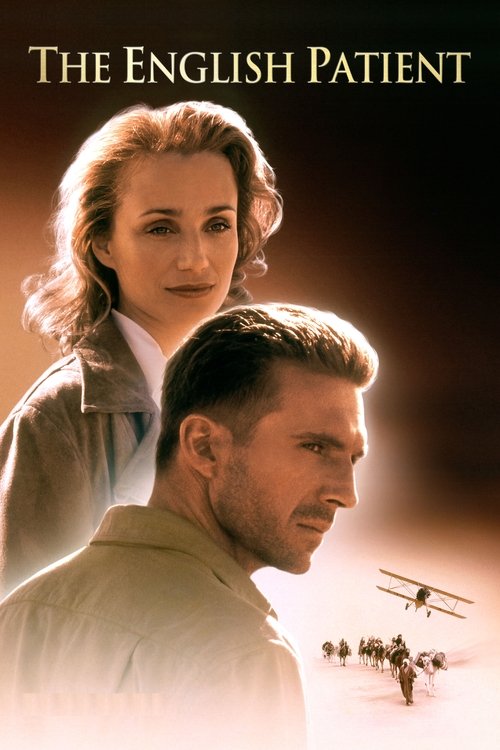
The English Patient
1996 · Anthony Minghella
For the night you want to be swept away — a grand, doomed romance to sink into with the lights off, ideally when you're in the mood for a good cry. It's a long, immersive commitment, not background viewing.
What it's about
In the last days of World War II, a young nurse withdraws to a ruined Tuscan monastery to care for a nameless patient burned beyond recognition in a plane crash. As she tends him, his memory drifts back to the 1930s Sahara, where a reserved Hungarian mapmaker charting the desert fell into a consuming affair with a married Englishwoman on the expedition. The two timelines circle each other — a love story, a war story, and a mystery about who this ruined man really is and what his passions cost.
The experience
Sweeping and unhurried, it moves like memory itself — sensual desert idylls giving way to wartime grief and back again. It's a swooning, aching watch that earns its tears; give it your full attention and it repays you with a genuine emotional avalanche.
Performances
Ralph Fiennes plays the mapmaker as a locked room slowly forced open, and Kristin Scott Thomas matches him with wit and devastating restraint. Juliette Binoche won an Oscar for the nurse Hana, whose battered tenderness gives the film its beating heart.
The craft
John Seale's cinematography turns the Sahara into rippling, body-like dunes, Gabriel Yared's score aches in the best way, and the editing weaves two timelines so fluidly that a spinning aircraft can dissolve into folds of fabric. This is exactly the kind of film built for the biggest screen and best speakers you can find.
Why it matters
It swept nine Oscars including Best Picture and crowned the 1990s wave of literary prestige epics, making Anthony Minghella a major director and setting the template — and the punchline — for the grand adaptation ever since.
Snapshot
The English Patient is the second feature directed by Anthony Minghella and the work that crowned the 1990s vogue for the literary prestige epic. Adapted from Michael Ondaatje's Booker Prize–winning 1992 novel, it braids two timelines: a frame set in the closing days of the Second World War, in which a French-Canadian nurse, Hana (Juliette Binoche), tends a faceless, near-mummified burn victim in an abandoned Tuscan monastery; and an extended flashback to the 1930s Sahara, where the Hungarian-born cartographer Count László de Almásy (Ralph Fiennes) charts the desert for the Royal Geographical Society and falls into a destroying love affair with Katharine Clifton (Kristin Scott Thomas), the wife of a fellow expedition member. Out of these strands the film constructs a meditation on memory, nationhood, possession, and the cost of desire. It became a critical and commercial sensation, winning nine Academy Awards from twelve nominations — including Best Picture and Best Director — and stands as a high-water mark of the Miramax-driven awards era. Its reputation has since cooled into something more contested: admired for its craft and ambition, occasionally derided (the Seinfeld episode in which Elaine cannot stand it is now part of its cultural footprint) for a stateliness that some find airless.
Industry & production
The film's production history is itself a parable of 1990s independent financing. Producer Saul Zaentz — the veteran behind One Flew Over the Cuckoo's Nest and Amadeus — championed Ondaatje's difficult, time-fractured novel and engaged Minghella to adapt and direct. Twentieth Century Fox initially backed the project but withdrew shortly before production, reportedly over casting: the studio pressed for a more bankable female lead (the much-repeated account is that they wanted a bigger name than Kristin Scott Thomas, and pushed for Demi Moore), and balked at the cost of a period desert epic with no guaranteed star wattage. Harvey Weinstein's Miramax stepped in to finance the film — on a budget generally reported in the region of $27 million — preserving Minghella's preferred cast. The episode became a touchstone in trade lore for the proposition that "difficult" prestige material could be both protected and profitably campaigned by a savvy independent. Whether that lesson was healthy for the industry is a separate question; the subsequent decade of aggressive Oscar campaigning owes a real debt to this film's success. Principal photography ranged across Tunisia for the Saharan sequences and Italy — Tuscany, Pienza, and Rome — for the monastery frame and the Cairo and Italian-front material. The film opened in late 1996 and went on to dominate the 69th Academy Awards in March 1997.
Technology
The English Patient occupies a genuine place in the technological history of postproduction: it is widely cited as the first film edited on a digital nonlinear system — the Avid — to win the Academy Award for Film Editing. Walter Murch, already a totemic figure in American postproduction, cut the picture digitally at a moment when many editors still regarded the Avid with suspicion, and his win helped legitimize nonlinear editing as a tool for serious, large-scale narrative work rather than merely a convenience. On the image side the film is resolutely photochemical — shot on 35mm anamorphic stock to render the desert in widescreen — and its technology is otherwise that of the classical epic rather than the digital frontier: real locations, large units, practical period dressing. The historical significance is concentrated in the cutting room, where Murch's embrace of the new platform coincided with one of the more intricate editorial problems of the decade.
Technique
Cinematography
John Seale's Oscar-winning photography is the film's most immediately seductive element. Seale shoots the Sahara as an abstraction as much as a place — dunes rendered as bodies, wind-rippled sand echoing the curve of a back or the fold of a sheet, the famous overhead of the swimming-cave paintings and the long aerial passages of the biplane over the desert floor. The visual rhyme between the desert and the human form is deliberate and sustained: skin, fabric, and sand are lit and graded to converse with one another, so that the geography of the body and the geography of the map become a single subject. Against this the monastery frame is cooler, more enclosed, candlelit and shadowed, its palette of ochre and stone deliberately muted so that the desert flashbacks bloom by contrast. Seale's compositions favor the horizon and the wide, patient frame characteristic of the Lean tradition the film consciously inherits.
Editing
Walter Murch's editing is, with the score, the film's structural achievement, and his contribution was doubly honored: he won the Academy Award for Film Editing and shared the Award for Sound, an unusual double for a single picture. Ondaatje's novel is radically non-linear, and the central craft problem was to make a dual-timeline structure — a dying man's fragmented memory triggered by sensory association — legible and emotionally cumulative without collapsing into either confusion or tidy flashback convention. Murch threads the two periods through associative cuts (an object, a sound, a gesture in the present summoning the past), building toward revelations that the audience assembles gradually. The collaboration was close enough that Ondaatje and Murch later turned their conversations into a book on the art of editing, The Conversations (2002) — a rare instance of a film's postproduction generating its own literature.
Mise-en-scène / staging
Stuart Craig's production design and Ann Roth's costumes — both Oscar-winners — anchor the film's two worlds. The villa is staged as a ruin reclaimed: frescoed walls, rubble, improvised domesticity, a space of convalescence and suspended time. The desert expeditions are dressed with period explorer's materiel — instruments, maps, vintage aircraft and vehicles — that lends the 1930s strand a tactile authenticity. Minghella stages the romance against grand spaces (the cave, the desert camp, a Cairo of colonial expatriate society) so that intimacy is repeatedly framed by vastness, reinforcing the theme of small human transgressions set against impersonal landscape and history.
Sound
The sound work, also Oscar-recognized, is integral to the film's associative method. Because the structure depends on sensory triggers carrying us between timelines, sound bridges and aural motifs do much of the narrative labor — wind, the drone of the biplane, footsteps in the stone villa, the textures of fire and water. Murch, who is as celebrated a sound designer as he is an editor, treats sound and picture as a single continuous design problem, and the seamlessness of the time transitions is as much an achievement of the soundtrack as of the cut.
Performance
Ralph Fiennes carries the film across two physical registers: the elegant, guarded, faintly arrogant cartographer of the flashbacks, and the immobilized, disfigured patient of the frame, where he must act largely through voice and the suggestion of a ruined face. Kristin Scott Thomas gives Katharine an intelligence and reserve that complicate the romance, keeping it from sentimentality. Juliette Binoche won the Academy Award for Best Supporting Actress as Hana, whose tenderness and grief in the present timeline give the film its moral center; her parallel romance with the Sikh sapper Kip (Naveen Andrews) opens a counter-melody about war, race, and care. Willem Dafoe as the maimed, vengeful Caravaggio and Colin Firth as the cuckolded Geoffrey Clifton round out an ensemble pitched to restraint rather than display.
Narrative & dramatic mode
The film's dramatic mode is the memory-epic: a present-tense deathbed frame from which a past is excavated in fragments. The engine is dramatic irony and gradual disclosure — we know from the first frames that the affair ends in catastrophe and that the patient is destroyed, and the film's suspense lies less in what happened than in how and at what moral cost. Almásy's betrayals — personal and, devastatingly, political, when his desperation to reach the dying Katharine leads him to trade maps to the Germans — are revealed late, recasting the romance retroactively as something culpable. The dual structure lets the two timelines comment on one another: the present's themes of nursing, forgiveness, and the tending of broken bodies answer the past's themes of conquest, mapping, and possession.
Genre & cycle
The English Patient belongs to the lineage of the David Lean desert/romance epic — Lawrence of Arabia, Doctor Zhivago — explicitly invoked through scale, landscape, and the figure of the European undone by a foreign vastness. It also sits within the 1980s–90s cycle of upmarket literary adaptation (the Merchant Ivory films, the heritage picture) while pushing beyond that cycle's drawing-room horizons into open landscape and graphic eroticism. Within Minghella's own work it forms part of a loose trilogy of adaptations exploring desire, guilt, and displacement, continued in The Talented Mr. Ripley (1999) and Cold Mountain (2003). Its commercial and awards success arguably defined a sub-genre for the rest of the decade: the handsomely mounted, Miramax-shepherded, awards-targeted adult romance.
Authorship & method
The film is the product of an unusually tight creative collective gathered around Minghella and Zaentz. Minghella — a playwright by training — wrote the screenplay himself, performing a substantial structural rethinking of Ondaatje's elliptical prose; he was nominated for Best Adapted Screenplay (losing to Sling Blade) though he won as director. His method was collaborative and literary, working closely with Ondaatje, who remained an active presence through editing. The key collaborators recur across his career and define the film's signature: cinematographer John Seale; composer Gabriel Yared, whose score is inseparable from the film's emotional architecture; editor and sound designer Walter Murch; designer Stuart Craig; and costumer Ann Roth. Yared's music leans on Bach (the Goldberg-era keyboard sensibility, a recurring aria) and, most memorably, on Hungarian folk song — the vocalist Márta Sebestyén's rendition of a Hungarian lament recurs as Almásy's leitmotif, tying the score to the protagonist's erased nationality. The authorship here is genuinely distributed: this is a director's film in vision but a craft-ensemble's film in execution, which the Academy recognized by spreading nine awards across its departments.
Movement / national cinema
The film resists tidy national assignment, which is fitting for a work obsessed with the dissolution of borders. It is, in pedigree, British — a British director and writer, British and Commonwealth talent — but it is American-financed (Miramax), shot in Tunisia and Italy, drawn from a Sri Lankan-born Canadian's novel, and concerned with a Hungarian who longs to belong to no nation at all. It is best understood as a product of 1990s transnational prestige cinema: international co-production capital, "British" cultural cachet, and Hollywood-scale distribution and marketing fused into a single object. It is adjacent to the British heritage film without being confined by it, and it marks the moment when independent-prestige distribution learned to compete with the studios on the studios' own awards terrain.
Era / period
The film is a 1990s work set across the 1930s and the Second World War, and both its historical setting and its moment of production matter. Its 1930s desert is the world of the real interwar explorers — the protagonist is loosely modeled on the historical László Almásy, a Hungarian aviator and desert explorer associated with the discovery of prehistoric cave art in the Gilf Kebir and, in fact, with later wartime service to German intelligence in North Africa. The film romanticizes and softens this record considerably, and it is honest to say the relationship between the screen Almásy and the historical one is loose; the film is a fiction inspired by a real biography, not a biopic. As a 1996 release it belongs to the late-century apex of the adult prestige drama, before the franchise era narrowed the commercial space such films occupied.
Themes
The governing themes are mapping and erasure, possession and its renunciation, and the tension between the nation and the human. Almásy is a cartographer who dreams of a desert without ownership, "a place without maps," yet his love for Katharine is fiercely possessive — he wants to own her even as he professes to despise borders, and the contradiction destroys them both. Names and nationality recur as instruments of both belonging and betrayal: the patient's deliberate namelessness, the question of who counts as "English," and the deadly consequence of a man whose statelessness makes him legible to no army and trustworthy to none. The frame timeline counterposes these with care, forgiveness, and the tending of damaged bodies — Hana's nursing, Kip's defusing of bombs — so that the film sets the erotics of conquest against the ethics of repair. Fire and water, the desert and the body, the map and the skin: the imagery insists throughout that the personal and the geopolitical are written on the same surface.
Reception, canon & influence
On release the film was met with strong critical admiration and major commercial success, sweeping the 1997 Academy Awards with nine wins — Picture, Director, Supporting Actress, Cinematography, Editing, Original Dramatic Score, Art Direction, Costume Design, and Sound — alongside multiple BAFTA and Golden Globe honors. It became, for a season, the definitional prestige film. Its influences run backward to David Lean's epics and to the European art-cinema tradition of fractured memory (the deathbed-recollection structure has a Proustian, even Citizen Kane–like inheritance), and to the heritage adaptation's faith in literature as a source of cinematic seriousness. Forward, its legacy is double-edged. It confirmed a commercial model — the independently financed, lavishly campaigned adult literary epic — that shaped Oscar seasons for a decade and underwrote Minghella's own subsequent films. It advanced the technological legitimacy of nonlinear editing through Murch's landmark win. And it entered popular culture as a byword for the tasteful, sweeping, slightly exhausting prestige movie — a status crystallized by its mockery on Seinfeld within a year of release, which is itself a backhanded measure of how thoroughly the film had saturated the culture. Critical opinion since has divided between those who see a richly crafted, emotionally serious epic and those who find it handsome but cold; that very argument has kept it alive in the canon as a representative — and a test case — of what the 1990s meant by a "great" film.
A Deleuzian reading
A biplane crosses the Sahara and the dunes below are not quite dunes.
The full Deleuzian reading of The English Patient →
Reception
It swept the 1997 Oscars with nine wins including Best Picture, then spent two decades as shorthand for stuffy prestige bait — the film Fargo lost to. Lately it's been getting a genuine reappraisal as a swooning, grown-up epic Hollywood no longer makes.
How The English Patient was received, from release to now →
Influences: the films it descends from and the films it influenced
- Lawrence of Arabia (1962) — The anamorphic desert grammar Minghella and Seale adopt — a lone human figure scaled against vast dune horizons, the body-in-landscape rhyme — descends directly from Lean and Freddie Young's wide-screen staging of intimacy against emptiness.
- Doctor Zhivago (1965) — Establishes the template the film inherits: a doomed adulterous romance framed as recollection and set against historical cataclysm, the literary epic that treats a love affair as the lens for an entire era's collapse.
- Citizen Kane (1941) — The deathbed/retrospective architecture — reconstructing a vanished man's life from fragmentary testimony and flashback rather than chronology — is the Wellesian inheritance the dual-timeline structure formalizes.
- Hiroshima mon amour (1959) — Pioneers the associative cut between present caress and remembered wartime trauma, the editing logic — memory triggered by sensory rhyme rather than plot — that governs Murch's transitions between Cairo and the Italian villa.
- The Conversation (1974) — Walter Murch's foundational work in subjective, layered sound design — using aural texture and motif to render interior states — is the method he carries forward into the film's leitmotif-driven soundscape.
- Apocalypse Now (1979) — Murch's montage of sound bridges and his practice of cutting picture to a musical/aural through-line (the 'aural motif bridge') is refined here before becoming the connective tissue of the desert-to-villa transitions.
- The Unbearable Lightness of Being (1988) — Murch edited this adaptation, working the same problem — braiding eros and political history across a fractured European timeline from elliptical literary prose — that he and Minghella solve again in the Avid suite.
- Out of Africa (1985) — Defines the commercial model the film perfects: the lavishly mounted literary-memoir romance in colonial Africa, with aerial landscape photography and a sweeping score as engines of Oscar-season prestige.
- Howards End (1992) — The heritage-film faith in canonical literature as the guarantor of cinematic seriousness — meticulous period design (Stuart Craig–style) serving a prestige adaptation — is the immediate tradition the film both joins and eclipses.
- The Last Emperor (1987) — Models the personal-history epic that interrogates a man's erased identity through a present-tense frame (interrogation/confinement) cross-cut with an opulent sweeping past — the dual-timeline as a structure of national self-erasure.
- Casablanca (1943) — Minghella transplants Casablanca's formal architecture into the prestige art film: wartime North African setting, amnesia-driven flashback structure as romantic memory counterpoint to a brutal present, John Seale's soft-diffusion photography of Kristin Scott Thomas as a female lead whose interiority is structurally withheld, and a sacrifice arc in which erotic attachment overrides political obligation — here ending not in redemption but catastrophe.
- Gandhi (1982) — Walter Murch's editing deploys cross-temporal dissolves to collapse personal memory against historical catastrophe — cutting between the desert past and the Italian hospital present — extending Gandhi's cross-decade dissolve grammar as both a narrative compression tool and an emotional device for registering time's passage as accumulated loss.
- Cold Mountain (2003) — Murch again edits and sound-designs a literary romance split between a war front and a remembered idyll, extending the associative cross-cutting between separated lovers and the aural-motif bridging into another epic.
- Atonement (2007) — Inherits the dual-timeline wartime romance built on dramatic-irony disclosure — a late revelation retroactively reframing the love story — pairing it with a heritage-prestige surface and a leitmotif-driven score.
- The Hours (2002) — Extends the associative-cut, multi-timeline literary-prestige form, using sound and gesture rhymes to suture three eras into one emotional argument the way the film sutures past and present.
- The Reader (2008) — Carries forward the adult literary-epic model — a love affair reconstructed across a dual timeline whose meaning turns on a withheld, late-disclosed secret about a character's hidden past.
- The Imitation Game (2014) — Minghella's three-strand temporal crosscutting uses a stratified color palette — amber wartime past, cooled present, intermediate register — to differentiate narrative layers, the specific chromatic and structural strategy Tyldum adopts for his wartime/Bletchley/1951 tripartite.
- Touch (2024) — Dual-timeline construction that cross-cuts a wartime love affair against a dying man's present recollection, using mortality as the frame that gates memory retrieval — Touch's structural architecture.
- The Talented Mr. Ripley (1999) — Minghella reassembles the identical craft ensemble — Seale's camera, Yared's score, Roth's costumes, Craig's design, Murch's cut — proving the film was an authored craft-collective signature, not a one-off.
- The Thin Red Line (1998) — Shares the staging of intimacy against vastness and the memory-voiceover register — private interior recollection floating over wartime landscape photography — as a rival 1990s mode of the lyrical war epic.
- The Cider House Rules (1999) — Miramax's flagship prestige literary adaptation, defining the operating template Cider House follows — lush cinematography, multi-craft Oscar nominations, and a dense novel surgically compressed for the screen.
Similar films
- Lawrence of Arabia (1962) — influence & lineage
- Out of Africa (1985) — influence & lineage
- The Last Emperor (1987) — influence & lineage
- Atonement (2007) — influence & lineage
- The Hours (2002) — influence & lineage
- Doctor Zhivago (1965) — influence & lineage
- Howards End (1992) — influence & lineage
- The Conversation (1974) — influence & lineage · often watched together
All the films related to The English Patient →