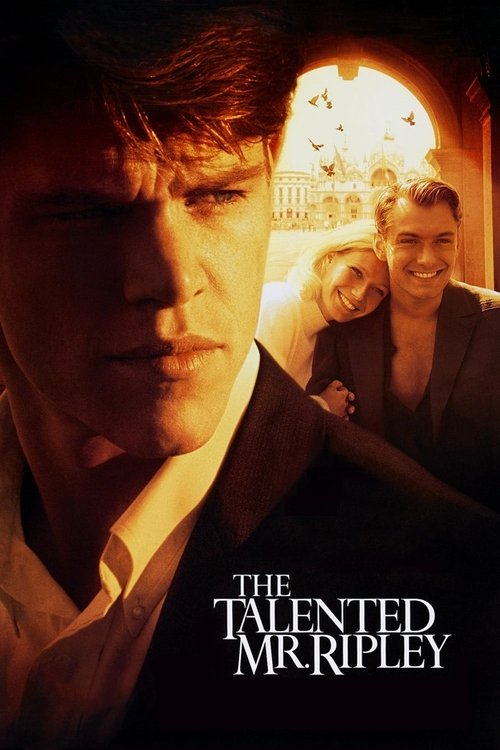
The Talented Mr. Ripley
1999 · Anthony Minghella
For when you want a gorgeous, grown-up thriller to sink into — a slow-burn evening where suspense comes from watching a liar improvise, not from jump scares. Comfort on the surface, moral vertigo underneath.
What it's about
A broke young New Yorker with a gift for imitation is sent to seaside Italy to fetch a shipping heir who won't come home. Instead of retrieving Dickie Greenleaf, Tom Ripley falls into his orbit — the boats, the jazz, the girlfriend, the sun-soaked carelessness of money — and begins to want that life so badly he starts rehearsing it. What begins as a summer of borrowed glamour slides into deception, and deception into something much darker.
The experience
Seductive first, suffocating later — it lets you luxuriate in the Mediterranean light before tightening a knot of dread that never quite lets go. You catch yourself rooting for someone you shouldn't, and squirming every time a lie threatens to unravel.
Performances
Matt Damon weaponizes his own likability, making Tom's neediness both pitiable and chilling; Jude Law is magnetic as Dickie, all golden charm with a cruel edge, in a career-making turn; Philip Seymour Hoffman steals scenes as a smug socialite who sees through everything.
The craft
Minghella shoots late-1950s Italy like a place you'd kill to stay in — coastal villages, Rome, Venice, all tailored linen and warm stone — while the script builds suspense out of near-misses and overlapping identities rather than action. Jazz runs through the film like a second language of longing. It's a lush, big-screen object that plays like a chamber piece.
Why it matters
The definitive screen version of Patricia Highsmith's most famous creation, it set the template for the prestige literary thriller and gave several of its young cast their breakout moment; Ripley's blend of envy, desire, and self-invention has haunted crime storytelling since.
Snapshot
Anthony Minghella's The Talented Mr. Ripley is a lavish, psychologically dense adaptation of Patricia Highsmith's 1955 novel, arriving three years after Minghella's Oscar-winning The English Patient and carrying the same prestige apparatus into darker, more ambivalent territory. It follows Tom Ripley (Matt Damon), a déclassé young New Yorker dispatched to late-1950s Italy by a shipping magnate to retrieve his wayward son Dickie Greenleaf (Jude Law). Tom's fascination with Dickie's golden, careless life curdles into obsession, and a sun-drenched idyll on the Mediterranean gives way to impersonation, murder, and an ever-deepening masquerade. The film is at once a glossy travelogue, a queer tragedy of desire and self-erasure, and a study of class envy in which the central crime is less homicide than the theft of an identity. It stands among the most intelligent literary adaptations of its decade — beautiful, mournful, and morally cold at its center.
Industry & production
The film was a major studio-prestige collaboration, produced by Paramount Pictures and Miramax, with Mirage Enterprises (Sydney Pollack and the late producer-team around Minghella's circle) and producers William Horberg and Tom Sternberg attached. It was conceived as Minghella's follow-up to The English Patient (1996), which had won nine Academy Awards including Best Picture and Best Director, and the new project inherited both the goodwill and the elevated budget that success afforded. Much of the creative crew carried over from The English Patient, making Ripley something close to a repertory production: cinematographer John Seale, composer Gabriel Yared, editor Walter Murch, and costume designer Ann Roth all returned.
Casting reflected a transitional moment in American and British stardom. Matt Damon, fresh from his Good Will Hunting breakthrough, was cast against type as the watchful, ingratiating Ripley; Jude Law's incandescent turn as Dickie effectively launched him as an international leading man; Gwyneth Paltrow, then at the height of her post-Shakespeare in Love visibility, played Dickie's fiancée Marge Sherwood. The ensemble also included Cate Blanchett as Meredith Logue — a character invented for the film and absent from Highsmith's novel — Philip Seymour Hoffman as the braying socialite Freddie Miles, Jack Davenport as Peter Smith-Kingsley, and James Rebhorn as the elder Greenleaf.
Production was mounted on location in Italy, lending the film an authenticity of place that was central to its appeal. Filming took place in and around Rome, Naples, the Amalfi/Procida coast (standing in for the fictional resort town of Mongibello), Venice, and elsewhere, with interiors at Cinecittà and Rome studios. Released in December 1999 to position it for awards season, the film performed respectably at the box office and was a critical success, though it did not match the commercial heights of The English Patient; precise grosses should be checked against trade sources rather than asserted here. It earned five Academy Award nominations — including Jude Law for Best Supporting Actor and Minghella for Best Adapted Screenplay — and Law won the BAFTA Award for Best Supporting Actor, though the film converted few of its nominations into wins.
Technology
The Talented Mr. Ripley was made with the mature tools of late-1990s prestige cinema rather than any technological novelty. It was shot photochemically on 35mm film and finished by traditional means; its ambitions lie in classical craft — composition, period reconstruction, performance — not in digital innovation. This places it deliberately apart from the effects-driven blockbuster culture of its release year (1999, the year of The Matrix and the digital-cinema conversations that surrounded it). What technological sophistication the film displays is logistical: large-scale location shooting across multiple Italian cities, the period dressing of public spaces, and the integration of live and recorded music. The film's "technology," in other words, is the apparatus of period verisimilitude — wardrobe, set decoration, and the controlled use of natural Mediterranean light — rather than any tool that announces itself.
Technique
Cinematography
John Seale's photography is fundamental to the film's seductive surface and its undertow of dread. The Italian exteriors are rendered in warm, saturated daylight — the bleached gold of the coast, the blue of the sea, the sun on white linen — so that paradise is fully sold before it is corrupted. As the narrative darkens, Seale tightens the palette and the framing: interiors grow shadowed and enclosed, Venetian and Roman scenes turn wintry and gray, and Tom is increasingly boxed by architecture, doorways, and mirrors. The camera is attentive to surfaces and reflections, a motif that literalizes Ripley's doubling and his perpetual self-surveillance. Seale's work earns the comparison to a Highsmith sentence: lucid and elegant on the surface, with menace pooling underneath.
Editing
Walter Murch — one of the most distinguished editors and sound designers in American cinema — cut the film, and his sensibility shapes its rhythm. The early Mediterranean passages are languid and unhurried, immersing the viewer in the same intoxication that captures Tom; the violence, when it comes (notably the boat sequence at San Remo), is handled with a brutal, almost clumsy realism rather than action-style fluency, emphasizing how unplanned and panicked these killings are. Thereafter the editing tracks Ripley's mounting logistical anxiety — the near-misses, the juggling of two identities — building suspense through the accumulation of small risks. Murch's restraint keeps the film from melodrama; tension is generated by what is withheld and by the lengthening silences.
Mise-en-scène / staging
The film's design is a study in class as spectacle. Roy Walker's production design and Ann Roth and Gary Jones's costumes construct two visual registers: Dickie's effortless, slightly rumpled wealth versus Tom's careful, acquisitive imitation of it. Clothing, eyewear, luggage, jewelry, and rings function as plot objects and as markers of belonging; Tom's progress is charted partly through his wardrobe as he learns to dress, smoke, and lounge like the people he envies. Staging repeatedly places Tom as observer — at the edge of frames, behind glass, watching Dickie and Marge — establishing his outsider's hunger before any crime occurs. Mirrors, photographs, and the physical apparatus of impersonation (signatures, rings, typewriters) recur as the visual grammar of a self under construction.
Sound
Music is so prominent that it nearly qualifies as a character. Jazz is Dickie's idiom and his world, and the film uses it both diegetically and as a marker of the bohemian, improvisatory life Tom can ape but never authentically inhabit. The celebrated nightclub set piece built around "Tu Vuò Fà l'Americano" — with Dickie and Tom performing — fuses the film's themes of American self-invention and mimicry into a single bravura number, while standards like "My Funny Valentine" recur as motifs of longing. The sound design contrasts the open acoustic of the coast with the close, echoing interiors of the later acts. Murch's ear for sound (he is credited among the era's great sound artists) is felt in the precision of these contrasts.
Performance
The acting is the film's deepest achievement. Matt Damon plays Ripley as a study in opacity and need — soft-spoken, watchful, his charm always faintly effortful, his violence shocking precisely because the surface stays placid. Jude Law's Dickie is the necessary counterweight: radiant, cruel, capricious, and so magnetic that the audience shares Tom's infatuation, which makes Law's mid-film exit destabilizing. Gwyneth Paltrow gives Marge a grief that sharpens into the film's moral clarity; she alone seems to see Tom truly. Philip Seymour Hoffman's Freddie Miles is a small masterclass in aristocratic contempt, his suspicion a constant threat. Cate Blanchett's invented Meredith adds a thread of social entrapment in the closing movement. The performances collectively dramatize the film's thesis that identity is something performed — and that some performers are more gifted, and more dangerous, than others.
Narrative & dramatic mode
The film operates as a slow-burn psychological thriller braided with tragedy. Its dramatic engine is not whodunit suspense but the Highsmithian dread of will he be caught — the audience is bound to the criminal's point of view and made complicit in his survival. Minghella's adaptation reorganizes the novel's structure around Tom's interiority and his desire, foregrounding the homoerotic charge that Highsmith kept more oblique and that the 1960 French adaptation suppressed. The mode is elegiac as much as suspenseful: the film mourns the self Tom destroys (Dickie) and the self he can never safely be. Its ending — colder and more solitary than earlier versions — closes on isolation rather than triumph, framing Ripley's "success" as a sentence of perpetual concealment.
Genre & cycle
Ripley belongs to several overlapping traditions. It is a literary-prestige adaptation in the late-1990s Miramax mold — handsome, awards-targeted, drawn from canonical fiction. It is a psychological crime thriller in the Highsmith lineage, where the criminal is the protagonist and morality is ambient rather than enforced. And it participates in a cycle of glossy, period-set, identity-and-class thrillers and queer-inflected dramas at the turn of the millennium. It also sits within the long tradition of the "American abroad" narrative — the innocent or the striver loosed in Europe — that runs from Henry James through Highsmith, here inverted so that the American is the predator who consumes the Europeanized expatriate dream.
Authorship & method
Minghella's authorship is defined by literary fidelity married to a strong directorial point of view: like The English Patient and his later Cold Mountain, Ripley is an adaptation of a respected novel rendered with painterly visual care, deep attention to performance, and a willingness to restructure source material around emotional and thematic emphasis. As his own screenwriter, Minghella made the decisive interpretive choices — amplifying Tom's queerness and loneliness, inventing Meredith, and bending the ending toward tragedy. His method is collaborative and recurring: the reunion of Seale, Yared, and Murch gave the film a consistent house style of lush image, melodic score, and unhurried cutting. Gabriel Yared's score and the jazz program are inseparable from the film's meaning, encoding the gap between authentic feeling and performed identity; John Seale's camera supplies the seductive surface; Walter Murch's editing and sound sense supply the dread. The result is a clear example of director-led authorship achieved through a trusted, returning ensemble of craftspeople.
Movement / national cinema
The film is a transatlantic, studio-financed production rather than a product of any national movement — American money and a largely Anglo-American cast and crew, shot in Italy and steeped in the imagery of postwar European leisure. It is best understood within Anglophone prestige cinema of the 1990s, particularly the Miramax-driven wave of literary adaptations. Its Italian settings are evocative backdrop and thematic resource (the expatriate fantasy of la dolce vita–era Italy) rather than evidence of participation in Italian national cinema; if anything, it consciously trades on an idealized, tourist's vision of late-1950s Italy as a stage for American self-reinvention.
Era / period
Set in the late 1950s, the film reconstructs the period with great specificity — the fashions, the jazz culture, the transatlantic shipping wealth, the American expatriate scene on the Italian coast. The period is not merely decorative: it situates the story in a moment of postwar American affluence and mobility, when a certain class of young Americans could decamp to Europe to live on inheritance and idleness, and when queerness remained necessarily clandestine. That historical closet is essential to the film's tragedy; Tom's desire and his criminality are entangled with the impossibility of living openly. Made in 1999, the film also reflects its own moment's renewed fascination with mid-century style and with stories of self-invention and surface.
Themes
The film's governing themes are identity, class, and desire. Tom Ripley embodies the conviction — stated early — that it is "better to be a fake somebody than a real nobody," and the film anatomizes the cost of that creed: to become someone else, he must annihilate both his rivals and himself. Envy and aspiration are rendered as forms of love, and love as a form of theft. Queer desire runs through the whole, treated as both the engine of Tom's longing and a source of shame he can never escape. Performance and authenticity recur insistently — in the music, in the impersonations, in the forged signatures — until the question of who anyone "really" is dissolves. Loneliness is the film's final note: the masquerade succeeds, and the self it protects is left utterly alone.
Reception, canon & influence
The film was warmly received on release, praised for its craft, its performances (Law's especially), and its intelligent, melancholy reworking of Highsmith; it drew five Academy Award nominations and a BAFTA win for Jude Law, cementing its standing as a high point of turn-of-the-millennium literary adaptation. Some contemporary debate concerned its length, its chilliness, and the audience's enforced identification with a murderer — the very qualities that have aided its critical durability.
Its lines of influence run backward and forward. Backward, the most direct sources are Patricia Highsmith's novel and the broader Ripley series, along with the earlier screen adaptation, René Clément's Plein Soleil (Purple Noon, 1960), starring Alain Delon, against which Minghella's version is inevitably measured — Minghella's film is generally read as more faithful to Highsmith's interiority and far more explicit about Tom's queerness and his survival, where Clément imposed a punitive ending. Behind both lies the Jamesian tradition of the American in Europe and the noir/crime tradition of the sympathetic criminal. Forward, the film helped sustain and shape an ongoing screen appetite for Highsmith and for Ripley specifically, a lineage extending to later adaptations of her work and, most recently, to renewed Ripley screen treatments; it remains a touchstone for stylish, identity-driven thrillers and for the depiction of class envy and queer longing. Within the careers it touched it was pivotal — a defining showcase for Jude Law and a key, deglamorized role for Matt Damon — and it endures as one of the most admired examples of how a literary thriller can be transmuted into serious, ravishing, morally unsettled cinema.
A Deleuzian reading
There is a nightclub in Naples where Dickie sits in behind the drums and the band kicks into "Tu Vuò Fà l'Americano," and Tom — sweating, thrilled, a little sick with it — gets pulled up to the microphone to sing.
The full Deleuzian reading of The Talented Mr. Ripley →
Reception
A prestige hit in its day — five Oscar nominations and mostly strong reviews, though some found it a chilly follow-up to The English Patient — it's since climbed into full-blown beloved status, rediscovered by a generation as the ultimate sun-drenched Italian-summer film and a queer cinema touchstone.
How The Talented Mr. Ripley was received, from release to now →
Influences: the films it descends from and the films it influenced
- Plein Soleil (Purple Noon) (1960) — The direct prior Ripley adaptation: establishes the sun-drenched Mediterranean surface and the criminal-POV identification with Tom that Minghella inherits, then deliberately reverses by withholding Clément's punitive moralizing ending.
- Strangers on a Train (1951) — Founds the Highsmith screen grammar of the seductive, casually amoral charmer who implicates a passive double in murder, the model of complicity-through-fascination Minghella stages between Tom and Dickie.
- L'Avventura (1960) — Source of the languid Mediterranean-island longueur and the disappearance-without-resolution that licenses withheld tension and an observer drifting at the frame's edge among wealthy idlers.
- The Conformist (1970) — Vittorio Storaro's seductive surface and Bertolucci's treatment of repressed queer desire and class performance as ravishing spectacle model Ripley's coupling of beautiful image with moral dread.
- The Servant (1963) — The class-envy chamber drama in which a subordinate insinuates himself into and inverts his master's world, mirrors used to track the dissolution of identity between the two men.
- Apocalypse Now (1979) — Walter Murch's editing-and-sound design supplies the same dread-from-the-margins technique—diegetic sound stretched into unease—that he brings to Ripley's languid-then-brutal cutting.
- Death in Venice (1971) — The elegiac study of an older observer consumed by unattainable beauty in a luminous Italian setting, encoding queer longing through gaze and saturated light rather than statement.
- Rear Window (1954) — The architecture of voyeuristic suspense—watching from a fixed vantage, the audience locked into a guilty observer's sightline—underpins Minghella's staging of the observer at the frame edge.
- The Third Man (1949) — The expatriate-among-Europeans noir of a naïf chasing a charismatic friend across a foreign city, with moral rot beneath glamorous surface and diegetic music as ironic signature.
- The American Friend (1977) — An alternate Ripley adaptation that, like Minghella's, foregrounds Tom's seductive opacity and the contaminating intimacy between Ripley and the man he draws into crime.
- The Swimming Pool (1969) — Minghella extends the Plein Soleil/La Piscine Highsmith-adjacent Mediterranean-murder lineage — surveillance of desire between men, murder by a figure who cannot possess what he covets, bodies in leisure landscapes — with Dryburgh's cinematography treating Italian light the way Tarbès treated Riviera light.
- Purple Noon (1960) — Returns to the same Highsmith novel and the same sunlit Italian coast Clément made iconic, consciously reworking the yacht murder and class-envy gaze as homage and revision.
- Cold Mountain (2003) — Extends Minghella's authorial method—respected novel restructured around emotional emphasis, rendered through the same trusted craftspeople's lush, performance-centered visual care.
- Match Point (2005) — Directly inherits Ripley's class-climbing criminal-POV thriller: an outsider murders his way into wealth while the film enforces audience complicity and withholds moral punishment.
- A Bigger Splash (2015) — Carries forward the sun-saturated Mediterranean-villa milieu of beautiful idle people, sexual tension and class friction simmering toward sudden violence among a closed ensemble.
- Call Me by Your Name (2017) — Extends the saturated northern-Italian summer light and queer longing rendered through gaze, surface and diegetic music—desire encoded in sensual texture rather than declaration.
- Saltburn (2023) — A near-explicit Ripley descendant: an envious outsider insinuates himself into an aristocratic family's gilded estate, queer obsession and class mimicry curdling into murder.
- Ripley (2024) — The most recent Highsmith screen treatment, returning to Tom's interiority and reflective-surface motif while deliberately rejecting Minghella's warmth for monochrome austerity.
- The Two Faces of January (2014) — Another Highsmith adaptation transposing the sympathetic-criminal con among American expatriates in sun-bleached Mediterranean ruins, sustaining the Highsmith screen appetite Ripley revived.
- Misericordia (2024) — Carries forward the Highsmith opaque killer driven by suppressed homoerotic desire who escapes punishment, braiding queer longing directly into the mechanics of the crime.
- Twinless (2025) — Builds sustained dramatic irony from an impostor insinuating himself into a dead man's intimate circle, the deception-and-grief engine and queer-coded longing Twinless re-tools.
- The Housemaid (2025) — Models the infiltrator who penetrates wealth through service and mimicry, weaponizing a buried past beneath a surface of aspirational glamour.
- The English Patient (1996) — The immediate template of Minghella's house style: the returning Seale–Yared–Murch ensemble delivering painterly image, melodic score, and unhurried cutting fused to a restructured literary adaptation.
- American Psycho (2000) — Minghella's adaptation uses extreme close-ups of luxury objects and a hollow-affect male protagonist who constructs identity by acquiring and mimicking social roles — asking the same formal question as Harron: whether the precise performance of desire constitutes a self or merely its absence.
- Nightmare Alley (2021) — John Seale's anamorphic widescreen cinematography encodes moral corruption through color temperature shifts — the warm golden privilege of Italy vs. the shadow-blue of transgression's interior — while Minghella's prestige literary adaptation of a manipulation-and-hubris narrative shares both the chromatic moral coding logic and the performance-motivated editing that follows psychological micro-states over action beats.
- Ripley's Game (2002) — The contemporaneous rival Ripley adaptation, sharing the aesthete-killer staging and class-aspiration-as-physical-space, against which Cavani's harder, more diabolical mature Ripley is measured.
Similar films
- The American Friend (1977) — influence & lineage
- The English Patient (1996) — influence & lineage
- Purple Noon (1960) — same viewing thread
- The Swimming Pool (1969) — same viewing thread
- Apocalypse Now (1979) — influence & lineage · often watched together
- The Count of Monte Cristo (2024) — often watched together
- Once Upon a Time... in Hollywood (2019) — often watched together
- Ripley's Game (2002) — shared sensibility
All the films related to The Talented Mr. Ripley →
Watch it with: curated runs of related films
- Elegant Betrayals — Watch these back-to-back for couples and beautiful people whose polished surfaces — a London flat, a Riviera villa, a spies' dinner party — hide a betrayal, a surveillance, and a body, each turning intimacy into a crime scene.