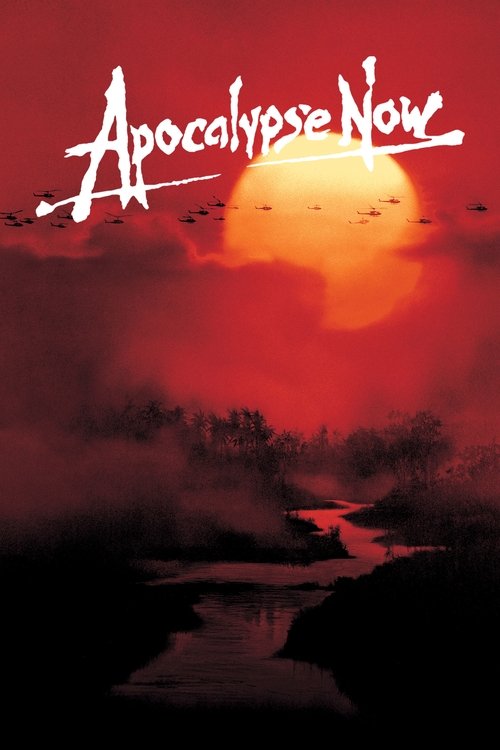
Apocalypse Now
1979 · Francis Ford Coppola
Megalopolis is the decade's great folly narrative: self-funded with $120M of wine money, chaotic Cannes premiere, a pulled trailer with AI-fabricated critic quotes, on-set conduct allegations, and a defiant "I don't care" tour. The conversation is about the mythology of the last mogul-auteur.
For a night when you want to be swallowed whole by a film — full attention, lights off, no phone. This is a challenge and a monument, not comfort viewing, and it will sit with you for days.
What it's about
At the height of the Vietnam War, Captain Willard is handed a mission that officially doesn't exist: travel up a river into Cambodia and eliminate Colonel Kurtz, a decorated Green Beret who has broken from the Army and rules his own private force in the jungle. The journey upriver takes Willard and a small patrol boat crew through escalating madness — surf-obsessed commanders, napalmed treelines, a war that makes less sense with every mile.
The experience
Overwhelming and hallucinatory — it starts as a war movie and slowly becomes a fever dream, by turns spectacular, absurdly funny, and genuinely frightening. It's long and immersive; you come out the other side feeling like you took the trip yourself.
Performances
Martin Sheen carries the film with haunted stillness as Willard; Marlon Brando makes Kurtz a whispering, half-glimpsed presence you can't look away from; and Robert Duvall's swaggering surf-mad colonel steals his stretch of the river with some of the most quoted minutes in movies.
The craft
Vittorio Storaro's cinematography turns the jungle into shifting walls of smoke, fire, and colored light, and the sound design — helicopters prowling from speaker to speaker — helped define what modern movie sound could do. The helicopter assault set to Wagner remains one of the most staggering sequences ever filmed. Demands the biggest screen and best speakers you can find.
Why it matters
The definitive Vietnam War film and the wild summit of 1970s New Hollywood ambition — its chaotic making became legend, and its imagery and lines soaked permanently into the culture.
Snapshot
A hallucinatory river journey into the heart of the Vietnam War and the heart of human darkness, Apocalypse Now follows Special Forces Captain Benjamin Willard (Martin Sheen) as he travels up the Nung River into Cambodia to terminate the rogue command of Colonel Walter Kurtz (Marlon Brando), a decorated officer who has declared himself a god among a tribal people. Transposing Joseph Conrad's 1899 novella Heart of Darkness from the Belgian Congo to Southeast Asia, Coppola constructs not a conventional war film but an operatic descent — part mythology, part fever dream, part indictment of American imperial self-delusion. It is among the most ambitious and turbulent productions in Hollywood history, a film whose making became as legendary as its content.
Industry & production
Apocalypse Now originated as a script developed by John Milius in the late 1960s, intended as a lean, guerrilla-style war film to be shot in 16mm during the actual Vietnam War. George Lucas was at one point attached to direct. By the time Coppola took control of the project through his American Zoetrope company, the concept had grown into something far more elaborate. Coppola financed a large portion of the production himself, mortgaging his Napa Valley winery and personal assets — a decision that placed him under extraordinary personal pressure throughout the shoot.
Production began in the Philippines in 1976, chosen for its jungle terrain and the availability of Philippine military hardware (including Huey helicopters loaned by Ferdinand Marcos's government). Almost immediately, the production entered a state of crisis that would persist for over a year. A typhoon struck and destroyed significant portions of the constructed sets. Martin Sheen, who had replaced Harvey Keitel in the lead role after early shooting revealed a mismatch between Keitel's intensity and the character's interiority, suffered a near-fatal heart attack on location. Marlon Brando arrived dramatically overweight, without having prepared his role, and without having read Conrad's novella. The screenplay was rewritten continuously on set. The original sixteen-week schedule expanded to over two hundred days of principal photography. The budget, initially around twelve to thirteen million dollars, escalated substantially — a fact Coppola acknowledged publicly and that became part of the film's cultural mythology.
Eleanor Coppola documented the production in photographs, diary entries, and footage, culminating in the 1991 documentary Hearts of Darkness: A Filmmaker's Apocalypse (directed by Fax Bahr and George Hickenlooper), which remains one of the most candid records of a film production in cinema history. The documentary reveals a director who had, in some sense, made himself the subject of his own film: the chaos, excess, and moral vertigo of the shoot mirrored the narrative being filmed.
The film premiered at the Cannes Film Festival in May 1979 in an unfinished form, and Coppola's remark there — that his film was not about Vietnam, it was Vietnam — encapsulates the film's self-reflexive ambition and its troubled relationship to the war it depicted.
Technology
Vittorio Storaro shot the film on 35mm, making extensive use of anamorphic lenses to fill the wide CinemaScope frame with environmental scale and psychological pressure simultaneously. The production deployed practical military hardware — Philippine Air Force helicopters, boats, and ordnance — at a scale rarely matched in narrative filmmaking. Napalm was burned practically on set, producing the enormous fireballs of the Kilgore beach assault.
Walter Murch served as both editor and sound designer, a dual role that was unusual at the time and that proved decisive to the film's texture. Murch worked with early multi-track mixing technology to layer an unusually dense sonic environment — overlapping dialogue, ambient jungle sound, Doppler-shifted rotor blades, and music — into a continuous, immersive field. His approach to sound as a compositional element on par with image influenced subsequent practices across American cinema.
A 70mm roadshow print was prepared for select theatrical engagements, capitalizing on the film's sonic and visual density. In 2001, Coppola released Apocalypse Now Redux, restoring approximately forty-nine minutes of footage cut from the original, including the extended French plantation sequence, which had been excised partly for pacing and partly because it did not yet exist in finished form at the time of the 1979 release.
Technique
Cinematography
Vittorio Storaro's work on Apocalypse Now is among the most studied in his career. He organized the film's visual progression around a deliberate chromatic arc: the early sequences in Saigon are bathed in amber and orange — heat, corruption, institutional rot — while the river journey increasingly drains into blue-gray murk and finally into the near-total darkness of Kurtz's compound. Storaro has described his approach to color as emotional rather than decorative, treating light as a form of dramatic argument. The helicopter assault is lit with the brazen clarity of a Western noon: it is meant to feel exhilarating before it feels monstrous. By the film's final act, imagery approaches abstraction — the face of Kurtz emerging from shadow, the ceremonial killing intercut with a sacrificial bull.
Editing
Walter Murch's editorial architecture organizes the film as a psychological progression rather than a conventional narrative chronology. The opening sequence — the jungle, the ceiling fan, the helicopter rotors superimposed — collapses space and time immediately, signaling that this will be a film about mental states as much as events. Murch employed what he has described as a rhythmic approach derived partly from music, cutting on beats and breath rather than purely on action. The intercutting of the Kurtz assassination with the ritual sacrifice at the film's climax — a technique owing a structural debt to Eisenstein's montage theory — achieves an effect of tragic inevitability: Willard does not escape the horror, he becomes it.
Mise-en-scène / staging
Coppola's staging is consistently theatrical in scale while remaining psychologically specific. The Kilgore sequences are arranged as a kind of grotesque performance — Duvall's colonel conducting the assault as though it were a personal drama, surfboards on the beach, the smell of napalm framed as connoisseurship. Kurtz's compound is organized as a tableau of imperial ruin: the Angkor Wat–style temple structure (an actual filming location in the Philippines), decapitated heads, bodies in various states of decay, Dennis Hopper's photojournalist darting through the frame like a broken chorus figure. Brando is staged almost entirely in shadow or partial light, his bulk and stillness made into a formal element — Coppola and Storaro refusing to show him fully, making him a presence more than a person.
Sound
Murch's sound design for Apocalypse Now is foundational to the history of cinematic sound. The film was among the first to use a 5.1-channel Dolby Stereo mix with true directional separation, and the helicopter sequences were engineered to track rotor noise spatially across the auditorium — an effect that was literally disorienting in original theatrical screenings. Beyond technical scale, Murch constructed the film's sonic world to blur the boundary between diegetic and non-diegetic sound: The Doors' "The End" opens and closes the film not as commentary but as atmosphere, bleeding into the ambient jungle as though it were always already playing there.
Performance
The film contains two opposed performance modes that it never fully reconciles, and this tension is part of its meaning. Robert Duvall's Lieutenant Colonel Kilgore is one of American cinema's great character performances — kinetic, specific, genuinely comedic and genuinely terrifying — a portrait of military masculinity so confident in its own mythology that it cannot perceive its own absurdity. Sheen's Willard is deliberately flattened, a vessel of witnessing rather than action; his performance is primarily interior, conveyed through voiceover narration that is sardonic, exhausted, and morally compromised. Brando's Kurtz, by contrast, is an experiment in withholding — improvised, digressive, shaped in the editing room as much as on set. The famous reading from T. S. Eliot's "The Hollow Men" and the closing "the horror, the horror" (transposed from Conrad) were assembled from multiple takes and sessions. Whether Brando's performance coheres or dissolves under scrutiny is a question that scholarly and critical accounts have never fully settled.
Narrative & dramatic mode
The film adopts the frame of Conrad's first-person riverine journey, which is itself a structural echo of Dante's Inferno — a descent through progressively more extreme circles of human behavior, each encounter representing a further stripping away of civilizational pretense. The narrator-witness structure (Willard's voiceover providing ironic distance on events he participates in) belongs to a tradition of unreliable, compromised narration running from Conrad through Raymond Chandler to the Vietnam-era literary memoir. The film resists closure: Willard's act of killing Kurtz does not restore order or meaning; the natives lay down their weapons, and Willard simply leaves, with no destination specified.
Genre & cycle
Apocalypse Now belongs to the cycle of major American Vietnam War films produced in the late 1970s and 1980s — including The Deer Hunter (1978), Coming Home (1978), Platoon (1986), and Full Metal Jacket (1987) — that collectively constitute Hollywood's belated reckoning with an unresolved national trauma. Within this cycle, it is the most formally extreme and the least interested in social realism. It transforms the war film genre through mythological overlay, using the genre's conventions (the patrol, the charismatic officer, the atrocity) as material to interrogate rather than fulfill.
Authorship & method
The film's authorship is genuinely collaborative and contested. John Milius's original screenplay provided the Conrad transposition and the river-journey structure, and his sensibility — an attraction to warrior mythology, romantic nihilism, and Hemingwayesque masculine codes — is legible throughout the Kilgore sequences. Coppola's rewrites, conducted partly during production, pushed the film toward the metaphysical and the operatic, adding the French plantation sequence (cut from the 1979 release) and reshaping the Kurtz material in response to Brando's improvisational approach.
Vittorio Storaro's contribution extends beyond cinematography into visual conceptualization — Coppola has spoken of collaborating with Storaro on what he called the film's "color script." Walter Murch's dual role as editor and sound designer gave him an unusual degree of authorial control over the film's final texture; it is widely acknowledged that the film Murch assembled from the raw footage differs substantially from what might have been constructed by a more conventional editorial approach. Carmine Coppola and Francis Ford Coppola are credited with the original score, though the most memorable music in the film consists of licensed recordings — The Doors, Wagner, the Rolling Stones, Creedence Clearwater Revival — whose pre-existing cultural weight Coppola deploys as a form of found commentary.
Movement / national cinema
Apocalypse Now is a product of New Hollywood: the generation of American directors — Coppola, Scorsese, Friedkin, Bogdanovich, Ashby, Altman — who, in the late 1960s and through the 1970s, broke with studio conventions to make formally and thematically ambitious films on studio budgets. Like The Godfather (1972) and The Conversation (1974), it reflects Coppola's ambition to work simultaneously within and against Hollywood commercial norms — to make a film that could fill a mass audience while refusing the consolations of genre resolution.
Era / period
The film sits at the hinge point between New Hollywood's creative peak and the onset of the blockbuster era inaugurated by Jaws (1975) and Star Wars (1977). Its production difficulties and cost overruns were widely cited in the trade press as evidence that the auteur model was unsustainable within the studio system — a narrative that, fairly or not, helped consolidate the industry's shift toward franchise filmmaking in the 1980s. It is simultaneously a culmination of the New Hollywood and a marker of its limits.
Themes
The film's central preoccupation is the corruption inherent in colonial and imperial violence — the argument, drawn from Conrad, that the civilizing project is inseparable from savagery and that the distinction between "us" and "the enemy" is ideological rather than moral. Kurtz's madness is presented not as aberration but as logical conclusion: the doctrine of necessary violence, extended to its endpoint, produces exactly what it claims to suppress.
Running through this is an interrogation of American masculine mythology — the soldier as self-creating hero, the frontier ethos displaced to Southeast Asia — which the film undermines systematically through juxtaposition and irony. Kilgore's surfboards and Wagner constitute the film's sharpest satirical instrument: the American military as a culture that aestheticizes its own violence and cannot perceive the aestheticization.
The film is also about witness, complicity, and the impossibility of innocence. Willard does not report Kurtz; he becomes his executor. The film's ethical weight rests on the question of whether this is justice, murder, ritual, or all three simultaneously.
Reception, canon & influence
Influences on the film. The primary literary source is Conrad's Heart of Darkness, but the film draws on a wide range of antecedents: the Greek tragic tradition (the descent into the underworld, the corrupted hero); Dante's Inferno as structural model; classical Hollywood war films against which it positions itself in critique; and the German Expressionist cinema of the 1920s in its use of environment as psychological projection. Coppola has cited Orson Welles as a stylistic touchstone. The film's free-associative, documentary-influenced visual texture owes a debt to the Italian neorealists and to the French New Wave's legitimization of hand-held location photography.
Critical reception. The film won the Palme d'Or at Cannes in 1979, shared with Volker Schlöndorff's The Tin Drum. It received Academy Awards for Cinematography and Sound, along with nominations including Best Picture and Best Director. Critical response at the time was divided: many reviewers recognized its formal achievement while questioning whether the Kurtz sequences, in particular, were philosophically coherent or merely grandiose. Pauline Kael's famously ambivalent review captured a widespread sense that the film was simultaneously overwhelming and unresolved. Over subsequent decades, critical consensus shifted decisively toward canonical status; it is consistently ranked among the greatest American films ever made.
Legacy and forward influence. The film's influence on the war film genre is pervasive and long-lasting. Oliver Stone's Platoon (1986) and Stanley Kubrick's Full Metal Jacket (1987) are in dialogue with it, even as both reject its mythological scale in favor of grunt-level realism and satirical detachment respectively. Terrence Malick's The Thin Red Line (1998) shares its contemplative voiceover structure and its interest in the war film as philosophical inquiry. Beyond cinema, the film's river-journey-as-moral-descent structure has become a template for narratives about imperial overreach and the confrontation with institutional evil, visible in works as varied as the video game Spec Ops: The Line (2012). The production itself — its chaos, self-destruction, and improbable completion — became a reference point for discussions of directorial obsession and the ethics of artistic ambition, a conversation renewed by every new making-of account and by the film's continuous presence in film school curricula worldwide.
A Deleuzian reading
A ceiling fan turns in a Saigon hotel room, and for a moment it is also the blades of a helicopter, and the jungle is burning behind both of them while Jim Morrison sings about the end.
The full Deleuzian reading of Apocalypse Now →
Reception
It premiered at Cannes 1979 as a 'work in progress' amid rumors of a production disaster, sharing the Palme d'Or while critics split hard on its final act — now it's near-universally canonized as the definitive Vietnam film and one of the great American movies.
How Apocalypse Now was received, from release to now →
Influences: the films it descends from and the films it influenced
- Battleship Potemkin (1925) — Eisenstein's collision montage—cutting opposing images to produce an affective third meaning neither contains alone—is the direct template for Murch's intercutting of the Kurtz assassination with the ritual bull slaughter.
- Touch of Evil (1958) — Welles's staging of moral corruption through deep-shadow chiaroscuro—authority figures half-emerged from darkness, filmed in grotesque low angles—is the direct precursor to Storaro and Coppola's visual grammar for Kurtz's compound.
- Dr. Strangelove or: How I Learned to Stop Worrying and Love the Bomb (1964) — Kubrick's deployment of opposed performance registers—Sellers's restrained control against Scott's volcanic theatricality within a single frame—is the structural model for the Kilgore-Kurtz axis, where operatic excess coexists with deadpan interiority.
- The Wild Bunch (1969) — Peckinpah's multi-camera slow-motion/real-time intercutting—rhythmically alternating speeds to produce kinetic elegy—is the direct technical template for the helicopter assault sequence's editing tempo and tonal ambivalence.
- The Conformist (1970) — Storaro developed his doctrine of color as emotional argument—warm tones for complicity, cold desaturated tones for spiritual void—while shooting this film with Bertolucci, and carried that methodology intact into Apocalypse Now.
- Aguirre, the Wrath of God (1972) — Herzog's handheld tracking of a delusional colonial expedition downriver—using the journey's physical deterioration to literalize imperial hubris as Dantean descent—is the closest structural-visual ancestor to Willard's Nung River passage.
- Seven Samurai (1954) — Coppola extends Seven Samurai's use of ambient sound and silence as emotional punctuation in ensemble-mission cinema: where Hayasaka's taiko percussion and rain-silence frame the battle's rhythm, Coppola's helicopter rotors and jungle silence perform the same structural work, signaling threat through density of sound rather than musical score.
- The Good, the Bad and the Ugly (1966) — The Ride of the Valkyries sequence deploys score-as-dramatic-architecture in the Leone manner—pre-existing music played diegetically drives editorial rhythm and invests carnage with operatic scale—while the picaresque MacGuffin journey (find Kurtz) is structurally homologous to GBU's three-way race toward buried Confederate gold.
- The African Queen (1952) — The river-journey structure aboard a practical military vessel through increasingly strange jungle terrain, with the confined boat crew as character crucible and the river as spatial metaphor for moral descent — and a production mythology of location suffering that explicitly echoes African Queen's legacy.
- The Birds (1963) — Walter Murch's sound design — in which environmental sound (rotor-wash, river ambience, jungle pressure) performs all the emotional modulation normally delegated to orchestral score — extends The Birds' demonstration that diegetic and electronic sound could replace composed music without affective loss, a lineage Murch has explicitly acknowledged in interviews on sound design methodology.
- The Conversation (1974) — Murch's sound design for Coppola directly extends The Conversation's diegetic-nondiegetic porosity to hallucinatory scale — helicopter blades dissolving into the Doors' guitar is the logical intensification of the multitrack acoustic ambiguity the two collaborators developed in 1974.
- Lawrence of Arabia (1962) — Vittorio Storaro's telephoto compression of figures in jungle atmospheric haze directly extends Young's technique of using long focal lengths to make distortion tactile rather than decorative; Walter Murch's strategic silences before violence echo Lawrence's sound design, and Willard's retrospective voice-over narrating his own complicity in the colonial mission it analyzes is the Lawrence framing device inverted to first person.
- Fitzcarraldo (1982) — Herzog extended Apocalypse Now's grotesque-theatricality principle into literal production practice, deploying Kinski's operatic breakdown against the real physical spectacle of a steamship hauled over a mountain, collapsing the boundary between performance register and documentary event.
- Come and See (1985) — Klimov and editor Valeriya Belkon treated editorial rhythm as a trauma-pacing device—compressing or elongating time according to the protagonist's dissociation—directly extending Murch's model of editing as psychological progression rather than narrative chronology.
- Platoon (1986) — Stone's decision to let Samuel Barber's Adagio for Strings rise out of the jungle ambient texture—indistinguishable at first from diegetic sound—is a direct application of Murch's diegetic/non-diegetic-blur technique to Vietnam-war-cycle elegy.
- Full Metal Jacket (1987) — Kubrick structured the film as a two-part Dantean descent and deployed R. Lee Ermey's hyper-theatrical performance against the recruits' deadened realism in conscious adoption of Apocalypse Now's opposed-registers strategy.
- The Thin Red Line (1998) — Malick and DP John Toll's chromatic arc—Pacific dawn gold bleeding into bleached combat white then twilight blue—and Malick's editorial model of perception and memory rather than cause-and-effect are direct heirs to Storaro's and Murch's respective contributions.
- Black Hawk Down (2001) — Skip Lievsay's multichannel sound design spatializes combat confusion—helicopter rotors, gunfire, and human voices occupying distinct planes in the 5.1 field—directly extending Murch's invention of combat as immersive sonic environment rather than illustrated action.
- The Lord of the Rings: The Return of the King (2003) — Walter Murch's intercutting between Willard's intimate close-quarters river journey and the full-scale military spectacle of the Air Cavalry sequence models the specific editorial problem ROTK faces: converging two narratives operating at incompatible emotional tempos and spatial scales — Frodo's private psychological ordeal and Aragorn's public war — without either register overwhelming the other.
- Aliens (1986) — Cameron directly inherits Coppola's dramatic engine of a military command that dispatches soldiers on a mission with concealed corporate objectives, translating the Kurtz/Willard institutional betrayal into the Burke/Weyland-Yutani axis — the institution that sends people to die is the real antagonist in both films.
- The Last Emperor (1987) — Storaro developed and demonstrated his Chromatics theory here — jungle greens surrendering to the infernal amber-orange of Kurtz's compound — winning the Oscar and establishing the anamorphic color-temperature architecture TLE would deploy as explicit historical grammar.
- Saving Private Ryan (1998) — The Do Lung Bridge sequence is the direct Hollywood precedent for SPR's multi-camera chaos: Coppola and Bill Butler stripped lens coatings, used simultaneous cameras in firefight conditions, and refused spatial orientation to render combat as sensory breakdown rather than choreography — the technical three-move bundle (stripped lenses, multi-cam, refused geography) that Kamiński formalized.
- The Last King of Scotland (2006) — The Conradian seduction arc—naive Western protagonist drawn stage by stage into complicity with a charismatic totalitarian intelligence, moral reckoning deferred until he is fully captured—is LKOS's foundational narrative architecture, Amin functioning as Amin-as-Kurtz with the jungle replaced by State House.
- Fear and Loathing in Las Vegas (1998) — Willard's voiceover narrates self-destruction as literary witness whose reliability collapses with his sanity; the doubled structure (deteriorating narrator / impossible quest) and 'The End' as period elegy are direct craft precursors to Gilliam's unreliable-witness framing and the wave-speech's retrospective mourning.
- Barry Lyndon (1975) — Kubrick and DP John Alcott pioneered a planned chromatic arc—natural-light clarity in the youth sequences yielding to candlelit amber decay—as a formal argument about historical corruption, a technique Storaro was simultaneously developing for Coppola.
- Taxi Driver (1976) — Bernard Herrmann's score functions simultaneously as Travis's diegetic interior world and as orchestral commentary—a sonic duality that Murch extended into a systematic philosophy of diegetic/non-diegetic blur across Apocalypse Now's entire acoustic architecture.
- Stalker (1979) — Tarkovsky and sound designer Eduard Artemyev constructed the Zone's acoustic environment as a continuous field in which ambient diegetic texture and scored music are indistinguishable—the identical sonic philosophy Murch realized through 5.1 Dolby multichannel technology the same year.
- Star Wars (1977) — Walter Murch's found-sound layering approach — recording real-world sources (helicopters, jungle, distorted radio) and processing them into continuous environmental texture — is the closest industrial precedent to Ben Burtt's method; both Murch and Burtt operated in the Bay Area milieu and the approach was a conscious parallel development.
- The Godfather Part II (1974) — Coppola's next major film continues Part II's darkness-as-moral-argument: Storaro's cinematography applies Willis's principle that light is an ethical statement, pushing it toward full expressionism as Willard's river journey descends into the same moral void Michael occupies at Lake Tahoe.
- Clear and Present Danger (1994) — Ancestor via co-writer John Milius, whose hard-edged operational/combat sensibility — sanctioned-then-disavowed black ops and morally abandoned soldiers in the field — surfaces in CAPD's betrayed Colombian incursion.
- The Deer Hunter (1978) — The companion serious American Vietnam epic: long-form art-cinema treatment of the war as descent into psychic dissolution, sharing the elegiac monumental scale.
- Born on the Fourth of July (1989) — Storaro's expressive, emotionally over-saturated lighting treats the camera as a subjective psychological instrument — the precedent Robert Richardson pushes further into the incandescent, halated key light that becomes Stone's signature.
- Reds (1981) — Immediately precedes Reds in Storaro's career and shows his theory of saturated, motivated source-light as expressive force, the same painterly color control Reds inherits.
- The Cranes Are Flying (1957) — Coppola's championing of I Am Cuba feeds the immersive, kinetically mobile war camerawork that treats movement itself as delirious subjective experience.
- Cross of Iron (1977) — Shares the New Hollywood device of scoring atrocity with ironic pop/anthemic music (Wagner, the Stones) — the same sardonic-soundtrack irony as the film's children's song — plus subjective combat delirium.
- 1900 (1976) — Storaro applies the identical color-as-meaning lighting system, letting hue and source-light carry ideological argument across a maximal, resource-heavy auteur epic.
Similar films
- Aguirre, the Wrath of God (1972) — influence & lineage · same viewing thread
- Come and See (1985) — influence & lineage · same viewing thread · often watched together
- Platoon (1986) — influence & lineage
- The Thin Red Line (1998) — influence & lineage
- Black Hawk Down (2001) — influence & lineage
- Fitzcarraldo (1982) — influence & lineage
- Full Metal Jacket (1987) — influence & lineage
- Stalker (1979) — influence & lineage · often watched together
All the films related to Apocalypse Now →
Watch it with: curated runs of related films
- Into the Heart of Darkness — A run of grueling journeys into hostile country — jungle, ice, desert, occupied forest — where the ordeal strips men down to something primal, hallucinatory, and often unrecoverable.
Film essays and courses that include it
- The Unreliable Eye: Cinema's First Person
- The Art of the Assault: How Cinema Stages War
- How Cuts Think: From Soviet Montage to New Hollywood Rhythm
- What the Ear Sees: A Century of Cinematic Sound
- The Camera at War: A Century of Reinvention
- American Cinema Breaks Open: New Hollywood 1967–1980
- Scope and Shadow: The Anamorphic Vision
- God Is Silent, Death Is Certain: Existentialism in World Cinema
- Witness: Cinema's Century of War and Its Wound
- Men Under Orders: Cinema's Century at War
- Commanded Vision: The Auteur Epic
- The Immense Frame: Cinema's 70mm Obsession from VistaVision to IMAX
- Into the Skin: Cinema's Greatest Performances of Total Commitment
- The Genre at War With Itself
- Painting With Meaning
- The Man Who Made Cinema Listen