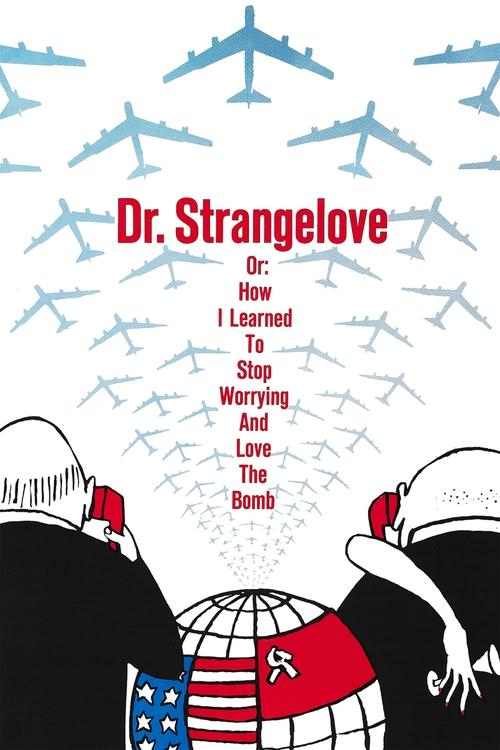
Dr. Strangelove or: How I Learned to Stop Worrying and Love the Bomb
1964 · Stanley Kubrick
For when you want to laugh at something that actually matters — smart, dark, and bracing rather than cozy. Perfect when the news has you despairing and you'd rather cackle at the abyss than doomscroll it.
What it's about
A deranged American general launches an unauthorized nuclear strike on the Soviet Union, and the machinery built to prevent exactly this turns out to be very good at preventing anyone from stopping it. The film ricochets between a B-52 crew dutifully flying toward its target, the air base where the order originated, and the Pentagon's War Room, where the president, his generals, a Soviet ambassador, and a sinister ex-Nazi strategist try to talk their way out of the end of the world.
The experience
It's genuinely funny — quotable, absurd, performed with a straight face — while a countdown to annihilation ticks underneath every joke. The laughter keeps curdling into dread and back again; few comedies leave you this unsettled.
Performances
Peter Sellers plays three roles — the decent, flustered president, a mild RAF officer, and the unhinged Dr. Strangelove himself — each one distinct and each a comic landmark. George C. Scott, as a gung-ho general, gives a performance of gloriously unhinged physical comedy.
The craft
Kubrick stages farce with the precision of a thriller: the stark black-and-white photography, the cathedral-like War Room set, and the procedural realism of the bomber scenes make the absurdity feel horribly plausible. The screenplay is a machine of escalating logic — every disaster follows sensibly from the rules the characters built themselves.
Why it matters
Arriving barely a year after the Cuban Missile Crisis, it changed what political satire could get away with, put phrases and images permanently into the culture, and remains the benchmark against which nuclear-age comedy is measured.
Snapshot
Stanley Kubrick's black comedy about accidental nuclear annihilation stands as the most consequential political satire in American cinema history — a film that exposed the logic of Mutual Assured Destruction as a form of institutional madness and did so by making it funny. Released in January 1964, barely two months after the Kennedy assassination and fourteen months after the Cuban Missile Crisis had brought the world to the edge of nuclear war, Dr. Strangelove transformed sober Cold War dread into farce without diminishing the stakes. Its central insight — that the bureaucratic, military, and strategic systems erected to prevent nuclear war might instead guarantee it — remains as unnerving now as it was then. The film earned four Academy Award nominations, entered the cultural lexicon almost immediately, and has never left it.
Industry & Production
The film originated with Red Alert, a 1958 thriller novel by former RAF officer Peter George, which treated the scenario of a rogue general launching a nuclear strike with deadly seriousness. Kubrick optioned the novel intending to adapt it as a straight suspense film and began developing it with George in 1961. As Kubrick researched deeply into nuclear strategy — reading widely in the literature of deterrence theory, including published works by RAND Corporation strategists — he found himself unable to sustain the dramatic register. The scenarios he encountered, and the strategic logic undergirding them, kept collapsing into absurdity. Rather than fight this reaction, Kubrick invited satirist Terry Southern to co-write the screenplay, a decision that fundamentally redirected the project. Southern's dark, mordant wit amplified the grotesque comedy latent in the source material, and the three-way collaboration between Kubrick, George, and Southern produced a script that treated nuclear apocalypse as black farce.
Production was financed through Kubrick's own company, Hawk Films, in partnership with Columbia Pictures. Kubrick had relocated permanently to England by this point, and the film was shot in its entirety at Shepperton Studios outside London. Columbia's distribution deal gave Kubrick an unusual degree of creative control — a condition he had begun negotiating with studios since Spartacus (1960) had demonstrated the costs of working within the traditional Hollywood system.
The casting of Peter Sellers in three roles — RAF Group Captain Lionel Mandrake, U.S. President Merkin Muffley, and the ex-Nazi weapons scientist Dr. Strangelove — was partly economic (Sellers' fee constituted a large share of the budget) and partly artistic: Kubrick valued Sellers' improvisational range and his ability to inhabit multiple registers of comic performance simultaneously. Sellers was originally slated for a fourth role, Major T.J. "King" Kong, the B-52 pilot, but withdrew from the part during production; accounts differ as to whether this was due to injury or difficulty mastering a convincing Texas accent. Slim Pickens, a genuine rodeo rider and character actor, replaced him and delivered the role's most iconic image. George C. Scott was cast as the bombastic General Buck Turgidson and later claimed Kubrick had manipulated him into playing the role far broader than he intended, by filming rehearsal takes he had assumed would be discarded. Scott reportedly vowed never to work with Kubrick again.
The film was originally scheduled to open in late November 1963. The assassination of President Kennedy on November 22, 1963 prompted Columbia to postpone the release to January 29, 1964. One line of dialogue — Turgidson's remark that the President had been "shot down in the prime of life" — was reportedly re-dubbed to remove the reference.
Technology
Kubrick shot Dr. Strangelove in 35mm black-and-white, a deliberate choice at a moment when color was becoming the commercial standard. The monochrome palette served multiple purposes simultaneously: it grounded the film visually in the documentary and newsreel aesthetic of the early Cold War, gave it an archival gravity that pure color comedy would have undercut, and flattened the film's visual world into something appropriately stark and institutional. Kubrick and cinematographer Gilbert Taylor made use of both traditional studio lighting setups and hand-held camera work, the latter particularly in the Burpelson Air Force Base sequences where a semi-documentary texture was desired.
The B-52 cockpit set posed a particular production challenge. The actual aircraft schematics were classified; Ken Adam's art department worked from publicly available technical manuals and published photographs to reconstruct the interior with sufficient accuracy that, according to accounts at the time, U.S. Air Force officials expressed concern the set was too accurate. Whether this concern was officially registered or acted upon is not fully documented in the public record, but the anecdote has been widely reported by production participants. The War Room, Adam's other major set, required no such improvisation — it was an entirely invented space, though its circular design and overhead lighting rigs have since been so thoroughly reproduced in political iconography that it can be mistaken for documentary record.
Technique
Cinematography
Gilbert Taylor — who would later photograph A Hard Day's Night (1964) and Star Wars (1977) — constructed three distinct visual registers for the film's three locations. The Burpelson base sequences are filmed in a quasi-documentary style, with relatively mobile camera, available-light simulation, and the visual grammar of military institutional photography. The B-52 interior is shot in tight, constricted close-ups and cramped angles that emphasize the mechanical and human confinement of nuclear delivery. The War Room, by contrast, is filmed with a wider, more theatrical formalism — deep-focus compositions that expose the absurdity of human figures dwarfed by Ken Adam's monumental set. The oscillation between these registers prevents the film from settling into a single satirical mode, keeping the viewer slightly off-balance throughout.
Editing
Anthony Harvey's editing — Harvey would later direct The Lion in Winter (1968) — manages the film's tri-strand structure with disciplined economy. The three storylines (Burpelson base, the B-52, the War Room) are intercut with a momentum that escalates alongside the plot's logic of irreversibility. Harvey largely avoids the kind of rhythmic intercutting that would turn the structure into a thriller; instead, the cuts emphasize the disconnects between the three spaces — the degree to which each group is isolated from the others, acting on incomplete information, unable to communicate, and arriving at disaster through processes that look, in each individual strand, almost rational.
Mise-en-scène / staging
Ken Adam's War Room is the film's central production achievement: a vast circular space dominated by a round conference table lit from above and ringed by translucent maps and status boards, surrounded by a raised command gallery and a lower operations floor. The deliberate theatricality of the set — its scale, its artificial grandeur — allows Kubrick to stage the film's most absurd comedy against a backdrop of genuine institutional power. The staging is frequently precise about spatial relations: where characters stand relative to one another and to the maps encodes the film's political geometry without dialogue. Ripper's office, by contrast, is shot as a series of claustrophobic mid-shots and close-ups; the space reads as a trap.
Sound
Dr. Strangelove uses pre-existing music rather than an original dramatic score for its most significant musical moments, and the choices are carefully calculated. "When Johnny Comes Marching Home," arranged and repeated in variations throughout the B-52 sequences, transforms a Civil War marching song into an ironic anthem for nuclear delivery — the music is patriotic, martial, entirely serious, and entirely wrong for the visual content, which is the point. The film's final sequence, in which nuclear explosions blossom silently across the globe, is accompanied by Vera Lynn's 1939 recording "We'll Meet Again" — a wartime sentimental ballad that shatters the distance between the Cold War's abstracted deterrence-speak and the human reality of what the film has just depicted. The tonal collision is devastating. Whether any original score was composed for connective passages, and by whom, is not a detail I can confirm with sufficient certainty.
Performance
Peter Sellers' three performances constitute one of the most concentrated displays of character differentiation in the sound film. Mandrake is played with repressed British anxiety — the comedy of inappropriate deference in the face of obvious catastrophe. President Muffley is an exercise in ineffectual reasonableness, his nasal American placidity the precise wrong instrument for the situation at hand. Strangelove himself is built from the physical comedy of a body and voice that have not been fully de-Nazified — the involuntary arm salute, the gloved hand that takes on a life of its own — and from a vocal delivery that mimics the rational language of strategic analysis while radiating pathology. Kubrick reputedly encouraged improvisation and kept cameras running through extended takes to capture spontaneous material. George C. Scott's Turgidson, broad as it is, locates genuine comic menace in the general's enthusiastic operational thinking. Sterling Hayden's Ripper is played entirely straight — the performance of a man who believes every word he is saying — which is precisely what makes it terrifying.
Narrative & Dramatic Mode
Dr. Strangelove is structured as a comedy of irreversibility. Unlike classical comic structure, which moves toward resolution and restored order, the film's plot is a one-way mechanism: once General Ripper initiates the strike, each subsequent attempt to stop it fails in ways that reveal another layer of systemic dysfunction. The humor is generated not by reversals or surprises in the conventional comic sense but by the gap between the language characters use — the measured, bureaucratic, technically competent language of Cold War strategy — and the consequences of the actions those words describe. The film ends without redemption or rescue. The bomb goes off. The comedy does not prevent the catastrophe; it is the catastrophe, observed from a sufficient altitude of irony.
Genre & Cycle
Dr. Strangelove emerged within and against a cycle of nuclear-anxiety films that had been building since the early 1950s. On the Beach (Kramer, 1959) and Fail Safe (Lumet, 1964) — the latter a near-direct competitor, released later in 1964 — treated the accidental nuclear war scenario as tragic drama. Kubrick's decision to play the same scenario as farce was a genre intervention: it argued that tragic drama was not an adequate form for the subject matter, that the systems generating nuclear risk were too absurd, too organized around euphemism and technical rationality, to yield to conventional dramatic pathos. The film belongs to the tradition of political satire — Jonathan Swift, Voltaire, Mark Twain — more than to any cinematic genre properly, though it also extends the postwar black comedy tradition associated with British Ealing productions and anticipates the American satirical cinema of the 1970s.
Authorship & Method
Kubrick's working method on Dr. Strangelove exemplified the research-driven, total-control approach that characterized his mature practice. His immersion in nuclear strategy literature gave him not only the subject matter but the specific vocabulary — "first-strike capability," "deterrence," "failsafe," "doomsday machine" — that the film then puts through satirical processing. Terry Southern's contribution was structural and tonal: Southern pushed the script toward greater extravagance and helped develop the characters' names (Ripper, Turgidson, Muffley, Strangelove) as a kind of allegorical signature system. Peter George, the source novelist, participated in the adaptation but later expressed ambivalence about the comedic direction; his own novelization of the film script, which he wrote under Kubrick's supervision, retained the farcical register. Ken Adam's production design was a creative partnership of exceptional importance: Adam's War Room did not merely illustrate Kubrick's intentions but extended them, providing a visual argument about power and space that the script alone could not make.
Movement / National Cinema
Dr. Strangelove occupies an unusual national position: an American story, financed through American studio distribution, made at a British studio by a director who had effectively emigrated to England. Kubrick's expatriate position — geographically removed from American political culture while remaining immersed in its idioms — may have contributed to the film's outsider perspective on the American military establishment. The film's British production context also meant access to a deep pool of technically skilled crew and character actors. It does not fit comfortably within the British New Wave or the kitchen-sink realism dominant in British cinema at the time; it is more accurately a product of the international, studio-backed British film industry of the early 1960s that supported Kubrick's increasingly autonomous practice.
Era / Period
The film was made and released in the immediate aftermath of the Cuban Missile Crisis (October 1962) and the nuclear test ban negotiations of 1963, during a period when public awareness of and anxiety about nuclear war was at its highest point in the postwar era. The Cuban Missile Crisis had demonstrated concretely that the mechanisms of deterrence could bring the world to the edge of accidental war; the RAND Corporation's strategic analyses, which circulated widely in the early 1960s and which Kubrick had read, had theorized exactly the scenarios the film depicts. The film registers this cultural moment precisely: it was possible in 1963–1964 to make a comedy about nuclear annihilation and have audiences understand both the joke and the underlying reality without needing exposition.
Themes
The film's central theme is the structural madness embedded in rational systems. The military and political apparatus assembled to prevent nuclear war is shown to guarantee it: every safeguard contains a failure mode, every rational actor is compromised by ideology, vanity, or pathology, and the aggregate of individually intelligible decisions produces collective suicide. Kubrick is interested in the specifically bureaucratic character of this madness — the way institutional language and procedure insulate individuals from responsibility for outcomes. Related to this is a sustained inquiry into sexual politics: virtually every significant character name, piece of military jargon, and strategic concept in the film carries phallic or sexual overtones (Ripper, Turgidson, Muffley, the CRM-114 discriminator, the bomb Kong rides). The film suggests that the drive toward nuclear destruction is not separate from, but continuous with, ordinary masculine aggression and anxiety — Ripper's conviction that fluoridation is a communist plot to contaminate his "precious bodily fluids" is the film's reductio ad absurdum of this logic. The title's double meaning — learning to stop worrying and love the bomb, in both the strategic/ideological sense and the eroticized sense — holds all of these threads together.
Reception, Canon & Influence
Critical reception: The film opened to strong but not universally enthusiastic reviews. Some critics were unsettled by its refusal of earnest anti-nuclear sentiment; others questioned whether farce was an appropriate register for the subject. Pauline Kael's review was notably ambivalent. Over the following decade, however, critical consensus hardened decisively in the film's favor, and it is now universally regarded as among the greatest films ever made. It appears on the AFI's lists of the 100 greatest American films and the 100 greatest American comedies; it received Academy Award nominations for Best Picture, Best Director, Best Adapted Screenplay, and Best Actor (Sellers), winning none — it competed in 1965 with My Fair Lady, which dominated the ceremony.
Influences on the film: Kubrick's acknowledged sources include Peter George's novel, the published literature of deterrence theory and strategic studies, and the tradition of literary political satire. Herman Kahn's On Thermonuclear War (1960) is frequently cited as a source for the Strangelove character's intellectual mode, and the Doomsday Machine concept engages directly with strategic debates Kahn and others had conducted in print. The physical character of Dr. Strangelove has been associated by various commentators with figures including Werner von Braun and Henry Kissinger, among others — these associations are speculative and disputed, and no authoritative account definitively settles the question.
Legacy: Dr. Strangelove's forward influence is vast and difficult to bound. The film established black political comedy as a viable mode for serious cinematic inquiry, clearing ground for films as different as MASH (Altman, 1970), Network (Lumet, 1976), Wag the Dog (Levinson, 1997), and In the Loop (Iannucci, 2009). Its satirical vocabulary — "Strangelovian" as an adjective, the War Room set as an image of political-military power — entered the general cultural lexicon. The film's specific argument about the failure modes of deterrence systems was taken seriously in policy circles; the scholar Daniel Ellsberg, who worked on nuclear targeting at RAND before becoming famous for leaking the Pentagon Papers, has written that Dr. Strangelove depicted the systems he worked on with disturbing accuracy. Ken Adam's War Room design has been reproduced, homaged, and referenced so pervasively in subsequent cinema and television that its artificiality has become, paradoxically, a kind of visual standard for the spaces of political power.
A Deleuzian reading
The last competent act in the film is the one that ends the world.
The full Deleuzian reading of Dr. Strangelove or: How I Learned to Stop Worrying and Love the Bomb →
Reception
A hit and an Oscar nominee on release — though some critics, notably Bosley Crowther in the New York Times, called it irresponsible and 'sick' for laughing at nuclear annihilation. Now it's routinely ranked among the greatest comedies ever made, and the 'too dark to joke about' complaint reads as the film's whole point.
Influences: the films it descends from and the films it influenced
- The General (1926) — Keaton's deadpan performance against escalating military machinery — culminating in a spectacular, irreversible bridge collapse — established the structural principle that comedy of catastrophe requires the performer to remain stone-faced as the mechanism runs to its logical conclusion; Kubrick transplants this directly into Slim Pickens riding the nuclear bomb.
- Duck Soup (1933) — McCarey's staging of Freedonia's war cabinet as a vaudeville comedy troupe — Groucho's deliberations indistinguishable from stand-up — established the formal model of political institutions rendered as performance spaces, which Kubrick literalizes in the War Room's roundtable functioning as an improv stage.
- The Great Dictator (1940) — Chaplin's double-role structure and his technique of satirizing authoritarian power through the performer's physical exaggeration of bureaucratic posture directly preceded Sellers' three-character turn; both films use the comedian's body to expose how institutional power normalizes its own absurdity.
- Kind Hearts and Coronets (1949) — Alec Guinness's eight-character performance established multiple-role casting as the signature formal device of British black comedy, giving Kubrick — working within the same national studio tradition at Shepperton — the precise precedent for Peter Sellers' three simultaneous characterizations.
- Paths of Glory (1957) — Kubrick developed his parallel-cut structure between two institutional locations — the generals' château and the soldiers' trenches — to expose the spatial and moral gulf within military hierarchy; Strangelove's three-location parallel architecture (Burpelson, B-52, War Room) is a direct elaboration of this formal strategy.
- Lolita (1962) — Sellers' improvisational performance as Quilty — multiple disguises, shifting accents, mid-scene tonal pivots — was developed in close collaboration with Kubrick, establishing the directorial method of capturing live improv rather than scripted performance that Kubrick then applied wholesale to all three Strangelove roles.
- The Manchurian Candidate (1962) — Lionel Lindon's deep-focus, high-contrast black-and-white cinematography and Frankenheimer's staging of Cold War political proceedings through a television-news visual grammar established the institutional visual register that Kubrick and Gilbert Taylor adapted for Strangelove's Burpelson Air Force Base sequences.
- The Exterminating Angel (1962) — Buñuel's structural principle of a social group trapped by invisible systemic forces in an irreversible escalation — the mechanism of entrapment never explained, the comedy deriving from watching the system execute its own logic — directly provided Strangelove's narrative architecture: once Ripper launches the bombers, the institutional system cannot retrieve them.
- M*A*S*H (1970) — Altman adopted Kubrick's model of improvised ensemble performance within military institutional farce and extended it into multi-channel overlapping dialogue; his ironic deployment of 'Suicide Is Painless' as a recurring source-music motif directly extends Kubrick's use of 'We'll Meet Again' as tonal counterpoint to institutional catastrophe.
- Catch-22 (1970) — Nichols adapted Heller's novel using Strangelove's structural logic of military bureaucracy as self-perpetuating comedy — non-linear sequencing where institutional absurdity accumulates rather than resolves, with discrete satirical set-pieces (the Milo Minderbinder scenes) functioning as the War Room exchanges' structural equivalent.
- Nashville (1975) — Altman extended Strangelove's parallel-cut architecture across twenty-four characters in five simultaneous narrative threads and adapted Kubrick's technique of deploying pre-existing popular music ironically — country and gospel songs performing the same critical function as 'When Johnny Comes Marching Home,' scoring American institutional self-mythology against itself.
- Being There (1979) — Sellers' performance as Chance extends the Kubrick-Sellers method of building a character entirely through behavioral externals — manner, gesture, accent — with no interior psychology; the political satirical effect depends on the same performed vacancy at the center that Sellers used for Muffley and Mandrake, making the collaborative method itself the direct lineage.
- Apocalypse Now (1979) — Walter Murch's deployment of pre-existing popular music as ironic counterpoint to military spectacle — 'Ride of the Valkyries' scoring the helicopter assault, 'The End' framing the narrative — directly extends Strangelove's technique of using familiar cultural music to expose the aestheticization of institutional violence.
- Brazil (1985) — Gilliam's production design for the Ministry of Information — circular bureaucratic architecture, oppressive overhead lighting rigs, institutional spaces scaled to dwarf individuals — descends directly from Ken Adam's War Room set; the comedy of irreversible bureaucracy executing its own logic toward catastrophe regardless of individual resistance extends Strangelove's narrative architecture into dystopian fantasy.
- Full Metal Jacket (1987) — The closing mushroom-cloud montage set to Vera Lynn's 'We'll Meet Again' established Kubrick's template for deploying ironic pop-song counterpoint over images of annihilation — the precise alienation device FMJ systematizes from 'These Boots Are Made for Walkin'' through 'Paint It Black,' refusing emotional suture at every turn.
- A Bridge Too Far (1977) — Established the template for scoring military catastrophe with triumphalist music — sentimental anthems playing against imagery of institutional madness — that John Addison's score for A Bridge Too Far inherits: orchestral fanfares and martial confidence deployed against operational failure, the gap between sonic confidence and visual chaos as primary ironic register.
- The Right Stuff (1983) — Kubrick's staging of Cold War aerospace bureaucracy as absurdist theater — the military institution rendered as slapstick — is the formal ancestor of Kaufman's press-conference and astronaut medical-examination sequences, where NASA's public apparatus is played for dark institutional comedy.
- Don't Look Up (2021) — Kubrick's invention of the genre-hosted extinction-comedy — the military procedural as satirical container, with the countdown-to-annihilation played as farce and institutional failure as the mechanism of self-destruction — is the structural template McKay directly inherits and updates for climate-era epistemic collapse.
- A House of Dynamite (2025) — Multi-node ensemble staging across simultaneous institutional spaces — War Room, bomber cockpit, base command — each governed by its own procedural logic and each capable of catastrophic autonomous failure, establishing the distributed-authority architecture of the nuclear thriller.
- The Death of Stalin (2017) — Establishes the Cold War black-comedy grammar this film inherits — rendering the apparatus of catastrophe as a squabble among incompetent men confined to institutional rooms, with annihilation played absolutely straight rather than for jokes.
- Fail Safe (1964) — Lumet treated the identical nuclear-accident premise in stark black-and-white real-time drama with no comedy; the simultaneous release of both films is a controlled experiment demonstrating how Kubrick's three-location parallel-cut structure and the tonal choice of farce produce opposite political effects from the same dramatic situation.
- The War Game (1965) — Watkins applied hand-held direct-cinema aesthetics and television news reportage conventions to a staged nuclear attack on Britain — pushing Strangelove's quasi-documentary visual register (used for Burpelson) to its limit, using the same documentary form Kubrick deployed for comedy as an instrument of horror.
Similar films
- Fail Safe (1964) — influence & lineage
- Brazil (1985) — influence & lineage
- Catch-22 (1970) — influence & lineage
- Lolita (1962) — influence & lineage
- M*A*S*H (1970) — influence & lineage
- Paths of Glory (1957) — influence & lineage
- The Manchurian Candidate (1962) — influence & lineage
- Duck Soup (1933) — influence & lineage
All the films related to Dr. Strangelove or: How I Learned to Stop Worrying and Love the Bomb →
Film essays and courses that include it
- Stanley Kubrick
- The Comedy of Catastrophe: How Dark Cinema Learned to Laugh at the Abyss
- The Mask of Command: Cinema's Portrait of Power
- Witness: Cinema's Century of War and Its Wound
- Men Under Orders: Cinema's Century at War
- The Machinery of Power
- Hold Everything: The Art of the Maximalist Genre-Collapse Comedy
- Worlds with Rules: The Deadpan Grotesque Fable
- In Camera: The Institutional Chamber Thriller from Joan to Conclave
- The Frame as a Trap