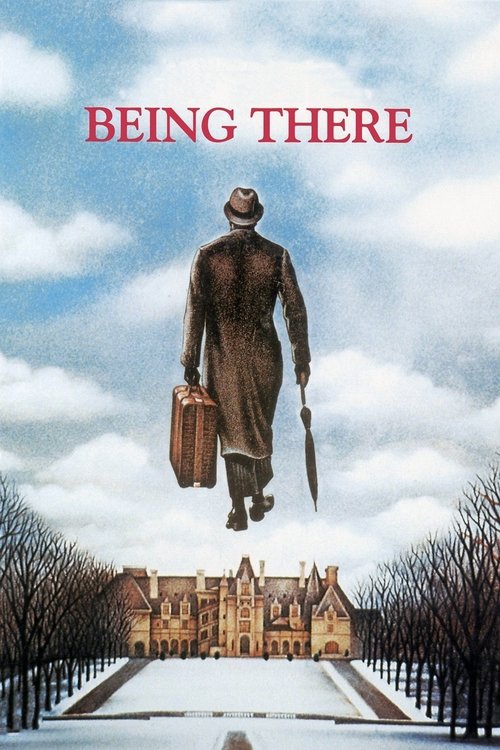
Being There
1979 · Hal Ashby
For when you want a smart, unhurried satire rather than a joke machine — something funny and sad at once that leaves you thinking about media, politics, and how easily we see what we want to see. A contemplative-evening pick.
What it's about
Chance is a simple-minded gardener who has never left the Washington townhouse where he works; everything he knows about the world came through a television screen. When his elderly employer dies, he's turned out onto the street in a tailored suit — and a chance encounter sweeps him into the company of the capital's most powerful people, who hear his plain talk about gardens as profound wisdom.
The experience
Slow, serene, and quietly hilarious — the comedy comes from stillness, from watching important people project depth onto a blank, courteous man. It's gentle on the surface and razor-edged underneath, and its ending will keep you talking.
Performances
Peter Sellers gives one of the great performances in American film, and one of the most disciplined: an entire character built from blankness, perfect diction, and televised gestures, never once winking at the audience. Melvyn Douglas is superb as the dying power broker who takes Chance under his wing.
The craft
Hal Ashby directs with enormous patience, letting scenes breathe until the absurdity blooms on its own, and the film's stately, elegant look plays deadpan against the comedy. The satire is delivered so softly you sometimes only feel the blade afterward.
Why it matters
It stands as the crowning performance of Sellers' career and one of the sharpest American political satires ever made — and its vision of a media-made public figure, mistaken for a sage because he sounds calm on television, has only grown more prophetic.
Snapshot
A mentally simple gardener named Chance (Peter Sellers) has lived his entire life inside the sealed Washington D.C. townhouse of an elderly benefactor, his only connection to the outside world a television set he navigates with a remote control. When his employer dies and he is turned out into the street, a chain of accidental encounters carries him into the orbit of powerful Washington insiders, who mistake his garden metaphors for oracular wisdom and his blankness for reserve. By the film's close, Chance — rebranded "Chauncey Gardiner" — is being floated as a presidential candidate. The final image shows him walking, literally, on water. Being There is at once a political satire, a Candide-like fable, a meditation on television and constructed identity, and a vehicle for one of the great performances in American cinema. Its satirical barbs, once aimed at a specific late-1970s political culture, have only sharpened with time.
Industry & Production
United Artists released Being There in December 1979, positioned for awards consideration. The film was produced by Andrew Braunsberg, who had a prior relationship with both Hal Ashby and Jerzy Kosinski. Kosinski's source novel, published in 1970, had long been considered unfilmable due to its radical narrative economy and the challenge of rendering Chance's inner vacancy on screen; it had circulated in Hollywood for nearly a decade without finding a director willing to attempt it. Ashby's involvement resolved that impasse — his instinct for patience and his willingness to trust an actor's silence made him an ideal match for the material.
Peter Sellers is reported to have pursued the role of Chance with unusual intensity, regarding it as the defining challenge of his career. The casting of Sellers gave the production a commercial anchor that helped secure financing, though the project remained modest by late-studio-era standards. Principal photography took place largely in Washington D.C. and at the Biltmore Estate in Asheville, North Carolina, which stood in for the palatial Rand mansion — its Gilded Age scale conveying the hermetic grandeur of old-money Washington without requiring construction. The film came in on a relatively contained budget, though precise figures are not reliably cited in public production records. Shooting concluded in 1978, with release held until late 1979 to capture the awards season.
Technology
Being There was shot on 35mm in the anamorphic Panavision format, a standard choice for prestige American productions of the period. No particularly experimental photographic technology was deployed; the film's visual distinction emerges from choices of lens, framing, and light rather than from any technological novelty. The anamorphic format contributes meaningfully to the film's look, placing Sellers in a wide, breathing frame that isolates him without crowding. The immaculate compositions owe more to rigorous pre-visualization than to any technical innovation.
The use of practical television sets throughout — their cathode-ray glow and channel-switching static rendered with period fidelity — functions less as technology than as iconography. The remote control Chance carries is both prop and emblem. No digital post-production was available or employed; the film's seamless, classical surface is achieved entirely in-camera and in the optical print.
Technique
Cinematography
Caleb Deschanel served as director of photography — an early major credit for a cinematographer who would go on to shoot The Black Stallion (1979, released the same year) and The Natural (1984). Deschanel's work on Being There is characterized by a cool, even, natural-seeming light that refuses to editorialize. There are no expressionistic shadows, no glamorizing halos; even interiors are rendered in a soft, ambient illumination that keeps the world looking scrupulously ordinary — which is, of course, the entire satirical point. The camera frequently holds on Sellers at a distance that allows the viewer to read the space around Chance rather than his (inexpressive) face, a strategy that forces the audience into the same interpretive position as the characters on screen: searching a blank surface for meaning.
Deschanel and Ashby make deliberate use of wide framings, particularly inside the Rand mansion, so that Chance is often dwarfed by the furnishings of power. The Washington exteriors are shot with a documentarian openness. One consistently discussed sequence — Chance's first encounter with the street, where he stands motionless on a sidewalk attempting to "change the channel" with his remote — is held in an unbroken medium shot that refuses comedy-film punctuation, generating an unease more akin to Beckett than to standard Hollywood satire.
Editing
Don Zimmerman edited the film. Ashby, who had come to directing from editing — he won the Academy Award for editing Norman Jewison's In the Heat of the Night (1967) — maintained throughout his career an unusual comfort with stillness and extended duration. Being There is cut with deliberate patience; scenes play out without being punched to their laugh lines, a choice that was commercially risky but thematically essential. The joke, such as it is, depends on the audience's accumulating discomfort rather than on comic punctuation. Long takes within scenes allow the viewer to sit with Sellers' impassivity and to observe the reactions of the other actors — reactions that constitute the film's real subject matter.
The final credit sequence, which intercuts outtakes of Sellers breaking character with laughter, was Ashby's addition and generated discussion about whether it was an appropriate epilogue to so carefully sustained a performance. The outtakes humanize Sellers in a way that somewhat complicates the preceding fiction; whether this enriches or deflates the experience remains a matter of critical disagreement.
Mise-en-scène / Staging
The film is organized around two sealed, artificial worlds: the Old Man's townhouse, a Victorian time-capsule insulated from history, and the Rand estate, an Edwardian monument to accumulated power. Chance passes from one to the other without friction, because he has no interior life to generate friction. Ashby stages his scenes with a theatrical stillness: characters are placed in relation to furniture and architecture in ways that emphasize hierarchy and formality. Chance consistently occupies the compositional center without appearing to have earned it — which is precisely the satirical conceit.
The television set, wherever it appears, draws Chance's eye and body. Ashby and Deschanel frame him in front of screens with a regularity that makes the TV a kind of gravitational field for his character. The mirror-dance sequence — Chance alone, imitating dance moves from the television — functions as the film's most intimate portrait of a man whose selfhood is entirely imitative and mediated.
Sound
The sound design reinforces the film's dreamlike insularity. Inside the Old Man's house, ambient sound is muffled, the world at bay; the sudden immersion in street noise when Chance first steps outside carries genuine sensory shock. Dialogue throughout is unusually spare; long silences, conventionally uncomfortable in mainstream American film, are allowed to simply persist. The score — credited to Johnny Mandel, who had collaborated with Ashby previously — is discreet, keeping its distance from the action in the manner of a documentarian soundtrack rather than underscoring every irony. Music is most present in the film's more ceremonial passages, where it echoes the grandiosity of the world that is being satirized.
Performance
Peter Sellers received an Academy Award nomination for Best Actor and delivered what many critics and fellow practitioners consider his finest screen performance. The challenge was to embody absolute vacancy without condescension or mugging — to play a character whose blankness is the canvas onto which everyone else projects meaning, while remaining technically present enough to be watchable. Sellers is said to have based elements of Chance's manner on figures he had studied, though accounts vary and should be read with some caution; what is documented is the meticulous construction involved, including precise choices about gait, posture, eye-focus, and an accent suggesting upper-class English filtered through nothing in particular.
Melvyn Douglas, as the dying financier Ben Rand, won the Academy Award for Best Supporting Actor. His performance is a study in aristocratic pragmatism, and the scenes between Douglas and Sellers carry the film's emotional weight — Douglas's acute intelligence playing against Sellers' vacancy in a way that quietly illuminates how power reproduces itself by projecting onto available surfaces. Shirley MacLaine as Eve Rand navigates the thankless role of an intelligent woman who falls under Chance's spell; Jack Warden gives a sharp turn as the President.
Narrative & Dramatic Mode
Being There is structured as an ironic fable, its engine being the systematic misreading of a simple man by an entire establishment. The dramatic irony is total and unbroken: the audience is never permitted to forget what Chance actually is, and the comedy — such as it is — is generated entirely by the gap between Chance's vacant innocence and the elaborate meanings projected onto him. There is no revelation scene, no unmasking; Chance never changes, never learns, never arrives at any self-understanding. The trajectory belongs entirely to the world around him, which spirals further into delusion.
The narrative mode is closer to fable than to realistic satire: events are schematic, coincidences programmatic, characters drawn with allegorical clarity. Kosinski's novel was shaped partly by Voltaire, partly by certain Eastern European literary traditions of the holy fool, and the film preserves this quality. The final image — Chance walking on water — tips fully into parable, foreclosing any realistic reading and insisting on the allegorical.
Genre & Cycle
Being There belongs to the American political satire, a mode that by 1979 had a substantial recent precedent in Dr. Strangelove (1964), The Manchurian Candidate (1962), and the gentler civic comedies of Frank Capra, which Ashby's film systematically inverts. Capra's naive idealists reform a corrupt system; Chance never even perceives the system, and the system — far from being reformed — crowns him. The film also participates in the "holy fool" fable tradition (Dostoevsky's Prince Myshkin provides a literary antecedent, though filtered through Kosinski's colder sensibility), and in the period's meditation on television and media image that included Network (1976). It is not a pure comedy — the arc of Ben Rand's dying lends it genuine elegiac weight — and not a tragedy, but occupies a coolly ambiguous middle register that was characteristic of the best American filmmaking of the decade.
Authorship & Method
Hal Ashby (1929–1988) was among the most distinctive American directors of the New Hollywood period. His trajectory was unusual: he came to directing from editing, and his feel for duration, rhythm, and the weight of silence is directly attributable to that background. By 1979 he had made Harold and Maude (1971), The Last Detail (1973), Shampoo (1975), Bound for Glory (1976), and Coming Home (1978) — a run of politically alert, formally patient films that made him one of the decade's most respected filmmakers. Being There was among his final significant achievements; his subsequent career was hampered by battles with studios and by personal difficulties, and he died in 1988 without having made another film of comparable stature.
Ashby's method centered on collaboration and an unusual tolerance for ambiguity in both content and process. He was known for allowing scenes to breathe, for refusing to over-cut, and for working with actors in a way that emphasized naturalism and felt truth over technical precision. His editorial instincts made him an atypically empathetic collaborator for cinematographers — he understood what the image required without needing to control it.
Jerzy Kosinski (1933–1991) adapted his own 1970 novel. The fidelity of the adaptation is remarkable; Kosinski essentially transcribed and compressed rather than reconceiving, and his screenplay preserves the novel's tonal flatness as a structural principle. Caleb Deschanel brought the visual intelligence of a formally trained cinematographer; his later career in prestige Hollywood cinematography was substantially launched by this film.
Movement / National Cinema
Being There is a late New Hollywood film, produced and released as that movement was giving way to the blockbuster-dominated industry that would characterize the 1980s. It carries the New Hollywood's characteristic formal confidence — its willingness to take risks with pacing, to withhold resolution, to trust the audience — alongside that era's political disenchantment. The film's portrait of a Washington establishment that mistakes vacancy for vision belongs unmistakably to the post-Watergate, post-Vietnam moment.
There is also a European inflection: Kosinski was Polish-born, his novel shaped partly by the allegorical and absurdist traditions of Central European literature, and the film's deadpan mode echoes figures like Jacques Tati and, more distantly, certain Bresson-ian approaches to performance and narrative economy. This European undertow helps explain why the film has always found a more immediate critical home in art-cinema circles than in mainstream American comedy.
Era / Period
The film is set in a recognizable late 1970s Washington of television press conferences, corporate philanthropy, and declining faith in institutional language. Its production coincided with the final year of the Carter administration and the imminence of the Reagan era — a political transition whose central innovation would be the thoroughgoing subordination of policy to image. In retrospect Being There appears almost prophetic in its portrait of a political culture ready to project whatever it needs onto an available face. The film was not made as prophecy, but history has received it as one.
Themes
The central preoccupation is the mediation of reality through television: Chance knows the world exclusively through its screen image, and the world, in turn, receives him through the screen. His rise is a closed system of image-making and image-reception. The film asks, with unusual rigor, what intelligence actually is — or rather, how we recognize it — and answers that we largely recognize it by social performance, by clothing, by the gap we are willing to fill on another's behalf. Power, the film proposes, runs on the projection of meaning onto available surfaces, and Chance is simply the most available surface in the room.
Related to this is a meditation on death and inheritance: Ben Rand is dying throughout the film, and the relationship between the dying patriarch and the empty inheritor carries an elegiac charge that the satire does not entirely absorb. The garden metaphor — "in the garden, growth has its seasons" — functions simultaneously as Chance's only genuine knowledge and as the unwitting wisdom that the establishment hears in it; Ashby allows both readings to stand.
Identity, constructed selfhood, and the impossibility of authentic self-presentation in a media culture are threaded through every scene. Chance cannot present a self because he has none; everyone else presents selves that are equally constructed and equally received as real.
Reception, Canon & Influence
Influences on the film (backward): The primary literary antecedent is Kosinski's novel, itself shaped by Voltaire's Candide, the Dostoevskian holy fool, and the Polish tradition of allegorical fiction under totalitarianism. Cinematic precedents include Chaplin's eternal innocent, Keaton's deadpan endurance, Tati's Mr. Hulot (physically in the world without belonging to it), and Stanley Kubrick's Dr. Strangelove in its political satire of institutional self-destruction. Robert Bresson's work with non-expressivity in performance is a formal antecedent for the approach to Chance's blankness, whether or not consciously invoked.
Critical reception: Initial reviews were respectful but divided — the film's deliberate pace and tonal ambiguity produced uncertainty about whether it was a comedy, a fable, or simply an extended performance showcase. Academy recognition (Sellers nominated, Douglas winning) established its prestige. Over the following decade, critical re-evaluation consistently elevated it, and it is now routinely cited among the finest American films of the 1970s. Sellers' performance is one of the most-discussed in American screen acting.
Legacy and forward influence: The most direct descendant is Robert Zemeckis's Forrest Gump (1994), which recasts the blank protagonist walking through history as sentiment rather than satire, with Tom Hanks in a role structurally identical to Sellers' but emotionally inverted. The comparison illuminates what Being There refuses: redemption, warmth, and the reassurance that the system can recognize and reward genuine goodness. More broadly, the film's portrait of a political culture constitutionally unable to distinguish depth from appearance has become a touchstone reference in every subsequent decade's debates about image politics, media credulity, and the construction of public figures. The arrival of reality television, social media celebrity, and the political figure-as-brand have made the film feel not like historical satire but like active description, ensuring that each new generation encounters it as a contemporary work.
A Deleuzian reading
Chance steps off the curb into Washington traffic, lifts the television remote in his hand, points it at an oncoming car, and presses.
The full Deleuzian reading of Being There →
Reception
Acclaimed on release (an Oscar for Melvyn Douglas, a nomination for Peter Sellers), it has only grown — every election cycle someone declares it the most prophetic American film ever made about politics, media, and the power of an empty vessel.
How Being There was received, from release to now →
Influences: the films it descends from and the films it influenced
- Sullivan's Travels (1941) — Sturges invents the ironic-fable structure where a naive protagonist traverses American power being systematically misread by every social stratum, with the audience holding the ironic gap permanently — Ashby takes this template and strips away the third-act revelation, leaving only the fable's irresolvable vacancy.
- Dr. Strangelove or: How I Learned to Stop Worrying and Love the Bomb (1964) — Kubrick's cold, flat, wide framings of Sellers performing multiple registers of political vacancy establish the formal principle Being There depends on — a political satire sustained by a performer playing pure surface behavior, shot without psychological editorializing or close-up cues.
- The Graduate (1967) — Nichols and DP Robert Surtees use anamorphic Panavision to compositionally isolate a passive, blank protagonist within the architectural frames of upper-class American life, foregrounding environmental meaning over facial expression — the compositional logic Deschanel inherits directly for his wide framings of Sellers.
- Playtime (1967) — Tati refuses close-up punctuation and holds sustained wide framings of a socially opaque protagonist who cannot read modernity, requiring viewers to search the frame actively for comedy — Deschanel and Ashby adopt this exact strategy, denying the audience the cut-to-reaction that would otherwise cue the laugh.
- Harold and Maude (1971) — Ashby's prior film establishes his own editorial signature — scenes that breathe without comedy-film punctuation, cuts made on mood rather than narrative logic, and a tonal equidistance that refuses to score the audience's emotional response — the identical vocabulary deployed in Being There.
- McCabe & Mrs. Miller (1971) — Vilmos Zsigmond's soft, practical, natural-source cinematography — refusing to glamorize or editorialize through light — establishes the West Coast New Hollywood DP aesthetic that Deschanel inherits: making the world look scrupulously ordinary as the film's entire satirical point.
- Nashville (1975) — Altman embeds television cameras within the diegetic political space as commentary on how media and aspiration co-constitute each other, and the wide Panavision frame holds crowds so individuals are always embedded in competing systems of gaze — both devices Ashby inherits for his TV-saturated political satire.
- Network (1976) — Chayefsky's script and Lumet's staging establish television as a gravitational power center that physically distorts everyone orbiting it — Ashby inherits this staging logic wholesale, with Chance's remote control as the isolated suburban echo of Beale's broadcast pulpit and the physical arrangement of characters around TV screens mirroring Lumet's.
- Hail the Conquering Hero (1944) — Inherits the accidental-blank-hero structure — a passive nobody elevated entirely by the public's projection of significance onto him, never his own claim.
- A Face in the Crowd (1957) — Inverts Rhodes into a blank, television-formed cipher elevated to political influence purely by media projection, satirizing the medium's power to anoint an empty populist icon.
- Harvey (1950) — Peter Sellers' serene simpleton is read as profound and sane by a conformist establishment; the deadpan sanity-and-conformity satire descends directly from Elwood's unbothered gentleness confounding the 'normal' world.
- Zelig (1983) — Allen inherits Ashby's satirical anatomy of constructed identity — a figure with no self who acquires the characteristics of those around him — applying mock-documentary framing to expose the same mechanism Ashby renders in classical style: the powerful projecting wisdom and meaning onto an available blank.
- Bob Roberts (1992) — Robbins extends the Ashby political-satire form into mockumentary, building a candidate whose media-constructed persona substitutes entirely for substance — the core Ashby dramatic mechanism (the audience sees the blank while characters project onto it) applied to the specific post-Reagan media landscape.
- Forrest Gump (1994) — Zemeckis directly inherits the holy-fool-traverses-American-power-structure form — a protagonist interpreted as wise by powerful people while the audience holds the ironic gap — resolving the irony sentimentally where Ashby holds it open, but using the same fable architecture of accidental authority and deferred revelation.
- The Truman Show (1998) — Weir takes Ashby's television-as-total-consciousness staging logic to its formal extreme: where Chance watches television to learn to be human, Truman IS the broadcast without knowing it — extending Ashby's insight that TV constructs perceived reality into the film's own structural and architectural premise.
- Election (1999) — Payne inherits Ashby's ironic-fable political satire form — no-revelation structure, deadpan wide framings that refuse to editorialize, characters who are systematically misread while the audience holds ironic distance — in a cinematographic patience that holds wide without cutting to emphasize comedy, a direct descendant of Ashby's editorial vocabulary.
- Being John Malkovich (1999) — Ashby's editorial patience — holding scenes past their comedic resolution so discomfort accumulates in the silence rather than being released by a punchline — is the direct model for Eric Zumbrunnen's editing in BJM; both films also cast their male lead as a semantic blank onto whom every supporting character projects meaning, making the actor a philosophical prop rather than a subject.
- Dream Scenario (2023) — A blank, passive protagonist accidentally vaulted to fame, played in a deadpan register where everyone around him projects meaning onto his vacancy.
- The Holdovers (2023) — Deadpan comic melancholy sustained through patient, unhurried long takes rather than joke-cutting — the tonal register Giamatti's Hunham inhabits.
- Man Facing Southeast (1987) — Blank flat-affect protagonist whom others read as messianic, with the film withholding any diagnosis of whether he is empty or enlightened — the unresolved-diagnosis structure as controlling device.
- O Lucky Man! (1973) — Anderson's holy-fool picaresque — a blank protagonist moving through British class strata being systematically misread and reinterpreted by each new power center — uses sustained wide framings and an identical ironic distance from social authority, constituting the British contemporaneous iteration of the same fable form.
- One Flew Over the Cuckoo's Nest (1975) — Forman's patient wide shots hold the gap between what McMurphy IS and what different institutional observers NEED him to be — the same dramatic engine structuring Chance, with sustained framing used to keep that gap open rather than resolve it through psychological close-up.
- The Gods Must Be Crazy (1980) — Deploys the deadpan holy-fool whose total innocence functions as an allegorical mirror moving through consumer-media society, the same satire-by-naïveté structure as N!xau's Xi.
- The King of Comedy (1982) — Deadpan-discomfort comedy in which an empty cipher is elevated by television into a national figure, the flat affect and unresolved close paralleling King of Comedy's mode.
- The Black Stallion (1979) — Deschanel's other 1979 breakthrough, where the same soft available-light exposure and restrained long-lens framing establish the naturalist optical signature he was defining across both films simultaneously.
- Shampoo (1975) — Ashby's editorial signature at full strength — the take held long past the joke's landing until discomfort displaces laughter — with television broadcast used as the ambient political weather of the frame.
Similar films
- Harold and Maude (1971) — influence & lineage · often watched together
- The Truman Show (1998) — influence & lineage
- Network (1976) — influence & lineage
- Forrest Gump (1994) — influence & lineage
- Nashville (1975) — influence & lineage
- PlayTime (1967) — influence & lineage · often watched together
- Shampoo (1975) — shared sensibility
- Being John Malkovich (1999) — shared sensibility
All the films related to Being There →