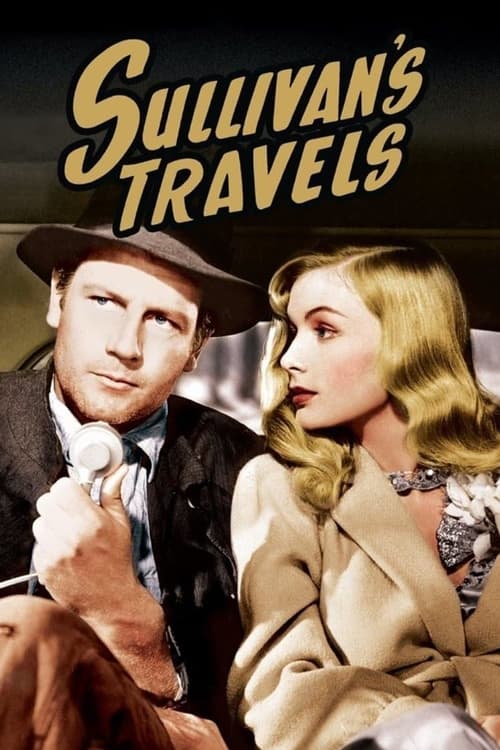
Sullivan's Travels
1941 · Preston Sturges
For when you want to laugh and be left with something — a film about why we need comedy, ideal when life's been heavy and you need permission to enjoy yourself. Both a comfort watch and an argument for comfort watches.
What it's about
John L. Sullivan is a rich, successful Hollywood director of fluffy hits who decides he can't make his serious masterpiece about human suffering until he's actually suffered. So he dresses as a hobo and hits the road to 'know trouble' — with the studio's publicity caravan trailing behind — and picks up a broke, sharp-tongued aspiring actress as a companion. Then his experiment stops being a game, and trouble finds him for real.
The experience
It starts as a rocket-paced satire of Hollywood self-importance, all slamming doors and machine-gun dialogue, then dares to go quiet and genuinely dark before landing somewhere surprisingly moving. Few comedies swing this wide and stick the landing.
Performances
Joel McCrea's easy, unshowy decency anchors the satire, and Veronica Lake — dry, funny, and touching as 'the Girl' — became a star on this role.
The craft
Sturges's screenplay is the star: it shifts registers from screwball farce to near-silent social realism and makes the shifts the point, with dialogue as fast and dense as anything of its era. The Depression-set passages are shot with a stark seriousness that makes the comedy around them mean more.
Why it matters
Now enshrined in the National Film Registry and endlessly referenced, it's Hollywood's sharpest film about its own conscience — the movie every filmmaker's crisis-of-purpose story descends from, and the peak of Sturges's astonishing run as a writer-director.
Snapshot
Sullivan's Travels is Preston Sturges's self-reflexive comedy about a pampered Hollywood director who tries to earn the right to make a serious picture about human suffering by disguising himself as a tramp and going in search of it. Made at Paramount during Sturges's extraordinary early-1940s run as a writer-director, the film swings deliberately between the verbal velocity of screwball farce and passages of near-silent social realism, and resolves into an argument for the dignity and social usefulness of comedy itself. Joel McCrea plays John L. Sullivan; Veronica Lake plays the down-on-her-luck aspiring actress, credited only as "the Girl," who attaches herself to his odyssey. Widely regarded today as one of the sharpest films Hollywood has ever made about its own conscience, it was added to the National Film Registry in 1990 and has become a touchstone whenever the industry debates the worth of entertainment versus "message" filmmaking.
Industry & production
The film was produced and released by Paramount Pictures, the studio to which Sturges was under contract and where he had, beginning with The Great McGinty (1940), become one of the first screenwriters permitted to direct his own scripts. That breakthrough is the essential industrial context: Sturges wrote Sullivan's Travels as an original screenplay and directed it himself, giving the picture the unusually unified authorial voice that distinguishes his Paramount comedies from the more producer-driven norm of the period.
The film belongs to Sturges's remarkable concentrated output at the studio — arriving in the same year as The Lady Eve and just ahead of The Palm Beach Story (1942) — a burst of creativity rarely matched by any writer-director working inside the classical studio system. Casting reflected both studio economics and Sturges's own habits. Joel McCrea, a dependable Paramount leading man, became a Sturges favorite; Veronica Lake was a rising star whose famous peek-a-boo look was near its commercial peak. The production is often noted for the fact that Lake was pregnant during shooting, a circumstance that reportedly created friction on set and had to be managed around her costuming and staging, though accounts of exactly how difficult the shoot was vary and should be treated with some caution.
As with all his Paramount films, Sturges surrounded the leads with his informal "stock company" of character players — William Demarest, Franklin Pangborn, Eric Blore, Robert Greig, Porter Hall, Robert Warwick, and others — whose familiarity gave the comedy its ensemble density. Precise budget and box-office figures for the film are not something I can state reliably, and I won't invent them; the safest characterization is that it was a mid-tier prestige comedy from a bankable writer-director rather than a blockbuster.
Technology
Technologically the film is entirely conventional for a major-studio release of 1941: 35mm black-and-white photography, the Academy aspect ratio (roughly 1.37:1), and a single-channel optical soundtrack. There is no technical novelty on the order of, say, the deep-focus experiments of Citizen Kane the same year. What is notable is not any new apparatus but the confident, resourceful use of standard studio tools — Paramount's sound stages, backlot, process photography, and a large complement of extras for the Depression-montage and chain-gang sequences. The film's ambition lives in its writing, structure, and tonal control rather than in any equipment or process innovation.
Technique
Cinematography
The cinematography is by John F. Seitz, one of the finest camera artists of the era and later the director of photography on Billy Wilder's Double Indemnity and Sunset Boulevard. Seitz's contribution is central to the film's dual identity. The comic Hollywood scenes are lit in the bright, even, high-key style of studio comedy, while the later "trouble" sequences — the flophouses, the rail yards, and above all the chain gang — are photographed in a darker, harder, more shadowed register that anticipates the noir idiom Seitz would help define a few years later. This shift in lighting and texture is one of the primary means by which the film signals its move from farce toward something graver.
Editing
Edited by Stuart Gilmore, the film is built around a striking structural gamble: extended stretches that abandon Sturges's trademark rapid dialogue almost entirely. The most celebrated is a long, largely wordless montage of Sullivan and the Girl moving through the world of the destitute — soup kitchens, missions, freight cars — carried by music and image rather than banter. Cutting these sequences against the machine-gun verbal comedy of the Hollywood scenes required a rhythmic control quite different from ordinary screwball pacing, and the editing has to manage the audience's tonal footing as the film repeatedly changes gears.
Mise-en-scène / staging
Sturges stages his comic scenes with a theatrical relish for crowded frames and overlapping business — the studio-executive conference, the pursuit of Sullivan's "land yacht" trailer by a caravan of studio staff, the bustling servants' quarters. His blocking favors long takes that let his character actors work, and dialogue that tumbles forward at speed. Against this, the poverty sequences are staged with a documentary plainness that borrows the visual grammar of the Warner Bros. social-problem films and the Dust Bowl imagery then current in American culture. The deliberate collision of these two staging modes — baroque comic clutter versus austere realism — is the film's defining formal strategy.
Sound
The soundtrack is dominated, in the comic passages, by Sturges's dense, fast, wittily written dialogue, delivered in the overlapping ensemble style he favored. The film's musical score is credited to Leo Shuken and Charles Bradshaw and functions largely in a supporting, mood-setting capacity, most importantly in scoring the near-silent montage sequences where music must do the emotional work that dialogue elsewhere carries. I would not overstate the score's independent prominence; its significance is chiefly structural, marking and sustaining the passages where the film goes quiet.
Performance
Joel McCrea grounds the film with a warm, self-deprecating sincerity that keeps Sullivan's naïveté sympathetic rather than merely foolish; the role asks him to be earnest, comic, and finally chastened, and he modulates across that range without strain. Veronica Lake, in one of her best-remembered parts, plays the Girl with a dry, deflating wit that punctures Sullivan's romantic idea of poverty. Around them, the Sturges regulars supply a continuous stream of sharply etched comic turns — Demarest's blunt studio man, Pangborn's fussiness, Blore's and Greig's servants — that give the ensemble its characteristic texture.
Narrative & dramatic mode
The film's dramatic mode is deliberately unstable, and that instability is the point. It opens as a Hollywood satire, becomes a road picture and a romance, detours into wordless social-realist tragedy, and lands, after Sullivan's memory loss and imprisonment, in something close to melodrama before returning to comedy for its resolution. Sturges frames the whole with a piece of formal wit: the film begins with a violent struggle atop a moving train that is revealed to be a clip from the kind of grim "significant" picture Sullivan admires — an embedded film-within-the-film that states the movie's central debate in its first minutes. The narrative is thus structured as an argument that tests its own thesis: Sullivan sets out to prove that suffering is the proper subject of art, and the plot subjects him to real suffering until he arrives at the opposite conclusion.
Genre & cycle
Sullivan's Travels is a hybrid that resists a single genre label. It is a screwball comedy in its verbal speed, its romantic sparring, and its comic set-pieces; a Hollywood-on-Hollywood satire in its treatment of studio executives and directorial vanity; a road movie in its picaresque structure; and, in its central montages and chain-gang act, a deliberate incursion into the Depression-era social-problem cycle associated with Warner Bros. and with the era's fiction of the dispossessed. Part of the film's originality is that it does not merely blend these cycles but stages a conversation between them, using the machinery of one (comedy) to examine the claims of another (social drama).
Authorship & method
This is emphatically an auteur's film in the specific, historically grounded sense that Sturges conceived, wrote, and directed it, and that its themes are inseparable from his own position as a Hollywood artist. Sturges came to directing from success as a Broadway playwright and a top screenwriter, and Sullivan's Travels can be read as his most personal statement on the vocation he had chosen — an interrogation, half-mocking and half-sincere, of his own temptation to make Important Art. His method depended on a repertory of trusted collaborators: his stock company of character actors, cinematographer John Seitz, editor Stuart Gilmore, and the Paramount art department under supervising art director Hans Dreier (long the studio's design chief). The score credited to Leo Shuken and Charles Bradshaw completes the key creative roster. The film's voice — literate, fast, ironic, but finally humane — is unmistakably Sturges's own.
Movement / national cinema
The film is a product of classical Hollywood at the height of the studio system, and it does not belong to any avant-garde or national art-cinema movement. Its most useful placement is within the American self-reflexive comedy tradition and, more specifically, within the brief, brilliant efflorescence of the writer-director in early-1940s Hollywood, of which Sturges was the leading exemplar. Its documentary-flavored poverty sequences show an awareness of the socially conscious currents in 1930s American culture, but the film absorbs those influences into a studio-comedy framework rather than joining any realist movement as such.
Era / period
Released in 1941, the film sits at a hinge in American history — after the Depression that supplies its imagery and rhetoric, and on the very threshold of the United States' entry into the Second World War. Its debate about whether art should confront suffering or provide relief from it carries a particular charge at that moment: the closing affirmation of laughter's value reads differently against the backdrop of a country about to go to war. The film's texture — the studio culture it satirizes, the tramps and rail yards it depicts, the chain gang it dramatizes — is thoroughly of its late-Depression, pre-war American moment.
Themes
The film's governing theme is the social function of comedy and, behind it, the ethics of representing suffering. Sullivan's conviction that only a serious artist who has "known trouble" can make meaningful work is systematically dismantled: when he finally experiences genuine misery, what he learns is that comedy is not a frivolous evasion but a real and sometimes the only consolation available to the powerless. This is crystallized in the chain-gang sequence, in which Sullivan watches his fellow prisoners — and himself — dissolve into helpless laughter at an animated cartoon, and grasps that the ability to make people laugh is "all some people have." Secondary themes cluster around this center: the gulf between Hollywood's self-image and the world outside it; the class blindness of privilege (Sullivan cannot simply choose poverty as an experiment); and the romantic partnership that grounds Sullivan's education in something human rather than abstract. The film's much-quoted closing dedication "to the memory of those who made us laugh" makes its thematic allegiance explicit.
Reception, canon & influence
Contemporary reception was, by most accounts, respectful but somewhat divided, with the film's abrupt tonal shifts puzzling some viewers who expected an unbroken comedy from Sturges; I would treat any more precise summary of 1941 reviews with caution rather than overstate a consensus that the record does not cleanly support. Its critical standing has risen steadily over the decades, and it is now firmly canonical, routinely cited among the finest American comedies and among the best films about the film industry, and preserved in the National Film Registry (selected in 1990).
Looking backward, the film draws on several traditions: the self-reflexive Hollywood satire; the picaresque road narrative (the "travels" of the title consciously echo the tradition of Swift's Gulliver's Travels and the moralized journey); the Depression-era social-problem and chain-gang pictures whose imagery it both borrows and interrogates; and Sturges's own background in fast, literate stage comedy. Its notable engagement with a Black congregation, welcoming the chain-gang prisoners into a church to watch a cartoon, is frequently singled out as unusually humane and non-caricatured for a mainstream Hollywood film of its date.
Looking forward, its most conspicuous legacy is the title of the pretentious social epic Sullivan longs to make — O Brother, Where Art Thou? — which Joel and Ethan Coen adopted for their 2000 film in direct homage. More broadly, Sullivan's Travels has become the standard reference point in the perennial argument over the value of entertainment versus "serious" cinema; filmmakers and critics invoke it whenever the industry second-guesses the worth of making audiences laugh. Its influence is therefore less a matter of stylistic imitation than of a durable idea — that comedy is a legitimate and even necessary art — for which this film remains the most eloquent and enduring Hollywood statement.
A Deleuzian reading
Start at the end, in the dark.
The full Deleuzian reading of Sullivan's Travels →
Reception
Critics in 1941 were split — many found its swerves between slapstick and grim social drama jarring, and some sniffed that Sturges was out of his depth. Now that tonal whiplash is exactly what's celebrated: it's in the National Film Registry and routinely called Sturges's masterpiece.
How Sullivan's Travels was received, from release to now →
How to watch Sullivan's Travels: what to notice on a first viewing
- Notice how bright and evenly lit the Hollywood scenes are. Seitz shoots the studio and comic sequences in the bright, even, high-key style of conventional studio comedy, a look he'll abandon once the story leaves Hollywood. The brightness itself is a genre signal, so you can feel exactly when the film's world starts to change later.
- Listen for characters talking over each other at top speed. Sturges writes the studio and comic scenes in dense, fast, overlapping ensemble dialogue, delivered so quickly that lines collide before the previous one finishes. The speed of the talk is doing comic work by itself, independent of any individual joke.
- Notice how many people and objects crowd a single comic frame. Sturges stages his comic scenes with a theatrical relish for clutter and overlapping business, the studio-executive conference and the caravan chasing Sullivan's trailer both built from crowded, busy frames. The clutter is part of the joke: too much is always happening at once for anyone to be fully in control.
- Watch how easily Sullivan admits his own naivety. McCrea plays Sullivan warm and self-deprecating rather than pompous, so his conviction that he needs to suffer for his art reads as sincere foolishness rather than arrogance. You end up liking him despite his plan being obviously a bad idea, which keeps the satire affectionate instead of cruel.
- Watch the film-within-a-film clip that opens the movie. Sturges opens with a violent train-top struggle, revealed within seconds as a clip from the kind of 'significant' picture Sullivan admires, stating the whole film's argument before the real story even starts. The debate about art versus entertainment is laid out as a joke in the first minute, before anyone has to argue about it out loud.
The whole guide to watching Sullivan's Travels, with the keys for a rewatch →
Influences: the films it descends from and the films it influenced
- It Happened One Night (1934) — Established the class-crossing bus-and-road picaresque with a privileged protagonist slumming among the poor — the template Sturges inverts by sending a rich director to ride the rails as a hobo.
- My Man Godfrey (1936) — Folds Depression 'forgotten man' social conscience into screwball farce, the tonal recipe of laughter-plus-pity that Sturges pushes to its breaking point.
- Modern Times (1936) — Fuses slapstick with Depression critique through near-wordless visual comedy, and stakes the very claim Sullivan's dramatizes — that laughter dignifies the poor.
- I Am a Fugitive from a Chain Gang (1932) — The Warner Bros. social-problem chain-gang picture whose stark prison imagery Sturges directly quotes and interrogates in the film's dark third act.
- Twentieth Century (1934) — Showbiz satire built on breakneck overlapping dialogue voiced by a gallery of grotesques — the verbal tempo and ensemble texture Sturges inherited from stage-bred comedy.
- Nothing Sacred (1937) — Ben Hecht's cynical media satire whiplashes between farce and cruelty, an early working model for the tonal instability Sturges makes structural.
- The Great McGinty (1940) — Sturges's directorial debut assembles the stock company of character actors and the writer-director satirical voice he carries directly into Sullivan's Travels.
- Sunset Boulevard (1950) — John Seitz's cinematography plus a self-reflexive Hollywood-devours-its-own narrative extends both Sullivan's DP method and its industry introspection.
- The Purple Rose of Cairo (1985) — Dramatizes Sullivan's exact thesis — that movies offer the Depression's poor a redemptive escape — through a battered viewer literally rescued by the screen.
- Barton Fink (1991) — A self-reflexive fable of a 'serious' writer paralyzed by contempt for popular entertainment — the Sullivan dilemma turned into nightmare.
- The Player (1992) — Self-reflexive Hollywood satire skewering the industry's second-guessing of its own commercial product, the perennial argument Sullivan's set the terms for.
- O Brother, Where Art Thou? (2000) — Takes its title directly from Sullivan's imagined social epic and rebuilds the Depression chain-gang picaresque, including the humane Black-congregation/music sequences.
- Hail, Caesar! (2016) — A studio-system comedy that re-argues Sullivan's case for the dignity and craftsmanship of popular entertainment against the pull of 'important' art.
- Being There (1979) — Sturges invents the ironic-fable structure where a naive protagonist traverses American power being systematically misread by every social stratum, with the audience holding the ironic gap permanently — Ashby takes this template and strips away the third-act revelation, leaving only the fable's irresolvable vacancy.
- They Shoot Horses, Don't They? (1969) — Anatomizes the way Depression-era misery is converted into mass entertainment, the precise commodification-of-suffering logic the dance marathon dramatizes.
- Paper Moon (1973) — Fuses fast studio screwball with documentary-grade Depression hardship imagery, modeling the tonal balance of comedy over genuine poverty that Paper Moon sustains.
- Adaptation. (2002) — Dramatizes the artist's anguished choice between serious art and crowd-pleasing formula — the exact thematic engine of Adaptation's third-act 'surrender to formula.'
- Anbe Sivam (2003) — Supplies the self-aware thesis that comedy and compassion for the poor are morally serious, framed through a privileged man's journey down among the destitute.
- The Miracle of Morgan's Creek (1944) — Codifies the deployment of character actors as a repertory troupe and the abrupt tonal pivots between slapstick and moral seriousness that Morgan's Creek weaponizes.
- The Lady Eve (1941) — Same-year Sturges production reusing the identical stock-company staging and the pairing of literate romance with physical pratfall comedy.
- His Girl Friday (1940) — Contemporaneous perfection of machine-gun overlapping dialogue that Sturges shares as the house style of early-'40s Hollywood comedy.
- Double Indemnity (1944) — Shot by John Seitz, who carries the low-key, shadow-drenched lighting he pioneered in Sullivan's chain-gang sequences into the full grammar of film noir.
- Mr. Smith Goes to Washington (1939) — Sturges constructed Sullivan's Travels as an explicit argument with Capra's civic-earnestness formula, using the same screwball-populism grammar — idealist hero, worldly female guide, comic interruption pacing morally serious material — to interrogate rather than affirm it, making the film formally legible as a refutation of Mr. Smith's terms.
- The Grapes of Wrath (1940) — Sturges directly answers the film's social-conscience mode, staging a Dust Bowl-style boxcar-and-breadline sequence that quotes Ford-Toland's documentary realism to interrogate Hollywood's capacity for it.
- Raising Arizona (1987) — Sturges's collision of high-flown rhetoric with low vernacular, his gallery of comic American grotesques, and his picaresque road structure are the direct model for Hi's mock-heroic narration and the film's social-comedy texture.
- It's a Wonderful Life (1946) — Runs the parallel machinery of overlapping-dialogue populism toward the same thesis reversal — the worth of ordinary lives — via a protagonist stripped of status and shown the value of the common crowd.
- Hail the Conquering Hero (1944) — Shares John F. Seitz's clean deep-focus imaging of crowded staging and the stock company, plus the mock-serious register that honors and mocks the same sentiment at once.
- Lisbela and the Prisoner (2003) — Ancestor of cinephilia-as-worldview: verbally dense screwball construction married to an explicit argument that popular comedy and the shared laugh of the movie house are a form of grace worth defending.
- The Palm Beach Story (1942) — The same year's undercranked land-yacht chase confirms fast-motion montage as a standing Sturges device, and it deploys the identical stock company — Demarest, Pangborn — as one-scene vaudeville turns dropped into an otherwise verbal picture.
Similar films
- Sunset Boulevard (1950) — influence & lineage
- It Happened One Night (1934) — influence & lineage
- O Brother, Where Art Thou? (2000) — influence & lineage
- The Lady Eve (1941) — influence & lineage
- Modern Times (1936) — influence & lineage
- The Palm Beach Story (1942) — shared sensibility
- Detour (1945) — shared sensibility
- Il Sorpasso (1962) — shared sensibility