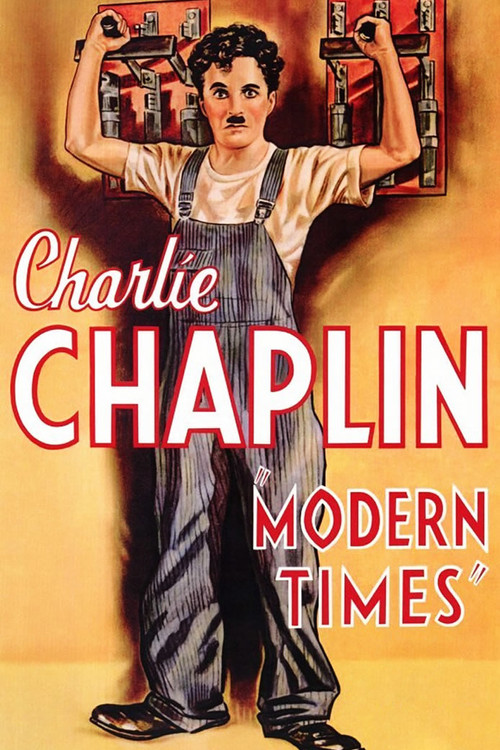
Modern Times
1936 · Charlie Chaplin
For when you want pure, uncynical delight — a film that makes you laugh out loud and leaves you feeling more hopeful about people than when you sat down. Total comfort viewing, no homework required.
What it's about
Chaplin's Tramp takes a job on a factory assembly line at the height of the Great Depression, and the machine age chews him up — literally, at one point — sending him careening through jail cells, department stores, and odd jobs. Along the way he teams up with a spirited homeless young woman, and the two scrape together dreams of an ordinary home while the world keeps knocking them flat.
The experience
Wall-to-wall physical comedy with a surprisingly tender heart — you're laughing at a gag every minute, then caught off guard by how much you want these two to be okay. It moves fast, plays light, and lands with a warmth that sneaks up on you.
Performances
Charlie Chaplin's body is the whole show — the factory breakdown is some of the most precise physical comedy ever filmed — and Paulette Goddard matches him with a fierce, scrappy energy that keeps the romance from going soft.
The craft
Chaplin made an essentially silent film nearly a decade into the sound era, and turned that stubbornness into a statement — machines get sound, people get pantomime. The set-piece engineering is astonishing: giant gears, roller skates on a ledge, an automatic feeding machine, each gag built with watchmaker precision. It plays beautifully with a crowd if you ever get the chance.
Why it matters
The farewell of the most famous character in early cinema and one of the sharpest satires of industrial life ever made — its images of a man swallowed by machinery are still shorthand for automation anxiety ninety years later.
Snapshot
Released on February 5, 1936, Modern Times is the final screen appearance of Charlie Chaplin's Tramp—the bowler-hatted, cane-twirling everyman who had anchored popular cinema since 1914. Shot in the manner of a late silent film at a moment when synchronized dialogue had been industry standard for nearly a decade, the picture follows the Tramp and a homeless young woman (the Gamine) through a series of Depression-era misadventures: factory labor, incarceration, department-store squatting, restaurant work, and, ultimately, an open road stretching toward an unresolved horizon. The film is simultaneously an elegy for the silent art, a satirical broadside against industrial capitalism, and one of the most technically accomplished comedies in the medium's history. It is among the small number of films that reshaped both comedy and political cinema while also serving as a kind of autobiography—Chaplin embedding his anxieties about modernity, artistic survival, and his own public identity directly into the gag architecture.
Industry & production
Modern Times was produced and distributed through United Artists, the company Chaplin had co-founded in 1919 with D. W. Griffith, Mary Pickford, and Douglas Fairbanks. By 1936, UA was under financial strain and the original founding quartet had largely dispersed; Chaplin operated with an unusual degree of vertical autonomy—financing, owning, and controlling the finished print himself—that was essentially unmatched in Hollywood at the time. That independence explains the film's most commercially daring gamble: refusing to produce a fully dialogue-synchronised feature six years after The Jazz Singer had ostensibly made silent cinema extinct.
Chaplin began developing the project in earnest in late 1933 after a long global journey, during which he observed mass unemployment in Britain, labor unrest in continental Europe, and the early effects of Fordist rationalization on factory floors. He had been brooding on an episodic structure organized around industrial labor since at least 1931, when he returned to London to cheering crowds of unemployed workers—an experience he described publicly and which visibly shaped the film's emotional substrate. Production began in October 1934 and, characteristically for Chaplin, extended far beyond a conventional schedule: the film was shot over roughly fourteen months, with Chaplin reshooting sequences extensively as gags evolved. The precise budget is not reliably documented in the public record, though it was understood within the industry to be substantial for a studio-independent production of the period.
Paulette Goddard, Chaplin's companion and, by most accounts, his common-law wife at some point during this period (the exact nature and timing of their union remains contested in biographical sources), plays the Gamine with vigorous, instinctive physicality. She had appeared briefly in Chaplin's City Lights crowd scenes and was not yet widely known; Modern Times effectively launched her as a leading actress, and she would return for The Great Dictator (1940). The production's small principal cast was surrounded by Chaplin's trusted long-term stock company—workers, policemen, and functionaries drawn from the ensemble he maintained across multiple pictures.
Technology
The decisive technological fact about Modern Times is what Chaplin chose not to deploy: synchronized dialogue. The film carries a fully synchronized soundtrack—music, diegetic sound effects, occasional radio and mechanical voices—but no human character speaks comprehensible words until the film's celebrated exception near its close. This was not ignorance or poverty; Chaplin had the resources and technical infrastructure to shoot a dialogue film and had demonstrated awareness of sound cinema's capacities in City Lights (1931), which similarly used a synchronized musical score without dialogue.
The choice was aesthetic, commercial, and political simultaneously. Chaplin recognized that the Tramp's universality—his capacity to be read across language communities—depended on muteness. A speaking Tramp with a specific accent and idiom would be localized, reduced. The single moment the Tramp "speaks" is the nonsense song performed in the restaurant sequence, in which Chaplin sings a pastiche lyric built from French-inflected syllables and invented sounds, drawing on the melody of the popular song "Léonie" (sometimes cataloged as "Titine"). The choice of gibberish was deliberate: the Tramp's voice, at last audible after more than two decades on screen, communicates through music and body rather than through language—a thesis statement about what Chaplin believed cinema to be.
The film also incorporates recorded mechanical voices emanating from industrial devices—the Billows Feeding Machine, the factory's video-surveillance system—making the machine the bearer of synchronized speech while the human remains silent. The irony is precisely calibrated.
Technique
Cinematography
The principal cinematographer was Roland Totheroh, who had worked with Chaplin continuously since the early Mutual and Essanay period; his collaboration with Chaplin is one of the longest-running director-cinematographer partnerships in Hollywood history. Ira Morgan is also credited. Totheroh's approach was conservative by the standards of 1936 Hollywood: the film was shot in the Academy ratio (approximately 1.37:1), with an emphasis on stable, full-figure framing that kept the Tramp's entire body visible for gag construction. Deep staging and frontal or near-frontal camera angles place the comedy in the classical pantomime tradition, where the body is the text.
Lighting is functional rather than expressive: high-key illumination preserves legibility of gesture. There are moments in the later sequences—the café, the Gamine's shack—where the lighting approaches a gentle domestic warmth, but Chaplin and Totheroh never pursue Expressionist effect. The camera's job is to serve the performer, not to interpret him.
Editing
Chaplin edited his own films. His approach to cutting was shaped by an extremely high shooting ratio—many takes and variants of each sequence—and by a governing principle that gag timing should be achieved primarily in performance and then confirmed, rather than constructed, in the edit. Cuts tend to coincide with natural gag endpoints rather than with rhythmic impulse. The factory opening is notable for an extended, largely unbroken contemplation of assembly-line rhythms before the Tramp's disruptions begin: the editing submits to the machine's tempo first, then fractures it.
The episodic structure of the narrative means that the film is, at a macro level, a series of largely self-contained set-pieces joined by transitional intertitles rather than classical plot causality. Within each episode, Chaplin builds to escalating complication and a decisive resolution before cutting away—a structure inherited from vaudeville and the two-reel comedy short.
Mise-en-scène / staging
The factory set—designed with Chaplin's close oversight, with production designer Charles D. Hall as the key collaborator—is the film's most celebrated spatial achievement. The assembly line, the enormous cogwheels, the feeding machine, and the synchronized test panel reproduce an industrial sublime that is simultaneously comic and genuinely disorienting. The Tramp's body is consistently scaled against machinery that dwarfs or threatens to consume him; the sequence in which he is literally fed through the gears is a mise-en-scène argument about the relationship between labor and capital that requires no intertitle.
The department store sequence demonstrates Chaplin's mastery of choreographic staging in an open space: the Tramp on roller skates near an unguarded elevator shaft is a long-take exercise in managed danger and spatial awareness, with Chaplin calibrating proximity to the void across multiple passes. The café-restaurant sequence layers multiple spatial registers—kitchen, dining room, exterior—across which the Tramp must navigate with a stolen duck, a plate of food, and a stolen song.
Sound
The score, composed and arranged by Chaplin himself, is among the most sophisticated original film scores of the 1930s. Chaplin—a self-taught musician who worked closely with arrangers including Edward Powell and David Raksin—built the soundtrack as a continuous contrapuntal partner to the image, using Romantic-inflected orchestration with sudden shifts into jagged mechanical rhythms during factory sequences. The score does not merely accompany the visuals but editorialises: lush strings when the Tramp and Gamine imagine their domestic future; sharp, metronomic figures when the feeding machine operates.
The diegetic sound design is equally purposive. Machine noise is stylized rather than documentary—exaggerated metallic clashing that renders the factory as expressionistic environment. The decision to give machines speaking voices while humans remain mute creates a thematic inversion that is one of the film's most cogent formal arguments.
Performance
Chaplin's performance as the Tramp is the fullest realization of a screen persona developed across more than a hundred films. By 1936, the physical vocabulary was completely internalized: the compensatory dignity of the cane, the shuffle-step, the double-take, the balletic pivot. What distinguishes the Modern Times performance is a new register of exhaustion and bewilderment—the Tramp here is not merely hapless but psychically frayed, subject to a genuine nervous breakdown in the factory sequence. The moment of the breakdown—Chaplin's body taken over by compulsive tightening movements, chasing anything that resembles the nuts he was designed to bolt—is a piece of physical acting that crosses from comedy into something closer to horror.
Goddard's performance is underrated in discussions dominated by Chaplin's presence. She brings an unsentimental toughness to the Gamine; her survival instincts, her occasional ruthlessness, and her genuine tenderness toward the Tramp are all registered in a style that is naturalistic by the standards of the period, particularly in the film's quieter passages.
Narrative & dramatic mode
Modern Times operates in what might be called the picaresque-episodic mode: a loosely affiliated sequence of encounters and reversals structured around a central pair rather than a resolved plot. The Tramp and the Gamine share a goal—stability, a home, a modest domesticity—but this goal is repeatedly deferred by circumstance, class, and the indifference of institutions. There is no antagonist in the conventional sense; the adversary is the system itself, distributed across factory bosses, sheriffs, social workers, and economic forces that exceed any single character's agency.
The film's dramatic arc is one of diminishing catastrophe rather than rising fortune: each new situation (the factory, prison, the department store) promises stability and is undone, but each undoing is somewhat less devastating than the last, and the closing sequence—which offers no resolution but an act of will, a decision to continue—transforms the picaresque succession into something approaching existential affirmation.
Genre & cycle
Modern Times sits at the intersection of slapstick comedy, social satire, and the Depression-era "fallen world" film. The slapstick inheritance is unmistakable: the gag-based structure, the reliance on physical performance, the escalating complication. The social satire positions the film alongside a loose cycle of Depression-era American pictures—including Frank Capra's comedies and the Warner Bros. social problem films—that mobilized popular narrative in response to mass unemployment and class anxiety. But Chaplin's critique is structurally more radical than most Hollywood contemporaries: rather than locating the problem in individual villains or resolvable in romantic resolution, the film implicates industrial capitalism as a system.
The film also belongs to a specific cycle of early-sound-era works that grappled with technology itself as subject: René Clair's À Nous la Liberté (1931) is the most direct comparison, depicting factory labor and automation in terms that closely parallel Chaplin's. The Tobis company, which held rights to the Clair film, filed a plagiarism suit against Chaplin; Clair himself publicly declined to pursue the claim, stating his admiration for Chaplin's work. The suit was eventually abandoned after World War II. Whether influence was direct or whether both films independently drew on the same cultural preoccupations—Taylorism, Fordism, the assembly line as the dominant trope of modern industrial organization—is a question the historical record does not decisively resolve.
Authorship & method
Chaplin's authorship of Modern Times is total in the traditional auteurist sense and then exceeds it: he produced, wrote, directed, scored, co-edited, and starred in the film. No equivalent concentration of creative control existed at major Hollywood studios during the sound era; Chaplin's position was a vestige of the early-cinema model of the performer-creator, maintained through decades of commercial success and strategic financial independence.
His method was iterative and improvisational within a planned structural frame. He would develop sequences through rehearsal and performance, often shooting many takes across days or weeks before arriving at the final version. The script, as such, was a living document subject to constant revision. This approach was expensive and time-consuming but produced a density of gag invention and physical precision that more conventionally scheduled productions could not replicate.
Totheroh's long partnership with Chaplin was collaborative in the sense that Totheroh understood and enabled Chaplin's staging instincts without imposing a separate visual agenda. Composer-arranger David Raksin, later to become a major film composer in his own right (Laura, 1944), contributed significantly to the orchestration of Chaplin's musical sketches, though the melodic and structural conception was Chaplin's. The degree of Raksin's contribution relative to Chaplin's own musical authorship has been a subject of some biographical dispute, with Raksin in later interviews indicating that his arranging role was more substantial than Chaplin's public account acknowledged.
Movement / national cinema
Modern Times occupies an ambiguous position within national cinema categories. Chaplin was British-born, deeply formed by the music-hall tradition of South London, and had never naturalized as an American citizen despite working in Hollywood for over two decades. The Tramp is, in some respects, a figure of Victorian and Edwardian working-class British comedy transposed to American industrial modernity—his pathos and his pretensions both belong to that tradition.
Yet the film is unambiguously a Hollywood production in its financing, distribution, and industrial context. And its political imagination, responding directly to American Depression conditions, positions it within the specifically American discourse around labor and capital of the 1930s. The film's critical and popular reception would later be mobilized as evidence of Chaplin's alleged communist sympathies during the HUAC investigations of the late 1940s—an accusation that contributed to his effective exile from the United States in 1952. Modern Times was cited in that context as a document of suspect political allegiance, whatever its maker's actual party affiliations.
Era / period
The film is a product of the mid-Depression and of Hollywood's early sound consolidation. By 1936, the formal experiments of early sound cinema had largely resolved into the classical Hollywood style; synchronized dialogue was universal, and the industry had developed stable conventions around narrative economy, genre, and star performance. Modern Times arrives as a deliberate archaism—a silent-era formal structure deployed with full awareness of its anachronism—which gives it, in retrospect, a quality of farewell. The Tramp is already a historical figure by 1936; the film is partly about what the modern world has done to the possibility of such a figure.
The era's political urgency saturates the film's imagery. The opening dissolve from a mass of sheep to a mass of workers arriving at a factory gate is among the most cited political images in American cinema of the period. The film was released into a cultural environment in which labor militancy, Popular Front politics, and debates about mechanization were central public concerns.
Themes
The film's primary thematic concern is the dehumanizing logic of industrial capitalism—specifically, the way that rationalized production treats human beings as interchangeable components of a mechanical system. The Billows Feeding Machine sequence makes this thesis comic and visceral simultaneously: a device designed to increase worker productivity by eliminating the lunch break turns eating itself into an automated process, subjecting the Tramp's body to the same rhythmic compulsion as the assembly line. The breakdown that follows—the Tramp's nervous system colonized by the machine's rhythms—extends this logic to its psychological conclusion.
Beneath the satire of industrialism, the film carries a sustained meditation on survival and companionship. The Tramp and the Gamine form an ad-hoc domestic unit—not a conventional romantic couple so much as two people pooling their poverty—and the film's emotional center of gravity is their mutual care across an unaccommodating world. The fantasy sequence in which the Tramp imagines their settled domestic life (a house, a refrigerator spontaneously producing food, a cow at the door) is among the most quietly devastating passages in the film: comedy inflected with genuine longing.
The film also explores the relationship between institutions and freedom—factories, prisons, and social welfare systems appear as roughly equivalent mechanisms of control, each promising security and each exacting submission.
Reception, canon & influence
Initial critical reception in 1936 was mixed in ways that have not aged well. Some reviewers found the silent format dated and the political content heavy-handed; others recognized the film as a major work. Commercial performance was solid but not exceptional by Chaplin's historical standards, reflecting both the deliberately anachronistic form and the growing polarization around Chaplin's political persona.
Influences on the film draw from Chaplin's own body of work—particularly The Kid (1921) and City Lights (1931)—and from the wider slapstick tradition of Keaton, Lloyd, and their predecessors. The music-hall inheritance of performers like Fred Karno, in whose company Chaplin trained, informs the gag structure and the physical vocabulary. The Clair connection is documented, and the broader cultural discourse of Fordism and Taylorism provided the film's raw material; Fritz Lang's Metropolis (1927), which also uses the factory as a site of human mechanization, is a frequently cited antecedent, though the relationship is more one of shared cultural concern than demonstrable influence.
The film's legacy operates on multiple registers. As a formal object, it is the most studied work in the comedy of embodiment and has influenced the physical comedy tradition across generations—Jacques Tati's engagement with modernity and the body in Mon Oncle (1958) and Playtime (1967) is inconceivable without Chaplin's template, and Tati acknowledged the debt. Terry Gilliam's Brazil (1985) recapitulates the film's central nightmare—a gentle individual ground up by an inhuman bureaucratic-industrial machine—in dystopian register. The image of the worker consumed by gears has become one of cinema's most reproduced icons, circulating independently of the film in political imagery, advertising, and visual culture.
As a political text, Modern Times remains one of the most effective critiques of capitalist labor relations to reach a mass audience through fictional film. Its durability as political art derives from its formal intelligence: the critique is metabolized into gag structure rather than stated as thesis, making it persuasive to audiences who would resist explicit ideological address.
Within the canon, the film is now universally acknowledged as a masterpiece and regularly appears in authoritative lists of the greatest films. The Tramp's closing walk—the two figures diminishing down an empty road, the scale of the world against their smallness—has been reproduced so frequently as a symbol of resilient humanism that it has acquired the status of archetype. It is also, knowing what Chaplin knew in 1936, a farewell: the Tramp would not return.
A Deleuzian reading
Start with the hands.
The full Deleuzian reading of Modern Times →
Reception
In 1936 it was a hit but a slightly baffling one — critics sniped at Chaplin for making an essentially silent film nearly a decade into the sound era, and its politics got it banned in Nazi Germany. Now that 'stubbornness' reads as genius, and it sits comfortably among the greatest films ever made.
How Modern Times was received, from release to now →
Influences: the films it descends from and the films it influenced
- À nous la liberté (1931) — Clair's factory floor ballet—workers moving in mechanical unison along a conveyor belt under a synchronized orchestral score—provided the direct choreographic and tonal template for Chaplin's Electro Steel Corp. opening; Tobis's subsequent plagiarism suit against Chaplin acknowledged the structural debt explicitly.
- The General (1926) — Keaton's sustained uncut gag sequences built around the body's precise synchronization with moving machinery in real time—where comedy accumulates through cumulative physical adaptation rather than intercutting—established the long-take choreographic grammar Chaplin applies to the bolt-tightening line and the Billows Feeding Machine.
- Metropolis (1927) — Lang's staging of shift-change sequences—mass formations of workers moving through industrial architecture as mechanical extensions of the machines they operate—provided the visual iconography of labor-as-automatism that Chaplin literalizes and satirizes in the factory induction scene and the worker-as-machine-cog physical comedy.
- City Lights (1931) — Chaplin's own immediately prior film proved that a synchronized orchestral score without spoken dialogue could succeed commercially six years into the sound era, directly authorizing Modern Times to extend the same formal gamble while adding diegetic mechanical voice irony as the sound design's political punchline.
- Safety Last! (1923) — Lloyd's multi-story building-climb climax pioneered the extended long-take gag sequence in which the body negotiates architectural and mechanical hazards in real time without intercutting—a grammar Chaplin applies to the factory conveyor belt and gear-tunnel sequences to generate escalating physical comedy.
- The Gold Rush (1925) — Chaplin's preceding feature refined the method of building extended gag sequences entirely around the body's improvised relationship with objects—the boot-eating ritual, the bread-roll dance—a performance logic Modern Times scales from domestic objects to industrial machinery while preserving the identical timing grammar.
- The Crowd (1928) — The little man ground through assembly-line grids and metropolitan machinery extends The Crowd's staging of the individual crushed by industrial mass, keeping its ambivalent walk-into-the-crowd ending.
- Steamboat Bill, Jr. (1928) — Literally feeds the individual through industrial machinery, extending Keaton's individual-dwarfed-by-systems staging into physical gags where the mechanized environment is the antagonist.
- The Great Dictator (1940) — Chaplin directly extends Modern Times' mechanical voice irony—the machine speaks while the human is mute—by making Hynkel's radio broadcasts a dehumanizing transmission system, while the globe-dance sequence applies the long-take physical choreography grammar explicitly to political metaphor.
- Bicycle Thieves (1948) — De Sica transposes Modern Times' picaresque episodic structure—a worker navigating Depression-era institutions (workplace, police, charity, church) as systemic antagonist—into neorealist location shooting, carrying forward the narrative template of the body moving through social machinery while inverting the formal strategy from studio long-take choreography to documentary-adjacent location staging.
- Monsieur Hulot's Holiday (1953) — Tati adopts Chaplin's full-figure framing grammar—the whole body always visible, comedy generated by posture and spatial relationship rather than close-up reaction—and replaces dialogue with a synchronized ambient soundtrack as the primary comic instrument, treating the holiday resort as a system that resists Hulot's improvised body exactly as the factory resists the Tramp's.
- The Errand Boy (1961) — Lewis constructs long sequences of near-silent physical comedy in which the body navigates corporate institutional space using synchronized sound effects and gag-timed cutting rather than dialogue—an explicit extension of Chaplin's method, with Lewis citing Modern Times as the template for his full-figure staging and sound-design approach.
- Playtime (1967) — Tati extends Modern Times' Fordism critique into the built environment: the modernist office tower replaces the factory as systemic antagonist, and Tati's deep-staged 70mm full-figure long takes—where dozens of bodies simultaneously negotiate architectural machinery—directly scale up Chaplin's assembly-line choreography grammar to the entire urban system.
- The Artist (2011) — Hazanavicius revives the exact formal vocabulary Chaplin defended as deliberate anachronism in 1936—intertitles, Academy ratio, synchronized orchestral score without spoken dialogue—making Modern Times' willful archaism the governing conceit of a historical meditation on the very sound transition Chaplin refused.
- WALL·E (2008) — The sustained romantic subplot conducted through gesture, proximity, and reaction rather than intelligible speech — and the editorial patience of holding on a character's face after a physical mishap — is the direct template for the WALL·E/EVE wordless courtship; Stanton explicitly cites Chaplin's pantomime vocabulary as the model for achieving emotional legibility without dialogue.
- Delicatessen (1991) — The clown figure pitted against an industrial apparatus, mixing pathos with mechanized slapstick, a register the film borrows for its grotesque-but-tender ensemble.
- The Gods Must Be Crazy (1980) — Pioneers slapstick as critique of mechanized consumer modernity—the bewildered innocent defeated by manufactured objects—which Uys inverts by sending a manufactured object into a world that has none.
- The Hudsucker Proxy (1994) — Comic-mechanical design vocabulary — the worker swallowed by oversized clockwork and assembly-line gigantism — feeding Hudsucker's mailroom machinery and the literal great clock as fate-engine.
- The Party (1968) — Establishes modernity-as-adversary as a physical-comedy engine — the body defeated by escalating machinery — which Edwards transposes from factory to luxury home.
- Sleeper (1973) — Sleeper revives Chaplin's man-fed-into-the-machine factory slapstick — the body overwhelmed by conveyor-belt automation — in its giant-produce harvest and malfunctioning-appliance gags.
- Duck Soup (1933) — McCarey's editing of the Marx Brothers' anarchic set pieces—timing cuts to land gag punchlines as rhythmic percussion rather than to serve narrative continuity—runs parallel to Chaplin's assembly-line editing grammar, both treating the cut as a comic instrument calibrated to physical action rather than to dialogue.
- Sons of the Desert (1933) — Laurel & Hardy's physical comedy rests on the same full-figure, long-take staging grammar as Chaplin's—bodies entirely visible within the frame, comedy generated by precise spatial timing rather than editorial rhythm—a parallel tradition of pantomimic performance that shares Chaplin's refusal to fragment the body through close-up cutting.
- L'Atalante (1934) — Vigo concurrently builds emotionally weighted proletarian sequences around synchronized score and physical performance rather than spoken dialogue, using Boris Kaufman's deep full-figure staging to make working-class bodies the primary expressive instrument—a parallel strategy of letting music and gesture carry meaning that sound cinema had largely reassigned to speech.
Similar films
- City Lights (1931) — influence & lineage · same viewing thread · often watched together
- The General (1926) — influence & lineage · same viewing thread
- The Artist (2011) — influence & lineage · same viewing thread
- The Great Dictator (1940) — influence & lineage · often watched together
- PlayTime (1967) — influence & lineage · often watched together
- Duck Soup (1933) — influence & lineage · often watched together
- Metropolis (1927) — influence & lineage
- The Kid (1921) — same viewing thread · often watched together
All the films related to Modern Times →
Watch it with: curated runs of related films
- The Great Silent Clowns — The masters of physical comedy back to back — watch these to feel the unbroken line from Chaplin's Tramp and Keaton's stone face to Tati's tiptoeing Monsieur Hulot.