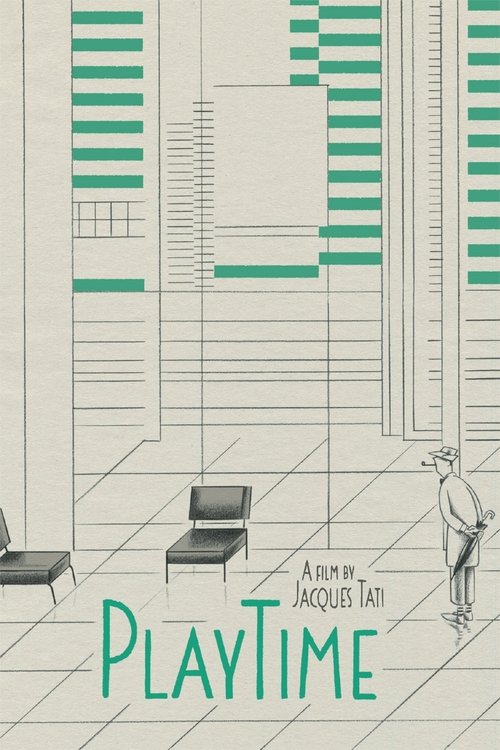
PlayTime
1967 · Jacques Tati
For when you want to be delighted rather than gripped — a playful, unhurried watch that rewards patience and a wandering eye. Great for a relaxed evening, and even better on the biggest screen you can find.
What it's about
Monsieur Hulot — trench coat, pipe, permanently perplexed — tries to keep a business appointment in an ultramodern Paris of glass offices, identical lobbies, and gadgets no one can operate. His path keeps crossing that of a friendly American tourist, and everyone eventually converges on the opening night of a swanky restaurant that isn't quite finished being built. There's barely a plot; the city itself is the comedian.
The experience
A gentle, ingenious, slow-blooming comedy where the gags hide in every corner of enormous, busy frames — you're not told where to look, and half the fun is discovering jokes on your own. The long restaurant sequence builds from stiff formality into joyous chaos, and it's hard not to grin the whole way through.
The craft
Jacques Tati built an entire modernist mini-city — nicknamed 'Tativille' — on the outskirts of Paris and shot it in 70mm, staging dozens of simultaneous sight gags in deep, wide compositions with almost no dialogue. The sound design does the talking: squeaking chairs, hissing doors, and murmuring crowds are the punchlines. It genuinely demands a big screen; on a large canvas the whole frame comes alive.
Why it matters
Its colossal cost nearly ruined Tati, but the film has grown into a landmark — a comedy filmmakers and architects alike keep returning to, and the most ambitious statement of Tati's career-long duel with modern life.
Snapshot
PlayTime is Jacques Tati's monumental comic essay on modernity — a near-plotless, dialogue-light film in which his recurring everyman, Monsieur Hulot, drifts through a gleaming, glass-and-steel Paris that the director built from scratch on the outskirts of the city. Across roughly two hours it follows Hulot's failed attempt to keep a business appointment, the parallel passage of a busload of American tourists led by the open-faced Barbara, and a long, escalating evening at a brand-new restaurant whose construction is not quite finished. There is no conventional protagonist-driven narrative and almost no individuated dialogue; instead Tati orchestrates dozens of simultaneous gags within vast deep-focus compositions, inviting — even requiring — the viewer to choose where to look. Shot in 70mm and conceived for the largest possible screen, it is at once the most ambitious slapstick film ever attempted and a sly humanist argument that warmth and improvisation can reassert themselves inside even the most dehumanizing architecture. Its commercial failure bankrupted Tati; its critical reputation has only risen since, and it is now routinely cited among the greatest films ever made.
Industry & production
PlayTime was an act of artistic hubris on a scale rarely matched in postwar European cinema. Following the international success of Mon Oncle (1958), Tati possessed both the prestige and the leverage to mount his most personal project, and he spent it all. Rather than shoot in actual Parisian locations, he had a complete modern cityscape constructed on a site at Saint-Maurice, east of Paris — a set so large it acquired the nickname "Tativille," with its own road system, multistory buildings, escalators, and electrical and heating infrastructure. The shoot stretched across roughly three years, plagued by weather, storms that damaged the set, financing crises, and Tati's own perfectionism.
The film was shot in 70mm with six-track stereophonic sound, a format Tati chose precisely because it could hold enormous amounts of visual detail in sharp focus across the frame. The budget ballooned far beyond projections — accounts agree it became one of the most expensive French films of its era, though precise inflation-adjusted figures vary by source and should be treated with caution. To finance it Tati mortgaged his future, reportedly pledging the rights to his earlier films and his own assets through his production company, Specta Films. When PlayTime underperformed on release, the consequences were ruinous: Tati lost control of his back catalog and was effectively bankrupted, a financial wound from which his career never fully recovered. He completed only two more features, the comparatively modest Trafic (1971) and the television-funded Parade (1974).
Technology
Tati's choice of 70mm was inseparable from the film's aesthetic argument. The large negative and wide gauge delivered the resolution and depth of field needed to keep foreground and far-background action simultaneously legible — essential for a film whose comedy lives in the relationship between distant figures within a single shot. He paired the image with multitrack magnetic stereo sound, allowing precisely localized effects (a squeaking chair, a hissing door, footsteps on hard floors) to be placed within the soundscape rather than merely centered.
The architecture itself was a technology of the gag. Tativille's modular glass partitions, plate-glass doors, plastic and chrome surfaces, and rectilinear office grids were designed as comic instruments: reflections that double and confuse, transparent walls that turn private moments into public spectacle, and a door whose famous glass pane is shattered yet whose brass handle the doorman continues to "open" by holding the handle alone. The film is, in a real sense, a feature-length demonstration of how modern building materials behave under comic pressure.
Technique
Cinematography
Photographed by Jean Badal and Andréas Winding, the cinematography is defined by deep focus, long takes, and a deliberately cool, desaturated palette of grays, blues, and glass-greens, against which small flashes of warm color (and warm human behavior) register all the more. Tati and his cinematographers favored wide, frontal, often locked-off compositions shot from a middle distance — far enough that no single face dominates, close enough that the choreography reads. The camera rarely pushes in for emphasis; there are few close-ups and little of the conventional grammar that tells an audience what matters. This refusal is the film's signature: by flattening visual hierarchy, Tati democratizes the frame and turns watching into an active search.
Editing
Cutting is sparse and unobtrusive. Where most comedy isolates a gag and punches it with a cut, Tati lets actions unfold within the shot and across the width of the frame, so that the "editing" often happens inside the viewer's eye as it travels the composition. Gags overlap and rhyme spatially rather than being serialized by montage. The result is a rhythm that feels observational and ambient early on, then accelerates and grows denser through the long restaurant sequence, where multiple comic lines run concurrently until the room itself seems to come apart and reassemble as an impromptu party.
Mise-en-scène / staging
This is the film's true medium. Tati composes "gag democracies" — frames in which several independent comic events occur at once, none flagged as the main one, so that repeat viewings reveal jokes missed the first time. The architecture is staged as a maze of reflections and partitions: tourists glimpse Parisian landmarks (the Eiffel Tower, the Arc de Triomphe) only as reflections fleetingly caught in swinging glass doors — a sardonic joke about a modern Paris that has paved over the postcard city. In the celebrated Royal Garden restaurant set-piece, the not-quite-finished room becomes a machine for escalating disorder: a collapsing ceiling grid, a sagging crown, a malfunctioning air conditioner, until the breakdown of the modern interior liberates its occupants into genuine conviviality.
Sound
Sound is arguably Tati's most radical tool. Dialogue is largely incidental — a multilingual murmur of English, French, German, and untranslated babble, treated as ambient texture rather than information. Meaning is carried instead by a hyper-designed effects track: the pneumatic wheeze of chairs, the click of heels, the hum of intercoms, the absurd thunk of a glass door that sounds nothing like glass. These effects are often slightly exaggerated and comically "wrong," foregrounding the alienating soundscape of the modern environment. Francis Lemarque's music enters intermittently, swelling most warmly as the human comedy reasserts itself. The whole track was built in post-production, an authored sound-world rather than a recorded one.
Performance
Performance is pantomimic and ensemble-based. Tati, performing Hulot, is no longer the film's center but one figure among many — often glimpsed at a distance, repeatedly mistaken for other tall men in raincoats, so that his very identity disperses into the crowd. Barbara Dennek, an inexperienced actor cast as the American tourist Barbara, supplies the film's emotional warmth through small gestures of curiosity and delight. The supporting players, many non-professionals chosen for body type and bearing, perform with the precise, repeatable physicality of dancers; the comedy depends on bodies negotiating space — slipping on floors, misjudging glass, navigating queues — rather than on faces or lines.
Narrative & dramatic mode
PlayTime dispenses almost entirely with plot. There is a loose temporal arc — morning at an airport-like terminal, a day of offices and a trade exhibition, evening at the restaurant, a final dawn — and two faint through-lines (Hulot's missed appointment; the budding, barely-spoken affinity between Hulot and Barbara). But cause-and-effect storytelling is replaced by a flâneur's drift and a structural rhythm of accumulation and release. The dramatic mode is observational and essayistic: the film advances an argument rather than a story, building from cool, regimented modernity toward a warm, chaotic communality, then sending its tourists home with the city briefly transformed — the closing traffic roundabout reimagined as a carousel — into something playful and human.
Genre & cycle
Formally it is a comedy, descended from silent-era visual slapstick, but it stretches the genre to its limit, approaching the condition of an experimental or "city symphony" film. It belongs to Tati's own Hulot cycle — Les Vacances de Monsieur Hulot (1953), Mon Oncle (1958), PlayTime (1967), Trafic (1971) — within which it represents both the apex of ambition and a near-abandonment of the character as conventional hero. It also sits within a broader mid-century lineage of comic anxiety about modernization and dehumanizing systems, sharing thematic ground with Chaplin's Modern Times (1936) while rejecting Chaplin's sentimental close-up intimacy for a cooler, architectural vision.
Authorship & method
PlayTime is among the purest auteur statements in cinema, but it was a collaborative construction. Tati directed, co-wrote, and starred; he developed the screenplay with Jacques Lagrange, his longtime artistic collaborator and a painter whose sensibility shaped the film's graphic, compositional approach, with additional English dialogue contributions credited to Art Buchwald. Cinematography was shared by Jean Badal and Andréas Winding, who realized the deep-focus 70mm look. The score was composed by Francis Lemarque (with contributions associated with James Campbell), supplying the film's intermittent, warming musical punctuation. Editing was handled by Gérard Pollicand. Tati's method was famously controlled and improvisatory at once: he storyboarded and engineered gags with exacting precision, yet built a set large and flexible enough to keep discovering comedy within it over a years-long shoot. The film's design — its very buildings — is as much "authored" as its script, blurring the line between director and architect.
Movement / national cinema
PlayTime is a French film made at the height of the French New Wave, yet it stands defiantly apart from it. Where the Nouvelle Vague prized location shooting, handheld immediacy, and youthful spontaneity, Tati built a studio-city and pursued an almost classical, painterly control. He belongs less to any movement than to an older European tradition of comic mime and music-hall performance, refracted through a modernist's eye. That said, his preoccupation with the alienations of postwar consumer modernity — glass towers, mass tourism, gadget culture, the Americanization of Paris — places him squarely within the concerns of 1960s European art cinema, alongside contemporaries like Antonioni who were anatomizing modernity's emotional architecture in a very different key.
Era / period
The film is a precise document of its moment: the France of Les Trente Glorieuses, the postwar boom of reconstruction, high-rise development, international trade fairs, and an emergent global tourist economy. The gleaming international-style architecture, the trade-show gadgets (silent doors, eyeglass frames, a broom with headlights), and the interchangeable glass-box offices satirize a Europe rebuilding itself into a placeless modernity in which Paris looks like London looks like any global capital — a joke made literal by the travel posters that advertise distant cities with identical high-rise images. Released in 1967, on the eve of May 1968, it captures the affluent, regimented society against which that upheaval would soon react.
Themes
At its core PlayTime concerns the relationship between human beings and the environments they build. Its central tension is between order and play: the rectilinear grid of modern life versus the irrepressible human tendency to improvise, err, connect, and make the space one's own. It is preoccupied with looking — with transparency, reflection, surveillance, and misrecognition — using glass to dramatize how modernity exposes and isolates us simultaneously. It satirizes consumerism, tourism, and the homogenization of place, while refusing despair: the film's deepest conviction is that warmth is not destroyed by modernity but merely displaced, ready to reassert itself the moment a ceiling collapses or a band strikes up. Crucially, Tati's democratized frame carries a moral dimension — by refusing to tell us where to look, he insists on the viewer's freedom and attention as itself a humane, anti-authoritarian act.
Reception, canon & influence
On release, PlayTime was a commercial disaster. Its length, its lack of conventional narrative or star-driven close-ups, and the sheer scale of its costs doomed it at the box office, and the failure destroyed Tati financially and cost him control of his earlier films. Critical reception was divided but contained early champions, and the film's standing has risen steadily ever since. It is now widely regarded as Tati's masterpiece and one of the greatest films of all time, a fixture in critical polls and a touchstone for scholars and filmmakers; its restoration and reissue in subsequent decades allowed audiences to finally see it closer to the large-format experience Tati intended (it is worth noting that many original 70mm prints were lost or reduced, and the film's full visual richness was long difficult to access — a fact frequently lamented in the literature).
Influences on the film (backward): Tati drew on the silent visual comedy of Chaplin, Keaton, and Max Linder; on French music-hall and mime traditions; and on his own earlier Hulot films, whose interest in modern gadgetry (Mon Oncle) here expands to engulf an entire city. The thematic kinship with Chaplin's Modern Times is direct, even as Tati repudiates Chaplin's intimacy.
Legacy (forward): PlayTime's influence runs deep among directors drawn to architectural staging, ensemble blocking, and sound design as comedy. Its democratized deep-focus frames and refusal of the guiding close-up anticipate the staging strategies admired in later "slow" and observational cinema; Roy Andersson's deadpan, deep-staged tableaux and Wes Anderson's meticulous symmetrical compositions are frequently traced in part to Tati. Its vision of glass-and-steel alienation and its play with reflection and transparency echo through subsequent films about modern environments. Perhaps most enduringly, PlayTime stands as the great proof-of-concept for a cinema of distributed attention — a film that trusts the viewer to do the looking, and in doing so reclaims a measure of freedom inside the modern grid.
A Deleuzian reading
Watch the swinging glass door near the start, the one that catches the Eiffel Tower for half a second and then lets it go.
The full Deleuzian reading of PlayTime →
Reception
A catastrophic flop in 1967 that bankrupted Tati — he'd spent years and a fortune building his own mini-city to shoot it — PlayTime is now routinely called his masterpiece and a fixture of greatest-films-ever polls. Few reappraisals in cinema history are this total.
How PlayTime was received, from release to now →
Influences: the films it descends from and the films it influenced
- À Nous la Liberté (1931) — Choreographs assembly-line and crowd movement as musical comedy with integrated sound-effect gags, establishing the French template of mechanized-modernity satire staged through ensemble blocking rather than star close-ups.
- The General (1926) — Builds gags as precision-engineered cause-and-effect within real architecture and machinery, framed in full-body long shots so the spatial mechanics — not the comedian's face — carry the laugh, the exact logic Tati expands to a whole city.
- Modern Times (1936) — The direct thematic ancestor Tati cites: an individual physically defeated by industrial systems and gadgetry, though Tati repudiates Chaplin's sentimental close-up intimacy in favor of dispersed, anonymous attention.
- The Crowd (1928) — Pioneers the dispersed protagonist swallowed by the modern office grid — the famous track across identical desks — anticipating Tati's refusal to privilege one figure inside the steel-and-glass bureaucratic lattice.
- Man with a Movie Camera (1929) — The plotless city-symphony form built on reflections, glass, and superimposed urban rhythm, supplying the essay-film structure and reflective-surface play Tati converts into deadpan comedy.
- The Apartment (1960) — Stages the insurance-firm office as an endless deep-focus grid of identical desks receding to vanishing point, the bureaucratic-modernist tableau Tati turns into the cubicle-maze sequence.
- Les Vacances de Monsieur Hulot (1953) — Establishes Tati's designed sound-effects track — the boinging door, dispersed offscreen noises — as the primary comic engine, and the seaside ensemble choreography of background gags later democratized in PlayTime.
- Mon Oncle (1958) — The immediate predecessor whose satire of modernist gadget-architecture and Hulot's awkwardness inside geometric domestic space PlayTime scales up from a single villa to an entire engineered metropolis (Tativille).
- Le Million (1931) — Choreographs whole crowds chasing through Parisian sets as rhythmic ensemble ballet with sound-as-music gags, an early model for staging comedy as group movement through designed urban space.
- The Trial (1962) — Pushes the 'human figure vs. institution' staging to its limit — the individual reduced to a speck inside glass-and-steel monumental modernism, lost in a labyrinth of partitions and desks.
- City Lights (1931) — Tati builds a near-wordless feature on choreographed visual gags and sound used as comic object rather than dialogue, extending Chaplin's principle that the moving image and a designed soundtrack can carry comedy without speech.
- Sherlock Jr. (1924) — Adopts Keaton's locked, distant camera and precision-geometry wide staging, letting gags play out in deep architectural space where the audience must hunt the frame for the comedy.
- Trafic (1971) — Tati's own continuation, transposing PlayTime's choreography of modern objects and designed mechanical sound into a road-trip of cars and gadgets, extending the dispersed-Hulot method.
- Brazil (1985) — Extends the comedy of bureaucratic glass-and-steel labyrinths and pneumatic-machine sound design, an individual lost inside an over-engineered modern system of ducts, forms, and identical interiors.
- Songs from the Second Floor (2000) — Builds the entire film from locked-off wide deep-focus tableaux with action distributed across the frame's depth, the deadpan 'gag democracy' staging directly traced to Tati by critics.
- Divine Intervention (2002) — A near-silent pantomime protagonist who merely observes absurd urban events composed in static, precisely blocked long shots — the dispersed-attention comedy of looking that PlayTime proved viable.
- The Illusionist (2010) — Animated directly from an unproduced Tati screenplay, it reconstructs his mime-based wordless gesture, sparse incidental-multilingual dialogue, and designed-sound comedy as conscious homage.
- The Grand Budapest Hotel (2014) — Inherits the meticulous symmetrical, planimetric wide composition and architecturally rigid staging — the camera locked to building geometry — that scholars trace from Tati's compositional control.
- Stranger Than Paradise (1984) — Tati's camera refuses to privilege characters over environment through fixed wide-angle compositions that let action play out at a distance; deadpan comedy emerges from spatial arrangement rather than performance emphasis — the direct model for Jarmusch's proscenium-frame approach.
- Punch-Drunk Love (2002) — Anderson's glass-walled warehouse office — a box inside a box that simultaneously exposes and traps Barry — is a formal quotation of Tati's Orly airport architecture, where modernist glass enclosures frame alienated figures while denying them privacy or escape.
- The Royal Tenenbaums (2001) — Tati's method of positioning figures in architecturally symmetrical widescreen compositions and observing them from a fixed, unhurried camera distance — the frame as a stage to be read, not a window to enter — establishes the static-tableau grammar Anderson codifies as a personal signature.
- Being There (1979) — Tati refuses close-up punctuation and holds sustained wide framings of a socially opaque protagonist who cannot read modernity, requiring viewers to search the frame actively for comedy — Deschanel and Ashby adopt this exact strategy, denying the audience the cut-to-reaction that would otherwise cue the laugh.
- WALL·E (2008) — Tati's staging of accumulation — objects, spatial repetitions, and visual motifs that aggregate into theme through behavioral comedy rather than exposition — is the formal ancestor of WALL·E's Earth act; in both films, a character's collection of objects and habitual routines constitute their entire inner life, rendered legible through patient long-shot observation rather than dialogue or voiceover.
- Bright Future (2003) — Tati's deployment of modernist architecture as ideological environment — characters geometrically arranged within grids of glass and concrete, their movements both comic and symptomatic — is the specific spatial vocabulary behind Kurosawa's oblique staging in the film's industrial periphery.
- 2 or 3 Things I Know About Her (1967) — Released the same year as a plotless essay-film on Parisian high-rise modernization, the New Wave counterpoint to PlayTime — both dissolve narrative into observation of the consumerist glass city, by opposite formal means.
- 2001: A Space Odyssey (1968) — Tati shot in 65mm to construct precisely geometric architectural environments where the camera habitually recedes to observe human movement through designed space without privileging any single figure — the same principle governing 2001's space-station sequences, where the built environment is the film's true subject and the actors are elements of its composition.
- The Discreet Charm of the Bourgeoisie (1972) — Tati's flat wide-angle observational mise-en-scène — even lighting across deep-focus frames, camera as neutral ethnographer refusing expressionistic emphasis — is a parallel strategy to Buñuel's unobtrusive camera, both withholding visual judgment to force the viewer to locate the comedy unaided.
- Alphaville (1965) — Tati took the wide-angle available-light rendering of Paris's new glass-and-steel modernism to its logical conclusion — human figures dissolved into reflective institutional surfaces, the city as pure self-referential geometry — extending in comic register the visual argument Alphaville's Coutard grammar had already made in thriller register.
- Red Desert (1964) — The Tativille set—a fully fabricated steel-and-glass city where every surface is designed and every ambient sound authored—pursues exactly the same logic as Antonioni's physically painted Ravenna locations: total directorial authorship over built environment as expressive medium rather than documentary backdrop.
- Weekend (1967) — Released the same year, it shares Weekend's frontal planar composition and deep-staged use of mechanized traffic and abrasive diegetic sound as a critique of consumer modernity.
- Sleeper (1973) — Tati stages comedy in found/built modernist architecture with the human body dwarfed by sterile high-key spaces and oversized design — Sleeper's exact spatial-comedy strategy.
- Il Posto (1961) — Tati turns the office into a maze of identical glass cubicles that swallow the individual, a satirical parallel to Il Posto's rendering of corporate-modern space as a machine for effacing selfhood.
- It's a Mad, Mad, Mad, Mad World (1963) — The other 1960s film to treat 70mm as a comic instrument: gags distributed laterally and in depth across a frame too wide to scan at once, forcing the viewer to hunt — Laszlo's compositional problem solved in the opposite register.
- A Night at the Opera (1935) — Pushes duration-over-juxtaposition to its limit: gags distributed in depth across a held wide shot and resolved by staging, architecture and sound rather than by editing — the Marx wide-shot principle rebuilt as an entire visual system.
- Gremlins 2: The New Batch (1990) — A formal rhyme critics have pressed rather than a documented debt: the glass-and-steel modernist tower as a gag machine whose automated systems malfunction in depth across a single deep-focus set — the atrium staging logic Dante applies to Clamp Center.
Similar films
- Monsieur Hulot's Holiday (1953) — influence & lineage · same viewing thread
- Modern Times (1936) — influence & lineage · often watched together
- Mon Oncle (1958) — influence & lineage
- Sherlock Jr. (1924) — same viewing thread · often watched together
- The General (1926) — influence & lineage · often watched together
- My Dinner with Andre (1981) — often watched together
- Napoleon (1927) — often watched together
- Amélie (2001) — often watched together
All the films related to PlayTime →
Watch it with: curated runs of related films
- Sight Gags and Soft Hearts — Watch these when you want comedy built from movement, timing, and architecture rather than punchlines — a gentle soul politely adrift in a bustling, beautifully machined world.