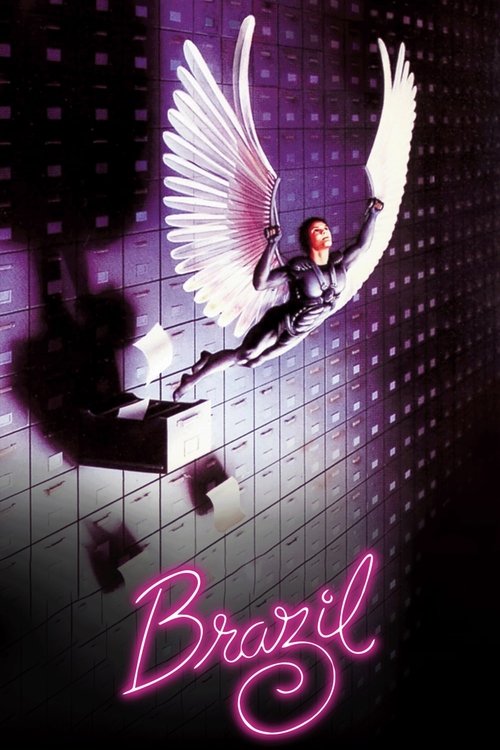
Brazil
1985 · Terry Gilliam
For when you want something wildly imaginative to chew on — a film that skewers office life, paperwork and surveillance while dazzling your eyes. A rewarding challenge, best met when you're alert rather than winding down.
What it's about
In a retro-futurist state where every act of living requires a form in triplicate, a timid ministry clerk daydreams of soaring above it all as a winged hero. When a literal bug in the system — a fly in a typewriter — causes the wrong man to be arrested, he's drawn into the machinery of the error and glimpses the woman from his dreams in the flesh. Chasing her means going up against the entire apparatus he's spent his life quietly serving.
The experience
A dizzying black comedy that keeps tipping into nightmare — hilarious, visually overwhelming, and quietly heartbreaking underneath the slapstick. It leaves you laughing and deeply uneasy at the same time.
Performances
Jonathan Pryce is perfect as the dreamer drowning in paperwork, and Robert De Niro turns up in a gleeful against-type cameo as a renegade heating engineer who treats duct repair like guerrilla warfare.
The craft
Terry Gilliam's production design is the star: a hand-built world of ducts, pneumatic tubes and towering gray ministries where the future looks like a broken past, shot with lenses that make every room loom. It's one of the most fully imagined worlds ever put on film, and the density of detail rewards a big screen and repeat viewings.
Why it matters
A foundational work of dystopian cinema whose look — bureaucratic grunge, retro machines, absurdist officialdom — echoes through decades of science fiction, and whose famous battle between its director and studio over the ending became Hollywood legend.
Snapshot
A foundational text of dystopian cinema, Brazil imagines a future that looks like the past: a sprawling, retro-futurist bureaucratic state in which every act of living requires a triplicate form and every surface conceals a maze of ductwork. Low-level Ministry of Information functionary Sam Lowry (Jonathan Pryce) nurses secret fantasies of winged heroism while processing the paperwork that sustains a regime of casual totalitarianism. When a clerical error — a fly falling into a typewriter — results in the wrongful arrest and death of a heating engineer named Buttle rather than the wanted terrorist Harry Tuttle, Sam is drawn into the machinery of error, falls in love with a woman who exists first in his dreams, and is ultimately consumed by the system he both served and imagined escaping. The film's ending — in which Sam retreats permanently into delusion as his body is broken in a Ministry interrogation chamber — remains among cinema's most devastating and debated conclusions.
Industry & production
Brazil was produced by Arnon Milchan through Embassy International Pictures with a budget of approximately fifteen million dollars, shooting primarily on location in England and at industrial and civic sites in France. Terry Gilliam had established his commercial credibility with Time Bandits (1981), a substantial popular success that gave him sufficient leverage to pursue a more uncompromising project. The production's defining conflict, however, came not during shooting but afterward. Universal Pictures, holding US distribution rights, demanded extensive cuts. Sid Sheinberg, president of MCA/Universal, preferred a truncated version — running approximately 94 minutes and retitled Love Conquers All — that reframed the narrative as a conventional romantic fantasy with a happy resolution. Gilliam refused to authorize the cut and undertook an aggressive public campaign, including a full-page advertisement in Variety directly challenging Universal to release his version. The Los Angeles Film Critics Association awarded the film Best Picture, Best Director, and Best Screenplay for 1985 — before it had received a US theatrical release — a circumstance that helped force Universal's hand. Gilliam's director's cut was released theatrically in the United States in late December 1985. The conflict became a celebrated case study in the collision between auteurist intent and studio commercial logic, and is documented in Jack Mathews' contemporaneous account The Battle of Brazil (1987).
Technology
The film's most distinctive technological premise is its deliberate embrace of obsolete or pseudo-obsolete machinery. Production designer Norman Garwood and Gilliam conceived a society whose technology had evolved sideways rather than forward: computers are enormous cathode-ray devices with tiny screens magnified by water-filled globes; pneumatic tubes convey paperwork through every wall and ceiling; visible ductwork proliferates in a grotesque infrastructure that the state either cannot conceal or has no interest in concealing. This retro-futurist aesthetic — a term the film helped codify for subsequent production design discourse — was achieved largely through practical construction rather than optical effects. The film predates the digital compositing era; its visual extravagance required physical sets and locations of genuine scale. Model work was used for certain exterior sequences in the fantasy register. Roger Pratt shot in anamorphic widescreen, supplemented by wide-angle and fish-eye lenses in the constricted interior spaces.
Technique
Cinematography
Roger Pratt, in one of his first major feature credits, worked with Gilliam to establish a grammar of visual anxiety. In the bureaucratic reality sequences, Pratt deployed wide-angle lenses at low angles, stretching corridors and offices into oppressive geometries and making ceilings feel actively threatening. The palette is desaturated — dominated by gray, brown, and the sickly yellow of institutional artificial light. Against this, the dream sequences are lit in rich, warm gold and shot at angles that privilege soaring and open sky. The visual contrast encodes the film's central binary: Sam's interior life as the only zone of color and scale in a world of cramped institutional gray. Pratt's grammar also implicates that contrast as seductive and therefore dangerous — the more beautiful the dream, the more fully it functions as the state's most effective instrument of control.
Editing
Julian Doyle edited the film under considerable constraint, given the multiple versions that were assembled. The most discussed feature of the editing is the management of transitions between reality and dream: these cuts are often abrupt rather than dissolved, snapping Sam from one register to another without cushioning, preventing the audience from fully trusting either state. The rhythm of the dream sequences is expansive, the cuts wide and slow; the rhythm of the bureaucratic scenes is tight and claustrophobic. Doyle's work contributes materially to the film's tonal instability — never quite comedy, never quite horror, never stable enough to be either.
Mise-en-scène / staging
Norman Garwood's production design is the film's most widely celebrated formal achievement. The organizing principle is accumulation: the state is materialized as an accretion of ductwork, paperwork, and apparatus that has grown past any rational purpose. Sets include the grotesque open-plan offices of the Ministry, Sam's tiny apartment whose walls are literally consumed by pipe and duct, and the film's nightmarish interrogation chambers. Exterior locations — among them Croydon's brutalist architecture, disused industrial sites across England, and locations in Paris — were selected to echo and extend the production design vocabulary. Staging consistently places characters in spaces they cannot fill or are dwarfed by, materializing the film's argument about institutional scale versus individual smallness. Garwood's design functions not as backdrop but as thesis.
Sound
Michael Kamen's score builds its entire architecture around Ary Barroso's 1939 samba "Aquarela do Brasil" — from which the film takes its title — woven through both dream sequences and, increasingly, reality in arrangements that shift from euphoric to ironic to elegiac. The choice is formally precise: a song associated with warmth, carnival, and the fantasy of an elsewhere is pressed into service as the underscore of a cold, gray, locked-down society. The ironic disjunction between diegetic bureaucratic noise — the clatter of typewriters, the hiss of pneumatic tubes, the drone of machinery — and the soaring orchestral "Brazil" is sustained throughout and contributes substantially to the film's tonal complexity. Sound design foregrounds the mechanical infrastructure of the state as ambient oppression, an unceasing hum beneath every scene.
Performance
Jonathan Pryce's performance operates in two registers kept carefully separated: a mousy, accommodating, apologetic complicity in reality, and an unguarded, physically expansive heroism in dream. The duality is the film's emotional hinge, and Pryce's refusal to sentimentalize Sam's smallness makes the final descent into permanent delusion genuinely tragic rather than merely ironic. Michael Palin, cast against the warmth of his public persona, plays the state torturer Jack Lint as a quietly mundane professional — cheerful, domesticated, entirely committed to his work — a casting choice that positions the film's violence as an expression of the everyday rather than the exceptional. Robert De Niro's Harry Tuttle is a deliberate irruption of movie-star charisma into a world that criminalizes it; his disappearance into a cascade of blowing paper is one of the film's most precise satirical gestures. Katherine Helmond as Sam's mother enacts the film's consumer culture satire through progressively more extreme cosmetic surgeries, the body as commodity and the family as instrument of conformity.
Narrative & dramatic mode
Brazil operates in the mode of the Kafkaesque nightmare transposed into black comedy. Its plot engine is a clerical error — a mistyped name — that cascades into institutional catastrophe, an incident both absurdist in its smallness and totalitarian in its consequences. The organizing irony is that Sam's attempt to correct the error, motivated partly by desire and partly by residual conscience, makes him indistinguishable from the terrorists the state claims to pursue. The film refuses catharsis: there is no redemption of the system, no heroic victory, no meaningful love story in any conventional sense. Sam's final retreat into fantasy is presented simultaneously as defeat, liberation, and psychic self-destruction. The dramatic mode sustains irony at every level without becoming cold — its emotional purchase depends on the sincerity of Sam's dreams even as it demonstrates their function as instruments of his subjugation.
Genre & cycle
Brazil belongs to the cycle of literary dystopian adaptations and science-fiction satires running from Lang's Metropolis (1927) through Godard's Alphaville (1965) and into the 1980s, a decade that saw renewed interest in authoritarian futures in proximity to Orwell's symbolic centennial year. It is also, anomalously, a British grotesque comedy in the tradition of Monty Python and Peter Sellers — Gilliam's background in animation and Python sketch comedy shapes the film's willingness to shift register without warning. This generic instability — neither pure science fiction nor pure comedy nor pure political allegory — was both a formal achievement and a commercial liability at the time of release; the genre position Brazil carved out has been occupied more comfortably by its successors than by any of its contemporaries.
Authorship & method
Gilliam's directing practice combines meticulous visual pre-planning — extensive storyboarding, production design developed as a conceptual argument before script — with an improvisatory relationship to performance and sequence. The screenplay was written in collaboration with playwright Tom Stoppard and actor-writer Charles McKeown; Stoppard's contribution brought structural sophistication and verbal precision, while Gilliam's conception supplied the visual and tonal architecture. The degree of Stoppard's contribution has been a matter of some discussion in interviews and press accounts, though the collaboration appears to have been genuine and mutually generative. Roger Pratt translated storyboarded compositions into photographable reality. Norman Garwood's production design role was generative rather than illustrative: the sets were conceived as arguments about power and space that the script then inhabited. Kamen, whose career encompassed orchestral film scoring and rock collaboration, gave the score its range from lyrical to percussive.
Movement / national cinema
Brazil is nominally a British production but resists straightforward national attribution. Gilliam was American-born, educated in the United States, and became a British citizen through his Monty Python association. The film draws from German Expressionism, French surrealism, Central European literary modernism, Italian grotesque, and British satirical comedy in roughly equal measure. Its industrial locations are unmistakably British, and its satirical target — bureaucratic administered society — has been read as specifically relevant to Thatcher-era Britain, though the critique is sufficiently broad to accommodate multiple geopolitical mappings. The film sits alongside contemporaneous British productions as part of a moment in which British cinema was producing internationally ambitious genre work with distinctively national industrial textures.
Era / period
Brazil was made in 1984 and released in 1985, the year following Orwell's symbolic date. This coincidence is inescapable: the film entered production as Michael Radford's adaptation of Nineteen Eighty-Four (1984) was released with John Hurt, and both films circulate around related imaginaries of totalitarian administration and state surveillance. The broader context is the Cold War's late phase and the consolidation of Thatcherite economic policy in Britain. The film's satire is not precisely partisan — its bureaucracy is not identifiably of the left or the right — but it registers a specific cultural anxiety about institutional power becoming autonomous from any human purpose or accountability, an anxiety that proved durable well beyond the decade.
Themes
The film's thematic core is the relationship between imagination and complicity. Sam's fantasy life is presented as his most vital resource and simultaneously as the mechanism by which the state maintains his docility — so long as he can dream of escape, he does not need to act. The ductwork filling every wall functions as a sustained visual metaphor for the invisible infrastructure of power: the apparatus is always already there, built into the structure, and any attempt to repair or circumvent it — as Tuttle, the outlaw plumber, does — is criminalized. The film interrogates the cultural myth of the individual hero, embodied in Sam's winged self, as a fantasy that substitutes imagined sovereignty for actual freedom. The cosmetic surgery subplot figures the consumer body as another form of institutional management, the self-improvement industry as a cousin of the Ministry of Information. The clerical error that initiates the plot proposes that the state's violence is not purposive but systemic: it kills not because it intends to but because its machinery cannot stop itself.
Reception, canon & influence
Influences on the film. Brazil's primary literary antecedents are George Orwell's Nineteen Eighty-Four (1949) and Franz Kafka's The Trial (1925), both acknowledged by Gilliam. The visual conception owes substantial debts to Fritz Lang's Metropolis (1927) — the vertical society, the machine-as-state aesthetic — and to Jacques Tati's Playtime (1967), whose satire of modern architecture and bureaucratic alienation operates through a related logic of comic accumulation and spatial overwhelm. Federico Fellini's 8½ (1963) is a discernible antecedent for the dream-sequence structure and the hero whose rich inner life compensates for worldly ineffectuality. The surrealism of René Magritte and the nightmare imagery of Hieronymus Bosch have been cited in relation to the production design vocabulary. Michael Powell and Emeric Pressburger's A Matter of Life and Death (1946) offers an earlier British template for the interpenetration of fantasy and bureaucratic procedure as dramatic form.
Critical reception. Initial reception was polarized, complicated by the version problem: European critics saw Gilliam's cut; American critics initially saw nothing, then encountered the director's cut following the LAFCA awards and the public campaign against Universal. The film was recognized as a significant formal achievement even by critics who found it excessive or tonally unstable. Over subsequent decades, critical consensus moved decisively toward celebration; it appears regularly on canonical lists of the greatest science fiction films and the greatest British films of the twentieth century.
Legacy. Brazil's influence on subsequent science fiction production design is pervasive and can be traced with reasonable specificity. The Wachowskis' The Matrix (1999) inherits both the visual grammar of dystopian institutional space and the philosophical proposition of a false reality sustained by systemic power. Gilliam's own Twelve Monkeys (1995) extends the film's preoccupation with institutional madness and temporal disorientation. Alfonso Cuarón's Children of Men (2006) carries forward the retro-futurist aesthetic and the bureaucratic state as affectless death machine operating on its own momentum. The concept of retro-futurism as a coherent aesthetic category in production design owes its critical coherence substantially to Brazil's influence on practitioners and critics in the decade following its release. More broadly, the film established a template for the dystopian black comedy as a viable commercial and critical form, a mode that has become a significant strand in anglophone cinema and television in the decades since.
A Deleuzian reading
A fly drops into a teleprinter and a key strikes wrong: "Tuttle" comes out "Buttle." One letter.
The full Deleuzian reading of Brazil →
Reception
Universal famously shelved it, demanding a shorter, happier cut — so Gilliam took out a Variety ad asking studio boss Sid Sheinberg when he'd release the film, and held clandestine screenings until the LA Film Critics named it 1985's Best Picture before it was even officially out. The bureaucratic dystopia that a studio bureaucracy tried to bury is now a stone-cold classic.
How Brazil was received, from release to now →
Influences: the films it descends from and the films it influenced
- Metropolis (1927) — Norman Garwood's retro-futurist production design doctrine — stratified urban architecture as a legible diagram of power — descends directly from Lang's grammar of city-as-class-map; the technique of filling frames with industrial accumulation until human figures become incidental is established here and quoted throughout the Ministry sequences.
- The Trial (1962) — Roger Pratt's wide-angle distortion of bureaucratic corridors extends the visual strategy Welles brought to Kafka's text: extreme low angles and wide lenses stretching institutional interiors into hostile geometries that dwarf the protagonist, with ceilings actively pressing down; the Advocate's filing-room sequences are the direct cinematographic antecedent of the Ministry offices.
- Playtime (1967) — Tati's practice of letting architecture — rather than character or plot — drive comedy, filling the frame with institutional mise-en-scène until human figures become incidental, precedes Garwood's logic in which ductwork accumulates until it visibly consumes the domestic and office spaces; both films derive absurdism from the built environment's indifference to the bodies inside it.
- If.... (1968) — Anderson inserts unannounced fantasy sequences — shot in black and white — into institutional satire without dissolve or score cue, establishing the grammar of abrupt reality-to-dream cuts that Julian Doyle inherits; the British public institution as totalitarian microcosm is Anderson's formal premise that Gilliam scales up to the state.
- Dr. Strangelove or: How I Learned to Stop Worrying and Love the Bomb (1964) — Kubrick deploys 'We'll Meet Again' — a cheerful period song — over nuclear detonation sequences, using popular melody as institutional self-justification against catastrophic content; Michael Kamen's ironic samba arrangement in Brazil directly extends this strategy, with the leitmotif functioning as the state's own soundtrack for its atrocities.
- The Wizard of Oz (1939) — Gilliam explicitly inverts this film's dual-world color grammar: where Fleming codes gray as drab reality and warm Technicolor as liberatory fantasy, Brazil reverses the polarity, making Sam's dream sequences golden and expansive only to reveal the escape as the state's most efficient control mechanism — the seductiveness of the dream encodes its danger.
- Alphaville, une étrange aventure de Lemmy Caution (1965) — Godard shoots existing 1960s Parisian modernist architecture — office towers, corridors, hotel lobbies — as a fascist police state without set construction, establishing the grammar of finding institutional power in present-tense built environments; Brazil's location choices (Croydon brutalism, industrial France) apply this logic while Garwood's design extends it inward.
- A Clockwork Orange (1971) — Gilliam's production design directly inherits ACO's logic of near-future rendered through exaggerated consumer and bureaucratic kitsch — retro-futurist objects that satirize contemporary culture by extrapolation — while the narrative double-indictment structure (helpless protagonist and the punishing state equally condemned) reproduces ACO's political argument within a fully systematized satirical world.
- Billy Liar (1963) — Builds an entire film on a clerk escaping bureaucratic drabness into soaring winged-flight fantasies — the maximalist culmination of Billy's imaginative-escape device.
- Sleeper (1973) — Gilliam fuses physical slapstick and malfunctioning gadgetry with a totalitarian-bureaucratic dystopia, descending from Sleeper's demonstration that comic mishap can carry serious dystopian satire.
- O Lucky Man! (1973) — Inherits the capacious, willfully excessive satirical-epic mode — an everyman swallowed by interlocking corrupt systems — delivering a comprehensive indictment through surreal episodic escalation.
- The Hourglass Sanatorium (1973) — Constructs a labyrinthine, decaying bureaucratic architecture in which dream and waking states bleed into one continuous designed space, inheriting Has's use of oppressive, over-built sets as a psychic maze.
- Twelve Monkeys (1995) — Gilliam redeploys Brazil's precise formal vocabulary: wide-angle distortion of asylum and institutional corridors shot from low angles, the anti-catharsis time-loop ending in which the protagonist's bid for escape is revealed as the mechanism of his doom, and a script by David Peoples that extends the clerical-error-as-engine-of-fate narrative premise.
- Delicatessen (1991) — Post-apocalyptic set construction built from the practical accumulation of repurposed industrial materials — pipes, fixtures, ductwork filling domestic space with infrastructural apparatus; Jeunet and Caro cited Garwood's production design directly as a primary influence, adopting the principle that visible infrastructure literalizes the state of a society's decay.
- The City of Lost Children (1995) — The dream-extraction machine as instrument of a controlling adult class literalizes Brazil's conceit that fantasy is a technology of power; retro-futurist production design built around accumulated mechanical apparatus in industrial port architecture extends Garwood's ductwork-as-power vocabulary into a film where the machinery of dream theft is the central staging device.
- Dark City (1998) — Practical large-scale set construction for a retro-noir dystopia in which the city's architecture is physically revised by its controllers each night; the production design logic — that environments are the primary instruments of power and must be built at full scale to be believed — is a direct inheritance of the Brazil/Garwood principle that practical sets encode ideology in ways optical effects cannot.
- Being John Malkovich (1999) — The 7½ floor deploys Garwood-style production design as a bureaucratic joke — institutional space physically warped to literalize power's indifference to those working within it; Kaufman's script derives its comic engine from clerical-absurdism, the same premise Brazil establishes with the fly in the typewriter, where administrative error initiates an ontological crisis.
- Children of Men (2006) — Jim Clay's production design extends Brazil's palette of bureaucratic decay into photorealist texture — surveillance architecture, detention infrastructure, the Ministry's administrative apparatus rendered as shabby institutional accumulation; Lubezki's cramped handheld-in-widescreen approach to occupied interior spaces echoes Pratt's grammar of ceilings and corridors as active threats.
- Sorry to Bother You (2018) — Tonal instability as formal strategy: abrupt cuts between comic and horrific registers without cushioning or score cue, in a capitalist-bureaucratic satire where the protagonist's dual register — performed call-center voice versus authentic self — mirrors Sam Lowry's bureaucrat/dreamer split, and where the anti-catharsis ending reveals the protagonist's complicity in the system he believed he was subverting.
- The Fifth Element (1997) — Gilliam's staging of an absurdist bureaucratic future through theatrical production-design excess and abrupt tonal lurches between black comedy and sincere pathos provides a template for Besson's comic-bureaucratic sequences and the tonal intercutting that governs the Fhloston structure.
- Fight Club (1999) — Gilliam's technique of embedding anti-capitalist critique in production design itself — bureaucratic architecture as physical oppression, consumer objects as instruments of social control — is the direct ancestor of Fight Club's IKEA-catalog apartment rendered as ideological literalization.
- Gattaca (1997) — The retro-futurist production design principle — making the dystopian future look like a degraded version of modernist optimism, so that the future reads iconographically as the past — and the institutional apparatus that reduces citizens to file numbers are the aesthetic grammar Niccol absorbs and reskins in DNA sequence rather than paperwork.
- Total Recall (1990) — Gilliam's maximalist production design of a bureaucratic dystopia with vertically stratified architecture — privileged surface above, laboring underclass below — and his embedding of grotesque physical comedy inside genuine menace is the formal ancestor of Verhoeven's Mars Colony spatial logic and the tonal register in which mutant prosthetics and corporate villainy coexist with broad satirical humor.
- Fear and Loathing in Las Vegas (1998) — Gilliam's own rehearsal of the visual toolkit deployed in F&L: extreme-wide-angle distortion of institutional architecture, production design as ideological critique, in-camera optical effects for fantasy intrusion, and the British-expatriate's satirical reading of Anglo-American bureaucratic capitalism that Gilliam then reroutes through Thompson.
- 1984 (1984) — The near-simultaneous British production of Orwell's novel established a competing formal grammar for literary dystopia that Brazil shares: desaturated gray-brown anamorphic palette, production design of institutional exhaustion and deprivation, and the widescreen frame used to make surveillance architecture feel spatially inevitable rather than menacing.
- Blade Runner (1982) — Norman Garwood's production design applies the same Mead-adjacent messy-coexistence philosophy — ducts, tubes, and retrofitted bureaucratic technology piled onto existing architecture — to satirical rather than melancholy ends; both films use totalizing mise-en-scène in which every frame plane is filled with period-layered environmental detail that implicates the viewer in the world's logic before narrative begins.
- 1984 (1956) — Gilliam inherits and satirizes the Orwellian machinery — telescreens, Ministry bureaucracy, and a torture-interrogation finale — extending the property's migration of Big Brother imagery into the shared dystopian vocabulary.
- The Hudsucker Proxy (1994) — Parallel retro-futurist maximalism — anachronistic bureaucratic-industrial design, oversized practical sets and pneumatic machinery as a closed satirical world dwarfing the dreaming clerk.
- Time Bandits (1981) — The middle panel of Gilliam's Imagination Trilogy, sharing Time Bandits' retrofitted maximalist production design and the thesis of imagination as escape from a crushing administrative order.
- The Kingdom of Diamonds (1980) — Renders a state that engineers its citizens' minds as grotesque comic spectacle — the thought-control bureaucracy played for satirical fantasy rather than sober dystopia, as Hirak plays its brain-washing.
- Nineteen Eighty-Four (1984) — Made from the same Orwellian material at the same moment, Roger Pratt's extreme wide-angle distortion and Norman Garwood's ducting-choked interiors take the identical premise — bureaucracy as physical environment — into farce, so that the two films read as a controlled experiment in what tone does to the same production-design problem.
Similar films
- Twelve Monkeys (1995) — influence & lineage · often watched together
- The Trial (1962) — influence & lineage · often watched together
- Dark City (1998) — influence & lineage · often watched together
- Metropolis (1927) — influence & lineage
- Dr. Strangelove or: How I Learned to Stop Worrying and Love the Bomb (1964) — influence & lineage
- Alphaville (1965) — influence & lineage
- Twenty Years Later (1984) — same viewing thread · often watched together
- The Secret Agent (2025) — same viewing thread
All the films related to Brazil →
Watch it with: curated runs of related films
- The Long Shadow of the Coup — A run of films tracing political violence from the mutiny and the massacre through martial law to the decades-long reckoning that follows — watch them near each other and the same machinery of power keeps rhyming across continents and eras.
Film essays and courses that include it
- The Comedy of Catastrophe: How Dark Cinema Learned to Laugh at the Abyss
- The Grammar of Dreams: Cinema's Surreal Century
- The Machinery of Power
- This Sceptred Isle: British Cinema's Long Reckoning
- The Architecture of Ruin: Ninety Years of Dystopian Cinema
- Hold Everything: The Art of the Maximalist Genre-Collapse Comedy
- Worlds with Rules: The Deadpan Grotesque Fable
- Being John Malkovich: A Viewer's Guide
- The Seven-and-a-Half Floor of the Self