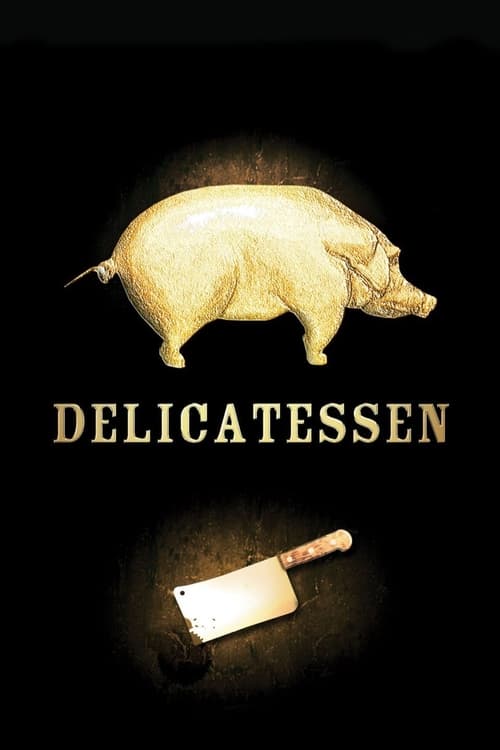
Delicatessen
1991 · Jean-Pierre Jeunet
For when you want something genuinely weird and wonderful — a cult movie night, a palate cleanser from ordinary films, dark humor that leaves you grinning rather than depressed.
What it's about
In a crumbling post-apocalyptic France where food is currency, a butcher runs an apartment building above his shop and keeps his tenants fed by luring in handymen who don't stay employed for long. Into this arrangement walks Louison, a gentle out-of-work circus clown, who takes the job and promptly falls for the butcher's cello-playing daughter — which puts her at war with her own father, with a band of vegetarian sewer rebels waiting in the wings.
The experience
Grim on paper, delightful in practice — a macabre fairy tale played as slapstick, full of clockwork visual gags and tenderness in the least likely places. It's funny, strange, and oddly sweet, with just enough dread underneath to keep the comedy sharp.
Performances
Dominique Pinon, with his rubber face and silent-comedy grace, makes Louison one of the great sweet-natured oddballs of 1990s cinema — the clown routines are performed, not faked.
The craft
Jeunet and Caro's debut is a marvel of handmade invention: amber-soaked cinematography, sets crammed with detail, and sound design that turns the whole building into an instrument — one famous sequence syncs the entire cast's chores to the rhythm of a creaking bed. Every frame is designed within an inch of its life, and it rewards a screen big enough to catch the background jokes.
Why it matters
It became a defining cult film of early-'90s European cinema, launched Jeunet toward international fame, and set the visual template — sepia tones, whimsical machinery, storybook grotesquerie — that his later work made world-famous.
Snapshot
Delicatessen is the feature debut of the French directing partnership Jean-Pierre Jeunet and Marc Caro, and one of the defining cult objects of early-1990s European cinema: a blackly comic post-apocalyptic fable set almost entirely within a single decaying apartment building perched above a butcher's shop. In a ruined, famine-stricken France where grain and lentils have replaced money, the butcher Clapet lures handymen to the building with advertisements for work, then slaughters them to sell as meat to his tenants. The arrival of Louison — a gentle former circus clown played by Dominique Pinon — disrupts the cycle when he falls in love with Clapet's myopic, cello-playing daughter Julie, prompting her to seek help from the Troglodistes, a band of vegetarian sewer-dwelling resistance fighters. From this grim premise the film extracts a relentless stream of invention: a sepia-toned, rust-and-amber world of clanking pipes, peeling wallpaper, and Rube Goldberg contraptions, animated by silent-comedy timing and the rhythmic, almost musical choreography of everyday catastrophe. Equal parts Marx Brothers, German Expressionism, and Terry Gilliam dystopia, Delicatessen announced two filmmakers of extraordinary visual control and launched, in cinematographer Darius Khondji and actor Dominique Pinon, careers that would shape the look and personnel of a distinctive strain of French cinema. It remains the purest expression of the Jeunet-Caro sensibility before their partnership and Jeunet's own trajectory diverged.
Industry & production
Delicatessen emerged from the world of French short film, advertising, and music video rather than from the established feature industry. Jeunet and Caro had collaborated since the late 1970s, building a reputation through award-winning animated and live-action shorts — most notably Le Bunker de la dernière rafale (1981) and Foutaises — and through commercial and music-video work that honed their taste for dense, stylized, technically meticulous imagery. Delicatessen was their first feature, and its production reflected the difficulty of translating that highly designed aesthetic into a feature budget.
The film was produced by Claudie Ossard, a producer central to a generation of distinctive French auteur cinema, working through Constructive Producers and associated entities, with backing that included UGC and French television and broadcast support typical of the period's financing structures. It was shot on constructed sets — the apartment building and its surrounding rubble-scape were largely studio-built — which allowed the directors the total environmental control their conception demanded. The single-location concentration was both an artistic choice and a practical economy, letting a limited budget purchase exceptional density of detail within a confined world.
The film opened in France in 1991 to strong domestic success and went on to sweep major categories at the following year's César Awards, where it won several prizes including, by general record, Best First Work, Best Editing, Best Original Screenplay, and Best Production Design — an unusually emphatic institutional embrace for a debut of such eccentricity. Internationally, the film was championed by Terry Gilliam, whose enthusiasm helped secure its distribution and framed its reception in English-language markets; it was released in the United States through Miramax in 1992. The exact contractual particulars of that arrangement are not something I can detail reliably, but Gilliam's public advocacy is part of the film's documented history and shaped how Anglophone audiences understood it.
Technology
Delicatessen is, technically, a film of traditional means deployed with exceptional craft rather than of technological novelty. It was shot photochemically on 35mm, and its effects are overwhelmingly practical: built sets, in-camera staging, mechanical contraptions, and the manipulation of light and color through lighting design and laboratory processing rather than digital intervention. The film predates the widespread adoption of digital effects, and its dystopian texture is achieved entirely through production design, cinematography, and editing.
What is genuinely notable is the rigor of the film's color control. The pervasive sepia-yellow-brown palette — the look of a world dried out, rusted, and starved — was achieved through art direction, costume, set surfacing, and photographic technique working in concert, a degree of chromatic unification that anticipates the heavily graded "looks" later cinema would pursue digitally. In that sense Delicatessen is an instance of a fully designed visual world produced by analog craft, and it would be an overstatement to credit any particular technological innovation; its achievement is one of discipline and integration.
Technique
Cinematography
The cinematography is by Darius Khondji, for whom Delicatessen was a breakthrough and the beginning of a celebrated international career. Khondji's images are the film's signature: a saturated sepia and amber palette that bathes everything in the jaundiced light of decay, deep and theatrical chiaroscuro, and a constant sense of the camera as an active, prowling participant. He favors wide-angle lenses that distort and exaggerate the cramped interiors, low and canted angles, and aggressive camera movement — tracking shots that race through the building's plumbing and stairwells, linking the tenants' simultaneous activities into a single mechanical organism. The lighting frequently isolates faces and objects in pools of warm light against engulfing shadow, lending the comedy a Gothic, almost expressionist weight. Khondji's work here established a visual vocabulary he and Jeunet would extend in The City of Lost Children and that would inform Khondji's later collaborations with directors including David Fincher.
Editing
The editing, by Hervé Schneid — recognized at the Césars — is fundamental to the film's effect, because Delicatessen is essentially a film of comic and rhythmic montage. Its most famous sequence is built entirely through cutting: as the butcher and a tenant make love, the squeaking rhythm of their bed-springs sets a tempo to which the whole building unconsciously synchronizes — a cello bow, a bicycle pump, a paintbrush, a ceiling whisk, all accelerating together toward a shared climax. The sequence is a virtuoso demonstration of cross-cutting as music, and it crystallizes the film's governing idea that the building is a single interconnected mechanism. Throughout, Schneid's cutting marries silent-comedy precision — the setup and payoff of visual gags timed to the frame — with a propulsive momentum that keeps the grotesque material buoyant.
Mise-en-scène / staging
Mise-en-scène is where the Jeunet-Caro partnership is most visible, and where Caro's contribution as designer is decisive; the two are co-directors, but the division of labor is generally understood to have given Caro principal responsibility for the film's visual and design conception and Jeunet for direction of performance and comic mechanics. The result is one of the most fully realized imagined environments in modern French cinema: a single building rendered as a self-contained, claustrophobic universe of rusted pipes, water-stained walls, junk-built machines, and accumulated bric-a-brac. Every surface is dressed; every room expresses character. The staging is built around physical contraptions and elaborate chains of cause and effect — most memorably the suicide-by-Rube-Goldberg-machine of the tenant Aurore, whose increasingly baroque self-destruction attempts are repeatedly, comically thwarted. The film's debt to bande dessinée (the French comics tradition) is evident in its caricatured figures, its exaggerated perspectives, and its panel-like compositional density. This is staging as worldbuilding: the apocalypse is never explained or shown at scale, only implied through the texture of the single building, which becomes a microcosm of a starved and predatory society.
Sound
The sound design extends the film's mechanical, rhythmic conception: the building is a soundscape of drips, creaks, springs, scraping metal, and the omnipresent hum of decay, and these noises are orchestrated as carefully as the score. The music is by Carlos D'Alessio, whose nostalgic, slightly antique themes — including a wistful musette-tinged quality — supply an unexpected tenderness and a sense of lost time that cuts against the grotesquerie. Julie's cello and Louison's musical saw provide a recurring diegetic motif, their fragile duet standing as the film's emblem of human connection amid the surrounding machinery. The interplay of carefully designed ambient noise, the integration of diegetic instruments into the film's rhythmic set pieces, and D'Alessio's bittersweet scoring together give the film a sonic identity as distinctive as its visual one.
Performance
The performances are pitched in a register of heightened, near-silent-film expressiveness. Dominique Pinon, with his unmistakable pugilist's face, anchors the film as Louison: physical, melancholic, and sweetly comic, a former clown whose gentleness makes him both the moral center and the principal vehicle for the film's elaborate physical gags. Pinon's casting began a long collaboration with Jeunet that would run through The City of Lost Children, Amélie, and beyond. Marie-Laure Dougnac plays Julie with a touching, fumbling sincerity — her short-sightedness a source of both pathos and comedy — while Jean-Claude Dreyfus gives the butcher Clapet a menacing, theatrical bulk that stops short of pure villainy. The ensemble of tenants, including performers such as Karin Viard, Ticky Holgado, and Rufus, fills the building with vivid grotesques, each given a defining tic or obsession. The collective performance style — broad, physical, choreographed to the editing — is integral to the film's identity as a modern silent comedy in sound.
Narrative & dramatic mode
Delicatessen's dramatic mode is that of the dark fable or grotesque comedy, closer to fairy tale and cartoon than to realism. Its narrative is loosely structured around the predatory economy of the building — Clapet's cycle of hiring and butchering handymen — and the romance between Louison and Julie that finally breaks it. The plot functions less as a tightly causal thriller than as an armature on which to hang set pieces, character vignettes, and escalating physical comedy; the film's pleasures are local and inventive as much as they are forward-driving. The tone holds an unstable, deliberately uneasy balance between horror and whimsy: cannibalism, murder, and starvation are rendered with cartoon lightness, while moments of genuine tenderness — the lovers' duet, Louison's bubble-blowing, the climactic flooded apartment — puncture the macabre surface. The resistance subplot involving the Troglodistes introduces an absurdist adventure-movie register in the final act, culminating in a chaotic, water-drenched climax that resolves the fable in the manner of comedy: the predatory order is overturned and the lovers survive. Throughout, the dramatic logic is that of the dream or the comic strip rather than of psychological realism, and meaning accrues through accumulation and atmosphere rather than through conventional plot mechanics.
Genre & cycle
The film is a genre hybrid — at once post-apocalyptic science fiction, black comedy, romance, and horror — that resists clean categorization, which is part of its identity. It belongs recognizably to a strand of stylized, designer-driven dystopian cinema whose most obvious kindred spirit is Terry Gilliam's Brazil (1985), with which it shares a retro-futurist aesthetic of decay, bureaucratic or social menace, and baroque production design; Gilliam's championing of the film made the affinity explicit. It also participates in a longer lineage of grotesque European fabulism and in the tradition of cannibal-comedy and "the building as microcosm of society" narratives. Within French cinema it stands at the head of a small cycle of highly designed, fantastical, visually maximalist films — continued by Jeunet and Caro's own The City of Lost Children (1995) — that some critics grouped, not always approvingly, under labels associated with a glossy, advertising-derived French style. Its fusion of silent-comedy mechanics with horror premises also connects it to a broader international vein of comic-macabre cinema running from German Expressionism through the early work of David Lynch.
Authorship & method
Delicatessen is a genuinely co-authored film, and its character is inseparable from the Jeunet-Caro partnership. The two had developed their shared sensibility across more than a decade of shorts and commercial work, and the feature represents its fullest realization. The generally understood division — Caro concentrating on visual design, art direction, and the overall look, Jeunet on directing actors, comic timing, and the orchestration of gags and editing — produced a film of rare unity between concept and execution, in which design and performance are mutually expressive. It would be a mistake to assign authorship to either alone; the film's distinctiveness lies precisely in the fusion.
Among the key collaborators, cinematographer Darius Khondji translated the directors' graphic conception into light and lens, establishing the sepia-drenched look that became the film's signature and a foundation of his own career. Editor Hervé Schneid gave the comic and rhythmic montage its precision. Composer Carlos D'Alessio supplied the bittersweet, antique-tinged score that lends the grotesquerie its unexpected warmth. And actor Dominique Pinon became, in effect, the human face of the Jeunet-Caro world, beginning a collaboration that would persist across the directors' subsequent films. The method throughout was one of total environmental control — building and dressing a complete world on set — and of meticulous pre-visualization rooted in the directors' backgrounds in animation, comics, and advertising, where every frame is composed and nothing is left to chance.
Movement / national cinema
Delicatessen is a landmark of early-1990s French cinema and is often cited in discussions of a visually flamboyant tendency that emerged in French film through the 1980s and into the 1990s — a cinema descended in part from the cinéma du look of directors like Jean-Jacques Beineix and Luc Besson, with its privileging of surface, design, color, and spectacle, and inflected by the visual languages of advertising, music video, and comics. Jeunet and Caro extended that designer sensibility into the territory of fantasy and the grotesque. The film also exemplifies a particular French industrial model in which producers like Claudie Ossard could shepherd idiosyncratic auteur projects to completion with a mix of private and broadcast financing. As national cinema, Delicatessen represents a confident, export-ready French art-house product of its moment — distinctly French in its references and humor, yet internationally legible, and its success abroad helped define how French stylistic cinema was received in the Anglophone world in the early 1990s.
Era / period
The film is very much an artifact of its early-1990s moment, even as its setting is a timeless, unplaceable post-apocalyptic ruin. Its retro-styling deliberately evokes an earlier France — a vaguely mid-twentieth-century world of musette music, antique appliances, and worn interiors — refracted through catastrophe, so that the period it conjures is a nostalgic, dreamlike past rather than any specified future. Made before the digital transformation of effects-driven cinema, it belongs to the last era in which such an elaborately imagined world had to be physically constructed and photographed in-camera, and its craft bears the marks of that constraint as a virtue. The film's preoccupations — scarcity, hoarding, the breakdown of social trust into predation — resonate with perennial anxieties rather than with a datable contemporary crisis, which is part of why the film has aged into a stable cult classic rather than a period curiosity.
Themes
At its center Delicatessen is a fable about scarcity and what it does to community: in a world where meat is precious and grain is currency, the social contract has curdled into literal cannibalism, neighbors complicit in one another's consumption. The building becomes a microcosm of a predatory society organized around hunger, and the film's horror-comedy mines the grim logic by which ordinary people accommodate themselves to atrocity for the sake of survival. Against this stands the redemptive force of love and art — the fragile duet of Julie's cello and Louison's saw, the gentleness of the clown — which the film offers, without sentimentality, as the means by which the cycle of predation is finally broken. Related themes recur throughout: complicity and resistance (the passive tenants versus the absurd but principled Troglodistes); the persistence of innocence and play in a brutal world (Louison's bubbles, his circus past, the recurring motif of performance); and a pervasive, affectionate nostalgia for a lost world of music and craft, embodied in the production design and D'Alessio's score. Underlying all of it is the film's characteristic vision of human beings as both grotesque mechanisms — locked into rhythms and obsessions, parts of a larger machine — and as creatures capable of tenderness, the two registers held in constant, productive tension.
Reception, canon & influence
Delicatessen was a critical and commercial success in France and a celebrated discovery abroad, where it acquired immediate cult status. Its institutional vindication came swiftly with its strong showing at the César Awards, where it took multiple prizes including, by the general record, Best First Work, Editing, Screenplay, and Production Design — a remarkable endorsement for so unconventional a debut. Internationally, aided by Terry Gilliam's advocacy and Miramax's U.S. release, it became a fixture of art-house and repertory programming and a touchstone for audiences drawn to stylized, dark European fantasy. Critical opinion, then and since, has occasionally faulted the film for privileging visual ingenuity over emotional or narrative depth — a charge sometimes leveled at the broader French stylistic tendency it represents — but the consensus regards it as a dazzling and original debut and one of the most distinctive films of its decade.
Influences on the film run backward to silent comedy (the physical timing and clown figure recall Chaplin, Keaton, and the gag traditions of early cinema), to German Expressionism (the chiaroscuro and distorted spaces), to the Marx Brothers' anarchic ensemble comedy, to the dystopian design cinema of Terry Gilliam, to David Lynch's Eraserhead and its industrial dream-horror, and to the French bande dessinée tradition that shaped the directors' graphic sensibility. Forward, its influence is felt first in the directors' own subsequent work: The City of Lost Children (1995) extended the partnership's aesthetic, and Jeunet carried elements of the Delicatessen method — the rich production design, the warm-toned palette, the ensemble of grotesques, and the recurring presence of Dominique Pinon — into his international breakthrough Amélie (2001), even as that film redirected the sensibility toward whimsy and warmth. More broadly, Delicatessen helped establish a template for darkly comic, maximally designed genre cinema, and its central set-piece — the building synchronized to a rhythm through cross-cutting — endures as a frequently cited example of editing as comic music. Darius Khondji's career as one of the most sought-after cinematographers in world cinema effectively began here. The film retains a secure place in the canon of 1990s European cult cinema and as the foundational statement of one of contemporary French film's most singular creative partnerships.
A Deleuzian reading
Start the film again at the squeak.
The full Deleuzian reading of Delicatessen →
Reception
A sensation in France on release — it won four Césars including Best First Film — and an arthouse crossover hit abroad, it's since settled in as one of the defining cult objects of 90s French cinema and the origin story cinephiles point to before Amélie.
How Delicatessen was received, from release to now →
Influences: the films it descends from and the films it influenced
- The Cabinet of Dr. Caligari (1920) — German Expressionist distortion of architectural space and painted chiaroscuro that Jeunet-Caro restage as the warped, tilting interiors and sourceless amber shadow of the tenement.
- Sherlock Jr. (1924) — Deadpan precision of the mechanical physical gag — the body timed against props and machinery — which underpins Pinon's silent-comedy contraption routines.
- Modern Times (1936) — The clown figure pitted against an industrial apparatus, mixing pathos with mechanized slapstick, a register the film borrows for its grotesque-but-tender ensemble.
- Duck Soup (1933) — Anarchic Marx Brothers ensemble comedy where every tenant is a self-contained comic engine, modeling the film's apartment-block-as-vaudeville-troupe staging.
- Eraserhead (1977) — Monochrome industrial dream-horror built from texture and a dense diegetic sound bed of hums and clanks — the tactile decay and unsettling sound design Khondji and Jeunet adapt.
- The Tenant (1976) — The apartment building as a closed paranoid microcosm whose neighbors collude against the protagonist — the literal architecture-as-society structure Delicatessen weaponizes through cannibalism.
- Brazil (1985) — Retro-future dystopian production design and wide-angle lens distortion of cramped bureaucratic interiors — the explicitly cited template for total designed worldbuilding.
- Themroc (1973) — Wordless French black comedy of an apartment dweller regressing into walled-off cannibal grotesquerie, a direct precedent for building-bound dialogue-light absurdism.
- The Cremator (1969) — Grotesque black comedy of a genteel professional-turned-killer shot in caricaturing wide-angle — the tonal fusion of fastidious politeness and cannibal horror that Herz's cremator originates.
- The Element of Crime (1984) — Confines a post-catastrophe European ruin to one amber-green chromatic band, staged in wide-angle deep focus, and is the clearest inheritor of the premise that a narrow spectrum can substitute for production design in building a world.
- The City of Lost Children (1995) — The partnership's immediate continuation — Khondji's sepia palette, Pinon, and total-environment set construction carried forward into a denser bande-dessinée world.
- Se7en (1995) — Khondji extends the same bleach-and-amber, tar-dark sepia grading and naturalistic-but-rotted texture he pioneered here into a different genre register.
- Amélie (2001) — Jeunet recycles the warm-toned palette, the ensemble of building-bound grotesques, and Pinon, redirecting the maximal-design method from dread toward whimsy.
- Sweeney Todd (2007) — The cannibal-butcher black comedy rendered as meticulously designed gothic grotesque, extending the trade-in-human-meat premise as stylized production-design spectacle.
- Micmacs (2009) — Plot mechanics built entirely from Rube Goldberg practical-analogue contraptions and a junk-troupe of grotesques — the contraption-as-narrative-engine taken to its limit.
- Snowpiercer (2013) — Post-apocalyptic society staged as a sectioned single structure read compartment-by-compartment, extending the building-as-stratified-microcosm with a cannibal underclass.
- Mickey 17 (2025) — Jeunet and Caro's debut deploys Khondji's cold atmospheric palette within dark satirical genre — cannibalism literalizing disposable-labor economics — and stages hierarchical building-strata through low-angle spatial geometry, delivering both the visual instrument and its social application that Bong recruits for Mickey 17.
- Survive Style 5+ (2004) — Pioneered the hermetic, over-designed production-design-as-engine approach where every prop, color and set surface is choreographed for surreal black comedy rather than realism.
- Estômago: A Gastronomic Story (2008) — A dark comedy built on food, hunger, and cannibalism in a cramped enclosed world, pairing culinary craft with deadpan grotesquerie the way Estômago does across its cell and kitchen.
- Okja (2017) — Khondji's calling card for the assignment: jaundiced amber-and-bile interior zoning and butchery photographed as comic grotesque, the same chromatic separation he uses to make Mirando's labs and the Manhattan showroom read as different worlds from the Korean mountainside.
- The Triplets of Belleville (2003) — French bande-dessinée caricature translated into motion — exaggerated grotesque physiognomy and near-wordless rhythmic visual gag-telling from the same graphic lineage.
- Mood Indigo (2013) — French maximalist practical-analogue whimsy — handmade in-camera contraptions and absurd domestic machines — sharing the anti-digital, build-it-on-set ethos.
- The Grand Budapest Hotel (2014) — A single building as a meticulously designed dollhouse populated by an ensemble of grotesques, orchestrated through rhythmic, music-like cross-cut montage.
- The Hole (1998) — Shares the strategy of grounding grotesque folktale logic in a hermetic, lovingly-textured domestic setting where dark humor and matter-of-fact horror coexist.
- The Shape of Water (2017) — Shares the Jeunet-Caro retro-industrial dinge—sepia-green apartment-block interiors, dripping pipes and machinery fetishized in close-up—that shapes Elisa and Giles's tenement world.
- Black Cat, White Cat (1998) — Runs an enclosed grotesque community as a clockwork of practical in-camera farce mechanics and choreographed simultaneous action, a European sensibility parallel to Kusturica's staged chaos.
- Jabberwocky (1977) — Degraded ochre palette, extreme wide-angle close-ups that bulge grotesque character faces, and dense mechanical ambience — a direct extension of Jabberwocky's lens-and-texture method of world-building on a small budget.
- Cronos (1993) — A parallel solution to the same problem: a decayed near-future built entirely from amber-and-verdigris design inside a single building, with a mix that foregrounds every spring, crank and ratchet as foley — the way Cronos scores its device's clockwork audibly over dialogue.
Similar films
- Amélie (2001) — influence & lineage
- The City of Lost Children (1995) — influence & lineage
- The Triplets of Belleville (2003) — influence & lineage
- I Lost My Body (2019) — shared sensibility
- Julien Donkey-Boy (1999) — shared sensibility
- Possession (1981) — shared sensibility
- Belle de Jour (1967) — shared sensibility
- The Exterminating Angel (1962) — shared sensibility