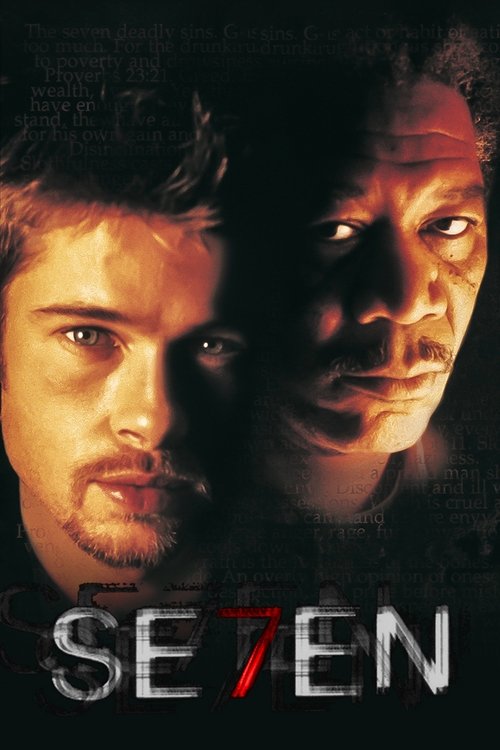
Se7en
1995 · David Fincher
The Killer and his Netflix marriage keep the "master craftsman in a streaming cage" discourse alive; every rumored project (the Chinatown prequel series, a Squid Game English remake rumor cycle) trends instantly.
For when you're craving something dark and gripping and don't need a happy ending — a rainy-night thriller that takes you all the way down. Definitely a challenge, not a comfort; know what you're signing up for.
What it's about
In a nameless, rain-soaked city, a serial killer is staging murders themed on the seven deadly sins — gluttony, greed, and on down the list. Detective Somerset, a week from retirement, wants to understand the mind behind the pattern; his new partner Mills, young and hot-headed, just wants to catch the guy. The investigation pulls both men somewhere much darker than a normal case.
The experience
Oppressive in the best way — dread accumulates scene by scene until it's almost physical. It's grim, smart, and genuinely disturbing, less about gore than about the feeling that the city itself is sick; the final stretch is famously unshakeable.
Performances
Morgan Freeman gives Somerset a weary, bookish gravity that anchors the whole film, and Brad Pitt's live-wire impatience plays perfectly against him. A third performance, arriving late, is chilling enough that people still talk about it.
The craft
Fincher drenches every frame in rain, shadow, and sickly light — interiors so dark you lean forward to see — and the mood is set from the first seconds by one of the most influential title sequences ever made. The design of the crime scenes is grisly without being gratuitous: you see less than you think you did. Watch it in a dark room.
Why it matters
It redefined the look and moral temperature of the American crime thriller — the wave of bleak, atmospheric serial-killer films and TV that followed all trace back here — and it made David Fincher's career.
Snapshot
Se7en is a neo-noir procedural thriller in which two detectives—the retiring Somerset (Morgan Freeman) and his newly transferred replacement Mills (Brad Pitt)—pursue a serial killer whose methodical murders enact the seven deadly sins as a theological indictment of modern civilization. The film is as much an exercise in atmosphere and dread as it is a narrative puzzle: its unnamed city is perpetually sodden, its interiors barely lit, its victims displayed with ritualistic horror. The climax—in which the killer, John Doe (Kevin Spacey), surrenders to the police and leads the detectives to a desert location where a delivered box resolves the film's final, devastating sin—remains one of the most discussed endings in contemporary Hollywood cinema. Se7en redefined the aesthetics and moral register of the American crime film for a generation.
Industry & production
Se7en originated with screenwriter Andrew Kevin Walker, who drafted the script while working at a Tower Records store in New York City during the early 1990s. The experience of living in a city perceived as deeply dysfunctional shaped the script's relentless urban pessimism. The screenplay circulated for some time before landing at New Line Cinema, where it was developed under producers Arnold Kopelson and Phyllis Carlyle. New Line, a mid-size studio that had recently broken into mainstream success with the Nightmare on Elm Street franchise and was pursuing prestige crime fare, greenlit the project at a relatively modest budget.
David Fincher came to the project following the notoriously troubled production of Alien 3 (1992), a studio-mandated experience that left him deeply frustrated with interference from 20th Century Fox. Se7en represented a corrective: the chance to work on a contained, character-driven script with collaborators he chose. He pushed hard for the script's original ending—the contents of the box, Tracy Mills's severed head—against resistance from the studio and some producers who reportedly wanted a more conventional resolution. The preservation of that ending is often credited in part to Brad Pitt, who made clear his commitment to the darker conclusion. Whether the exact dynamics of that negotiation are as clean as the myth suggests is difficult to verify, but Fincher's own account consistently emphasizes the ending as non-negotiable to his participation.
Kevin Spacey, cast as John Doe after the character's appearance in the third act required a performer capable of calm, unnerving authority, insisted his name be removed from the promotional materials and opening credits so that audiences would encounter him without foreknowledge. This was an unusual commercial decision—Spacey was a rising presence following The Usual Suspects, released the same year—and it largely succeeded in preserving the surprise of the casting.
Technology
Se7en's most consequential technical contribution was its use of photochemical silver retention processing, colloquially described as a bleach-bypass or ENR (Ernesto Novelli) process, applied to the film's print stages. By partially or fully skipping the bleach step in conventional color development, cinematographer Darius Khondji and Fincher achieved increased contrast, reduced color saturation, and a distinctive silver sheen in the blacks. The result is a visual texture that feels simultaneously decayed and hyper-real—shadows pool with unusual depth, flesh tones gray toward the mortuary, and the film's pervasive rain-slicked surfaces reflect light with unsettling clarity. This look was not invented for Se7en, but the film popularized the technique to such a degree that silver retention became a widely imitated signature of dark thrillers in the late 1990s and 2000s.
The film's title sequence—designed by Kyle Cooper at the studio that would become Imaginary Forces—achieved its own technological notoriety. Cooper used actual razor blades to scratch directly onto processed film stock, combined with hand-rendered text and macro photography of disturbing imagery, to create a sequence that feels authored at a micro-physical level. The sequence runs over a slowed, remixed version of Nine Inch Nails' "Closer" and functions as a compressed articulation of John Doe's inner world: obsessive, self-mutilating, biblical in its catalog of transgression. It became one of the most studied and imitated title sequences in cinema, effectively launching a new era of typographic experimentation in the form.
Technique
Cinematography
Darius Khondji's work on Se7en is among the most influential visual documents of 1990s American cinema. His approach was systematic: sources of light within the frame are motivated—a bare bulb, a flashlight beam, streetlight through a rain-slicked window—and the camera is positioned to allow maximum shadow. Khondji rarely illuminated from above in the conventional studio sense; interiors are lit from below or from angles that render faces ambiguous and architecture menacing. The unnamed city, constructed primarily on studio backlots and Los Angeles locations transformed through production design and weather, never suggests sunlight as a possibility. Khondji maintained the affectation of a city that simply does not dry out. His lens choices tend toward slight wide angles in confined spaces, exaggerating depth and making rooms feel simultaneously too large and claustrophobic. This was Khondji's American debut feature of major profile; he had already demonstrated his atmospheric range in Jean-Pierre Jeunet and Marc Caro's Delicatessen (1991).
Editing
Richard Francis-Bruce's editing is notable for what it withholds. The film's procedural rhythm is deliberate to the point of austerity: we spend considerable time with victims after the fact, in the company of forensic investigators and Somerset's painstaking research, rather than with the killer during the acts themselves. Cutting follows character consciousness more than conventional thriller momentum. The effect is that dread accumulates laterally rather than escalating in a linear ratchet. The intercutting in the climactic desert sequence is among the most analyzed in the film—the deliberate pacing of shot/reverse shot between Mills, Somerset, and the approaching delivery van creates a space in which the audience's knowledge of what might be in the box arrives slightly ahead of Mills's comprehension, producing something close to tragic irony.
Mise-en-scène / staging
Arthur Max's production design is as central to the film's meaning as any performance. John Doe's apartment—papered floor to ceiling with obsessive journals, furnished with a grim asceticism—communicates his inner logic more efficiently than exposition. The staging of the crime scenes operates on a logic of excess: gluttony enacted through surfeit, sloth through extended inaction, pride through erasure. Fincher consistently places his actors in relation to environmental texture—peeling walls, stacked paperwork, institutional corridors—so that the city's material decay registers as an argument rather than a backdrop. The unnamed city is deliberately constructed to feel placeless: the production avoided specific landmarks and dressed locations to suggest a composite American urban environment. Rain was, in part, a practical solution to concealing location-specific cues, but it became inseparable from the film's tonal identity.
Sound
Howard Shore's score operates at a low frequency of menace, eschewing the conventional thriller vocabulary of sudden orchestral stabs. Shore grounds the music in a minor-key unease that suggests institutional weight rather than personal terror—the score feels almost procedural, a bureaucratic rhythm beneath the horror. The contrast with the opening credits' use of "Closer" is deliberate: Nine Inch Nails' industrial texture represents John Doe's register, while Shore's orchestral writing represents Somerset's—measured, melancholic, exhausted. Sound design throughout makes effective use of ambient urban texture: rain, distant sirens, institutional HVAC hum. The film's sound world is relentlessly uncomfortable without being showy about it.
Performance
Morgan Freeman's Somerset is the film's moral and tonal center. Freeman plays against the conventions of the world-weary detective by grounding Somerset's exhaustion in genuine intellectual life: he is a reader, a researcher, a man who has chosen to understand what he polices even as that understanding destroys his capacity for optimism. The performance is notably still. Brad Pitt's Mills functions as the film's surrogate audience identification—impulsive, confident, unequipped—and Pitt's natural charisma is precisely calibrated against Freeman's reserve. Kevin Spacey appears late and delivers John Doe as a figure of eerie equanimity, a man who has achieved a terrible coherence. Spacey's underplaying in the handcuffed scenes, while Mills escalates toward violence, creates an asymmetry that is deeply unsettling. Gwyneth Paltrow's Tracy is given less screen time than her narrative function demands, a structural limitation the film is aware of but does not fully resolve.
Narrative & dramatic mode
Se7en operates in the procedural mode characteristic of literary crime fiction—the detective investigates backward from effect to cause—but it subverts procedural conventions at nearly every turn. The killer is not gradually revealed through deduction; he surrenders. The mystery the detectives must solve is not who committed the crimes but what the crimes mean, a hermeneutic task Somerset is suited for and Mills is not. The script's organizational device, the seven deadly sins, draws on Thomas Aquinas and medieval Catholic moral taxonomy, and Walker uses the structure with genuine rigor: each victim is implicated in their own destruction, which allows the film to sustain moral ambiguity about whether Doe's diagnosis of his world has a kind of terrible validity.
The film's ending inverts the procedural's conventional promise of order restored. Somerset, who has spent the film methodically seeking pattern and meaning, watches the pattern complete itself in a way that destroys the one person he has come to care for. The final act belongs to Mills, who is used by Doe as an instrument—made to enact Wrath in response to Envy—which strips him of agency in a manner that retroactively reframes his character as a tragic figure. Somerset's final voiceover, adapted loosely from Ernest Hemingway, closes on ambivalence rather than resolution.
Genre & cycle
Se7en belongs to the neo-noir revival of the early-to-mid 1990s and specifically to the post-Silence of the Lambs serial killer procedural cycle. The Silence of the Lambs (1991) had demonstrated that the serial killer could be the subject of prestige filmmaking—psychologically complex, morally serious, commercially viable. A cluster of films responded to this: Copycat (1995), Kiss the Girls (1997), The Bone Collector (1999), and many others of diminishing returns. Se7en is the most formally accomplished of this cycle's secondary wave, distinguishing itself through the severity of its visual approach and the rigor of its structural conceit.
More broadly, Se7en belongs to the 1990s revitalization of hard-boiled detective narrative in American cinema, a moment that included Heat (1995), The Usual Suspects (1995), L.A. Confidential (1997), and Fincher's own subsequent work. These films shared an interest in institutional failure, masculine exhaustion, and the inadequacy of conventional justice frameworks.
Authorship & method
David Fincher's directorial signature is legible in Se7en more fully than in Alien 3, where studio interference obscured his intentions. His method involves extensive pre-visualization—he is a director who shoots what he has planned, with minimal improvisational latitude—and a demanding relationship with visual precision. He worked closely with Khondji to develop a shooting strategy in which source light motivated every setup, a constraint that shaped performance and staging as much as it shaped the image. Fincher has spoken in various interviews about his preference for working within genre conventions in order to subvert them from within, and Se7en demonstrates this sensibility: it fulfills the procedural's promises structurally while evacuating its emotional reassurances.
Andrew Kevin Walker's contribution is foundational. Walker's script arrived with its structure, its voice, and its ending largely intact; Fincher's contribution was to realize the script's latent visual logic rather than to redirect it. Walker subsequently wrote 8MM (1999, dir. Joel Schumacher), a film that demonstrates what Se7en might have looked like in less precise hands, and contributed to the screenplay for Sleepy Hollow (1999). His career suggests a consistent investment in dark urban subject matter, though Se7en remains his most fully realized work.
Howard Shore brought to the score a sensibility developed across his collaboration with David Cronenberg—an ability to treat psychological horror as something to be underscored with orchestral weight rather than genre signaling. Darius Khondji, departing the project before Fincher's next film, established in Se7en a visual grammar he would develop further in his subsequent career, including his work with James Gray.
Kyle Cooper's title sequence deserves separate acknowledgment as a collaborative work of considerable consequence. It is the film's overture, and it established a new expectation for what opening credits could do aesthetically and argumentatively.
Movement / national cinema
Se7en is firmly within the American studio system but operates at the margins of the commercial mainstream in terms of its tonal ambitions. It participates in what might be called the prestige crime film as it developed in American cinema after the New Hollywood period: serious in literary intent, pessimistic about institutions, willing to forgo catharsis. The film has no meaningful connection to a national cinema in the tradition of explicitly political filmmaking; its concerns are moral and atmospheric rather than sociological or historical. If it belongs to a "movement," it is the generation of American directors who came to features through music video and advertising in the late 1980s and early 1990s—Fincher, Michael Bay, Spike Jonze, Jonathan Glazer—who brought a high degree of visual sophistication and formal control to genre materials.
Era / period
The mid-1990s in American cinema were characterized by a particular form of generic self-consciousness: films aware of their genre conventions, either to subvert them (Pulp Fiction, 1994; The Usual Suspects, 1995) or to reinvest them with formal seriousness (Heat, 1995; Se7en). This was also the last period before digital intermediates became standard, which meant that photochemical processes—including silver retention—remained viable tools for cinematographic experimentation. Se7en's look belongs specifically to this chemical moment; the texture it achieves is not easily reproducible through digital grading alone, and the film's visual identity is inseparable from its photographic substrate.
Themes
Se7en's central thematic argument concerns the impossibility of disinterested witness. Somerset attempts to maintain professional distance from a city he has concluded is beyond saving; the film demolishes this posture not by restoring his faith but by implicating him in a personal loss that makes indifference no longer available. John Doe's project is the coercion of witnesses—he needs Somerset and Mills to see, to understand, to complete his demonstration—and in this sense the film is a meditation on the ethics of spectatorship, including, reflexively, of watching horror cinema.
The film is also concerned with institutional failure. The police department in Se7en functions as a bureaucracy incapable of preventing the crimes it is designed to prevent; Somerset's exhaustion is partly exhaustion with paperwork, with the gap between investigative capacity and criminal imagination. The library scene—Somerset researching Dante and Chaucer while a jazz standard plays—presents reading and thought as the only available response to a world the institutions cannot manage, a consolation that the film both endorses and ultimately disables.
Religion functions as structural armature rather than sincere moral framework. The seven deadly sins are Doe's grid; the film does not endorse medieval Catholic theology but uses its categories as a container for contemporary anxieties about consumption, violence, and vanity.
Reception, canon & influence
Se7en received generally strong reviews on release, with critics noting its formal ambition and distinguishing it from more commercial entries in the serial killer cycle. Roger Ebert's review praised the film's atmospheric coherence and Freeman's performance while expressing some reservation about the bleakness of its vision—a response that fairly represents the critical mainstream. The film performed significantly above its modest budget at the domestic and international box office, establishing Fincher as a commercially viable filmmaker and demonstrating that extreme tonal darkness was not incompatible with mass audience appeal.
Influences on Se7en: The Silence of the Lambs (1991) is the direct precursor in terms of cycle, tone, and the figure of the psychologically articulate killer. Behind it lies the entire tradition of hard-boiled detective fiction—Dashiell Hammett, Raymond Chandler—and the noir films they generated. Walker's script engages seriously with Dante's Inferno and Chaucer's Parson's Tale as moral taxonomies. Stylistically, the film draws on the visual grammar of European crime cinema—the underlit, rain-soaked city has antecedents in Carol Reed's The Third Man (1949) and in the French polar tradition—as well as the American neo-noirs of the 1970s, including Chinatown (1974) and Taxi Driver (1976), the latter particularly in its portrait of urban despair as theological condition.
Se7en's legacy: The film's influence is pervasive and genuinely difficult to overstate within the crime genre. The bleach-bypass aesthetic was adopted across a range of thrillers and action films through the late 1990s and 2000s, becoming something close to a generic marker for moral seriousness in the crime film before it calcified into cliché. Kyle Cooper's title sequence inaugurated a period of intense typographic and filmic experimentation in main title design that continued through the 2000s; its influence can be traced directly to the title sequences of Fincher's subsequent films and to work as distant as Daniel Kleinman's James Bond title sequences.
The "puzzle killer" with an elaborate conceptual scheme—a murderer whose crimes constitute an argument—became a major cycle in its own right, generating imitators of varying quality including The Cell (2000), Saw (2004) and its franchise, and numerous television procedurals. Fincher's own television production work on Mindhunter (2017–2019), which examines the early history of the FBI's Behavioral Science Unit, can be read as a more historical and institutional engagement with questions Se7en raises about the attempt to understand criminal logic.
Within Fincher's own filmography, Se7en sits as the film where his formal priorities crystallized. The obsessive precision, the interrogation of masculine competence and failure, the pessimism about institutional and civic life—all of these recur in The Game (1997), Fight Club (1999), Zodiac (2007), The Girl with the Dragon Tattoo (2011), and The Killer (2023). Se7en remains the most viscerally immediate expression of those concerns, the film in which Fincher's method and the material achieved an unusually complete correspondence.
A Deleuzian reading
The first thing John Doe leaves is a word.
The full Deleuzian reading of Se7en →
Reception
Critics in 1995 were split — plenty admired it but many recoiled at its grimness — and audiences turned it into a word-of-mouth sleeper hit; three decades on it's settled comfortably into modern-classic status and rehabilitated Fincher after the Alien 3 debacle.
How Se7en was received, from release to now →
Influences: the films it descends from and the films it influenced
- Chinatown (1974) — Se7en's finale structure—the detective who arrives too late, the victim he could not save, the deliberate refusal of catharsis—inherits its tragic logic directly from Chinatown's ending, where the private eye's intervention accelerates rather than prevents the catastrophe.
- Blade Runner (1982) — Jordan Cronenweth's neon-through-wet-surface cinematography and the rain-soaked, placeless city as philosophical environment are the direct visual precedent for Se7en's unnamed city, which Khondji and Fincher treat as an organism that simply does not dry out.
- Tenebrae (1982) — Argento's giallo grammar—the killer's murders as aesthetic statements authored for the investigator to read, each crime scene arranged as a legible text—is the formal ancestor of Se7en's 'crime scene as argument' staging, where John Doe's tableaux function as theological propositions demanding interpretation.
- Manhunter (1986) — The first American feature to build prestige-thriller grammar around the FBI profiler who must inhabit the killer's aesthetic sensibility; Se7en inherits the profiler-as-mirror structure, the ritualistic murder as authored statement, and the investigator's moral contamination by prolonged proximity to a superior intellect.
- Angel Heart (1987) — Supplies the theological architecture Se7en develops: a detective descending through a case whose structure is infernal rather than merely criminal, culminating in a calm, philosophically assured antagonist who appears in the final act and reframes the entire investigation as a form of damnation.
- The Silence of the Lambs (1991) — Established the prestige serial-killer procedural grammar—FBI investigation elevated to moral tragedy, the intellectual killer as theological problem, the victim as object within the killer's philosophical system—that Se7en inherits and darkens by removing the investigator's victory entirely.
- Delicatessen (1991) — Khondji's source-motivated, severely desaturated low-key work in decay-saturated industrial spaces—practical lamps and shafts of exterior light doing all the illumination—directly trained the visual language he brought to Se7en four years later; this was his calling card before his American debut.
- In the Line of Fire (1993) — Advances the sympathetic-yet-monstrous antagonist who orchestrates the duel from psychological intimacy and surrenders on his own terms — Leary's lineage of the controlling villain.
- Dirty Harry (1971) — Inherits Scorpio's innovation of the serial killer who authors and controls the investigation, taunting and out-maneuvering the detectives so the manhunt becomes the murderer's design.
- The Testament of Dr. Mabuse (1933) — Its unseen planner engineers a sequence of crimes that keep executing even after his capture, the Testament structure of an incarcerated mind whose scheme runs autonomously beyond the author's confinement.
- Stray Dog (1949) — Drives its procedural through the weary veteran / green rookie mentorship, the buddy-detective pairing whose template Stray Dog is repeatedly credited with fixing.
- Nineteen Eighty-Four (1984) — Darius Khondji ran silver-retention on the release prints to hold black and kill color saturation — the same photochemical lever Deakins pulled — and paired it with an unrelieved wet, lightless city, carrying the bleach-bypass dystopia directly into American studio filmmaking.
- Cure (1997) — Japanese parallel development of Se7en's detective-contaminated-by-investigation structure: the homicide investigator pursues a killer whose crimes leave investigators morally eroded rather than triumphant, and the procedural form is used to deliver philosophical dread rather than resolution.
- L.A. Confidential (1997) — Participates directly in the prestige crime cycle Se7en launched: city-as-corruption-body staging, procedural investigation that exposes systemic evil rather than individual transgression, and the elevation of the crime film to literary moral tragedy through controlled cinematography and withheld revelation.
- Dark City (1998) — The unnamed, perpetually nocturnal, rain-drenched city as philosophical architecture descends from Se7en's placeless-city staging—the environment as argument rather than location—extended into science fiction by making the city's unreality the film's explicit subject rather than its atmospheric implication.
- Fight Club (1999) — Fincher extends Se7en's uncredited-late-entry antagonist device: Tyler Durden's revelation reconfigures the entire preceding film exactly as John Doe's third-act surrender does; the Saul Bass-influenced kinetic title design continues the Kyle Cooper–Se7en tradition of the credit sequence as compressed manifesto.
- Memories of Murder (2003) — Inverts Se7en's serial-killer procedural so that the detectives fail and the case goes cold, performing the same subversion of genre expectation that Se7en's ending executes but sustaining it across the entire investigative arc rather than concentrating the subversion in a single climactic delivery.
- Zodiac (2007) — Fincher extends Se7en's procedural-withholding editing to its logical conclusion: an investigation that actively refuses resolution and transforms inquiry into obsessive self-destruction, with cutting that implicates the act of looking itself as a form of moral contamination rather than heroic purpose.
- The Girl with the Dragon Tattoo (2011) — Trent Reznor and Atticus Ross's title sequence—hand-authored imagery over a remixed industrial track—closes the NIN circle opened by Kyle Cooper's Se7en main title; Jeffrey Cronenweth's bleach-bypass-emulating digital photography continues the high-contrast desaturated visual grammar Darius Khondji established on the original.
- Prisoners (2013) — Roger Deakins' silver-toned, heavily desaturated digital cinematography directly continues Se7en's bleach-bypass visual grammar; the editing's procedural withholding—scenes of investigation that accumulate dread without revelation—extends Se7en's most radical formal innovation into contemporary prestige crime.
- The Dark Knight (2008) — The philosophical killer who constructs a scenario forcing the hero to violate their own moral code in the final act; Fincher's editing restraint—holding John Doe in medium shot, refusing the accelerating close-up—is the direct template for Lee Smith's Joker scenes.
- The Game (1997) — Darius Khondji and Fincher pioneered the aggressive photochemical bleach-bypass desaturation — stripping warmth toward silver-gray to make the image feel post-vital — that Harris Savides then applied and refined as The Game's governing color ideology.
- I Saw the Devil (2010) — The anti-cathartic resolution structure — a finale that refuses the protagonist's satisfaction and implicates him in the catastrophe he sought to prevent — is the narrative template I Saw the Devil radicalizes by distributing the moral corruption across the full running time rather than concentrating it at the climax.
- Mickey 17 (2025) — Khondji's collaboration with Fincher established his signature desaturated, green-shifted cold-atmospheric palette — underexposed shadows, clinical highlights, visible grain from bleach-bypass processing — that Khondji carries directly into Mickey 17 as a visual grammar for institutional dread.
- The Usual Suspects (1995) — Released the same year, it co-deploys Kevin Spacey's calm uncredited-surprise antagonist strategy—both films withheld Spacey from advertising—and develops the hermeneutic mystery procedural, a narrative that reveals its entire structure has been authored by the killer all along, in exact parallel to Se7en.
- The City of Lost Children (1995) — Darius Khondji's near-contemporaneous cinematography deploys the same desaturated, bleach-and-grade palette and oppressive low-key lighting, marking his signature pre-digital-intermediate look applied across both films.
- Hannibal (2001) — Murders staged as deliberately authored compositions, advancing the killer-as-erudite-artist whose crimes demand curatorial reading.
Similar films
- Zodiac (2007) — influence & lineage
- Fight Club (1999) — influence & lineage
- The Usual Suspects (1995) — influence & lineage
- Chinatown (1974) — influence & lineage
- Dark City (1998) — influence & lineage
- The Girl with the Dragon Tattoo (2011) — influence & lineage
- Serpico (1973) — shared sensibility
- The Chaser (2008) — shared sensibility
All the films related to Se7en →
Film essays and courses that include it
- David Fincher
- Portrait of the Killer: Serial Murder from Lang to Fincher
- The Grammar of Shadow: Chiaroscuro from Expressionism to Digital Noir
- Portrait of a Killer: How Cinema Learned to Inhabit the Monster
- Premeditated: Cinema's Century of the Kill
- What the Darkness Knows: The Occult Procedural and Its Investigators
- The Autopsy