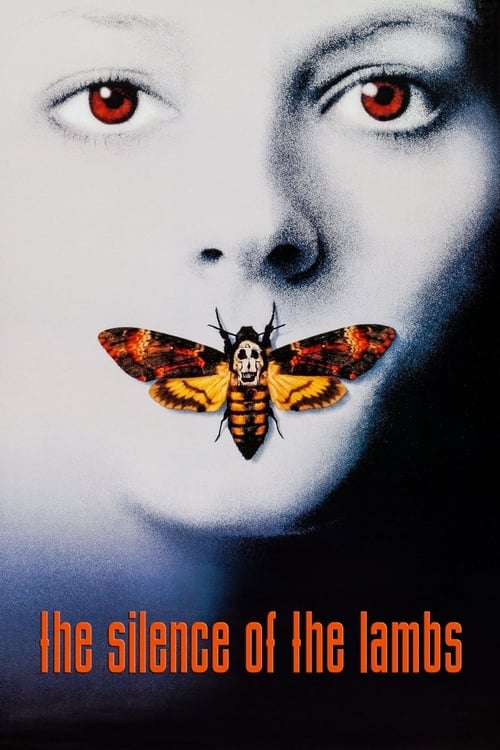
The Silence of the Lambs
1991 · Jonathan Demme
When you're craving a real scare with a brain behind it — gripping enough for a first watch, rich enough for a fifth. Not a casual background movie; it wants the lights off and your full attention.
What it's about
Clarice Starling, still a trainee at the FBI academy, is sent to interview Hannibal Lecter — a brilliant psychiatrist locked away for murder and cannibalism — because he may hold insight into an active serial killer called Buffalo Bill. Lecter will help, but only in trade: a piece of the case for a piece of Clarice's own past. As women keep disappearing, the interviews become a duel she can't afford to lose.
The experience
Relentlessly tense without cheap tricks — the scariest scenes are two people talking through glass, faces filling the frame, staring almost straight at you. It's a thriller that gets under your skin and stays there.
Performances
Anthony Hopkins makes Lecter one of cinema's great monsters with barely twenty minutes of screen time — courtly, still, and terrifying. Jodie Foster grounds the whole film as Clarice, letting you see the nerve it costs a young woman to hold her own in every room she enters.
The craft
Jonathan Demme shoots conversations in tight, direct-to-camera close-ups so you feel personally cornered, and the film's queasy power comes from that intimacy more than from any gore. The screenplay tightens Thomas Harris's novel into a flawless procedural engine, and Howard Shore's score keeps a low dread humming underneath everything.
Why it matters
One of only three films ever to sweep the five major Oscars — Picture, Director, Actor, Actress, Screenplay — it made the serial-killer thriller respectable and set the template every profiler drama since has worked from.
Snapshot
The Silence of the Lambs is the rare horror-thriller that the film establishment embraced without reservation: it became only the third film in history to sweep the five major Academy Awards — Picture, Director, Actor, Actress, and Adapted Screenplay — after It Happened One Night and One Flew Over the Cuckoo's Nest. Adapted from Thomas Harris's 1988 novel, it follows FBI trainee Clarice Starling as she is dispatched to interview the imprisoned forensic psychiatrist and cannibal Hannibal Lecter, whose insight she must barter for in order to track an active serial killer known as Buffalo Bill. Directed by Jonathan Demme — a filmmaker until then associated with warm, humanist ensemble comedies and music documentaries — the film fused procedural suspense, gothic horror, and an unusually rigorous attention to a woman's experience of being watched. Its lasting power rests on two performances of almost diagrammatic precision, Jodie Foster's Starling and Anthony Hopkins's Lecter, and on a visual strategy that places the viewer inside the predatory gaze the story interrogates.
Industry & production
The film was produced by Orion Pictures, an independent-minded studio then in serious financial distress; it would file for bankruptcy protection within months of the film's release, which complicates the usual narrative of a major studio reaping a blockbuster's rewards. Strong Heart/Demme Production developed the project with Edward Saxon, Kenneth Utt, and Ron Bozman producing. The rights history is itself notable: Gene Hackman had initially been attached, intending to direct and possibly star, and the property passed through development before Demme took it on. Orion's Mike Medavoy was instrumental in assembling the package.
Casting was the production's defining set of decisions. The role of Lecter was, by various accounts, offered to or considered for several established actors before Hopkins — then known to American audiences more for stage and supporting screen work than star roles — was cast on the strength of his ability to project menace through stillness. Foster actively pursued Starling; Demme reportedly had other actresses in mind initially, but Foster's identification with the character's class background and drive made her the choice. The supporting cast drew on Demme's repertory instincts: Scott Glenn as Jack Crawford, Ted Levine as the killer Jame Gumb, Anthony Heald as the unctuous Dr. Chilton, and Brooke Smith as the abducted Catherine Martin.
Shooting took place largely in and around Pittsburgh, with the FBI's cooperation extending to filming at the Academy in Quantico — an unusual degree of institutional access that lent the procedural scenes their texture. The Bureau saw value in the depiction of a competent female agent. The production was efficient and mid-budget by Hollywood standards of the era, and its commercial success was substantial and sustained, anchoring it as a profitable release at a moment when its studio could least afford to squander one.
Technology
The film was shot photochemically on 35mm in a standard spherical format, finished for a conventional 1.85:1 presentation, and carries no significant technological novelty in its image-making — its innovations are compositional rather than mechanical. Where it is quietly distinctive is in its disciplined use of the most basic apparatus: the direct-address lens, the locked or smoothly tracked camera, and analog sound design built around proximity and silence. The Buffalo Bill night-vision climax is the one sequence that foregrounds a technology as a narrative device, staging the killer's predatory advantage through a green monocular point-of-view that the audience shares while Starling is plunged into darkness. That sequence aside, the film's modernity is a matter of craft rather than gadgetry, and its restraint is part of why it has aged so well.
Technique
Cinematography
Tak Fujimoto's photography is inseparable from the film's meaning. Its signature device is the near-frontal point-of-view shot: characters look almost directly into the lens when addressing Starling, so that the viewer occupies her position and feels the weight of every appraising, condescending, or predatory gaze directed at her. This is not a decorative tic but the film's central formal argument — Starling moves through a world of men who look at her, and the camera makes that looking inescapable. Fujimoto and Demme withhold the device selectively, reserving the most direct eyelines for moments of greatest scrutiny. The palette runs to institutional greens, browns, and clinical fluorescents, with Lecter's basement cell lit to isolate Hopkins's face against darkness. Compositions favor tight singles and shallow focus that trap characters in their own frames, and the camera's calm, deliberate movements contrast with the lurid material to produce dread rather than spectacle.
Editing
Craig McKay's cutting is patient and classical, building suspense through duration and withheld information rather than fragmentation. The most celebrated structural gambit is the cross-cut climax: the film leads the audience to believe the FBI's tactical team is converging on Buffalo Bill's house, only for a doorbell to reveal that Starling, alone, is the one who has found him. The misdirection is achieved purely through parallel editing and the suppression of a geographic cue, and it remains a textbook example of montage used to ambush an audience's assumptions. Elsewhere McKay holds on the long interview shot/reverse-shots between Starling and Lecter, letting the rhythm of conversation rather than cutting generate tension.
Mise-en-scène / staging
The film's spaces are organized around confinement, descent, and thresholds. Lecter is staged behind glass and bars, his cell a stage on which he performs control; the recurring motif of barriers — cell walls, cages, the pit in Gumb's cellar — externalizes the story's concern with captivity and the gaze. Demme stages the Starling–Lecter exchanges with formal symmetry, the two facing one another across a transparent divide that paradoxically intensifies intimacy. Gumb's house is a labyrinth of cluttered, decaying rooms that culminate in the literalized abyss of the well, a descent into the unconscious of the film's pathology. Production design by Kristi Zea grounds the horror in the banal textures of institutions, motels, and storage units.
Sound
Howard Shore's score is one of his most restrained — somber, string-led, and elegiac rather than stinging, refusing the shock-cue conventions of slasher cinema and instead lending Starling's quest a mournful dignity. The sound design is equally essential: Lecter's quiet, precise diction and the wet sounds of his violence; the breathing and rustle of the night-vision sequence; and above all the film's structuring metaphor of silence itself — the title's lambs, whose screaming Starling cannot quiet, made audible only in memory. Demme uses near-silence as a weapon, dropping ambient sound to make small noises enormous.
Performance
The film is a duet. Hopkins's Lecter is built from economy: minimal blinking, a flat affect that erupts into precise cruelty, and a stillness that makes the character seem to consume attention. The much-discussed lip-and-hiss flourish and the unwavering eye contact are tools of intimidation calibrated for the frontal camera. Foster's Starling is the deeper achievement and the film's true center — a portrait of competence under constant assault, the West Virginia accent she works to suppress signaling class anxiety, her courage visibly costing her something. Ted Levine's Gumb avoids caricature in his quieter registers even as the writing courts controversy, and Scott Glenn, Anthony Heald, and Brooke Smith fill out a world of credible institutional and human texture.
Narrative & dramatic mode
Structurally the film is a procedural quest grafted onto a gothic horror, organized around the bargain between Starling and Lecter: she must surrender pieces of her own history in exchange for the insight that will let her read Buffalo Bill. This quid pro quo converts the investigation into a psychological striptease, so that solving the external crime requires Starling to confront an internal wound — the memory of the slaughtered spring lambs she once tried and failed to save. The dramatic engine is therefore double: a ticking-clock manhunt to save Catherine Martin, and a coming-of-age in which Starling earns authority in a world designed to deny it to her. The film withholds and rations information with classical discipline, and its most famous narrative move, the cross-cut misdirection, weaponizes the audience's own genre literacy against it.
Genre & cycle
The Silence of the Lambs sits at the confluence of several cycles. It is a serial-killer thriller arriving at the moment that subgenre was crystallizing into a dominant commercial form, and it did much to define the template — the captured monster as oracle, the forensic profiler as protagonist, the killer with a baroque signature — that the 1990s and 2000s would endlessly reproduce in film and television. It draws on the police procedural and the gothic horror tradition, and it is in dialogue with Manhunter (1986), Michael Mann's earlier adaptation of Harris's Red Dragon, which introduced Lecter to the screen in a colder, more stylized register. By giving the genre an Oscar-anointed respectability, Silence effectively legitimized adult horror-thriller hybrids for prestige audiences and spawned a Hannibal Lecter franchise.
Authorship & method
Demme's authorship here is, on its surface, a departure from the generous ensemble humanism of Melvin and Howard, Something Wild, and Married to the Mob, yet it is continuous in its fascination with faces, its democratic attention to minor characters, and its empathy for outsiders. What Demme brought to potentially exploitative material was a moral seriousness and an insistence on Starling's subjectivity. His key collaborators were instrumental: cinematographer Tak Fujimoto, a long-standing Demme partner, devised the frontal-gaze grammar; editor Craig McKay shaped the suspense architecture; composer Howard Shore supplied the somber emotional through-line; and screenwriter Ted Tally distilled Harris's dense novel into a lean, propulsive script that preserved the Starling–Lecter dynamic as the spine. Production designer Kristi Zea and the casting instincts that surrounded Demme's loose repertory company complete the picture of an auteur working through trusted collaborators rather than imposing a single sensibility.
Movement / national cinema
The film belongs to mainstream American studio cinema rather than any avant-garde or national-cinema movement, but it can be situated within the post-New-Hollywood maturation of genre filmmaking, in which directors trained in the 1970s ethos applied serious craft and thematic ambition to popular forms. It is also a product of the independent-studio ecosystem — Orion's prestige-minded model — that briefly flourished before consolidation. Demme's own roots in the Roger Corman exploitation school inform the film's efficiency and its willingness to deliver visceral effect, even as its sensibility reaches for something more humane.
Era / period
Released in early 1991, the film is of its moment in ways both explicit and structural. It arrives amid a heightened cultural fascination with serial murder and FBI profiling, the institutional milieu it depicts with near-documentary access. Its foregrounding of a woman navigating an overwhelmingly male professional world resonates with contemporary debates about gender and the workplace. At the same time, the film became a flashpoint: LGBTQ activists protested the characterization of Gumb as drawing on transgender and queer-coded imagery for horror, a controversy the film tries to deflect with a line clarifying that Gumb is not "truly" transsexual, but which has remained central to critical reassessment. The dossier record on the filmmakers' intentions here is genuinely contested, and the debate is best understood as integral to the film's reception rather than settled.
Themes
At its core the film is about seeing and being seen — the gaze as an instrument of power, predation, and survival. Starling is perpetually appraised, and her heroism lies partly in refusing to be reduced to the object men attempt to make of her. A second theme is transformation and metamorphosis, literalized in Gumb's death's-head moth and his monstrous attempt to remake his own body, and figured more benignly in Starling's own becoming. Class is a quiet but persistent thread: Starling's rural poverty, the accent she suppresses, and Lecter's contempt for the merely vulgar all locate the story in a fine-grained American hierarchy. And the film is structured around rescue and the impossibility of it — the screaming lambs Starling could not save, displaced onto Catherine, whose rescue might finally silence them.
Reception, canon & influence
Critical reception was strong and grew into consensus; the film's Oscar sweep cemented an unusual establishment embrace of horror-adjacent material, and it was later selected for preservation in the National Film Registry as a culturally significant work. The principal countercurrent in its reception was the protest over its depiction of Gumb, a debate that has only sharpened in subsequent decades and that any honest account must hold alongside the praise.
Looking backward, the film's influences run through Thomas Harris's source novel and the earlier Manhunter, through the gothic and the woman-in-peril traditions of horror, and through the American procedural. Looking forward, its legacy is enormous. It standardized the modern serial-killer narrative and the figure of the imprisoned-genius killer as interlocutor, patterns visible across decades of film and especially television, from Profiler and Criminal Minds to Hannibal. It elevated the female forensic protagonist as a durable type. It directly generated a franchise — Hannibal, Red Dragon, and Hannibal Rising — and Bryan Fuller's later television Hannibal. And it demonstrated, durably, that a meticulously crafted genre film could command both popular success and the highest critical honors, reshaping what mainstream Hollywood believed prestige cinema could look like.
A Deleuzian reading
Start with the face that looks at you.
The full Deleuzian reading of The Silence of the Lambs →
Reception
A rare February release that swept to Best Picture a full year later — one of only three films ever to win the 'Big Five' Oscars. But its coronation came with an asterisk: queer activists protested the 1992 Academy Awards over the Buffalo Bill character, and that tension has only grown louder in retrospect.
How The Silence of the Lambs was received, from release to now →
Influences: the films it descends from and the films it influenced
- Manhunter (1986) — First adaptation of Harris's material that established the core engine Lambs inherits: an FBI profiler extracting insight from an imprisoned, articulate killer through glass-barrier interviews.
- Psycho (1960) — Supplies the Ed Gein-derived killer whose violence springs from a shattered maternal/gender identity, plus the audience-sympathy bait-and-switch and the cellar/house reveal Buffalo Bill's basement echoes.
- Peeping Tom (1960) — Pioneered the first-person camera-as-weapon that implicates the spectator's look — the root of Demme and Fujimoto's frontal-POV predation grammar and night-vision gaze.
- M (1931) — Template for the dual manhunt procedural pursuing a compulsive killer through forensic detail, with an auditory leitmotif (the whistle) as the murderer's signature.
- Klute (1971) — Female protagonist navigating predatory male surveillance via shallow-focus intimate singles and a paranoid, restrained sound design — the procedural's gaze-and-vulnerability blueprint.
- The Texas Chain Saw Massacre (1974) — The Ed Gein house of human trophies and skin/taxidermy craft that Gumb's lair and skin-suit literalize.
- Frenzy (1972) — The serial-strangler procedural built on parallel cutting between an everyman monster and the investigating police — the cross-cut misdirection Lambs refines in its climax.
- Halloween (1978) — Codified the stalking killer-POV shot and the resourceful imperiled woman who flips hunted into hunter — the 'final girl' that Starling matures into a professional.
- The Exorcist (1973) — Demme consummates The Exorcist's authorization of horror as prestige awards cinema — five Oscars completing what ten nominations began — inheriting its procedural-realism structure (FBI investigation as horror container), clinical fluorescent-institutional look, and naturalistic performance anchoring extreme transgressive content.
- Something Wild (1986) — Systematizes Something Wild's frontal close-up into a full eyeline-to-lens grammar with Fujimoto and McKay, and makes the mid-film menace of Ray Sinclair — a charming man addressing you directly — the entire visual architecture.
- Copycat (1995) — A direct riff on the Starling type: a female forensic expert profiling a killer who quotes prior murderers, with the imprisoned-interlocutor dynamic relocated to an agoraphobic specialist.
- Se7en (1995) — Inherits Lambs' prestige-horror seriousness and a meticulous, oppressive procedural in which a captured genius-killer dictates the finale's terms.
- The Bone Collector (1999) — Extends the female-forensic-protagonist-plus-immobilized-mentor pairing into a clue-driven serial-killer procedural.
- Hannibal (2001) — Direct franchise continuation of the Lecter–Starling relationship the film established as the genre's defining dyad.
- Red Dragon (2002) — Re-adapts the Manhunter source within Lambs' aesthetic and glass-cell interview grammar, retrofitting the franchise's house style.
- Zodiac (2007) — Pushes the forensic procedural toward obsessive investigative process and ambient dread, privileging the mechanics of the hunt over violence.
- Prisoners (2013) — A prestige abduction procedural carrying Lambs' moral gravity and restrained dread, with Deakins's shallow-focus singles and confinement staging.
- Contact (1997) — Demme's deployment of Foster in sustained extreme close-up — her face filling the Panavision frame, registering intellectual exposure while navigating male-dominated institutional corridors — is the precise performance grammar Burgess and Zemeckis reprise for Arroway, culminating in the shot of Foster's eye that resolves into her reflected radio dish.
- I Saw the Devil (2010) — Contributed the layered predator-space staging — the killer's environment as an extension of predatory psychology — and the performance mode of predatory opacity that rewards the protagonist's scrutiny with information he cannot act on to stop the killing, the dynamic I Saw the Devil's catch-and-release structure runs on repeat.
- Get Out (2017) — Demme's direct-address close-up — the camera placed at the interlocutor's eye level so the character appears to look out at the audience — is the specific technical ancestor for Oliver's close-up-eye shots in Get Out, which use the same grammar to implicate the viewer in the act of scrutinizing a Black subject, making the audience complicit in the Armitages' appraising gaze.
- The Gangster, the Cop, the Devil (2019) — Established the procedural grammar of the investigator who must recruit the criminal's cognitive expertise to solve the serial-killer case; Akinjeon refracts this through Korean genre conventions, replacing psychological profiling sessions with physical alliance.
- In the Line of Fire (1993) — Pioneers the intimate predator/pursuer duel built on direct, almost seductive address from the brilliant antagonist — the exact register Malkovich's Leary adopts in his phone calls to Eastwood.
- Henry: Portrait of a Serial Killer (1986) — Contemporaneous countercurrent of unromantic, vérité serial-killer realism that defined the genre territory Lambs entered from the prestige side.
- The Vanishing (1988) — The methodical, banal abductor and the dread of procedural pursuit — quotidian evil rendered through restraint rather than gore.
- Memories of Murder (2003) — A humane, procedurally grounded serial-killer investigation that foregrounds investigator subjectivity and unresolved dread over spectacle.
- Gorky Park (1983) — Builds a procedural set-piece around clay facial/forensic reconstruction to identify a victim — the same Gerasimov-style anthropological technique Gorky Park makes its investigative centerpiece.
- Misery (1990) — Released months later, it confirmed Bates' achievement — that a horror-thriller performance could win top Oscars — cementing the genre's prestige standing the dossier ties to Misery.
- Devil in a Blue Dress (1995) — Shares Tak Fujimoto's signature method — subjective, character-anchored camera and controlled warm/cool palette contrasts — applied here to make the audience inhabit Easy's wary point of view as he moves through hostile spaces.
- Thesis (1996) — Places a lone young investigator descending into a predator's world with POV and reaction-shot proximity while keeping the worst off-frame — the protagonist template and restraint Tesis mirrors.
- The Conjuring: The Devil Made Me Do It (2021) — Ancestor for the procedural-investigation spine: an investigator following forensic clues toward an occult antagonist, importing whodunit detective logic — tracking a curse to a human culprit — into a horror register.
Similar films
- Psycho (1960) — influence & lineage · often watched together
- Hannibal (2001) — influence & lineage
- Manhunter (1986) — influence & lineage
- Halloween (1978) — influence & lineage
- M (1931) — influence & lineage · often watched together
- Zodiac (2007) — influence & lineage · often watched together
- Memories of Murder (2003) — influence & lineage · often watched together
- One Flew Over the Cuckoo's Nest (1975) — often watched together
All the films related to The Silence of the Lambs →
Film essays and courses that include it
- The Fractured Mind: Twelve Landmarks of the Psychological Thriller
- Portrait of the Killer: Serial Murder from Lang to Fincher
- Portrait of a Killer: How Cinema Learned to Inhabit the Monster
- On the Edge: Cinema's Grammar of Suspense
- Premeditated: Cinema's Century of the Kill
- The Tyranny of Reason: Cinema Inside the Breaking Mind
- The Long Beat: How Cinema Invented the Police Film
- The Investigator's Eye: From Sam Spade to Zodiac
- What the Darkness Knows: The Occult Procedural and Its Investigators