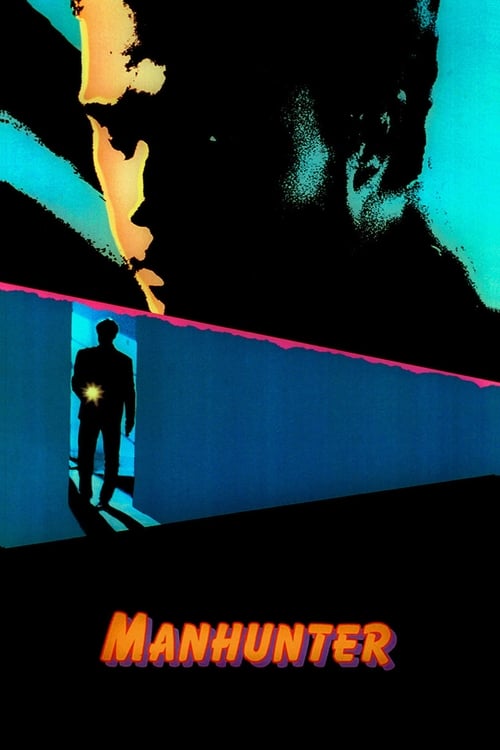
Manhunter
1986 · Michael Mann
For a late night when you want a serial-killer thriller that's more eerie than gory — stylish, immersive, and genuinely under-your-skin. More of a slow spell than a jump-scare ride.
What it's about
A retired FBI profiler with a dangerous gift — he can slip inside the minds of killers — is coaxed back to hunt a murderer who slaughters whole families on the full moon. His only real lead is the brilliant, imprisoned psychiatrist he caught years ago, a man whose mind nearly destroyed him. To read the new killer, Will Graham has to reopen that door.
The experience
Cool, hypnotic, and quietly frightening — the dread builds through pastel rooms, glass, and synthesizer pulses rather than gore. It's a thriller that moves like a trance and then tightens without warning.
Performances
William Petersen plays Graham frayed and half-haunted, a man visibly paying for his talent, and Brian Cox's Lecktor is chilling precisely because he's so casual — a monster played at conversational volume.
The craft
Michael Mann shoots the mid-80s like no one else: color-coded interiors, glassy widescreen compositions, and a throbbing electronic score that turns a police procedural into pure atmosphere. It rewards a big screen and good speakers — the images and music do as much detective work as the plot.
Why it matters
The first film ever to put Hannibal Lecter on screen, it flopped in 1986 and was rediscovered over decades as a stylistic landmark — the template for the moody profiler thrillers and forensic prestige TV that followed.
Snapshot
Manhunter is Michael Mann's adaptation of Thomas Harris's 1981 novel Red Dragon, and the first screen appearance of Hannibal Lecter — here spelled "Lecktor" and played by Brian Cox. It follows Will Graham (William Petersen), a retired FBI profiler coaxed back to hunt a serial murderer nicknamed the "Tooth Fairy," who slaughters entire families on the lunar cycle. To reconstruct the killer's logic, Graham must re-enter the headspace of his old quarry, Lecktor, the man whose mind nearly destroyed him. Released in August 1986 by the DEG (Dino De Laurentiis Entertainment Group), the film underperformed commercially and slipped quickly from theaters, only to be reclaimed over subsequent decades as a stylistic landmark — a glassy, synthesizer-scored procedural that fused Mann's Miami Vice-era aesthetic with the empathic-detective thriller. Its reputation now far outstrips its original reception; it is routinely cited as one of the most influential and visually distinctive serial-killer films of the 1980s.
Industry & production
Manhunter emerged from the orbit of Dino De Laurentiis, who held the rights to Harris's novel. De Laurentiis had produced an expensive flop in Year of the Dragon and other titles, and his company, DEG, was financially fragile by the mid-1980s — a context relevant to the film's marketing fate. The title was changed from Red Dragon reportedly out of De Laurentiis's wariness of "dragon" in a title after Year of the Dragon had stumbled, and to avoid audiences mistaking it for a martial-arts or fantasy picture; the new title repositioned it as a hard genre thriller. Michael Mann, then riding the cultural wave of Miami Vice (which he executive-produced) and coming off his feature debut Thief (1981) and the horror film The Keep (1983), wrote the screenplay himself and directed.
The production drew personnel and sensibility from Mann's television work — most consequentially composer-collaborator relationships and a slick, design-forward visual culture. Casting ran against the grain of star-driven thrillers: William Petersen, a Chicago stage actor who had broken through in William Friedkin's To Live and Die in L.A. (1985), took the lead; Tom Noonan, a tall, unsettling character actor, played the killer Francis Dollarhyde; Joan Allen, early in her film career, played the blind woman Reba; and Brian Cox, a Scottish stage actor little known to American audiences, played Lecktor. The commercial release was hampered by DEG's instability — the company collapsed not long after — and the film received limited promotional support. It did not recover its budget theatrically. Precise box-office figures from the period are thin and inconsistently reported, so claims of exact grosses should be treated cautiously; what is well established is that the film was considered a commercial disappointment in 1986.
Technology
Manhunter is a product of mid-1980s production technology deployed with unusual rigor. It was shot photochemically on 35mm, but its look depends heavily on color design, lighting gels, and architectural location work rather than optical trickery. The film is notable for its embrace of contemporary modernist and high-tech environments — plate-glass houses, fluorescent institutional interiors, an aquarium, an airport — that read as up-to-the-minute in 1986 and signal Mann's lifelong fascination with surfaces, systems, and the built environment.
The score is the film's most conspicuous technological signature: a largely electronic soundtrack built on synthesizers and processed textures, supplemented by licensed tracks from acts including Tangerine Dream-adjacent electronic music, The Reds, Shriekback, and Iron Butterfly. The use of synthesized and pop-source cues over a crime narrative was characteristic of Mann's Miami Vice sensibility and of the broader 1980s vogue for electronic scoring, but Mann pushed it toward the operatic in the climax. The reliance on needle-drop source music as structural scoring — rather than a traditional orchestral underscore — was a deliberate aesthetic technology choice that dates and distinguishes the film simultaneously.
Technique
Cinematography
Cinematographer Dante Spinotti — beginning a long, defining partnership with Mann that would continue through The Last of the Mohicans, Heat, and The Insider — gives Manhunter a cold, designed palette dominated by blues, teals, whites, and clinical greens, punctuated by warmer or more saturated accents. The compositions favor symmetry, hard horizons, and wide negative space; characters are frequently dwarfed by architecture or set against blank skies and seas. The film's most discussed image is Graham's beachside house and the white-on-white interiors that flatten figures into graphic shapes. Spinotti and Mann use the modernist glass-and-concrete vocabulary to externalize psychological exposure — characters under surveillance, behind or in front of glass, lit so that interiors and reflections compete. The visual coldness is not incidental: it renders the procedural world as a controlled, almost antiseptic system into which violence intrudes.
Editing
The editing, credited to Dov Hoenig (another Mann regular), is patient by thriller standards, holding on Graham's reconstructive thought and on charged dialogue exchanges, then accelerating sharply for set pieces. The investigative procedure is built through accretion — evidence, voiceover-like reasoning spoken aloud, and the slow assembly of the killer's psychology — which makes the eventual eruption of action more violent by contrast. The climactic raid is cut in tight rhythmic coordination with Iron Butterfly's "In-A-Gadda-Da-Vida," one of the most analyzed music-and-montage passages in 1980s American cinema, where editing surrenders the scene's pacing to the song's build.
Mise-en-scène / staging
Mann's staging is architectural and frontal. Interiors are chosen and dressed for their geometry; Dollarhyde's house is a cavernous, decaying contrast to the FBI's chilly modernism, and Lecktor's all-white cell is a void that makes the man inside it more disturbing through sensory deprivation rather than gothic clutter — a stark departure from later, more baroque Lecter settings. Mann blocks conversations across hard lines and reflective surfaces, and repeatedly frames characters through glass, screens, and doorways to underline themes of watching and being watched. The killer's world is bound up with images — photographs, home movies, the act of seeing — and the mise-en-scène foregrounds optics and visual apparatus throughout.
Sound
Beyond the synthesizer-and-pop score, the film's sound design is spare and pointed, with ambient hum, silence, and sudden intrusions. Dialogue is often clipped and procedural. The marriage of electronic textures to the cold imagery produces a hypnotic, dread-soaked atmosphere; the climactic deployment of "In-A-Gadda-Da-Vida" and the recurring use of tracks like The Reds' "Heartbeat" and Shriekback's "This Big Hush" and "Coelacanth" function as emotional and structural scaffolding rather than mere accompaniment.
Performance
Petersen plays Graham as a man perpetually on the edge of dissociation — controlled, watchful, and visibly costed by his empathic gift, which the film frames as a dangerous merging of self with the criminal mind. Brian Cox's Lecktor is the film's quiet revelation: clinical, urbane, and chillingly ordinary rather than theatrical, a banality-of-evil reading that contrasts pointedly with Anthony Hopkins's later, more operatic interpretation. Tom Noonan's Dollarhyde is the film's most sustained achievement in performance — physically imposing yet wounded and tender, especially in the scenes with Joan Allen's Reba, whose blindness lets her perceive his humanity rather than his monstrousness. Noonan reportedly maintained distance from the rest of the cast to preserve the character's separateness, and the Reba sequences give the film its unexpected emotional core.
Narrative & dramatic mode
The film operates in the mode of the empathic-detective procedural: its engine is not whodunit but how the hunter thinks his way into the killer. Graham's method — projecting himself into the murderer's perspective, speaking the killer's reasoning aloud — makes interiority the dramatic action. The structure braids three consciousnesses: Graham's, Lecktor's (as tempter and mirror), and Dollarhyde's (developed in extended scenes that humanize him without exonerating him). The dramatic tension is psychological contamination — the fear that to catch the monster one must become monstrous — and the narrative repeatedly stages the permeability between investigator and investigated. Information is doled out through forensic reconstruction, and the climax resolves the chase abruptly and violently, refusing a drawn-out cat-and-mouse denouement.
Genre & cycle
Manhunter sits at the intersection of the crime procedural, the serial-killer thriller, and horror, and it is a foundational text of the modern serial-killer film. It predates and arguably enables the cycle that The Silence of the Lambs (1991) would popularize: the profiler protagonist, the incarcerated cannibal mentor consulted for insight, the FBI Behavioral Science framing, and the aestheticization of forensic detail. Where the later cycle leaned gothic and explicitly horrific, Manhunter keeps its horror cold and procedural, more akin to the antiseptic dread of Mann's crime cinema than to slasher conventions. It belongs equally to the 1980s neo-noir and "stylish thriller" cycle, sharing DNA with To Live and Die in L.A. and the glossy, synth-scored crime media of the Miami Vice moment.
Authorship & method
Manhunter is a strongly authored film, bearing nearly all of Mann's signatures: professional men defined by craft and competence; the collision of work and identity; immaculately designed environments; electronic scoring; and a fascination with surveillance, systems, and the moral cost of expertise. Graham is a quintessential Mann protagonist — a specialist whose mastery is inseparable from his self-endangerment, a figure who recurs across Thief, Heat, The Insider, and Collateral. Mann's authorship here is collaborative in a consistent way: the partnership with cinematographer Dante Spinotti begins a career-long visual dialogue; editor Dov Hoenig and the music-driven cutting reflect Mann's television-honed instinct for image-and-sound montage; and the source-music curation functions as authorial scoring. As both screenwriter and director, Mann reshaped Harris's Red Dragon into something more austere and design-forward than the page, foregrounding the visual and psychological over the procedural detail. The film is also, like much of Mann's work, deeply researched in its depiction of investigative procedure and forensic culture.
Movement / national cinema
The film is firmly within American mainstream genre cinema, but its sensibility is shaped by the convergence of 1980s Hollywood with the visual culture of television and advertising that Mann did much to forge. It belongs to no formal movement, yet it can be read as part of a strain of American "stylized realism" or neo-noir in which surface design and atmosphere carry as much meaning as plot. Its electronic scoring and modernist production design also align it with a transatlantic 1980s pop-modernism — the same currents informing European synth and post-punk music, several of whose artists appear on the soundtrack.
Era / period
Manhunter is emphatically a film of the mid-1980s: in its synthesizer score, its sleek modernist and high-tech production design, its fashion and palette, and its faith in nascent forensic science and behavioral profiling as cutting-edge institutional knowledge. It arrives at a cultural moment when the FBI's Behavioral Science Unit and the concept of "profiling" were entering public consciousness, and it treats this expertise with documentary seriousness. The film's look is so period-specific that it has become a touchstone for "1980s cinematic style," even as its formal control has aged better than many of its contemporaries.
Themes
The central theme is empathy as both gift and contagion: Graham's ability to understand the killer requires a dangerous identification that threatens to dissolve the boundary between hunter and hunted. The film is preoccupied with seeing and being seen — surveillance, photography, the gaze, and the killer's own obsession with images and witnesses (he wants his victims to "see" him become the Red Dragon). Vision recurs as a moral and erotic motif, culminating in the relationship with the blind Reba, whose inability to see Dollarhyde's monstrousness allows a fragile humanity to surface. Other themes include the cost of professional expertise, the fragility of family (both Graham's and the murdered families), transformation and self-mythology (Dollarhyde's "Becoming"), and the antiseptic modern world as a stage for primal violence.
Reception, canon & influence
On release in 1986, Manhunter was a commercial disappointment and received mixed-to-respectful reviews; it lacked the marketing muscle and star power to find an audience, and DEG's collapse foreclosed any sustained push. Its critical reputation grew substantially over the following decades, aided by home video, cult reappraisal, and the enormous success of the later Hannibal Lecter films, which sent viewers back to the first screen Lecter.
Influences on the film (backward): Most directly, Thomas Harris's Red Dragon supplies the plot, characters, and the profiler-consults-incarcerated-killer structure, itself informed by real FBI Behavioral Science Unit work. Mann's own Thief and Miami Vice establish the visual and musical grammar. The cold modernist photography and procedural rigor connect to a lineage of stylish crime cinema, and the film's faith in forensic detail reflects the period's documentary-realist crime reporting. The empathic-detective conceit also draws on a longer tradition of detective-as-double-of-the-criminal in noir and gothic fiction.
Legacy (forward): Manhunter is widely regarded as the template for the modern serial-killer procedural. The Silence of the Lambs and the broader 1990s cycle inherited its profiler framework and incarcerated-mentor device; the Lecter franchise eventually circled back to remake the same source material as Red Dragon (2002). Bryan Fuller's television series Hannibal (2013–2015) drew extensively on the Graham–Lecter dynamic and on Mann's chilly, aestheticized visual sensibility, and the film is frequently cited as a key influence on prestige crime television's look. More broadly, Manhunter's fusion of synthesizer scoring, modernist design, and procedural dread anticipated a generation of stylized thrillers and has been embraced by later filmmakers and critics as a high point of 1980s genre filmmaking — a film whose initial failure has been thoroughly reversed by its enduring influence.
A Deleuzian reading
A man sits alone in a dark room and runs a murdered family's home movies.
The full Deleuzian reading of Manhunter →
Reception
A box-office flop in 1986 — sunk partly by distributor De Laurentiis's financial troubles — it was steadily reappraised after The Silence of the Lambs made Lecter a phenomenon, and is now widely regarded as one of Michael Mann's best films and a high point of 80s style.
How Manhunter was received, from release to now →
Influences: the films it descends from and the films it influenced
- Thief (1981) — Mann's own template for Manhunter's grammar: a Tangerine Dream synth score cut directly to action, rain-slick neon surfaces, and a craftsman-protagonist whose tradecraft is filmed as quasi-documentary procedure.
- Le Samouraï (1967) — Originates the desaturated, near-monochrome neo-noir palette and the cold, process-obsessed professional whose interiority is conveyed through behavior and environment rather than dialogue — the affective blueprint for Graham and Dollarhyde alike.
- Point Blank (1967) — Pioneers the use of brutalist/modernist architecture and hard geometric framing as psychological alienation, the spatial vocabulary Mann and Spinotti adopt for their glass-and-concrete crime world.
- The Conformist (1970) — Storaro's architectural compositions — figures dwarfed by symmetrical modernist interiors, color blocking, framing through structural elements — supply the design-forward, painterly staging Manhunter pushes toward austerity.
- Peeping Tom (1960) — Establishes the killer-as-camera conceit and the seeing/being-seen reflexivity (vision as both weapon and wound) that Manhunter literalizes in Dollarhyde's home-movie surveillance of his victims.
- Klute (1971) — Gordon Willis's surveillance aesthetic and the detective who is contaminated by intimate identification with the hunted — the empathy-as-contagion procedural Mann inherits and intensifies.
- The French Connection (1971) — Sets the documentary-realist standard for procedural cinema — handheld immediacy, forensic attention to investigative method — that underwrites Manhunter's faith in the texture of real Behavioral Science work.
- Sorcerer (1977) — Friedkin's pairing of a Tangerine Dream synthesizer score with sustained dread demonstrates electronic scoring as suspense architecture, a method Manhunter's needle-drop and synth cues extend (notably the In-A-Gadda-Da-Vida climax).
- Frenzy (1972) — Mann extends Frenzy's predatory-normalcy staging—Dollarhyde as socially functional, even empathetic, actor—and runs Hitchcock's dramatic-irony structure at procedural length, with the FBI's investigative knowledge permanently lagging behind what the audience is shown of the killer's interior life.
- M (1931) — The FBI behavioral-profiling methodology — reconstructing the killer's compulsion from patterned traces left at crime scenes — is the institutional systematization of M's chalk-mark identification device; reading behavioral signature as involuntary self-disclosure is the investigative logic M invented in 1931, here elevated to a professional discipline with its own epistemology.
- Heat (1995) — The same Mann–Spinotti dialogue scaled up: cold-blue urban palette, glass-and-horizon compositions, and ambient electronic scoring binding professional men whose mastery endangers the self.
- Collateral (2004) — Extends Manhunter's nocturnal architecture-of-glass framing and source-music-as-scoring into the digital era, with the city itself rendered as a cold modernist surface.
- The Silence of the Lambs (1991) — Directly inherits the profiler-consults-incarcerated-killer structure and the mentor-monster's mind-game interview format from the same Harris universe Manhunter first filmed.
- Red Dragon (2002) — A literal re-adaptation of the same source novel, inviting direct comparison to Manhunter's leaner, more design-forward reshaping of the Graham–Lecter procedural.
- Hannibal (TV) (2013) — Builds its entire visual and dramatic identity on Manhunter's chilly, aestheticized surfaces and the empathic-profiler conceit — Graham's gift of total identification staged as visionary contamination.
- Seven (1995) — Carries forward the serial-killer procedural's fusion of forensic dread, designed environments, and an unseen killer whose crimes are authored tableaux to be 'read' by the investigator.
- Zodiac (2007) — Distills Manhunter's documentary-procedural rigor — the obsessive, evidence-driven hunt and the investigator consumed by the case — into a meticulous chronicle of method.
- Drive (2011) — Revives Manhunter's neon-noir surface and synth/needle-drop scoring as authorial voice, with a near-silent professional defined by craft against immaculate nocturnal-city design.
- The Dark Knight (2008) — Mann's procedural detective who must psychologically inhabit the criminal's worldview to function establishes the moral-contamination logic that Batman enacts when he deploys mass surveillance: the investigator becomes the thing he pursues.
- Insomnia (2002) — Mann's anamorphic neo-noir investigation establishes the formal device of rendering a detective's absorption into criminal consciousness through compositional sterility and ambient electronic score — Dante Spinotti's geometric coldness and the Tangerine Dream textures — that Pfister's widescreen grammar and David Julyan's score directly extend.
- Se7en (1995) — The first American feature to build prestige-thriller grammar around the FBI profiler who must inhabit the killer's aesthetic sensibility; Se7en inherits the profiler-as-mirror structure, the ritualistic murder as authored statement, and the investigator's moral contamination by prolonged proximity to a superior intellect.
- I Saw the Devil (2010) — The procedural grammar of an investigator who must psychologically inhabit the predator's perspective to track him — Mann's wide, surveillance-style compositions staging obsessive tracking are a direct formal precedent for I Saw the Devil's GPS-monitoring structure, which literalizes the Manhunter investigator's dangerous perceptual merging.
- Blade Runner (1982) — Contemporary neo-noir that pairs synthesizer scoring (Vangelis) with neon-and-glass modernist production design and a detective doubled with his quarry — the same early-'80s stylization Manhunter channels into procedure.
- To Live and Die in L.A. (1985) — Direct continuation: it casts William Petersen straight out of this film and extends the same cool, designed, synth-scored procedural surface into the obsessive-investigator thriller.
Similar films
- Peeping Tom (1960) — influence & lineage · same viewing thread
- Thief (1981) — influence & lineage · often watched together
- The Silence of the Lambs (1991) — influence & lineage
- M (1931) — same viewing thread
- Kiss Me Deadly (1955) — same viewing thread
- The Testament of Dr. Mabuse (1933) — same viewing thread
- Following (1999) — same viewing thread
- Blade Runner (1982) — influence & lineage · often watched together
All the films related to Manhunter →
Watch it with: curated runs of related films
- The Long Shadow of M — A run from Lang's Weimar crime films through their noir and neo-noir children — killers, con men, masterminds, and manhunts — where you can watch expressionist menace mutate step by step into the modern thriller.