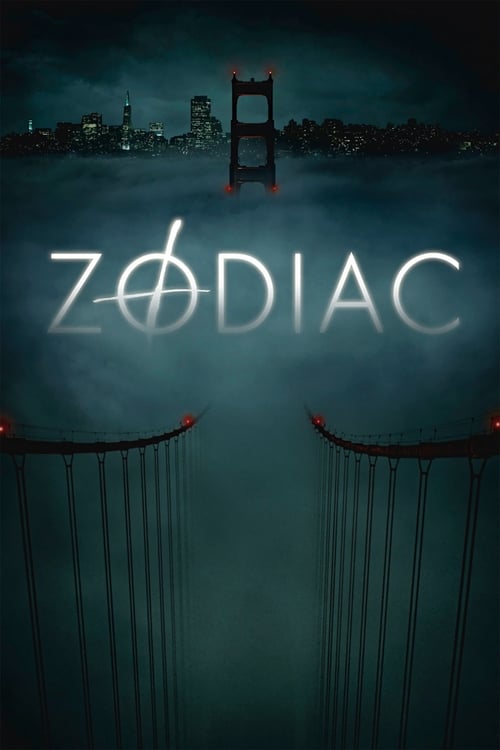
Zodiac
2007 · David Fincher
The Killer and his Netflix marriage keep the "master craftsman in a streaming cage" discourse alive; every rumored project (the Chinatown prequel series, a Squid Game English remake rumor cycle) trends instantly.
For a night when you want to sink into something long, dense, and true-crime-serious — a film to lean forward into for three hours and argue about afterward. It's a commitment, and it pays.
What it's about
In 1969, letters and ciphers from a self-named killer start arriving at the San Francisco Chronicle, and the Zodiac case swallows three men whole: a hard-living crime reporter, a homicide detective, and a boyish political cartoonist who can't let the puzzle go. Across more than a decade, the film follows the investigation as leads multiply, jurisdictions tangle, and obsession quietly costs each of them everything else.
The experience
Absorbing rather than jolting — a long, meticulous procedural that replaces jump scares with creeping dread and the slow ache of not knowing. A handful of early scenes are terrifying precisely because they're so matter-of-fact, and the film's refusal of easy answers gets under your skin.
Performances
Jake Gyllenhaal makes obsession look like boyish innocence curdling; Robert Downey Jr. is all charm and decay as the reporter; and Mark Ruffalo, rumpled and dogged, gives the detective a weary decency that anchors the whole film.
The craft
Fincher rebuilds the 1970s Bay Area with fanatical precision, shooting on early digital cameras that give the night scenes an eerie, inky depth, and paces the film like the investigation itself — accumulation, corroboration, erosion. The period detail and sound design reward the biggest screen you can find.
Why it matters
Initially underrated, it's now widely considered one of the great American films of its century — the high-water mark of the serial-killer procedural and a turning point in Fincher's career toward forensic realism.
Snapshot
David Fincher's Zodiac is a two-and-a-half-hour procedural epic about the limits of knowing. Working from James Vanderbilt's screenplay—adapted from cartoonist Robert Graysmith's investigative books Zodiac (1986) and Zodiac Unmasked (2002)—Fincher reconstructs the San Francisco Bay Area's Zodiac Killer case across roughly fifteen years (1968–1983), following three men whose pursuit of the killer costs them, in differing registers, their careers, their marriages, and their peace. The film refuses catharsis: the case was never definitively solved, and Fincher honors that void. Where most serial-killer procedurals trade in dread-and-revelation, Zodiac trades in accumulation, corroboration, and erosion. It is the closest American studio cinema has come, in the twenty-first century, to a film about epistemology.
Industry & production
Fincher had wanted to make Zodiac for years before it entered active development at Phoenix Pictures, which co-produced with Paramount and Warner Bros. (the split releasing arrangement complicated the film's marketing and awards positioning). The director grew up in Marin County, California; the Zodiac case was ambient fact of his childhood, and he approached the project with the fervency of a man reclaiming local memory. Graysmith's books gave the production its structural spine but also its forensic philosophy: Graysmith the amateur is the film's unlikely hero, a man who simply will not stop cross-referencing.
The shoot was extensive and meticulous. Production designer Donald Graham Burt, working with Fincher's characteristically exacting demands, recreated the Chronicle's bullpen, 1970s San Francisco streetscapes, and a succession of interiors across something like four decades of American décor. Much of the production photographed Los Angeles locations standing in for San Francisco, with select San Francisco location work integrated through Fincher's precisely controlled digital pipeline. The budget has been widely reported at approximately sixty-five million dollars—a modest sum for a 157-minute prestige drama at a major studio—and the film's box-office performance was similarly modest, underperforming expectations on initial release. Its reputation has since grown considerably beyond what opening-weekend returns suggested.
Technology
Zodiac is a landmark in digital cinema. Fincher shot the film on the Thomson Viper FilmStream camera, capturing at 1080p in a raw log format—one of the first major American narrative features to photograph entirely on digital without film backup or intercut film footage. (Michael Mann's Collateral, shot partially on Sony digital cameras in 2004, was an earlier harbinger; Zodiac solidified the viability of all-digital origination at the studio prestige tier.) The Viper allowed cinematographer Harris Savides and Fincher to deploy extended takes without magazine changes, to work with extremely low practical light levels, and to achieve a tonal range—slightly compressed highlights, a coolness in shadows—that suited the film's anti-glamorous aesthetic. The digital capture fed into a meticulous digital intermediate grading process, in which the period palette—the amber warmth of the early 1970s sequences, the harsher, flatter look of the early 1980s scenes—was shaped in post. The absence of grain, paradoxically, contributes to the film's uncanny quality: Zodiac looks like a document from a time that never quite was, vivid and unreal simultaneously.
Technique
Cinematography
Harris Savides was among the most distinctive cinematographers of his generation before his death in 2012, and his work on Zodiac stands as one of his most sustained achievements. His signature—practical-light sourcing, minimal supplemental fill, a willingness to let faces fall partially into darkness—is deployed with particular discipline here. The Bay Area location aesthetic Savides cultivated draws on the naturalist traditions associated with Gordon Willis and Haskell Wexler, but filtered through a digital medium that strips out any nostalgic warmth those predecessors' grainy celluloid might have provided. Savides and Fincher frame Zodiac with a kind of forensic patience: wide shots that establish institutional spaces as isolating environments (the Chronicle newsroom as a cathedral of information overload), over-the-shoulder arrangements that turn conversations into interrogations even when none are intended. The film's visual grammar insists on distance and legibility rather than expressionistic distortion.
Editing
Angus Wall, Fincher's long-term editorial collaborator, cut Zodiac with the discipline of a man assembling a case file. The 157-minute theatrical cut (a longer version exists for home viewing) moves through time in ways that require the audience to do active work: years collapse into time-lapses of construction and erosion (the building and demolition of the Transamerica Pyramid becomes a motif for temporal passage), while individual investigative scenes dilate, accumulating detail past the point where genre convention would cut away. Wall's editing refuses the conventional rhythmic acceleration of the thriller; instead, it matches the film's subject—the patient, unglamorous assembly of evidence—at the level of form. This made the film feel slack to some critics on release; it now reads as radical commitment.
Mise-en-scène / staging
Fincher's staging is theatrical in the old sense: actors are positioned and moved with architectural intentionality. The film's celebrated Toschi interview scene—Mark Ruffalo's detective and Jake Gyllenhaal's Graysmith meeting across a cluttered desk—is choreographed so that authority and obsession gradually swap registers without the camera announcing the shift. Fincher uses depth of field not for beauty but for information, keeping background detail legible as a way of insisting on the world's indifference to the foreground drama. His staging also deploys spatial disorientation systematically: doors that should lead somewhere certain lead somewhere unexpected; the geography of the Zodiac's crimes becomes labyrinthine in Graysmith's apartment, walls covered in pinned evidence, an image of interiority externalized.
Sound
The film's sound design, overseen with Fincher's typical intensity, layers period ambient texture against David Shire's spare, unsentimental score. Shire—a veteran whose work runs from The Taking of Pelham One Two Three (1974) to Saturday Night Fever (1977)—contributes music that suggests procedural machinery without melodrama. The more audacious audio choices involve the film's period pop selections: Donovan's "Hurdy Gurdy Man" plays over the opening 1969 murder at Blue Rock Springs Park, its psychedelic drone transforming a summer love song into something sinister through contextual displacement. The Carpenters, Marvin Gaye, and other period-accurate selections function as temporal markers and ironic counterpoints simultaneously.
Performance
Fincher elicits performances of deliberate restraint. Jake Gyllenhaal's Graysmith is physically closed-off, a man whose compulsive tidiness—the color-coded binders, the meticulous handwriting—reads as compensation for a gathering disorder underneath. Mark Ruffalo's Inspector Dave Toschi, based closely on the real detective, is warmly inhabitable in the early sections and progressively hollowed as the case grinds on; Ruffalo's technique involves withholding the actor's natural charm in calibrated degrees as Toschi's investment cools. Robert Downey Jr.'s Paul Avery, the Chronicle's crime reporter, is the film's most kinetic performance—quick, sardonic, self-destructive—and Downey uses the character's decline into paranoid dissolution to reveal that charisma, under pressure, is just another way of not engaging. Brian Cox appears briefly as Melvin Belli, the celebrity attorney targeted by the Zodiac, and brings a characteristic volatility that renders Belli's ambiguities legible in a few economical scenes.
Narrative & dramatic mode
Zodiac structures itself around a problem rather than a solution. The film's three loosely defined acts track three protagonists—Avery, Toschi, Graysmith—whose investment in the Zodiac case intensifies, crests, and either burns out or calcifies. Fincher presents this as a relay race in which none of the runners reaches a finish line. The narrative mode is procedural, which is to say: it privileges process over climax, evidence over intuition, and institutional reality over individual heroism. The film contains no interrogation that cracks a suspect, no confession, no definitive identification. What it contains is a scene—the film's emotional and epistemological pivot—in which Graysmith sits across from a man he believes to be Arthur Leigh Allen and knows, in some pre-rational register, that he is looking at the Zodiac, while knowing simultaneously that knowing is not enough. This is the dramatic mode: not thriller resolution but tragic accumulation.
Genre & cycle
Zodiac belongs to a lineage of American procedural films that gained prominence in the early-to-mid 1970s: paranoid thrillers defined by institutional distrust, unglamorous detective work, and resolutions that leave the world not improved. Alan Pakula's "paranoia trilogy"—Klute (1971), The Parallax View (1974), All the President's Men (1976)—is the most direct precedent: All the President's Men in particular offers an investigative-journalism template (the newspaper bullpen as the theater of action, reportorial persistence as a moral stance) that Vanderbilt's script consciously recapitulates. Roman Polanski's Chinatown (1974) haunts the film's noir-adjacent atmosphere and its commitment to a corrupt, unresolved ending. William Friedkin's The French Connection (1971) supplies the unglamorous procedural texture. These are films about systems that do not work properly, and Zodiac situates itself firmly in that tradition while updating it into the digital era's informational anxiety.
Within the serial-killer cycle Fincher himself helped establish with Se7en (1995), Zodiac represents a deliberate negation: where Se7en is operatic, aestheticized, and culminates in maximalist revelation, Zodiac is stripped, anti-aesthetic, and culminates in nothing. The films exist in productive tension, the later work almost as a critical reexamination of the earlier one's genre pleasures.
Authorship & method
Fincher's authorship is defined by preparation, repetition, and control. He is among the most documented directors when it comes to take counts and technical demands; his method—long rehearsal periods, many takes designed to exhaust actors into naturalness rather than perform it—is well established in the production discourse around his work. Zodiac extends and complicates this method: its relative naturalism (Savides's available-light aesthetic runs against the high-stylization of, say, Fight Club or Se7en) suggests that Fincher's control, in this instance, was deployed in the service of suppression rather than spectacle.
Harris Savides (1957–2012) was a cinematographer whose career encompassed Fincher (The Game, Zodiac), Gus Van Sant (Elephant, Milk), Sofia Coppola (Somewhere), and Jonathan Glazer (Birth). His work across these directors shares a commitment to available or near-available light and a suspicion of conventional beautification. On Zodiac, his collaboration with Fincher produced a visual vocabulary as distinctive as anything in either man's career.
David Shire is a respected veteran composer; the relative spareness of his Zodiac score reflects both his craft and Fincher's preference—across his career—for music that frames rather than underscores.
Angus Wall and James Vanderbilt round out the key creative unit: Wall as the editor who shapes Fincher's excessive material into coherence, Vanderbilt as the screenwriter whose structural confidence enabled a narrative of this scope to remain legible across its sprawl.
Movement / national cinema
Zodiac is American studio cinema operating in a register of conspicuous craft and institutional skepticism that links it—through its content and its formal choices—to the Hollywood of the early-to-mid 1970s, without being a period piece in the nostalgic sense. Fincher's Bay Area childhood gives the film a quality of personal investment unusual in his otherwise studied, often deliberately impersonal body of work. The film participates in what might be called the post-9/11 cycle of American genre cinema engaged with unresolved threat, institutional failure, and surveillance—a loose grouping that includes Munich (2005), Syriana (2005), and Michael Clayton (2007)—without being reducible to allegory.
Era / period
The film was released in March 2007, at a moment when American public culture was processing unresolved institutional failures (Iraq, Hurricane Katrina, the erosion of intelligence credibility). Whether Zodiac's production explicitly encoded these concerns is debatable; that audiences and critics read its thematics of unanswered threat and bureaucratic exhaustion against that context seems likely. The film depicts 1968–1983, a period whose cultural associations—Vietnam, Watergate, the deindustrialization of American cities—the film does not foreground but allows to accumulate in the texture of its period reconstruction.
Themes
Obsession is the film's central subject: what drives individuals to pursue certainty past the point of institutional or personal viability, and what that pursuit extracts. Graysmith's compulsion is presented neither as heroic nor as pathological but as something queerer—a mode of attention that produces knowledge without producing meaning. The film is equally interested in the costs of obsession: Avery loses himself, Toschi loses his certainty, Graysmith loses his marriage. The Zodiac case becomes a machine for transforming purposeful men into hollowed ones.
Alongside obsession runs the film's skepticism about evidence. Zodiac is meticulous about what can and cannot be proved, and it dramatizes the gap between conviction and proof—the film's emotional climax, such as it is, rests entirely on Graysmith's subjective certainty about Arthur Leigh Allen, which the film refuses to ratify. Memory, eyewitness testimony, handwriting analysis, cipher decryption: all of these are shown to be fallible or contested. The film functions, in this register, as an epistemological thriller—a thriller about the difficulty of knowing.
Media complicity and the ethics of attention form a third strand: the Chronicle's publication of the Zodiac's letters, the television appearances, the public-anxiety management that shapes how the case is presented—these are treated as morally complicated decisions embedded in institutional systems, not individual villainy.
Reception, canon & influence
Zodiac received respectful but divided notices on release. The consensus appreciated Fincher's craft and the performances but found the film's length and deliberate lack of resolution taxing; commercial performance was modest for a film of its profile. Roger Ebert awarded it four stars and recognized its ambition clearly. End-of-decade reassessments in 2009 and 2010 placed it considerably higher—many critics who had been neutral on first viewing returned to it and found it exceptional—and by the 2010s it had settled into the rough canon of twenty-first-century American films that reward sustained attention.
Influences backward: The Pakula paranoia cycle (All the President's Men, Klute, The Parallax View) is the most explicit formal and thematic precedent. Chinatown's unresolved noir provides structural permission for the ending. The Conversation (1974) contributes the theme of surveillance turned back against the surveiller. Michael Mann's Manhunter (1986)—itself a serial-killer procedural built on restraint rather than sensation—is a closer antecedent than Silence of the Lambs, and Mann's commitment to procedural authenticity clearly influenced Fincher's approach. Within Fincher's own filmography, Se7en (1995) is the genetic opposite that Zodiac consciously inverts.
Legacy forward: Zodiac's influence is visible across the prestige-television and cinema landscape of the following decade. Nic Pizzolatto has cited it directly as a primary reference for True Detective (HBO, 2014), which shares its obsessive detective structure, its Southern Gothic variant on paranoid atmosphere, and its willingness to deny genre resolution. Fincher's own Mindhunter (Netflix, 2017–2019), which he produced and directed episodes of, extends Zodiac's FBI-procedural methodology into a serialized format; the connections in sensibility, subject matter, and visual approach are unmistakable. Denis Villeneuve's Prisoners (2013) and Sicario (2015) inherit its procedural patience. The broader streaming-era true-crime documentary boom—Making a Murderer, The Jinx—participates in a cultural appetite for unresolved criminal investigation that Zodiac was instrumental in legitimizing for prestige audiences.
Fincher's own subsequent work—The Girl with the Dragon Tattoo (2011), Gone Girl (2014), The Killer (2023)—confirms Zodiac as the methodological center of his mature filmmaking: a cinema of precision, withholding, and the cold study of systems in which individual human beings grind themselves down to nothing.
A Deleuzian reading
Start with the basement.
The full Deleuzian reading of Zodiac →
Reception
A box-office disappointment in March 2007 that got zero Oscar nominations, Zodiac has since climbed onto countless best-of-the-2000s lists and is now routinely called Fincher's masterpiece — the textbook modern flop-to-classic story.
How Zodiac was received, from release to now →
Influences: the films it descends from and the films it influenced
- All the President's Men (1976) — Gordon Willis's available-light newsroom photography—actors pooled in practical desk lamps against dark voids—is the direct visual ancestor of Savides's forensic-wide Chronicle bullpen staging; both films frame journalism as epistemological labor that accumulates evidence without cathartic revelation.
- The Parallax View (1974) — Willis's deep-focus institutional geometry—wide-angle lenses holding foreground and background in equal forensic clarity—and a paranoid conspiracy that structurally refuses resolution directly precede Zodiac's forensic-wide shot grammar and anti-climactic procedural architecture.
- The Conversation (1974) — Walter Murch's sound design as epistemological trap—a surveillance professional who mishears the central evidence and is destroyed by his misinterpretation—establishes the contextual displacement strategy Fincher deploys; both films end with an investigator's identity evacuated by failed certainty.
- Blow-Up (1966) — A photographer's forensic enlargement of visual evidence seems to reveal a murder but ultimately proves nothing—the epistemological structure of investigation as self-defeating inquiry—is Zodiac's intellectual template before the procedural genre existed.
- In Cold Blood (1967) — Conrad Hall's available-light photography on actual Kansas locations established the aesthetic grammar of the true-crime procedural; the film's refusal to psychologically explain its killers is the ethical ancestor of Fincher's withholding of the Zodiac's identity.
- Night Moves (1975) — Gene Hackman's detective completes his investigation only to discover it has prevented nothing and revealed only his own inadequacy—Gordon Willis's naturalistic night photography and the anti-genre structure of investigation-as-futility are direct formal ancestors of Zodiac's epistemological dead end.
- Manhunter (1986) — Mann's video-texture cinematography imposes clinical distance from forensic evidence, and the FBI profiler whose investigative obsession costs him his domestic life establishes the genre template Fincher then formally strips of catharsis; Graham's breakdown is the emotional blueprint for Graysmith's.
- Collateral (2004) — Mann's Sony HDW-900F digital cinematography for available-light Los Angeles night work—the first major studio film to sustain HD digital acquisition across low-light urban environments—directly preceded and validated Fincher's choice of the Thomson Viper FilmStream as an all-digital capture system.
- Se7en (1995) — Fincher explicitly inverts his own film's grammar—where Se7en delivers the serial killer's baroque revelation and cathartic climax, Zodiac evacuates both, testing whether the procedural genre can survive removal of its foundational payoff; same director consciously dismantling his earlier film's structural contract.
- Memories of Murder (2003) — Both films reconstruct an actual unsolved serial killing using procedural accumulation and investigator exhaustion; Bong's editing rhythm similarly refuses genre acceleration, letting interrogation sequences dilate past conventional thriller pacing, and both films terminate in the same epistemological defeat: the killer is never identified.
- The Insider (1999) — Mann's investigative-journalism procedural deploys mixed digital/film texture to signal institutional alienation, uses calibrated-withholding performance (Crowe suppresses rather than expresses), and structures its documentary-evidence accumulation as exhaustion rather than revelation—a parallel route to Zodiac's anti-cathartic procedure.
- Casino (1995) — Fincher adopts Casino's surveillance-montage-as-procedural-structure and archive-building chronicle form — evidence folders, wire transcripts, institutional hierarchy mapped obsessively — translating the mob's operational machinery into a manhunt's documentation logic.
- The Social Network (2010) — Angus Wall extends his Zodiac anti-rhythm editing through the deposition-frame structure, which performs forensic time reconstruction—assembling disputed events from multiple unreliable accounts—as accumulation rather than verdict; the film applies Zodiac's epistemological procedure to institutional betrayal.
- Prisoners (2013) — Roger Deakins's forensic-wide framing of suburban spaces in flat winter light and Villeneuve's architectural staging of investigation—actors positioned for information rather than expressionistic effect—directly extend Zodiac's mise-en-scène vocabulary; competing evidence and inconclusive interrogation are structural inheritances.
- Spotlight (2015) — McCarthy directly adopts Zodiac's newsroom-as-information-overload visual grammar—forensic-wide shots subordinating actors to document accumulation—its investigative-journalism procedural structure, and its exhaustion naturalism in performance, where actors underplay revelation because revelation keeps failing to arrive.
- Gone Girl (2014) — Fincher extends Zodiac's calibrated-withholding performance grammar through Rosamund Pike's Amy (affect as forensic surface rather than interiority), applies the anti-catharsis procedural ending (marriage as unresolved case file), and uses Jeff Cronenweth's forensic-wide suburban framing to continue Savides's institutional-distance aesthetic.
- First Man (2018) — Patient procedural duration tracking institutional obsession across years, making the investigative process itself — not resolution — the emotional subject; establishes the elegiac procedural mode in which professional fixation visibly hollows out private life without the film condemning or psychologizing the protagonist.
- Kill the Messenger (2014) — The obsessive truth-seeker whose pursuit corrodes his career and family; a procedural that curdles into personal ruin, prefiguring Webb's domestic and professional collapse.
- The Batman (2022) — Supplies the template of the unsolved serial-killer procedural built on a cipher-leaving murderer and obsessive, document-driven investigation rather than action set-pieces, the structural spine Reeves and co-writer Craig adopt wholesale.
- To Catch a Killer (2023) — The acknowledged model for the sober, procedural, anti-catharsis treatment: a cold digital grade, accumulation of process over thrills, and a refusal to deliver the climactic confrontation the genre promises.
- Woman of the Hour (2024) — Withholds catharsis and the killer's interiority, sustaining dread through procedural restraint and ambient unease instead of gore — the template for fear without exploitation.
- The Order (2024) — Period-precise procedural built on obsessive documentation, elliptical jumps across years, and a muted late-'70s/'80s palette that The Order explicitly emulates in its 1983 setting.
- Longlegs (2024) — Models the obsessive period-set procedural assembled from ciphers, documents and dates, with an analog-era texture and a dread that comes from a case that resists solution.
- The Amazing Spider-Man (2012) — Shares screenwriter James Vanderbilt, whose obsessive-investigation scaffolding — a protagonist chasing a paper trail left by an absent figure — supplies TASM's 'parental-mystery hook' (Peter reconstructing his vanished father's research).
- The Dark Knight (2008) — Fincher's concurrent procedural shares TDK's institutional-frustration architecture and source-plausible digital cinematography (Harris Savides); both treat the criminal's unknowability as a formal organizing principle rather than a solvable narrative problem, and both refuse the catharsis of capture.
- Insomnia (2002) — Fincher deploys the same strategy of making time's physical cost visible in performance — Gyllenhaal and Ruffalo deteriorating across decades of obsessive investigation — and Harris Savides's overlit, color-drained cinematography operates in the same expressionistic register as Pfister's Arctic overexposure: both use natural light made hostile as an index of psychological damage.
- The Departed (2006) — Fincher simultaneously develops parallel-investigative-timeline cutting — multiple protagonists tracking the same case across years without convergence — with the same desaturated procedural palette and the same premise that sustained institutional investigation consumes and dissolves the investigator's identity rather than confirming it.
- Gone Baby Gone (2007) — Released the same year, Fincher demonstrated that procedural patience—scenes extended to investigative duration rather than dramatic economy—could sustain a studio crime film without conventional resolution, validating alongside Gone Baby Gone an editorial mode that trusts accumulated procedural detail over kinetic plot machinery.
- American Gangster (2007) — Harris Savides shot both films in the same period, applying the identical surveillance-inflected, available-light aesthetic philosophy to asymptotic-convergence procedural narratives; the two films are the definitive paired statement of Savides's late-career cinematographic method — cool, institutional, suspicious of beauty — applied to true-crime material.
- Unbreakable (2000) — Fincher's anamorphic procedural grammar — ambient sound texture over conventional score, investigative interiority that cannot achieve closure, and the structural decision to withhold confirmation from an obsessive who has nonetheless identified the truth — runs parallel to Unbreakable's ontological detective architecture and its refusal of conventional revelation.
- The Andromeda Strain (1971) — Fincher's procedural cutting rhythm — the edit arrives when the viewer has processed the previous data point and requires the next — is a direct formal parallel to Stuart Gilmore's information-driven editorial logic, relocating the same epistemological structure from virology to criminal investigation.
- Argo (2012) — Procedural thriller using archival obsession, location-derived period-specific color, and Super 35 film grain to build suspense through accumulation of documentary detail rather than action set-pieces — the same strategy that sustains Argo's first two acts.
- Oppenheimer (2023) — Fincher compresses two decades of documented institutional investigation through aggressive temporal ellipsis — police interviews, newspaper archives, official hearings — making the accumulation of procedural evidence the film's primary affect; the same documentary-procedural mode Oppenheimer deploys in its hearing sequences.
- 12.12: The Day (2023) — Fincher's procedural compression of a multi-year investigation into a mechanism-driven narrative — in which institutional process, documentary evidence, and jurisdictional friction displace psychological character study as the film's substance — shares 12.12's formal commitment to depicting systemic failure through procedural accumulation rather than individual tragedy.
- Weapons (2025) — The catastrophe-procedural mode applied to community-scale violence: procedural investigation as dramatic engine, de-dramatized framing, and structural hard cuts managing information across an ensemble without delivering conventional resolution or a final confrontation.
- A House of Dynamite (2025) — Epistemic procedural in which the investigation's structural failure to achieve attribution is the formal point: information accumulates across an extended timeline but cannot be made to cohere into a legible causal chain, sustaining dread through the persistence of the gap between evidence and knowledge.
Similar films
- Prisoners (2013) — influence & lineage · often watched together
- The Conversation (1974) — influence & lineage · often watched together
- Se7en (1995) — influence & lineage
- Gone Girl (2014) — influence & lineage
- The Social Network (2010) — influence & lineage
- Memories of Murder (2003) — influence & lineage · often watched together
- Vertigo (1958) — often watched together
- Being John Malkovich (1999) — often watched together
All the films related to Zodiac →
Watch it with: curated runs of related films
- The Killer You Can't Look Away From — A run of murder mysteries where obsession — the witness's, the investigator's, the killer's own — curdles into pure style, from the gloved-hand giallo that invented the look to the modern heirs still working the vein.
Film essays and courses that include it
- David Fincher
- Portrait of the Killer: Serial Murder from Lang to Fincher
- Portrait of a Killer: How Cinema Learned to Inhabit the Monster
- The Long Beat: How Cinema Invented the Police Film
- The Investigator's Eye: From Sam Spade to Zodiac
- What the Darkness Knows: The Occult Procedural and Its Investigators
- The Frame as a Trap
- The Autopsy