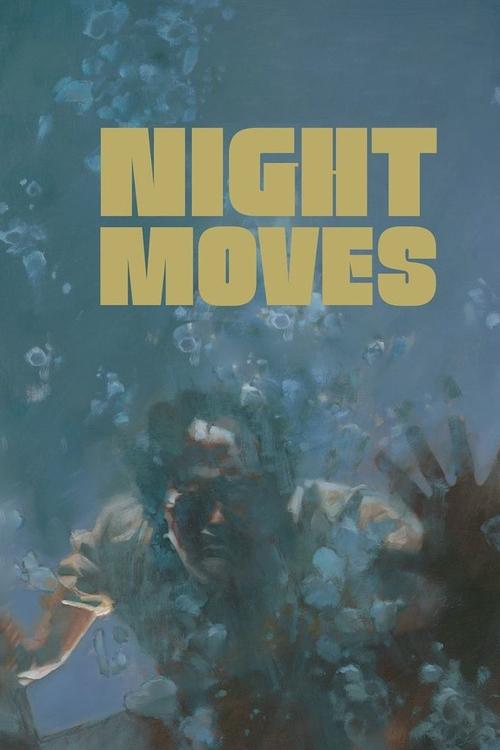
Night Moves
1975 · Arthur Penn
When you want a detective story for grown-ups — moody, bitter, more character than plot — and you're okay with a film that unsettles instead of resolves. Definitely a challenge pick, not a cozy whodunit.
What it's about
Harry Moseby, an ex-pro-football player turned small-time Los Angeles private detective, takes what looks like a routine job: a fading Hollywood actress wants her runaway teenage daughter found and brought home. The trail leads through movie-stuntman circles to the Florida Keys, where Harry starts sensing connections between the girl, a suspicious mechanic, and an unsolved death — all while his own marriage is quietly falling apart.
The experience
Slow-burning and sour in the best way — less about clues clicking into place than about a smart man slowly realizing how little he understands, in his case and in his life. It's melancholy, adult, and it leaves a bruise rather than a bang.
Performances
Gene Hackman is the whole show: his Harry is intelligent, wounded, and self-deceiving, a detective whose confidence erodes scene by scene. It's one of the great 1970s leading-man performances precisely because it refuses to make him heroic.
The craft
Alan Sharp's screenplay is dense with double meanings — the title itself is a chess pun — and Arthur Penn directs against genre expectation, letting scenes end on unease rather than answers. The Florida Keys sequences, with their glass-bottom boats and open water, give the film a sun-bleached dread that's the opposite of shadowy noir.
Why it matters
A cornerstone of the 1970s wave of disillusioned American detective films, initially overlooked and now regarded as one of the era's key statements about a country that had lost the plot of its own story.
Snapshot
Night Moves is the bleakest and most self-questioning of the great 1970s neo-noir detective films, the cycle that also produced Chinatown (1974) and Robert Altman's The Long Goodbye (1973). Arthur Penn directs Gene Hackman as Harry Moseby, a Los Angeles private investigator and former pro-football player hired by a fading actress to retrieve her runaway teenage daughter. Harry succeeds at the literal task — he finds the girl in the Florida Keys and brings her home — and yet understands almost nothing about the web of smuggling, exploitation, and murder he has been walking through. From an original screenplay by the Scottish writer Alan Sharp, the film turns the detective story inside out: the genre's promise that an intelligent observer can read clues and arrive at truth is precisely what Night Moves dismantles. Its title is a double pun — the nocturnal maneuvers of its plot and the "knight moves" of chess, the game through which Harry contemplates his own blindness. Commercially overlooked on release, it has become a touchstone of post-Watergate American cinema and one of the most admired films in both Penn's and Hackman's careers.
Industry & production
The film was produced and released by Warner Bros., the studio that had backed Penn's epochal Bonnie and Clyde (1967) and Little Big Man (1970). It arrived at the tail end of the brief window when major studios financed director-driven, downbeat genre revisions for adult audiences — the New Hollywood moment that Jaws, also released in 1975, would help bring to a close by inaugurating the blockbuster era.
Production drew on two geographies central to the story: Southern California, where Harry's office, home, and the Hollywood stunt-and-film milieu are set, and the Florida Keys, where the runaway Delly has fled to her stepfather's coastal compound and where the film's underwater climax unfolds. The detailed mechanics of the budget and shooting schedule are not richly documented in the popular record, and I will not invent figures; what is well established is that the film underperformed at the box office and was received tepidly, only to be substantially reappraised in later decades. The casting is notable as a snapshot of talent in transition: Hackman was at the height of his post–French Connection (1971) stardom, while the supporting cast included very early screen appearances by Melanie Griffith, roughly seventeen at the time, as the sexually precocious Delly, and James Woods as the mechanic Quentin.
Technology
Night Moves was shot photochemically on 35mm in the standard manner of mid-1970s studio production, with no exotic technical apparatus driving its style. Its most technically demanding sequences are the underwater scenes off the Florida coast, where the discovery of a sunken seaplane and a body provides the plot's grim hinge; these required underwater cinematography and the staging of a fatal diving "accident." The film's interest in technology is more thematic than instrumental — it is preoccupied with vehicles and machines as instruments of both livelihood and death: stunt aircraft, boats, the mechanic's garage, and finally the runaway powerboat of the closing image. Where the contemporaneous paranoia thrillers leaned on surveillance hardware (the wiretaps of The Conversation, the photographic enlargements of Blow-Up), Night Moves keeps its technology workaday, which sharpens the irony that a professional whose trade is observation cannot see what is in front of him.
Technique
Cinematography
Bruce Surtees, the cinematographer most identified with Clint Eastwood's films of the period, shoots Night Moves in a restrained, naturalistic register that resists the high-contrast expressionism of classic noir. Interiors are often low-key and underlit — Surtees was nicknamed for his command of darkness — but the Florida material opens into bright, flat coastal daylight, an anti-noir glare in which menace hides in plain sight rather than in shadow. The visual scheme supports the film's central conceit: clarity of image does not produce clarity of understanding. The underwater photography in the climax converts the sea into a literal field of obscured vision, and the famous final overhead of a boat circling helplessly turns the camera's superior vantage into a comment on the protagonist's entrapment.
Editing
The picture was cut by Dede Allen, Penn's most important collaborator and one of the most influential editors in American film, whose work on Bonnie and Clyde had reshaped the rhythm of Hollywood cutting. In Night Moves her editing is comparatively recessive by design, withholding the kinetic montage of the earlier collaboration in favor of a deliberate, sometimes disorienting construction that mirrors Harry's faulty processing of information. Crucial connections are buried, glimpsed, or registered too late, so that the audience, like Harry, is given the pieces but denied the assembling click of revelation until it is useless.
Mise-en-scène / staging
Penn stages the film around motifs of looking and not-seeing. The recurring chess board in Harry's home is the governing emblem: Harry replays a historic game in which a player failed to perceive a winning combination of knight moves, a defeat he calls one the loser never forgot. The staging repeatedly places Harry as a spectator — to his wife's infidelity, to a stunt performer's filmed plunge, to a screening — and repeatedly shows him misreading what he watches. The Hollywood stunt world supplies a metaphor made literal: people who fake danger for the camera while real death circulates beneath the surface.
Sound
Michael Small composed the score. Small was effectively the house composer of the 1970s paranoia thriller, having scored Klute (1971) and The Parallax View (1974), and his contribution here is similarly understated and unsettling rather than melodic or reassuring. The sound design favors ambient realism — surf, engines, the mechanical drone of boats and planes — culminating in the relentless, unanswered noise of the circling vessel that closes the film.
Performance
Hackman gives one of his finest and least vain performances. His Harry Moseby is intelligent, wounded, and self-deceiving, a man who deploys wisecracks to manage a marriage and a profession he cannot actually control; the bravado of the genre's hard-boiled detective curdles into something closer to a midlife crisis of competence. The supporting performances are textured: Jennifer Warren as Paula brings a weary, complicit warmth that becomes the film's emotional and moral pivot; Susan Clark plays Harry's wife Ellen, whose affair Harry "detects" early and then mishandles entirely; and Melanie Griffith's Delly registers a disturbing mixture of childishness and exploited sexuality that the film treats with unsettling frankness. James Woods, Harris Yulin, Edward Binns, and John Crawford fill out the milieu with sharp character work.
Narrative & dramatic mode
The dramatic mode is the detective story deliberately deprived of its catharsis. The conventional mechanism — investigation leading to revelation leading to restored order — is run to completion and shown to fail. Harry "closes" the missing-person case in the first movement, only for the real plot, a smuggling operation moving valuable pre-Columbian artifacts through the stunt-and-diving world, to surface obliquely and largely beyond his grasp. Information arrives, but Harry consistently arrives at the wrong reading or arrives too late, so that the film's true subject is epistemological: the gap between seeing and knowing. The screenplay folds Harry's professional failure into his domestic one — his inability to read his own marriage rhymes with his inability to read the case — and refuses the genre's usual consolation that the detective at least understands. The celebrated ending, with Harry wounded aboard a boat named Point of View that circles uncontrollably in open water, is one of the most resonant ambiguous closures in American film: motion without direction, vantage without comprehension.
Genre & cycle
Night Moves belongs squarely to the 1970s neo-noir revival, the cohort of films that reopened the classic private-eye form in order to interrogate it. Alongside Chinatown and The Long Goodbye, and in dialogue with the surveillance paranoia of The Conversation (1974) and The Parallax View, it transposes the disillusionment of the Watergate years onto the figure of the investigator. Where classic noir presumed a corrupt world legible to a tough enough observer, the 1970s cycle presumed corruption that exceeds and outwits the observer entirely. Night Moves is arguably the cycle's purest expression of detective futility: less stylized than Altman's deconstruction, less monumental than Chinatown, but more unsparing about the hero's irrelevance to the outcome.
Authorship & method
The film is a meeting of distinctive authorial sensibilities. Arthur Penn, a founding figure of New Hollywood, had spent his career puncturing American myths — the outlaw romance of Bonnie and Clyde, the frontier history of Little Big Man — and Night Moves extends that project to the myth of the competent investigator and, by extension, of American self-knowledge after the 1960s. Alan Sharp, the screenwriter, was a literary Scot whose American work — including the Westerns The Hired Hand (1971) and Ulzana's Raid (1972) — shares a fatalistic, morally unresolved cast; his dialogue gives Harry both his mordant wit and his blind spots, and the script's refusal of resolution is central to the film's identity. The collaboration with editor Dede Allen and composer Michael Small placed the project in the hands of artists who had each helped define the decade's screen grammar — Allen its editing, Small its sound of dread. Cinematographer Bruce Surtees supplied the deceptively plain, daylight-and-darkness palette. The result is a film whose authorship is genuinely shared between a director's thematic skepticism and a writer's tragic structure.
Movement / national cinema
The film is a product of the American New Wave (New Hollywood), the roughly 1967–1976 period in which a generation of directors won unusual creative latitude inside the studio system to make personal, often pessimistic genre films influenced by European art cinema. Night Moves exemplifies the movement's late, autumnal phase: its borrowing of modernist ambiguity, its anti-heroic protagonist, and its bleak political undertone all mark it as native to that moment. It also reflects the transatlantic cross-pollination of the era through Sharp's European literary sensibility working within an American idiom.
Era / period
Made in 1975, the film is saturated with the malaise of the early-to-mid 1970s: the aftermath of the Kennedy assassinations, Vietnam, and Watergate hang over its sense that public and private trust have collapsed. A recurring beat of dialogue gestures at the decade's disorientation by treating "where were you when Kennedy was shot" as a question whose very answer — which Kennedy? — signals a culture stunned into confusion. Harry's casually dismissive remark about sitting through an Éric Rohmer film likewise dates and places the character within a moment when European art cinema was a live cultural reference even for a wisecracking American detective. The film's pessimism is inseparable from its year.
Themes
The film's master theme is the failure of perception — the chasm between observing and understanding, dramatized through chess, stunt work, underwater murk, and the detective's trade itself. Closely linked is the theme of belated knowledge: truths that arrive only after they can do any good, figured in the chess player who sees his winning move years too late. A third strand concerns the corrosion of intimacy and trust, with Harry's marriage serving as the private mirror of his professional impotence and of the wider social distrust of the period. The film also examines the exploitation lurking beneath the glamour industries — Hollywood stunt work and the sexualization of a teenage girl — and, finally, the impossibility of control, sealed by an ending in which the protagonist can only go in circles.
Reception, canon & influence
On release, Night Moves was met with mixed-to-respectful notices and modest commercial returns; it did not register as a major event in the way Chinatown had the year before, and it was somewhat overshadowed in a crowded field of 1970s detective films. Over subsequent decades, however, its critical standing rose substantially, and it is now routinely cited among the finest neo-noirs of its era and among the strongest films of both Penn and Hackman. Specific institutional honors and restoration history I will leave unstated rather than risk inaccuracy, but the trajectory from neglect to reappraisal is well documented in critical writing on the period.
Backward — the influences on the film — run through the hard-boiled literary tradition of Dashiell Hammett and Raymond Chandler and the classic Hollywood detective films adapted from them, which Night Moves both honors and negates. Its preoccupation with the ambiguity of the visible owes a clear debt to European modernism, particularly Michelangelo Antonioni's Blow-Up (1966), another work about an observer who cannot finally interpret what he has seen. It is also in active conversation with its immediate contemporaries — The Long Goodbye and Chinatown — within the shared post-Watergate sensibility.
Forward — its legacy — lies in the enduring template it offered for the deconstructed detective film: the investigator as a man defeated by, rather than master of, the world he probes, and the noir of bright daylight and ambiguous, unredemptive endings. Later neo-noir and "anti-mystery" filmmaking that denies audiences the comfort of solution draws on the ground Night Moves helped clear, and its final image of the circling, rudderless boat has become a frequently invoked emblem of cinematic futility. Its reputation today rests less on what it earned than on how completely it anticipated a more skeptical view of the detective's — and the viewer's — capacity to know.
A Deleuzian reading
Start with the last image, because the whole film has been circling toward it.
The full Deleuzian reading of Night Moves →
Reception
It landed with a thud in the summer of 1975 — buried by Jaws and met with shrugging reviews — but has since been reappraised as one of the essential paranoid neo-noirs of the New Hollywood era, now routinely mentioned in the same breath as Chinatown and The Long Goodbye.
How Night Moves was received, from release to now →
Influences: the films it descends from and the films it influenced
- The Big Sleep (1946) — Supplies the labyrinthine, finally-unsolvable Chandler plot and the hard-boiled-PI template that Night Moves inherits structurally and then inverts into defeat.
- The Maltese Falcon (1941) — Hammett's mercenary detective and the coveted object (smuggled antiquities here) that drives a chain of betrayals is the noir architecture Sharp's script honors and negates.
- Blow-Up (1966) — The observer who scrutinizes and enlarges an image yet cannot extract its meaning — the 'looking-and-not-seeing' device — is lifted almost wholesale into Harry's epistemological failure.
- Bonnie and Clyde (1967) — Establishes the Penn–Dede Allen editing grammar (elliptical, rhythm-breaking cuts, abrupt violence) and the myth-puncturing project that Night Moves redeploys against the detective myth.
- Little Big Man (1970) — Penn's deflation of American self-mythology — here the frontier — is the authorial through-line extended to the myth of the competent investigator and post-1960s self-knowledge.
- Ulzana's Raid (1972) — Alan Sharp's fatalistic, morally unresolved screenwriting and refusal of redemptive closure is the same dramaturgy that shapes Harry's tragic structure.
- The Hired Hand (1971) — Sharp's elegiac, anti-heroic script logic — characters undone by their own blind spots — prefigures Harry's mordant wit masking fatal misreadings.
- Chinatown (1974) — The bright-daylight neo-noir whose detective unwittingly precipitates the catastrophe he probes, ending in unredemptive helplessness — the contemporaneous benchmark Night Moves answers.
- The Long Goodbye (1973) — Deconstructs Marlowe into a man out of step with a corrupt Los Angeles, the same anti-detective revisionism within the shared post-Watergate sensibility.
- The Breaking Point (1950) — Reprises the charter-boat trap and the held final shot — the climactic violence confined to the deck and water around a hired boat, then an ending that refuses release by holding on the vessel circling with no one able to steer it.
- Blow Out (1981) — Directly extends the Blow-Up/Night Moves line: a sound-and-image technician reconstructs evidence flawlessly yet saves no one, closing on pure futility.
- Cutter's Way (1981) — Inherits the daylight neo-noir of the defeated investigator and the deliberately unresolved, anti-redemptive ending Night Moves helped license.
- Zodiac (2007) — An anti-detective procedural that withholds solution and replaces mastery with corrosive obsession, building on the ground Night Moves cleared.
- Inherent Vice (2014) — A deconstructed PI adrift in a plot he can never assemble, dramatizing the detective's impotence and the impossibility-of-control as Sharp's script first did.
- No Country for Old Men (2007) — The lawman defeated by a world he cannot master, ending on bewildered withdrawal rather than resolution — the impossibility-of-control template in late form.
- Absolute Power (1997) — Hackman's physically restrained performance in a jazz-textured procedural—the investigator's methodical movement through institutional concealment shot with naturalistic intimacy and unhurried crosscutting—anticipates both the score's inflection and Cox's editing logic in the film's procedural accumulation passages.
- The Big Lebowski (1998) — Gene Hackman's Harry Moseby explicitly names his own investigative failure — 'I'm not sure who won' — establishing the self-aware neo-noir detective who cannot resolve his case as a formal genre position; the Coens develop this into the Dude's complete non-investigation, and the Stranger's closing monologue names the narrative's non-resolution in the same register of equanimity.
- Jackie Brown (1997) — Establishes the anti-resolution crime film in which protagonist interiority is systematically withheld — Gene Hackman's Harry Moseby acts without fully understanding his own motivations — a formal model for how Tarantino renders Jackie's internal life through behavior rather than confession.
- One Battle After Another (2025) — Gene Hackman's detective whose investigative competence produces no enlightenment — the case resolves into historical forces too large for genre procedure to contain — crystallizes the tragicomic private eye figure PTA deploys: a man whose professional style is no protection against the scale of what he has blundered into.
- Klute (1971) — Shares Michael Small's score of low, dread-saturated unease and a surveillance-paranoia mood where watching yields anxiety rather than knowledge.
- The Parallax View (1974) — Small's scoring and the post-Watergate conspiracy form in which the investigator is consumed rather than vindicated runs parallel to Night Moves' futility.
- The Conversation (1974) — A surveillance professional whose entire expertise is perception, yet who misreads the evidence he gathers — the failure-of-perception theme as craft subject.
- Three Days of the Condor (1975) — Penn's epistemological quest that concludes in the protagonist's literal inability to comprehend what he has discovered runs parallel to Turner's situation: both films use the private-investigator or analyst structure to produce knowledge that cannot be converted into action or justice; the available-light aesthetic and the formal pessimism about individual agency against systemic force are coordinated.
Similar films
- The Long Goodbye (1973) — influence & lineage
- Chinatown (1974) — influence & lineage
- The Conversation (1974) — influence & lineage
- The Big Sleep (1946) — influence & lineage
- Marnie (1964) — shared sensibility
- Mulholland Drive (2001) — shared sensibility
- Murder, My Sweet (1944) — shared sensibility
- Taxi Driver (1976) — shared sensibility
All the films related to Night Moves →