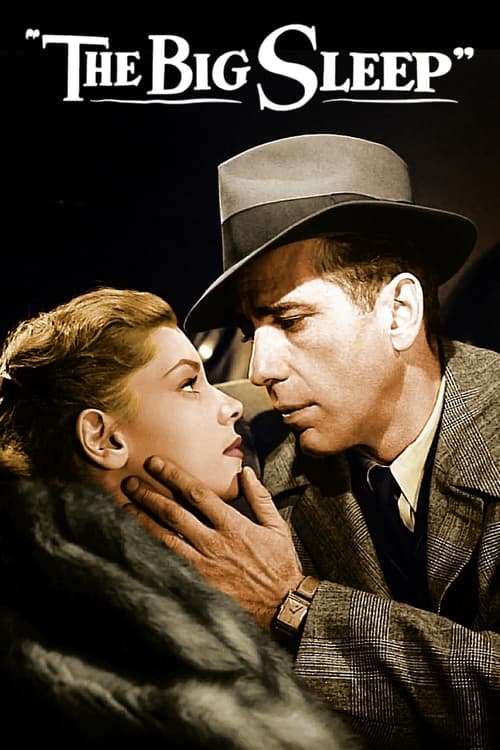
The Big Sleep
1946 · Howard Hawks
For a rainy-night noir fix — when you want cigarettes-and-trenchcoat atmosphere and razor dialogue more than a puzzle you can actually solve.
What it's about
Private eye Philip Marlowe is hired by a dying millionaire general to handle a blackmail problem involving his wild youngest daughter — and the job immediately sprouts murders, double-crosses, and a Los Angeles underworld nobody fully controls. Along the way Marlowe keeps circling the general's other daughter, and the case gets less solvable and more dangerous the deeper he goes.
The experience
Famously, the plot doesn't entirely add up — and it doesn't matter, because the pleasure is the crackling wall-to-wall innuendo, the shadows, and the sense of danger around every doorway. It's fast, witty, and slinky rather than grim.
Performances
Humphrey Bogart's Marlowe is the mold for the wisecracking private eye, and his scenes with Lauren Bacall are pure charged electricity — their real-life chemistry practically burns through the screen.
The craft
Howard Hawks directs Raymond Chandler's tangled novel at speed, letting atmosphere and flirtation carry what the plot can't, with studio-era black-and-white shadowcraft at its most seductive. The dialogue, sharpened by a team that included William Faulkner among its writers, is some of the most quotable in the genre.
Why it matters
One of the handful of films that fixed the look, sound, and attitude of American film noir — the detective, the dangerous women, the city at night — for every generation since.
Snapshot
A private detective is hired to resolve a blackmail case and finds himself descending into a Los Angeles underworld of pornography, murder, and layered deception that neither he nor the audience can fully map. Philip Marlowe, played by Humphrey Bogart, moves through the city not as a master logician but as a morally alert improviser, and the film's celebrated narrative opacity — its refusal to resolve every killing — becomes less a flaw than a formal argument: atmosphere, character, and desire matter more than solution. The Big Sleep is the definitive synthesis of hard-boiled fiction and Hollywood studio craft, and one of the two or three films that fixed the vocabulary of American film noir for subsequent generations.
Industry & production
Warner Bros. purchased the rights to Raymond Chandler's 1939 debut novel shortly after the commercial and critical success of Double Indemnity (1944) demonstrated the commercial viability of dark crime material. Howard Hawks produced the film independently under his own banner, with Warner Bros. distributing — an arrangement that gave Hawks unusual creative latitude. The casting of Humphrey Bogart and Lauren Bacall was driven partly by commercial calculation: the two had ignited screen chemistry in Hawks's previous film, To Have and Have Not (1944), and had married in May 1945. Warner Bros. was invested in cementing Bacall as a star, and the studio's intervention after initial completion led to one of classical Hollywood's most documented cases of post-production restructuring.
The film exists in two substantially different versions. A 1945 pre-release cut was screened for military audiences and shelved; when studio executives judged that Bacall's role needed expansion, Hawks and company shot new scenes in late 1945. The theatrical release of August 1946 incorporated these additions — most notably an extended bookshop sequence and a sexually charged racetrack dialogue scene — at the cost of tightening or removing other material. The 1945 version was rediscovered and released publicly in the 1990s, allowing scholars to study both cuts side by side. The 1946 version is more tonally electric in its Bogart-Bacall exchanges but marginally less coherent in its already labyrinthine plotting.
Technology
The Big Sleep is a sound-stage-dominant production in the Warner Bros. tradition, with limited location shooting in the Los Angeles area. Cinematographer Sidney Hickox worked within the studio's infrastructure of arc lighting and the fast orthochromatic-successor panchromatic film stocks that had become standard, using the controlled environment to build the elaborate low-key setups that define the film's visual texture. The period's Technicolor process was explicitly not used; Hawks and Hickox worked in black-and-white, which they treated not as a limitation but as the medium native to this world of shadow and moral ambiguity. No unusually experimental camera technology was deployed; the achievement is one of craft and pictorial intelligence rather than mechanical novelty.
Technique
Cinematography
Sidney Hickox's work on The Big Sleep is exemplary studio noir cinematography without quite rising to the expressionist extremes of, say, Carol Reed or the émigré-inflected work of John Alton. The dominant mode is high-contrast low-key: single or limited light sources that model faces harshly and leave large portions of the frame in near-total darkness. Venetian blind patterns cast across figures and walls — a visual motif the film did not invent but employs with particular discipline — literalize the theme of entrapment and partial vision. Interiors are dense with shadow; even daylit spaces like the Sternwood greenhouse opening scene are made oppressive by the humid close framing. Hickox favors medium shots and medium close-ups that keep Bogart's face readable without isolating it from its environment. The camera is generally unobtrusive, rarely calling attention to itself through dynamic movement; what drama there is comes from light placement and staging rather than tracking shots or crane work.
Editing
Christian Nyby cut the film — he would later direct The Thing from Another World (1951), a production on which Hawks's supervisory hand was reportedly heavy. The editing of The Big Sleep is functional and propulsive rather than stylistically foregrounded. Scene transitions are predominantly hard cuts; the pace accelerates through Marlowe's accumulated encounters without lingering on any single confrontation long enough for the audience to audit the plot logic. This speed is arguably editorial cover for the screenplay's notorious gaps: the film moves so efficiently from one charged scene to the next that viewers rarely have time to register what has been left unexplained. The 1946 reshoots required re-editing that somewhat disrupted continuity in the middle third, and critics have noted structural unevenness in those passages, though it rarely registers as a viewing problem.
Mise-en-scène / staging
Hawks's staging is the film's most under-discussed technical strength. He consistently places Marlowe in environmental relationships — leaning against doorframes, occupying a chair in someone else's space, positioning himself slightly too comfortably in rooms he has no right to be in — that convey character without exposition. The blocking of the Bogart-Bacall scenes is particularly charged: the two actors are repeatedly placed in intimate spatial proximity that the dialogue barely justifies, creating a layer of erotic subtext that the censorship apparatus of the Production Code required to remain subtext. Hawks had developed this approach in To Have and Have Not and refined it here. The famous bookshop sequence — in which Marlowe and a bespectacled proprietor engage in a flirtation conducted entirely through innuendo about rare books — is a clinic in how Hawks could make the Production Code's constraints generative rather than restrictive.
Sound
Max Steiner composed the score, delivering a characteristically lush Warner Bros. orchestration that telegraphs emotional beats with more insistence than many modern viewers find comfortable. The score is most effective in the thriller action sequences and least effective when it underscores the romantic scenes that the Bogart-Bacall chemistry already handles without assistance. More notable from a sound-design perspective is Hawks's use of silence and ambient noise in some of the darker nocturnal sequences — moments where the score withdraws and room tone takes over. Dialogue recording is clean throughout; Hawks, like his contemporary Preston Sturges, treated overlapping and rapid-fire speech as a directorial tool, and the film's conversation scenes maintain an unusual velocity that the production sound supports.
Performance
Bogart's Marlowe is the pivot on which the film turns. His performance is notable for its self-amused quality: Marlowe is frequently surprised, occasionally frightened, and never omniscient, yet Bogart plays each reversal with a sardonic equanimity that reads as toughness without brittleness. The performance draws on his work in The Maltese Falcon (1941) while being warmer and more openly sensual. Bacall, then twenty-one, gives her most assured early-career performance; the archness she deployed in To Have and Have Not is more controlled here, deployed strategically rather than as a default register. The supporting cast is exceptional even by Warner Bros. standards: Martha Vickers as Carmen Sternwood is genuinely disturbing in a performance that goes further than the Production Code usually permitted in suggesting pathology, while Dorothy Malone, Charles Waldron, and Elisha Cook Jr. make the most of limited screen time.
Narrative & dramatic mode
The Big Sleep is canonical for its plot's resistance to full comprehension — a resistance that is largely, though not entirely, intentional. Chandler's novel already compressed several disparate pulp magazine stories and contained genuine loose ends; the screenplay by William Faulkner, Leigh Brackett, and Jules Furthman simplified some material while apparently neglecting to resolve the question of who killed the Sternwood chauffeur Owen Taylor. The anecdote — that Hawks and Chandler both telegrammed each other asking who had done it, and that Chandler replied he did not know — may be apocryphal in its details but is accurate as a description of the film's structure. Hawks himself, in interviews with Peter Bogdanovich and others, expressed indifference to plot coherence in principle, arguing that his interest lay in individual scenes rather than narrative architecture. The film's mode is consequently closer to picaresque than to classical detective fiction: Marlowe moves through a series of encounters that are individually compelling, and the satisfaction offered is experiential and tonal rather than logical.
Genre & cycle
The Big Sleep belongs to the mid-1940s film noir cycle that also includes Double Indemnity (1944), Laura (1944), Mildred Pierce (1945), and Detour (1945). The term "film noir" was not in American critical circulation at the time of the film's release — it was coined and developed by French critics, most prominently Raymond Borde and Etienne Chaumeton in their 1955 study Panorama du film noir américain. The films in this cycle were produced for varied commercial reasons and were not understood by their makers as a coherent movement; what they share are stylistic tendencies (expressionist lighting, location shooting, femmes fatales, first-person or fragmented narration) that retrospective criticism has consolidated into a genre. The Big Sleep is a private-eye film rather than an insurance-fraud or domestic-noir film, placing it within the hard-boiled detective subgenre most closely associated with Chandler and Hammett. It codified the screen version of the private eye so thoroughly that nearly all subsequent iterations — television procedurals, neo-noir films, parodies — negotiate with its template.
Authorship & method
Hawks is the film's dominant authorial intelligence despite the significant contributions of his collaborators. His "auteur" status, retroactively assigned by French critics in Cahiers du Cinéma during the 1950s — particularly in Jacques Rivette's 1953 essay "Genie de Howard Hawks" — rests partly on The Big Sleep's evidence of consistent thematic and stylistic preoccupations: the professional group under stress, the tension between masculine competence and feminine challenge, the preference for behavioral observation over psychological depth, the rapid overlapping dialogue that refuses to sentimentalize. Hawks maintained in interviews that he never read scripts before production and that the best scenes were improvised on set, claims that scholars regard with skepticism but that reflect his genuine preference for an improvisatory set atmosphere.
Leigh Brackett's contribution deserves emphasis: she was recruited based on her hard-boiled fiction and brought to the project a writer's understanding of Chandler's prose rhythms that Faulkner, whatever his literary stature, did not necessarily share. Brackett would go on to a distinguished Hollywood career, ultimately writing The Empire Strikes Back (1980). Faulkner's scenes are difficult to disentangle from hers in the finished film, and claims about specific authorial contributions to individual scenes should be treated with caution.
Max Steiner's scoring is professional Warner Bros. craft. Sidney Hickox had a long career at the studio without achieving the reputation of Gregg Toland or James Wong Howe; The Big Sleep is generally regarded as his best work.
Movement / national cinema
The Big Sleep is American studio cinema operating at a high pitch of classical efficiency. It intersects with a broader cultural moment in which the trauma of World War II — still ongoing during production — inflected popular entertainment with a pervasive cynicism about institutions and surfaces. The influence of German Expressionism, mediated through the émigrés who had fled to Hollywood during the 1930s, is diffuse rather than direct; Hawks was not himself shaped by that tradition in the way that Fritz Lang or Billy Wilder were, and The Big Sleep's visual darkness is more a matter of genre convention and craft than of explicitly Expressionist aesthetic philosophy. It is quintessentially a Los Angeles film in its sense of the city as a geography of concealment and exposure, a quality that connects it to the broader tradition of Southern California fiction that runs through Nathanael West, James M. Cain, and Joan Didion.
Era / period
The film was shot in 1944–45 and released in August 1946, placing it temporally within the transition from wartime to postwar America. The Marlowe of the film does not return from war — unlike some noir protagonists — but the world he inhabits registers postwar anxieties about moral corruption, class, and social instability. The wealth and decadence of the Sternwood household, the criminality that connects upper-class clients to underworld operators, and the general sense that nothing is what it appears to be all resonate with a society processing the gap between wartime idealism and the more complicated texture of peace.
Themes
The film is centrally concerned with knowledge and its limits: Marlowe is a professional whose job is to discover truth, yet he operates in a world where truth is layered, withheld, and sometimes unavailable. The plot's opacity enacts this thematically — the audience is placed in Marlowe's position of partial knowledge, required to trust him not because he understands what is happening but because his values seem reliable. Power and class are persistent concerns: the Sternwood patriarch is literally immobile, managing the world through wealth and delegation, while Marlowe must negotiate the spaces between his authority and the criminal ecosystem that has grown around his family. Sexuality, desire, and danger are intertwined throughout in ways the Production Code required to remain oblique; the film is more frank than almost any American film of its period in treating women as agents of their own sexuality rather than objects of male transaction, a quality that complicates easy readings of its gender politics. The femme fatale trope is present in Carmen Sternwood but is complicated by Vivian Rutledge (Bacall), who ultimately aligns with rather than destroys the male protagonist.
Reception, canon & influence
Influences on the film. The primary source is Chandler's 1939 novel, itself a consolidation of hard-boiled short fiction Chandler had published in Black Mask magazine during the 1930s — specifically drawing on "Killer in the Rain," "The Curtain," and "Death on Chess Board." The screen template of the Bogart private eye was established in John Huston's The Maltese Falcon (1941), which Hawks both acknowledged and competed with. The expressionist visual grammar that The Big Sleep deploys was partly absorbed from German Expressionism via the studio system and partly from the earlier cycle of Warner Bros. crime films of the 1930s. Billy Wilder's Double Indemnity (1944) had demonstrated that dark adult crime material could succeed commercially in the prestige market, and its success made The Big Sleep possible.
Critical reception. Bosley Crowther's review in The New York Times at the time of release praised Bogart and Bacall's chemistry but expressed reservations about the plot's complexity. The film performed well commercially. Serious critical reappraisal came primarily through the auteurist movement of the 1950s–60s: French critics at Cahiers du Cinéma, and subsequently American critics influenced by them, identified Hawks as a major artist and The Big Sleep as central evidence. Andrew Sarris placed Hawks in the top tier of his auteurist pantheon in The American Cinema (1968).
Legacy. The film's forward influence is vast and substantially unmappable because it became definitional. Robert Altman's The Long Goodbye (1973) is the most direct critical engagement: Altman systematically unmoors Marlowe from the competence and cool that Bogart supplied, treating the Chandler template as a mythology that no longer fits the world it was designed to navigate. Roman Polanski's Chinatown (1974) inherits the Los Angeles private-eye structure while replacing Hawks's comic erotic energy with tragic determinism. Curtis Hanson's L.A. Confidential (1997) operates in conscious dialogue with the whole tradition The Big Sleep helped found. On television, virtually every American detective series from Perry Mason onward owes a formal and tonal debt to the Marlowe template Bogart fixed. The film's influence on the craft of dialogue — its model of how charged, witty, oblique conversation can carry narrative and characterization simultaneously — has been pervasive in American screen comedy and crime writing.
A Deleuzian reading
Marlowe walks into the Sternwood greenhouse and starts to sweat.
The full Deleuzian reading of The Big Sleep →
Reception
A hit on release thanks to Bogart-and-Bacall fever, even as critics grumbled that the plot was impossible to follow — and that 'confusion' has since been rebranded as a feature, with the film now sitting comfortably in the noir canon as pure atmosphere and chemistry.
How The Big Sleep was received, from release to now →
Influences: the films it descends from and the films it influenced
- His Girl Friday (1940) — Hawks perfected the overlapping rapid-dialogue technique here — actors speaking across each other's lines so that information is conveyed through rhythm as much as content — and transplanted it intact into The Big Sleep's Bogart-Bacall scenes as the sonic texture of erotic combat.
- The Maltese Falcon (1941) — Huston established Bogart's persona as a sardonic detective navigating an incomprehensible criminal web through controlled studio interiors with propulsive hard-cut pacing; Hawks and Brackett built The Big Sleep's casting logic and protagonist template directly against this performance precedent.
- Double Indemnity (1944) — Warner Bros. purchased the Chandler rights expressly because Double Indemnity proved studio crime drama could sustain adult moral ambiguity commercially; Wilder and Chandler's script modeled the adaptation method of honoring hard-boiled atmosphere by sacrificing rather than papering over causal gaps — the license Brackett and Hawks then claimed.
- Murder, My Sweet (1944) — The first Chandler-Marlowe adaptation established the picaresque episodic structure — detective accumulates disconnected underworld encounters without integrating them into a causal whole — that Brackett adopted as The Big Sleep's screenplay backbone.
- To Have and Have Not (1944) — Hawks's own immediate predecessor with Bogart and Bacall is the laboratory where he developed Production Code-evasive staging: dialogue operating simultaneously as literal exchange and sexual negotiation, with spatial proximity between actors carrying erotic charge the censor's line-reading could not intercept.
- Laura (1944) — Preminger introduced the convention of the detective as aesthetically implicated observer — investigating a woman he is simultaneously constructing through desire — whose epistemological position is corrupted from the outset; Hawks inherits this structure of entangled investigation and attraction for Marlowe's relationship with Vivian Sternwood.
- Touch of Evil (1958) — Russell Metty's cinematography pushes the venetian-blind shadow motif and high-contrast chiaroscuro to expressionist extremes, and Welles's staging of characters in corrupt environments — doorframes, stairwells, dilapidated interiors — extends Hawks's environmental-character-placement method into a politically explicit register.
- The Long Goodbye (1973) — Leigh Brackett wrote both screenplays — a direct authorial lineage — and Altman's overlapping sound design, voices layering across each other through doorways and across rooms, is a systematic development of the aural texture Hawks created in the Bogart-Bacall scenes; Altman simultaneously honors and deconstructs the picaresque opacity.
- Chinatown (1974) — Polanski constructs his plot on the Hawksian picaresque template — private detective accumulates disconnected LA underworld encounters that generate atmosphere rather than causal clarity — while raising the epistemological uncertainty from sardonic acceptance to tragic consequence.
- Night Moves (1975) — Harry Moseby's inability to solve the case or interpret the meaning of events converts The Big Sleep's atmospheric opacity into explicit philosophical argument: detection reveals the detective's limits rather than the crime's solution, a thesis latent in Hawks that Penn makes the film's stated subject.
- Blade Runner (1982) — Jordan Cronenweth's cinematography translates the venetian-blind shadow motif — light striping through horizontal slats across faces and walls — into a neon-and-rain urban texture; the picaresque structure of a detective moving through layered underworld encounters without achieving cognitive mastery of his environment is transferred intact to science fiction.
- L.A. Confidential (1997) — Dante Spinotti's cinematography revives high-contrast studio-noir chiaroscuro with period specificity, and Hanson's multi-investigator structure — different detectives at different angles of partial comprehension — is a formal development of The Big Sleep's epistemological claim that no single observer can hold the whole picture.
- The Big Lebowski (1998) — The Coens explicitly model their plot construction on The Big Sleep's picaresque opacity: the Dude accumulates incomprehensible encounters in a case that never coheres, and the film's comic argument that this incomprehension is formally purposeful rather than a narrative failure is a direct theoretical engagement with Hawks's precedent.
- Mulholland Drive (2001) — Lynch adopts The Big Sleep's formal claim — narrative opacity is an epistemological argument rather than a construction error — and pushes it into surrealist register; the Los Angeles underworld of desire, crime, and corrupted identity is recognizably Hawksian terrain translated into oneiric syntax.
- Nouvelle Vague (2025) — Bogart's hard-boiled persona — which Belmondo's Michel literally imitates lip-thumbing before a cinema poster — is the genre iconography the period reconstruction quotes.
- Rio Bravo (1959) — Leigh Brackett co-wrote this screenplay with Faulkner and Furthman, establishing her overlapping-dialogue method and the verbal parity between professional male lead and female equal (Bogart/Bacall) that she carries directly into Rio Bravo's Chance/Feathers exchanges and Hawks's ensemble-conversation staging.
- Miller's Crossing (1990) — Hawks established the hard-boiled adaptation precedent of deliberately sacrificing plot legibility so that dialogue rhythm and character interaction carry weight; Miller's Crossing adopts this anti-expository strategy, trusting the audience to follow tone and relationship rather than demanding narrative accountability.
- Knives Out (2019) — Models the charismatic detective who navigates deliberately labyrinthine plotting through social wit and theatrical persona rather than procedural deduction — a mode in which the investigator's performance for suspects is itself the investigative instrument, which Johnson transposes directly onto Blanc.
- Out of the Past (1947) — Nicholas Musuraca's cinematography deploys venetian-blind shadow patterns and high-contrast low-key framing with the same pictorial discipline as Sidney Hickox's work; the protagonist's fatalistic movement through a layered criminal web he partially reads but cannot escape mirrors The Big Sleep's picaresque opacity beat for beat.
- In a Lonely Place (1950) — Bogart's sardonic Hollywood screenwriter inherits the equanimity-under-pressure performance template established by Marlowe, while Ray uses Hawksian spatial intimacy — actors placed in proximity the dialogue barely justifies — to generate erotic charge under identical Production Code constraints.
- Kiss Me Deadly (1955) — Aldrich extends The Big Sleep's intentional-opacity logic to its formal extreme: Hammer's bewilderment at what he is chasing is not a plot failure but the film's argument that the detective's comprehension is structurally capped by design — a position The Big Sleep licenses but stops short of making explicit.
- Nightmare Alley (1947) — Furthman's other 1946 adaptation, sharing his method of building noir out of clipped, coded verbal exchange — the diegetic verbal-code craft that becomes Stan and Zeena's cold-reading act.
Similar films
- Double Indemnity (1944) — influence & lineage · same viewing thread
- Laura (1944) — influence & lineage · often watched together
- In a Lonely Place (1950) — influence & lineage · often watched together
- Mulholland Drive (2001) — influence & lineage · often watched together
- Murder, My Sweet (1944) — influence & lineage
- The Maltese Falcon (1941) — influence & lineage
- The Long Goodbye (1973) — influence & lineage
- Chinatown (1974) — influence & lineage
All the films related to The Big Sleep →
Watch it with: curated runs of related films
- The Golden Age of Suspense — A run of immaculate mid-century crime pictures — Hitchcock plus his sharpest rivals — where guilt, obsession, and dangerous romance are staged in gorgeous black-and-white; watch them close together and the shared DNA of the perfect-murder plot lights up.