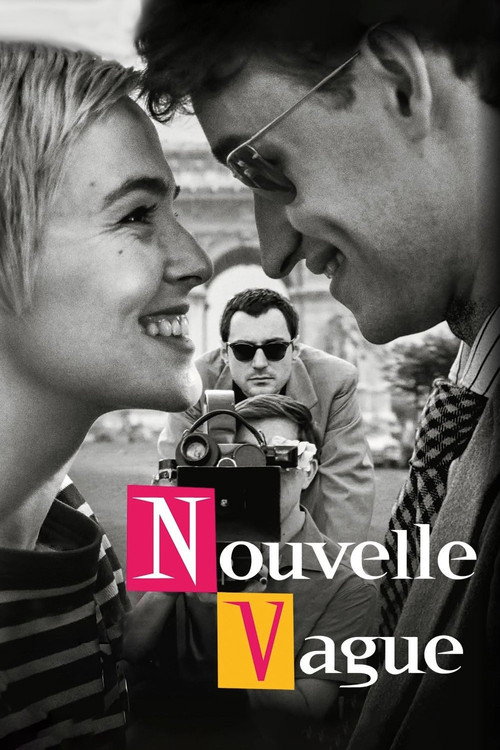
Nouvelle Vague
2025 · Richard Linklater
For when you love movies about making movies, or need a shot of creative nerve — a warm, playful watch for film lovers and anyone stuck on a project that feels impossible. Pure pleasure, no homework required.
What it's about
Paris, 1959. A young Jean-Luc Godard, tired of writing criticism for Cahiers du cinéma, decides the best film criticism is making a film — and talks producer Georges de Beauregard into funding a shoestring gangster picture from a treatment by François Truffaut. Linklater recreates the chaotic, improvised weeks of shooting Breathless: no script pages until morning, a bewildered crew, a borrowed wheelchair for a dolly, and a director inventing his method one provocation at a time.
The experience
Buoyant, funny, and infectious — a hangout movie about people who believe cinema can be reinvented by Tuesday. It moves with the loose, caffeinated energy of the era it depicts and sends you out wanting to watch (or make) something immediately.
Performances
Zoey Deutch is a delight as Jean Seberg, catching the amused, slightly stranded glamour of an American star adrift on a French guerrilla shoot, and the little-known lead playing Godard makes the young provocateur both insufferable and magnetic.
The craft
Linklater shoots the whole thing as period-faithful pastiche — black and white, boxy Academy ratio, in French — so the film about Breathless looks and breathes like a film from 1960. The recreation of late-fifties Paris and its run-and-gun street shooting is loving down to the smallest detail.
Why it matters
Premiering in competition at Cannes, it doubled as Linklater's love letter to the French New Wave and a reminder of his own recurring subject: how loose collaboration and stolen time turn into art.
Snapshot
Nouvelle Vague is Richard Linklater's black-and-white, French-language reconstruction of the making of Jean-Luc Godard's À bout de souffle (Breathless, 1960) — the film that, more than any other single work, came to stand for the French New Wave. Premiering in competition at the Cannes Film Festival in May 2025, it dramatizes a few crucial months around 1959–1960 in which a young Godard, fresh from the critical trenches of Cahiers du cinéma, persuades producer Georges de Beauregard to bankroll a low-budget feature, builds it from a treatment by François Truffaut, and improvises his way to a film that would rewrite the grammar of narrative cinema. Linklater approaches this not as conventional biopic but as a loving, period-faithful pastiche: shot in the Academy 1.37:1 ratio, in monochrome, in French, with little-known actors cast for resemblance and texture rather than star wattage. It is at once a comedy of artistic temperament, a procedural about how a landmark film actually got made, and a meta-commentary on cinephilia by one of American independent cinema's most committed cinephiles. The film belongs to a small genre — the movie about the making of a famous movie — but bends it toward Linklater's lifelong subjects: time, youth, talk, and the texture of a particular cultural moment.
Industry & production
The film is a transatlantic art-house production, conceived by an American director working entirely in French with a largely French cast and crew — an unusual undertaking for Linklater, whose career has been rooted in Austin, Texas, and the American independent scene. Its institutional home is the festival-and-streaming circuit characteristic of mid-2020s prestige cinema: a Cannes competition launch followed by specialty distribution. Netflix has been reported as a distributor for the project, situating it within the platform-funded auteur model that has supported other directors' passion projects; the precise contours of financing and territorial rights are, given the film's recency, not fully documented in the public record and should be treated cautiously.
The production's defining choice was fidelity to its subject's own conditions. À bout de souffle was famously made fast and cheap, partly on the street, with a small crew and improvised methods; Linklater's film mirrors that economy of means as both homage and discipline, recreating 1959 Paris locations and the look of late-1950s production. Casting prioritized authenticity over recognition: Guillaume Marbeck plays Godard, Zoey Deutch plays the American actress Jean Seberg, and Aubry Dullin plays Jean-Paul Belmondo, with the surrounding ensemble populated by figures from the Cahiers milieu (Truffaut, Claude Chabrol, and others). Deutch is the most established name, her presence as Seberg quietly underscoring the historical irony of an American import at the center of a quintessentially French revolution.
Technology
Technologically, Nouvelle Vague is an exercise in deliberate anachronism: a 2025 production engineered to look like a 1959 one. The most conspicuous choices are the boxy 1.37:1 Academy aspect ratio and black-and-white photography, both of which align the image with the original Breathless and its era rather than with contemporary widescreen color norms. Whether Linklater and his cinematographer captured on photochemical film stock or on a digital pipeline finished to emulate period monochrome is not something the public record settles definitively, and I won't assert a specific format. What is clear is that the film's entire technical apparatus — lensing, grain, lighting, contrast — is bent toward reproducing the handmade, available-light, fast-and-loose aesthetic that the New Wave pioneered partly out of necessity. The original Breathless was itself a landmark of lightweight technology: Raoul Coutard shot much of it with portable equipment, pushing fast film stock and using a wheelchair and a mail cart in place of dollies. Linklater's project is, in effect, a meditation on that older technological revolution, staged with modern tools made to disappear.
Technique
Cinematography
The cinematography, by David Chambille, is the film's most immediately legible statement of intent. Monochrome and Academy ratio do not merely cite Breathless; they reconstruct the conditions of its visual style — high-contrast daylight, location interiors, the feel of a camera that can go anywhere. The challenge Chambille and Linklater set themselves is double-edged: to evoke Coutard's loose, reactive handheld energy and natural-light improvisation without simply photographing a museum diorama. The camera is asked to behave like a participant in the period rather than a tourist visiting it.
Editing
Linklater's longtime editor Sandra Adair, his collaborator across most of his major work, is the figure most associated with shaping his films' distinctive rhythm, and the assumption that she cut Nouvelle Vague is reasonable though I flag that I cannot fully confirm the credit for this specific title. The editorial problem here is pointed: Breathless is the film that made the jump cut a manifesto, shattering classical continuity into a jagged, self-aware modern style. A film about its making must decide how much to imitate that radicalism versus observe it from outside. The expectation, consistent with Linklater's practice, is a relatively transparent, naturalistic cut that lets performance and duration breathe — reserving stylistic rupture for moments that quote Godard's own discoveries rather than adopting them wholesale.
Mise-en-scène / staging
Staging is where Linklater's affinities and his subject align most naturally. His cinema has always favored ambient, conversational, lived-in spaces — apartments, cafés, streets, cars — and 1959 Paris offers exactly that register. The film reconstructs the Cahiers offices, the bars and editing rooms and sidewalks where the New Wave was argued into existence, treating the physical and social environment as a character. The mise-en-scène carries much of the film's argument: that this revolution was made by young people talking, hustling, and improvising in real places, not by institutions.
Sound
Sound design and music are areas where I have limited firm information, and I will not invent a composer credit or scoring approach. What can be said is that the original Breathless used Martial Solal's nervy modern-jazz score and a roughened, partly post-synced soundtrack that contributed to its sense of immediacy; any film reconstructing that world inherits a strong sonic reference point. How Linklater's production handles music and the French dialogue track — period jazz, source sound, the texture of the language itself — is central to its illusion, but the specifics deserve confirmation rather than assertion.
Performance
Performance is calibrated toward impersonation-as-texture rather than showy mimicry. Guillaume Marbeck's Godard, Zoey Deutch's Jean Seberg, and Aubry Dullin's Belmondo must each evoke figures who are themselves preserved on film and deeply familiar to cinephiles — a high-wire act of resemblance. Deutch's Seberg carries particular weight: Seberg's gamine American presence was itself a found object that Godard recontextualized, and the performance must register both the actress's vulnerability and her status as an icon-in-the-making. Linklater's well-documented preference for naturalistic, unforced ensemble playing suits a story about young artists who hadn't yet become legends.
Narrative & dramatic mode
The film operates in a hybrid mode: backstage comedy, artistic origin story, and gentle historical reconstruction. Its engine is process — the granular, often absurd business of getting an unprecedented film financed, cast, shot, and finished against skepticism. The dramatic stakes are creative and interpersonal rather than melodramatic: Will the money hold? Will the method — improvised dialogue, no finished script, shooting in the street — produce a movie or a fiasco? Comedy arises from the friction between Godard's intransigent, oracular self-confidence and the practical anxieties of producers, collaborators, and actors who cannot yet see what he sees. This is a recognizable Linklater structure: low external plot pressure, high attention to character, talk, and the passage of a charged interval of time. The audience's foreknowledge — that Breathless will become a classic — supplies dramatic irony that the film can play either for warmth or for sly comedy.
Genre & cycle
Nouvelle Vague sits within the "making-of" or film-about-filmmaking genre, a self-reflexive cycle that includes works as varied as Truffaut's Day for Night, Fellini's 8½, and, more recently, biographical reconstructions of landmark productions. Within that cycle it occupies a specific niche: the reverent reconstruction of a single canonical film's genesis, made by an admirer steeped in the source material. It also participates in a broader 2020s tendency toward cinema that historicizes and mythologizes the medium's own past — films about movies, about cinephilia, about lost modes of production. As comedy-drama-history (its TMDB genre tags), it is closer to affectionate chronicle than to satire or tragedy.
Authorship & method
The film is unmistakably a Linklater project despite its French setting and language. Across Slacker, Dazed and Confused, the Before trilogy, Boyhood, and Everybody Wants Some!!, Linklater has pursued a cinema of duration, ambient sociability, and naturalistic talk, often anchored in a precisely rendered time and place. Nouvelle Vague extends that sensibility to a historical moment he plainly reveres: the late-1950s eruption of cinephile-critics into filmmakers. His method here is fidelity — formal, linguistic, and atmospheric — deployed in service of recovering how a revolution felt from the inside, before it hardened into doctrine.
Among collaborators, cinematographer David Chambille is the most important named partner, charged with realizing the monochrome, Academy-ratio period look. Editor Sandra Adair, Linklater's career-long collaborator, is the presumptive shaping intelligence behind the cut, though I flag the credit as not fully confirmed for this title. On the writing side, the film is Linklater's authored account; it depicts, rather than reuses, the historical collaboration in which Truffaut supplied the original story idea and Chabrol served in a supervisory capacity on Breathless itself. Composer and sound credits I leave open rather than guess.
Movement / national cinema
The film's entire reason for being is a movement — the French Nouvelle Wave — observed at its birth. It dramatizes the Cahiers du cinéma cohort (Godard, Truffaut, Chabrol, and their circle) at the instant they crossed from criticism into production, enacting the politique des auteurs by becoming auteurs. Nouvelle Vague is therefore an American director's act of homage to a French national cinema, made in French and on French ground — a gesture that mirrors the New Wave's own transnational appetites (the original Breathless fed on American gangster pictures and cast an American lead). It is national cinema viewed lovingly from outside, by a filmmaker whose own independent practice descends, in part, from the very revolution he depicts.
Era / period
The film is doubly period-bound: it is set in 1959–1960 and made in 2025, and its whole aesthetic project is to collapse that gap. Late-1950s Paris — its cafés, streets, jazz, and intellectual ferment, and a film culture being remade by a generation that had grown up in the dark of the Cinémathèque — is the texture the film labors to recover. For Linklater, a director repeatedly drawn to the precise reconstruction of bygone moments (the 1970s of Dazed and Confused, the spans of the Before films and Boyhood), the period is not backdrop but subject. The 2025 vantage adds elegiac distance: this is a portrait of a now-mythologized golden age of cinema's modernist self-reinvention, made at a time when the theatrical, photochemical film culture it celebrates has itself become historical.
Themes
At its center is the conviction — voiced in the synopsis and central to Godard's biography — that making films is itself the truest form of film criticism: that cinephilia must become creation. Around this orbit the film's other themes: youth and audacity; the romance of working fast, cheap, and against the rules; the porous boundary between life and art that defined the New Wave's improvisatory ethos; and the transnational circulation of style (American genre, French sensibility, an American star at a French center). There is also a reflexive theme of canon-formation — the film knows it is depicting the birth of a classic, and meditates, gently, on how revolutions become institutions. Underlying all of it is Linklater's perennial preoccupation with time: a fleeting, electric interval in which a handful of young people changed an art form before they, or anyone, fully understood it.
Reception, canon & influence
Because Nouvelle Vague is a 2025 release, its critical reception and longer reputation are still forming, and any account must be provisional. Its Cannes competition premiere positioned it as a major work by an established auteur and guaranteed substantial early critical attention; a detailed, settled critical consensus is not yet available, and I will not manufacture review verdicts, ratings, or box-office figures.
The influences on the film are unusually explicit, since the film is itself an act of homage: À bout de souffle and the broader Nouvelle Vague are not merely cited but reconstructed, and behind them stand the same American genre traditions and cinephile culture that shaped Godard. Linklater's own naturalistic, time-attentive body of work supplies the directorial lens. As for what the film may shape going forward — its legacy is unwritten. Its most plausible contributions are to the ongoing cycle of cinema-about-cinema and to the popular memory of the New Wave, potentially sending new viewers back to Breathless and to the Cahiers generation. Whether it earns a durable place in Linklater's canon or in the meta-cinema tradition is a judgment that only time, the director's own great subject, will render.
A Deleuzian reading
Picture the wheelchair.
The full Deleuzian reading of Nouvelle Vague →
Reception
Premiered in competition at Cannes 2025 to one of the festival's warmest receptions — then landed at Netflix, and cinephiles savored the irony of a handmade tribute to celluloid-era Godard debuting on the streamer.
How Nouvelle Vague was received, from release to now →
How to watch Nouvelle Vague: what to notice on a first viewing
- Watch for the black and white, boxy frame throughout the whole film. Chambille shoots in monochrome and the old Academy ratio, reconstructing the visual conditions of Breathless rather than just quoting its look. The format itself is doing the work of putting you inside 1959 instead of just describing it.
- Notice when the camera goes loose and handheld on real streets. Chambille evokes Coutard's reactive, available-light energy, a camera behaving like a participant in 1959 Paris rather than a tourist photographing it. The handheld energy is meant to make the reconstruction feel discovered, not staged.
- Watch how much of the film happens in cafés, offices, and cars. Linklater stages the New Wave's birth in ordinary, lived-in spaces, treating the physical and social environment itself as a character. The setting argues that a revolution here was made by people talking and hustling, not by institutions.
- Watch how the actors resemble, without exactly imitating, the real historical figures. Marbeck, Deutch, and Dullin are cast and played for texture and resemblance rather than showy impersonation of Godard, Seberg, and Belmondo. The restraint keeps the film from turning into an impression act instead of a portrait.
- Notice how little external plot pressure the film actually runs on. The stakes stay creative and interpersonal, will the money hold, will the method work, rather than melodramatic or violent. The low-key stakes match the loose, talky way the actual New Wave got made.
The whole guide to watching Nouvelle Vague, with the keys for a rewatch →
Influences: the films it descends from and the films it influenced
- À bout de souffle (Breathless) (1960) — The literal object of recreation: its jump-cuts excised from within continuity shots, fast available-light location shooting on the Champs-Élysées with Coutard hand-holding the camera in a wheelchair, and post-synced dialogue are the exact techniques Nouvelle Vague reconstructs.
- Bob le flambeur (1956) — Melville's lightweight-crew, natural-light shooting of nocturnal Pigalle set the low-budget location template Godard borrowed — and Melville himself appears in Breathless, making him a craft bridge the film stages.
- Gun Crazy (1950) — Its single-take handheld robbery shot from the back seat of a moving car, plus its disreputable B-picture energy, is the concrete American-genre debt behind Godard's run-and-gun street method.
- The 400 Blows (1959) — Truffaut — who supplied Breathless's story idea — pioneered the freer handheld camera and available-light Paris location shooting that the New Wave production depicted here was built on.
- Le Beau Serge (1958) — Chabrol, who served as technical supervisor and financial backstop on Breathless, launched the movement's cheap on-location, small-crew production model that the film dramatizes in process.
- The Big Sleep (1946) — Bogart's hard-boiled persona — which Belmondo's Michel literally imitates lip-thumbing before a cinema poster — is the genre iconography the period reconstruction quotes.
- Day for Night (La Nuit américaine) (1973) — The original New Wave film-about-making-a-film, establishing the affectionate procedural form — crew, mishaps, the camaraderie of a shoot — that Linklater adopts wholesale.
- Contempt (Le Mépris) (1963) — Godard's own cinema-about-cinema, foregrounding the apparatus and the act of production as subject — the reflexive lineage Nouvelle Vague extends back onto Godard himself.
- 8½ (1963) — The canonical making-of-as-creation film, modeling the genre of process-driven narrative about an artist mid-production that the seed inherits.
- Before Sunrise (1995) — Supplies the director's own signature method imported here: durational real-time walk-and-talk, naturalistic ambient dialogue, and attention to a precisely felt place.
- Boyhood (2014) — Demonstrates Linklater's obsessive fidelity to recovering how a specific time felt from inside it — the same period-immersion discipline applied to 1959 Paris.
- Slacker (1990) — Establishes his loose ensemble sociability and drifting, plotless attention to a scene's milieu — the observational texture brought to the Cahiers circle.
- Ed Wood (1994) — An affectionate Academy-ratio black-and-white biopic that finds romance in the scrappy mechanics of low-budget filmmaking — the same monochrome-homage register and making-of warmth.
- The Artist (2011) — Reconstructs a vanished cinematic idiom in its own period format (silent, Academy ratio) as pastiche-homage rather than mere depiction — the same fidelity-as-tribute strategy.
- Mank (2020) — A period monochrome recreation centered on the making of a landmark film, reverse-engineering an era's look to dramatize how a canonical work got written and shot.
- Once Upon a Time in Hollywood (2019) — Meticulous reconstruction of a specific film-industry moment with actors impersonating real figures, prizing atmospheric period accuracy and cinephile in-jokes over conventional plot.
- Babylon (2022) — A maximalist recreation of a film-industry epoch and its production chaos, the contemporary counter-pole to Linklater's intimate reconstruction of cinema being born.
Similar films
- The 400 Blows (1959) — influence & lineage
- Boyhood (2014) — influence & lineage
- Before Sunrise (1995) — influence & lineage
- Masculin Féminin (1966) — same viewing thread
- Vivre Sa Vie (1962) — same viewing thread
- Cléo from 5 to 7 (1962) — same viewing thread
- Pierrot le Fou (1965) — same viewing thread
- Breathless (1960) — shared sensibility
All the films related to Nouvelle Vague →
Watch it with: curated runs of related films
- Adrift in the Modern World — Watch these when you want to drift through postwar Rome and Paris alongside people who have everything and feel nothing — they rhyme on beautiful boredom, aimless days, and a search for meaning that modern comfort keeps failing to supply.